Game Production Costs: Indie vs AA vs AAA Budgets 2026
-

Written byDenys Zadoienyi
-

Updated on30.06.2026
-

Time to read9 min
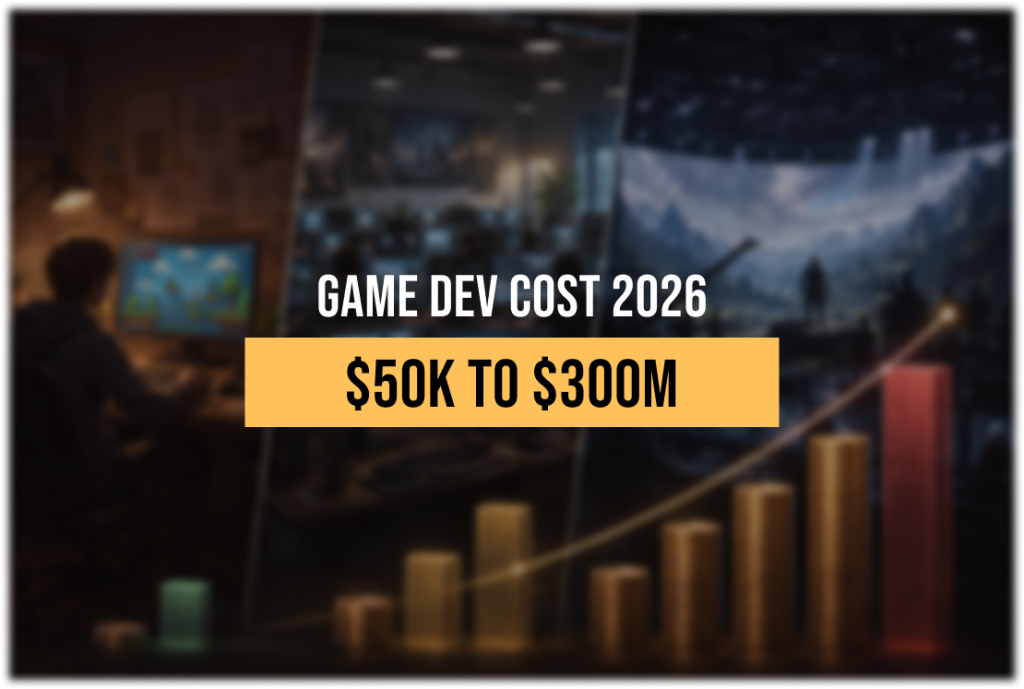

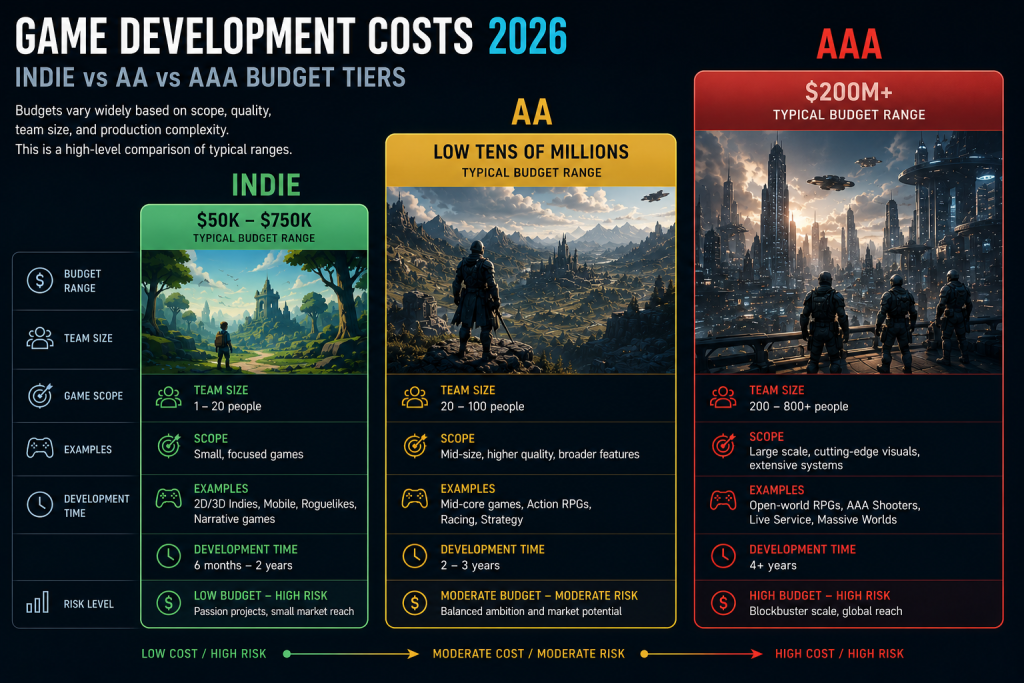
Game development cost is the question every producer answers twice: once for the greenlight deck, and once eighteen months later when the real number arrives. The documented range in 2026 runs from a $50,000 solo indie project to AAA productions that publishers’ own court filings put at $300 million and beyond-a spread so wide that any single “average” is useless. If you’re the producer who signs the greenlight, you need three things the typical cost guide skips: figures with named sources, the anatomy of where the money goes, and the short list of levers that genuinely move the total. That’s this article.
“Editorial illustration created for visual reference purposes. It does not represent a real project, client work, or official software screenshot unless stated otherwise.”
Definition. Game development cost is the total spend required to bring a game from concept to release: salaries and overhead, content and asset production, technology and licensing, QA, and-often matching or exceeding development itself-marketing. In 2026 it spans roughly $50K–$750K for indie, tens of millions for AA, and $200M+ for modern AAA.
Why Most Cost Figures You Find Are Unverifiable
Budgets are among the industry’s best-kept secrets, which is why the internet overflows with confident numbers nobody can trace. Most circulating “averages” are guesses laundered through repetition. The figures worth building a plan on come from exactly four source classes: shareholder reports, court filings and regulatory disclosures, leaks later confirmed, and on-record executive statements. Everything else is directional at best.
That filter changes the picture. The UK’s Competition and Markets Authority, reviewing the Microsoft–Activision merger, published publisher-submitted development budgets of $80 million to $350 million per major title, with marketing reaching $310 million on top-and noted that a AAA title with a 2024–25 launch window typically costs $200 million or more, up from a $50–150 million norm just five years earlier. In my experience, producers who anchor their expectations to these disclosed ranges, rather than to a blog’s “$60–80M average,” walk into greenlight meetings with far fewer surprises waiting downstream.
The Documented Numbers, Tier by Tier
Start at the top, because that’s where the receipts are. CD Projekt Red disclosed $174 million in development costs for Cyberpunk 2077 in a report to shareholders; legal disclosures and confirmed leaks later added $212 million for Horizon Forbidden West and roughly $300 million for Marvel’s Spider-Man 2. Activision’s own court filing put Call of Duty: Black Ops Cold War’s lifetime development and operating cost at $700 million. Bloomberg reporter Jason Schreier’s 2026 reporting describes US and Canadian AAA game development budget levels “floating around $300 million or more,” driven primarily by salaries and overhead. The pattern behind the gamedeveloper.com analysis of why development costs keep rising holds across every disclosed case: the development figure understates the true total, which marketing can double.
The indie game development budget floor is documented from the other direction. Auroch Digital, a working indie studio, puts the realistic range at $50,000 to $750,000-a solo year of work at the bottom, a five-person team over two years plus publisher costs at the top-with most indie publishers expecting $250–500K in development spend.
The business impact. A 2025 industry study of distributed development found the average game budget jumped from $18–24 million in 2010 to $150–300 million in 2024-roughly an eightfold rise in fourteen years. For a producer, the arithmetic explanation matters more than the trend line: a 300-person team at a loaded cost near $150K per year burns $45 million annually before a single marketing dollar, so a four-year cycle clears $180 million on payroll alone. A game budget is, first and foremost, a payroll ledger with a deadline. Every credible cost lever-scope, timeline, team shape, external capacity-works by shortening that ledger or moving lines off it.
Fun fact: the industry’s most-cited budget became public only by accident of crisis. CD Projekt Red disclosed Cyberpunk 2077’s $174 million development cost to shareholders after the game’s troubled 2020 launch-a transparency exercise almost no healthy launch has ever volunteered. The norm remains “closely guarded,” which is exactly why documented figures are worth collecting.
Indie vs AA vs AAA: The Production Matrix
| Tier | Budget range (source class) | Team / timeline | Main cost driver | Biggest budget risk |
| Indie | $50K–$750K (studio & publisher disclosures) | 1–20 people, 1–2 years | Founder time, contracted art and audio | Scope creep against a fixed runway |
| AA | Low tens of millions (directional-few public disclosures) | 20–100 people, 2–3 years | Salaries plus content volume at near-AAA quality bar | Quality expectations of AAA without AAA capacity |
| AAA | $200M+ typical; $300M+ for US/Canada front-liners (CMA, court filings, confirmed leaks) | 200–800+ people, 4+ years | Salaries and overhead, then content and marketing | Timeline slip multiplying the payroll |
The AA row deserves the honesty the SERP avoids. AA game development cost is the worst-documented segment in the industry: mid-sized studios rarely face the disclosure events that expose AAA numbers, so public AA figures are scarce and the commonly quoted ranges are directional shorthand, not evidence. What is documented is the blur at the ceiling-The Callisto Protocol, positioned as a AAA-adjacent debut from a mid-sized team, reportedly cost $162 million-proof that “AA” describes a production structure more than a price band. Read the tiers by team size, timeline, and review structure, and the budgets follow; read them by marketing label, and they mislead.
Where the Money Actually Goes
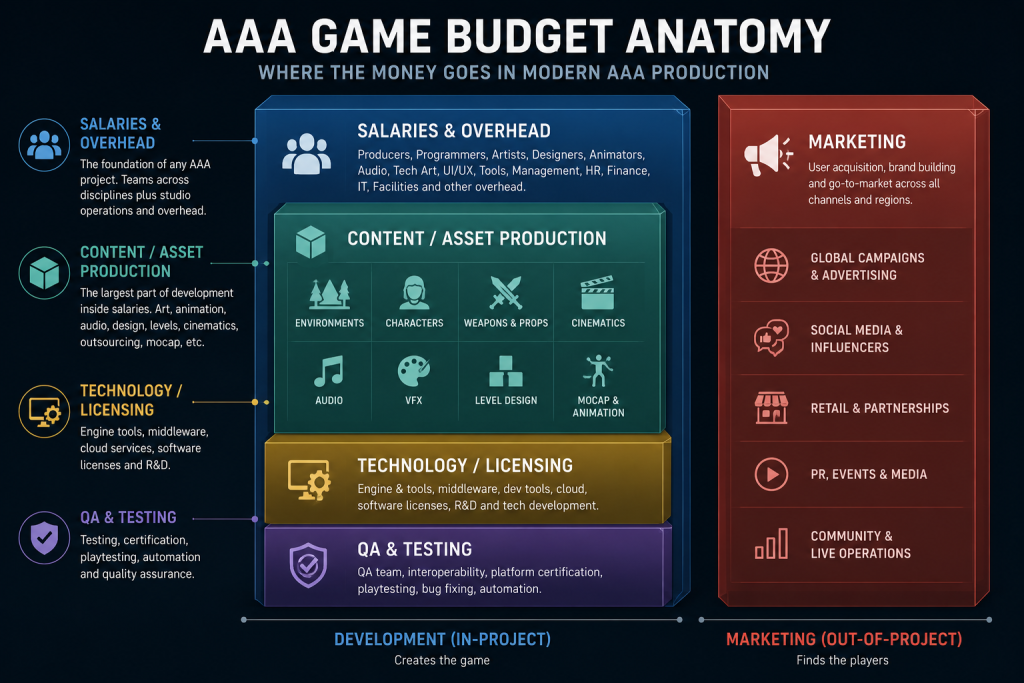
Salaries and overhead dominate AAA budgets-Bloomberg’s reporting attributes the bulk of those $300M+ figures to exactly that-which means headcount over time is, in practice, the budget. Content sits inside that line and scales worst: characters, environments, weapons, and props are produced by people, and a AAA content plan can run to thousands of assets. This is why AAA character art production and environment work appear in budget reviews not as art questions but as capacity questions: every asset class is a sub-ledger of person-months.
Technology is the smaller, more predictable line. Engine licensing is forecastable to the dollar-Unity’s seat pricing for 2026 is public, as covered in 80.lv’s report on Unity’s pricing update, and Epic’s 5% royalty above $1 million per product is a published rate. Middleware, build infrastructure, and QA tooling add real money but rarely surprise anyone. Marketing surprises everyone: on disclosed AAA cases it routinely matches development, and the CMA’s published figures allow up to $310 million for a single title’s campaign. When someone quotes you “the cost of a game,” always ask whether the number includes the half that ships no gameplay.

“Editorial illustration created for visual reference purposes. It does not represent a real project, client work, or official software screenshot unless stated otherwise.”
The Levers Producers Actually Control
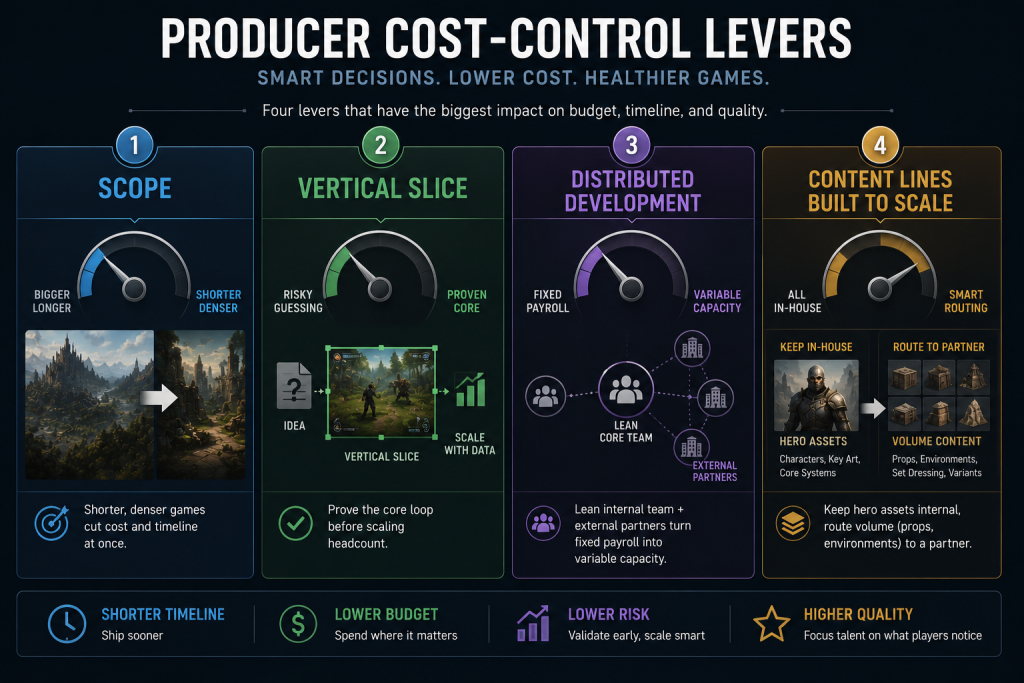
Strip away what you can’t change-platform holder cuts, market salaries, engine rates-and four levers remain.
“Editorial illustration created for visual reference purposes. It does not represent a real project, client work, or official software screenshot unless stated otherwise.”
Scope. Former PlayStation Studios head Shawn Layden has argued the point publicly: with roughly a third of players finishing games, studios fund enormous volumes of content most buyers never see, and shorter, denser games attack the payroll ledger directly. Scope is the only lever that cuts cost and timeline at once.
The vertical slice. Proving the core loop at target quality before scaling the team converts the most expensive failure mode-discovering the game isn’t fun at 300 headcount-into a cheap one. Every month of full-team burn spent answering questions a 20-person slice could answer is pure budget leakage.
Distributed development. This stopped being a cost compromise and became the structure of modern production: Game-of-the-Year-tier titles of recent years-Astro Bot and Black Myth: Wukong among them-shipped from deliberately lean internal teams scaled with external partners, and the same study that tracked budgets’ eightfold rise found freelance and external capacity in UK development tripling in a single year. The economics are straightforward: an external content line converts fixed payroll into variable capacity that scales with milestones instead of with the calendar. Where studios get it wrong is treating it informally-the engagement needs the same rigor as hiring, which is why we wrote a separate guide to RFP and SOW practices for art outsourcing. Geography belongs in the same calculation: time zones, legal frameworks, and rate structures differ enough that we treat studio geography as a production decision, not a procurement footnote.
Content lines built to scale. The build-vs-buy question for art is rarely all-or-nothing. Keeping hero assets and style ownership internal while routing volume-props, environment kits, secondary characters-through a partner with a proven pipeline is the configuration we see working across budgets: the studio keeps creative control, and scalable 3D prop production stops competing with core features for internal headcount. Teams that try to brute-force the full content plan in-house tend to meet the same milestone twice: once when it slips, and once when the overtime bill explains why.
Our approach
The pattern across every tier is the same: budgets fail at the content-volume line before they fail anywhere else. At Nasty Rodent we operate as that external content line-environments, characters, props-sized to the milestone rather than to the org chart, with budgets and asset specs agreed before production starts.
Game Production Costs at a Glance
| Tier | Typical range | Team | Timeline |
| Indie | $50K–$750K | 1–20 | 1–2 years |
| AA | Low tens of millions (directional) | 20–100 | 2–3 years |
| AAA | $200M–$300M+ development; marketing can match it | 200–800+ | 4+ years |
Ranges reflect documented disclosures where available; development cost excludes marketing unless noted.
Budgeting Without Illusions
Build the plan in this order: headcount-by-month ledger first, content volume second, marketing as its own budget beside-not inside-development, and a named source class for every benchmark figure you put in the deck. Most budget blowups we’ve seen weren’t bad estimates; they were unverifiable ones nobody could defend when the slip arrived.
And if the content-volume line is where your numbers get soft, that’s the cheapest part to test: send us your asset list and target quality bar, and we’ll return a scoped production estimate-asset classes, throughput, milestones-so the biggest variable in your budget arrives at the greenlight as a quote instead of a guess.