Concept Art Brief: How to Write One That Actually Works for Game Outsourcing
-

Written byDenys Zadoienyi
-

Updated on28.05.2026
-

Time to read14 min

- What a Concept Art Brief Actually Is (and What It Is Not)
- The Anatomy of a Strong Concept Art Brief
- What Makes a Brief Weak: The Seven Most Expensive Gaps
- The Concept Art Brief for Different Asset Types
- The Difference Between a Brief and an Art Direction Session
- Did you know that…?
- Strong vs. Weak: The Concept Art Brief at a Glance
- The Brief Is the Partnership
Most revision loops in concept art outsourcing don’t start with the wrong artist. They start with the wrong brief.
A studio sends a request: character concept, dark fantasy, something gritty. The outsource team delivers work that is technically skilled, visually confident, and completely misaligned with what the game actually needs. Three rounds of revisions later, someone finally shares a screenshot from a reference game and says “more like this.” That screenshot — had it been in the original brief — would have prevented the entire cycle.
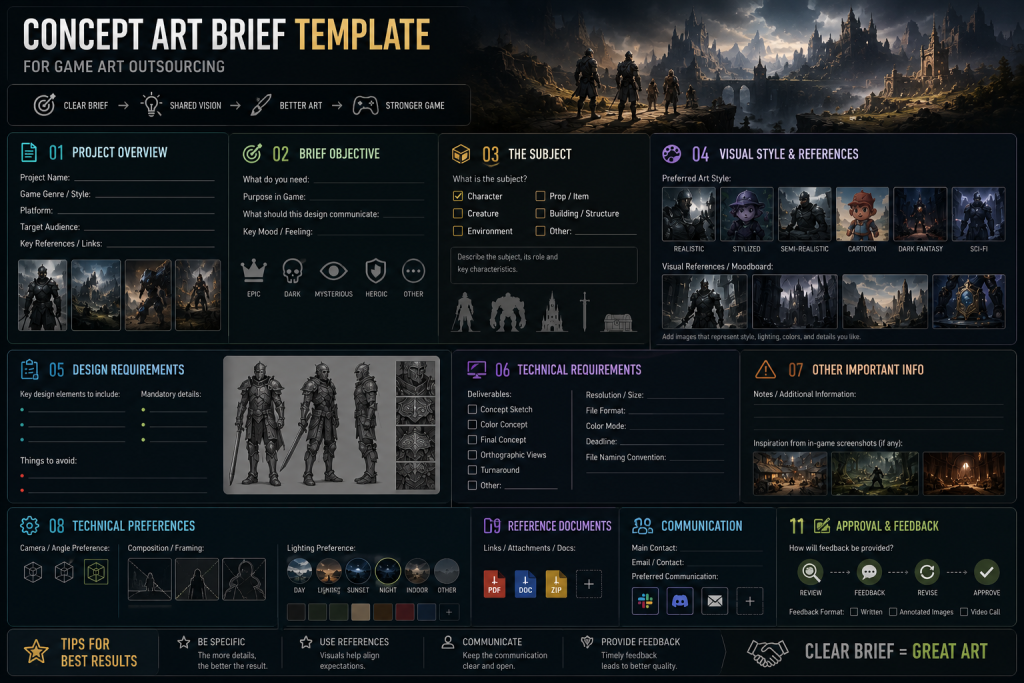
“Editorial illustration created for visual reference purposes. It does not represent a real project, client work, or official software screenshot unless stated otherwise.”
If you are responsible for outsourcing concept art on a mid-core or AAA production, the brief is your most underinvested production document. It costs a few hours to write well. A weak one costs weeks of rework, inflated revision counts, and the kind of vendor friction that makes first-pass approval rates drop and milestone confidence drop with them.
This guide breaks down every section of a production-grade concept art brief — what goes in, why it matters, and what distinguishes a brief that gets alignment on round one from one that generates creative interpretation where there should be specification.
What a Concept Art Brief Actually Is (and What It Is Not)
A concept art brief is a production document that defines the visual, narrative, and technical parameters an outsource artist or studio needs to create concept art that serves your game’s pipeline — not just looks good in isolation.
That distinction matters. Concept art is not illustration for its own sake. It is a functional deliverable that must communicate design intent to the teams downstream: 3D artists who will model from it, art directors who will approve it, and producers who will milestone-gate it. A brief that treats concept art as a creative commission rather than a pipeline input will produce outputs that require translation before they can be used.
The brief is also not a mood board. A mood board is part of a brief — one of its most important sections — but the brief itself is the document that frames scope, specifies deliverables, establishes acceptance criteria, and defines revision protocol. Without that frame, a mood board is an inspiration collage. Inside a brief, it becomes a binding visual reference.
Three things a production-grade concept art brief must do: constrain creative interpretation to the correct direction, define what “done” looks like before work begins, and make the downstream pipeline legible to the artist.
The Anatomy of a Strong Concept Art Brief
Every section below corresponds to a layer of information the outsource team needs to begin, execute, and deliver. Missing sections don’t get filled with nothing — they get filled with assumptions. And assumptions generate revisions.
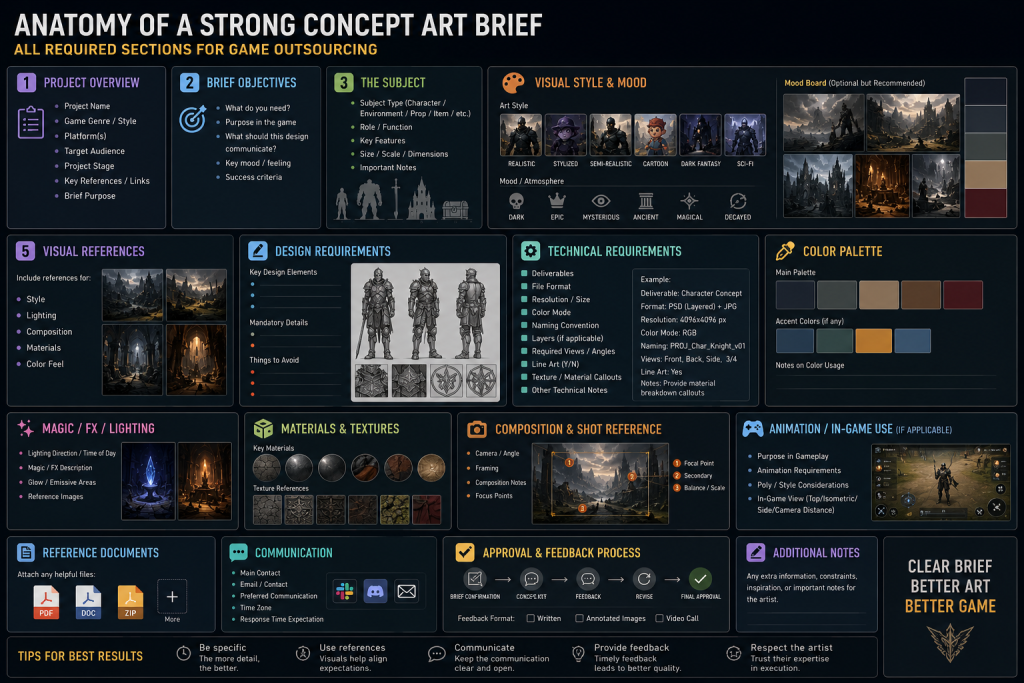
“Editorial illustration created for visual reference purposes. It does not represent a real project, client work, or official software screenshot unless stated otherwise.”
1. Project Context (2–3 paragraphs)
Before any visual direction, the artist needs to understand the game. Not a marketing blurb — a production-relevant summary that answers: What genre and platform? What is the tone — where does it sit on the spectrum between dark realism and stylized fantasy? What role does the concept art play in the game’s experience? Who is the player, and what do they need to feel when they encounter this character, environment, or asset?
Context shapes every creative decision. An artist who understands that a character is the player’s primary companion in a survival horror title will design differently than one briefed on “a female character with armour.” Same words, radically different outputs. The brief that includes production context gets closer to intent on the first pass.
Include: genre, platform, target audience, production phase (pre-production exploration vs. locked direction), and the emotional target the asset should hit.
2. Asset Scope and Deliverable List
Be explicit about what is being produced. Not “character concepts” — a list. For each deliverable, define:
- Asset type (hero character, environment establishing shot, prop set, vehicle overview)
- Quantity and variations (one hero design with three colour palette variants; two environment concepts from different elevation angles)
- View requirements (front/side/back orthographic views for characters going to 3D; top-down overview + ground-level detail for environments)
- Finish level (rough thumbnail exploration, polished colour concept, callout sheet with material notations)
The quantity and variation question matters more than most studios acknowledge. Asking for “a character concept” and asking for “one hero character design with front/side orthographic views, three expression studies, and a callout sheet for costume material breakdown” describe the same creative object but entirely different scopes of work. The second brief enables accurate estimation, realistic timelines, and clear acceptance criteria.
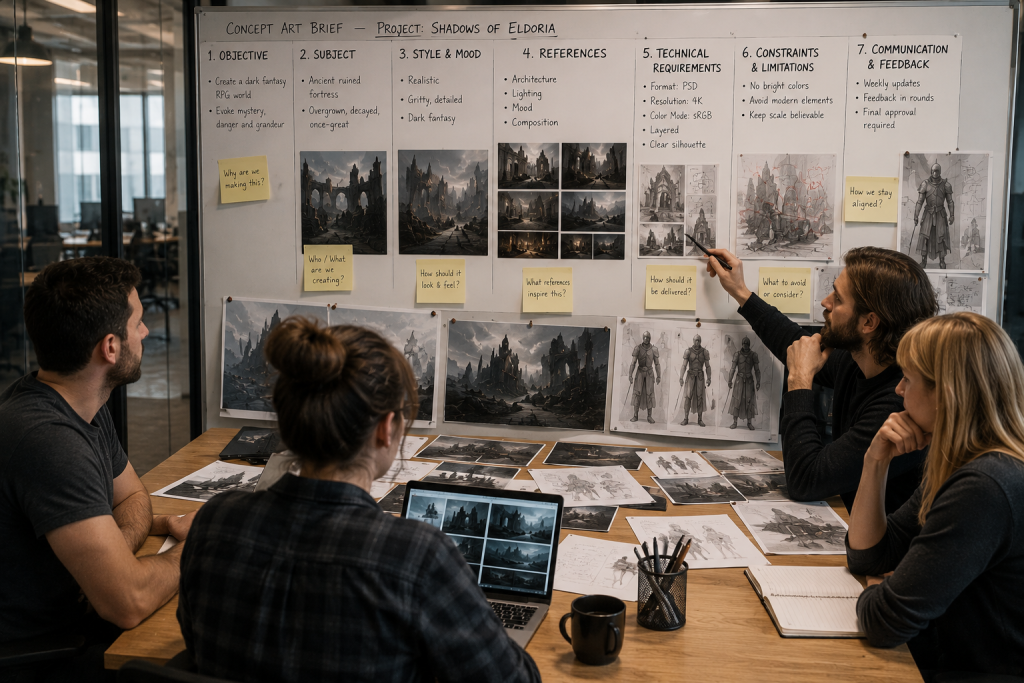
3. Visual Reference Board — The Highest-Value Section of Any Brief
Art direction lives in visual references, not written descriptions. Words like “gritty,” “atmospheric,” or “stylized” mean different things to every artist who reads them. Images are precise in a way prose cannot be.
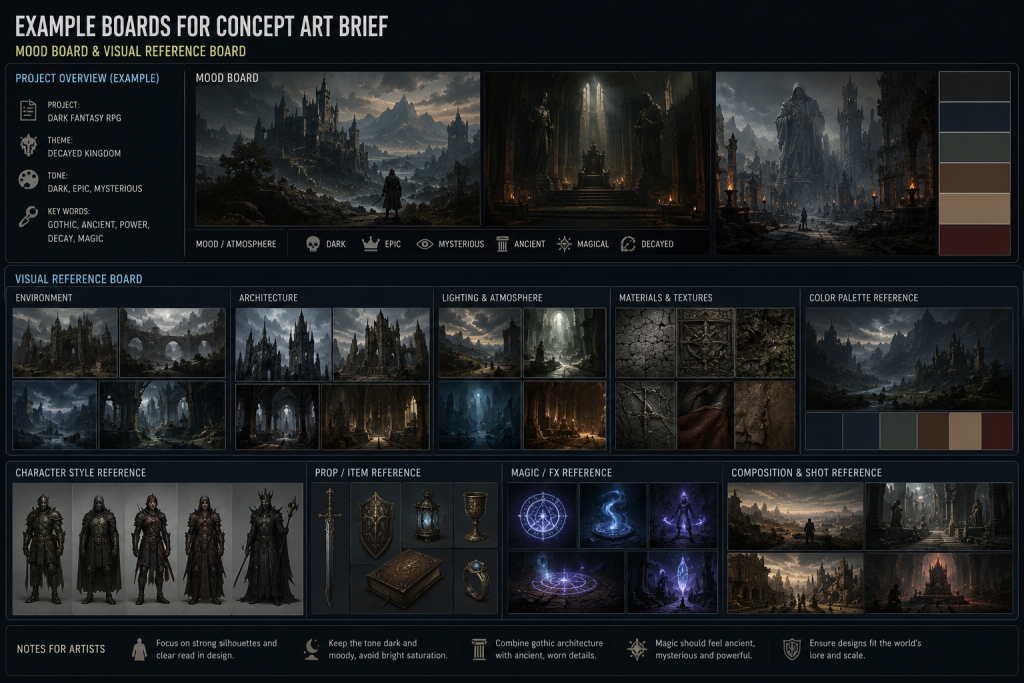
“Editorial illustration created for visual reference purposes. It does not represent a real project, client work, or official software screenshot unless stated otherwise.”
A strong visual reference board for a concept art brief includes:
Positive references — images that capture the direction you want. These should span multiple attributes simultaneously: not just style, but colour temperature, level of detail, silhouette language, material quality, and lighting approach. Pull from games, films, concept art portfolios, and photography — diversity of source makes the direction legible across multiple dimensions.
Negative references — images that show what to avoid. This is the section most studios skip and the one that prevents the most common misinterpretations. If your game reads dark fantasy but you do not want the saturated, highly stylized approach common in certain RPG aesthetics, show an example of what you mean by that and annotate it. “Not this” eliminates entire categories of misaligned interpretation before work begins.
Annotated callouts — arrows and text labels on reference images that identify which specific element is relevant. “This silhouette readability,” “this material texture quality,” “this level of environmental detail density” removes ambiguity from even the most carefully chosen reference images. Andreas Husballe, concept artist at Vizlab Studio, describes this practice in a production breakdown published on 80.lv as central to preventing the misreads that generate unnecessary revision rounds. The principle: never assume the artist will extract the same point from a reference image that you intended to communicate.
4. Style Parameters
Beyond the reference board, explicit style parameters give the artist measurable direction:
Stylization scale — where on the spectrum from photorealistic to heavily stylized does this asset sit? A 1–10 scale (1 = pure realism, 10 = fully abstracted) with two reference examples at the relevant point gives the artist a calibrated target.
Colour brief — primary palette, prohibited colours, temperature (warm/cool), saturation range. If a colour script exists for the game, include it. For environment concepts, note the time of day and lighting conditions the concept should depict.
Silhouette requirements — for characters and creatures especially, silhouette readability is a production priority, not an aesthetic preference. A character whose silhouette reads clearly in HUD thumbnails, combat at distance, and marketing key art is a better-briefed character than one whose silhouette was never specified. As 80.lv’s character design development guide documents, orthographic views and material callouts exist precisely to make this downstream legibility legible at the brief stage.
Detail density — how much surface complexity is appropriate? A brief for a stylized mobile title and a brief for a mid-core PC game operating at cinematic detail levels require radically different density expectations. Without specification, the artist defaults to their own aesthetic.
5. Technical Requirements
Concept art for a game pipeline is not a standalone illustration. It has technical downstream consequences, and the brief is where those consequences get specified.

Pipeline destination — where does this concept go next? If it feeds directly into 3D character modelling, the artist needs front/side/back orthographic views, not just a three-quarter hero illustration. If it feeds into a style guide, the concept needs to document colour values, not just render them. Specifying the downstream use determines which views and formats are actually useful to the receiving team.
File format and resolution — layered PSD, flat render, or both? Resolution for print key art is different from resolution for in-engine review. Name naming conventions, if your pipeline uses them.
Production constraints the artist needs to know — polycount budgets for 3D characters derived from the concept, camera angles the game uses (which affects which details need to read clearly), technical limits on texture complexity, or platform-specific considerations. These are not creative restrictions — they are accuracy conditions that prevent the concept art from producing technically unusable outputs downstream. The connection between a well-briefed concept and a smooth concept-to-3D workflow is direct: 3D artists who receive concepts with orthographic views and material callouts need significantly fewer clarification rounds before modelling begins.
6. Revision Protocol
Define revision rounds in the brief, not after the first delivery. Standard industry practice for concept art outsourcing is two to three rounds of revisions included in the quoted scope, with major direction changes beyond that scope triggering a change order.
But revision count is only part of the protocol. Also specify:
- Who on your side provides feedback — one decision-maker or a committee? Consolidated feedback from a single reviewer prevents the “multiple reviewers with conflicting notes” failure mode that sends outsource teams into contradictory revision spirals.
- What format feedback takes — written annotations on the concept, video walkthrough, marked-up file.
- What constitutes a revision vs. a new brief — if the game’s creative direction changes after work has begun, that is scope change, not a revision. The brief should state this explicitly.
7. Acceptance Criteria
The brief should define what “approved” means before the first sketch begins. Not “we’ll know it when we see it” — a set of checkable conditions. For concept art, acceptance criteria typically include: adherence to the visual reference direction, correct deliverable set (views, variants, finish level), technically usable file format, and alignment with specified style parameters.
Acceptance criteria serve two purposes: they prevent disputes at delivery, and they prevent the outsource team from over-investing in elements that are not in scope. An artist who knows the brief requires approved thumbnails before full-colour development will not spend days on colour work that gets rolled back when the thumbnail direction changes.
What Makes a Brief Weak: The Seven Most Expensive Gaps
Understanding what a strong brief contains is half the problem. The other half is recognising the patterns that generate revision loops before the brief leaves your desk.
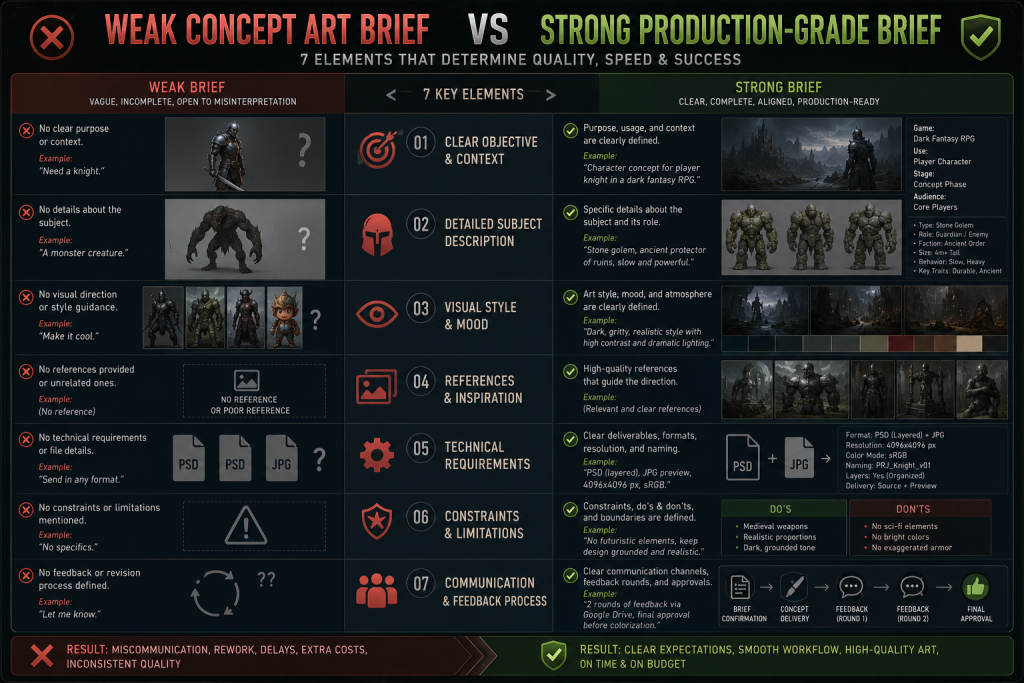
| Gap | What happens without it |
| No negative references | Artist interprets “gritty” in a different register than intended; full rework after first delivery |
| Deliverable list says “concepts” not quantities + views | Scope ambiguity produces mismatched estimation and delivery |
| Style parameter as adjective only (“atmospheric”) | Five artists produce five valid interpretations of the same word |
| No downstream pipeline destination specified | Concept art produced without orthographics; 3D team requests new passes |
| Multiple feedback providers, no single decision-maker | Contradictory revisions; outsource team waits for consolidated direction |
| Revision scope undefined | Third round of revisions becomes a dispute about what was included |
| Acceptance criteria absent | “Approved” is decided after delivery based on feel, not specification |
The cost of each gap is not the revision itself — it is the schedule impact and the vendor confidence loss. An outsource team that receives three consecutive briefs with the same structural weakness learns to budget more heavily for revision rounds when working with that client. First-pass approval rates drop. Timeline confidence drops. The relationship becomes more expensive to operate than it needs to be.
The Concept Art Brief for Different Asset Types
The core structure above applies to all concept art. The emphasis shifts by asset type.
Character concept art briefs require the most detail on personality, silhouette, and downstream views. The brief must include: character backstory relevant to design (not the full game narrative — only the traits that should be visible in the design), faction or affiliation visual language if applicable, relationship to other characters (relative scale, contrasting silhouette), view requirements (minimum front/side/back for 3D, expression studies if facial animation is relevant), and costume and equipment callout requirements. A character brief that produces a hero illustration without orthographic views has produced half the deliverable the pipeline needs.
Environment concept art briefs require strong emphasis on lighting and time-of-day, compositional requirements (does the environment need to work as a wide establishing shot, a ground-level player perspective, or both), modularity notes if the environment feeds into a modular kit, and scale references (a human figure placed in the concept anchors every subsequent production decision). Underinvestment in environment concept art is one of the most expensive mistakes in 3D production — as the 80.lv guide to character design and downstream production notes, when visual direction is not established at the concept stage, it gets decided at the modelling stage, which is the most expensive phase to make creative decisions.
Prop and weapon concepts require precise scale references, material breakdown requirements (especially if the prop goes to a PBR workflow), any functional mechanism the artist needs to communicate (how does it open, extend, fold), and front/side views as standard. For props going directly to 3D production, the callout sheet — with arrows identifying material zones, structural joints, and surface texture targets — is as important as the concept illustration itself.
The Difference Between a Brief and an Art Direction Session
One structural failure that generates outsized revision costs: treating the brief as a document the client writes alone, and then reviewing the output as if the brief were a complete specification.
No brief is complete. A brief is a starting position — the clearest articulation of direction that exists before work begins. What makes the brief valuable is the clarification session that follows: a structured conversation between the client and the outsource studio before the first sketch begins, where the studio asks the questions the brief left open.
A production-mature outsource team will identify gaps in the brief during the pre-production phase rather than discovering them in the first delivery. This is one of the meaningful signals that separates studios with operational maturity from those without it. The question to ask: does the studio you’re evaluating read your brief critically and ask for clarification before starting, or do they proceed and let the gaps surface in the first review?
At Nasty Rodent, we approach game concept art services through structured communication that begins before the first sketch. When a brief arrives with gaps — missing negative references, undefined finish level, no downstream specification — we surface those gaps in the pre-production session rather than interpreting them. The goal is alignment before execution, not interpretation followed by rework.
“Editorial illustration created for visual reference purposes. It does not represent a real project, client work, or official software screenshot unless stated otherwise.”
From mood boards and early-stage sketches to fully rendered concepts with callout sheets and orthographic views, our concept art work is built to serve the pipeline stage that follows it — whether that is art direction review, style guide development, or direct handoff to 3D production.
Did you know that…?
A brief that takes two to three hours to write with proper reference annotation and section completeness can prevent three full rounds of concept art revision. At typical studio review-and-revision cycles of three to five working days per round, that brief investment saves ten to fifteen working days of production time on a single asset batch. The arithmetic is not subtle: the brief is the highest-leverage production document in the entire outsourcing engagement.
Strong vs. Weak: The Concept Art Brief at a Glance
“Editorial illustration created for visual reference purposes. It does not represent a real project, client work, or official software screenshot unless stated otherwise.”
The Brief Is the Partnership
A concept art brief is not paperwork before the interesting work begins. It is the first decision of the outsourcing engagement — one that determines whether the studio you’ve chosen can deliver alignment on round one, or whether you’re paying for iteration that a clearer document would have prevented.
The brief also reveals something about your outsource partner: do they accept underspecified briefs without comment, or do they return with the clarifying questions that make alignment possible? The latter is the behaviour of a studio with production maturity and a genuine investment in first-pass results.
At Nasty Rodent, we offer a free capability assessment for studios beginning concept art outsourcing — a 48-hour review that maps your project scope against our production workflow and identifies the brief elements that will most directly affect revision count and first-pass approval rate. No commitment required.
If you are building a preferred vendor list and want to understand how your concept art pipeline would work with Nasty Rodent, this is where that conversation starts.
Explore our full portfolio across characters, environments, props, and weapons at nastyrodent.com/portfolio, and find more production strategy content at the Nasty Rodent blog.