How Much Does Concept Art Cost? A Breakdown by Asset Type and Finish Level
-

Written byDenys Zadoienyi
-

Updated on10.08.2026
-

Time to read11 min

- What Actually Sets the Price
- Illustrative Cost Bands by Asset Type and Finish Level
- Why Key Art Breaks the Pattern
- Factors That Can Push a Quote Outside the Typical Range
- Freelance vs. Studio: Where the Number Actually Comes From
- What a Concept Art Quote Should Actually Include
- Budgeting a Full Concept Package
A concept art quote is only useful once it names the deliverable behind the number. A $250 character sketch and a $2,500 production-ready character sheet can describe the same character – but they represent different amounts of exploration, documentation, and revision work, and comparing them as if they were the same product is where most budgeting confusion starts.
“Editorial illustration created for visual reference purposes. It does not represent a real project, client work, or official software screenshot unless stated otherwise.”
Definition. Concept art is visual development work that defines a game’s characters, environments, props, and other production assets before or alongside final-asset creation. It’s most concentrated in pre-production but routinely continues through full production for new asset batches, DLC, and late-stage design changes. This guide also covers key art – a related but separately scoped marketing illustration – since it’s commonly grouped under “concept art cost” even though it follows a different brief. Cost depends on four variables that interact rather than stack cleanly: asset type, finish level, iteration count, and rights terms. Published rates and studio scoping estimates both place concept art prices anywhere from roughly $80 for a basic prop sketch to several thousand dollars for a high-scrutiny promotional key art assignment – and quality alone explains only part of that spread.
This breakdown treats those variables separately, the way a real quote should, so the number you plan around is attached to a defined scope rather than a headline figure lifted out of context.

What Actually Sets the Price
Five factors shape a concept art quote. None of them works in isolation – a cheap asset type at a high finish level can cost more than an expensive asset type at a low one.
- Asset type. Character, environment, prop, and key art aren’t priced on the same scale. A character concept typically carries more interconnected design decisions – silhouette, costume, proportions, expression – than a prop. An environment concept usually takes longer to compose because it has to establish mood, scale, and readability across a whole scene rather than a single subject.
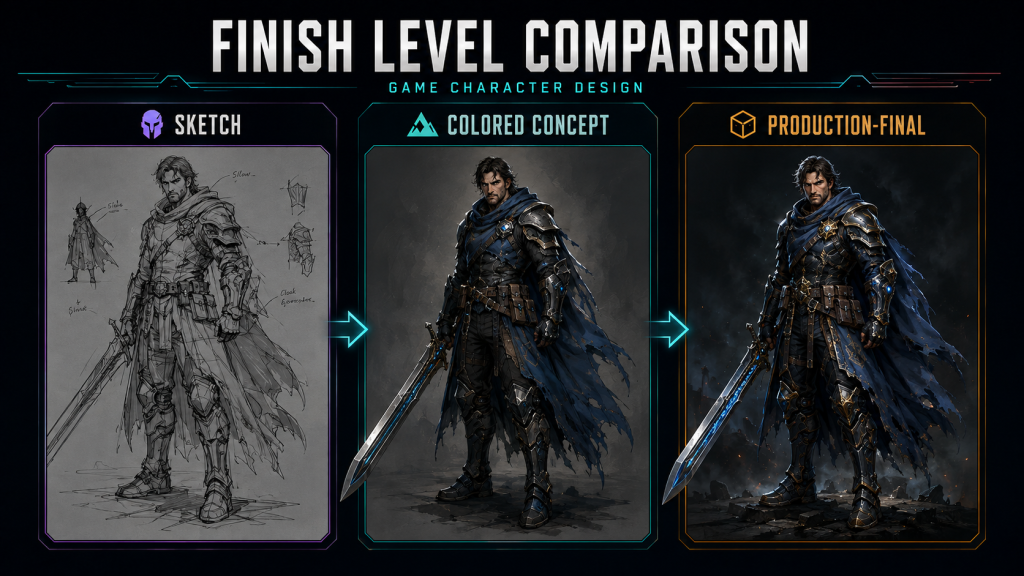
- Finish level. A rough sketch, a colored concept with basic rendering, and a production-final sheet with reference views and material callouts are three different deliverables, not three quality tiers of the same one. Each step adds hours that don’t show up in the previous stage.
- Iteration count. Concept art is inherently iterative – silhouette exploration, direction selection, refinement passes. A quote scoped for one revision round and a quote scoped for three aren’t comparable even if they name the same asset type and finish level.
- Rights and IP terms. Pricing can shift when an engagement requires broader licensing, exclusivity, source-file transfer, or a specific IP-assignment structure. Game outsourcing agreements commonly define the client’s ownership or usage rights at the contract level – through an assignment clause, a work-for-hire provision where that doctrine applies, or an equivalent mechanism under the governing jurisdiction – so the relevant price driver is the exact rights package and file-delivery scope, not simply whether the art is used internally or publicly.
- Turnaround. Rush timelines compress the exploration phase that normally absorbs revision cycles, which is why urgent requests carry a premium that has nothing to do with the art itself.
“Editorial illustration created for visual reference purposes. It does not represent a real project, client work, or official software screenshot unless stated otherwise.”
Two AAA-focused studios can quote very different prices for what looks like the same brief, and the difference usually traces back to one of these five variables being defined differently – not to one studio being more expensive for no reason.
Illustrative Cost Bands by Asset Type and Finish Level
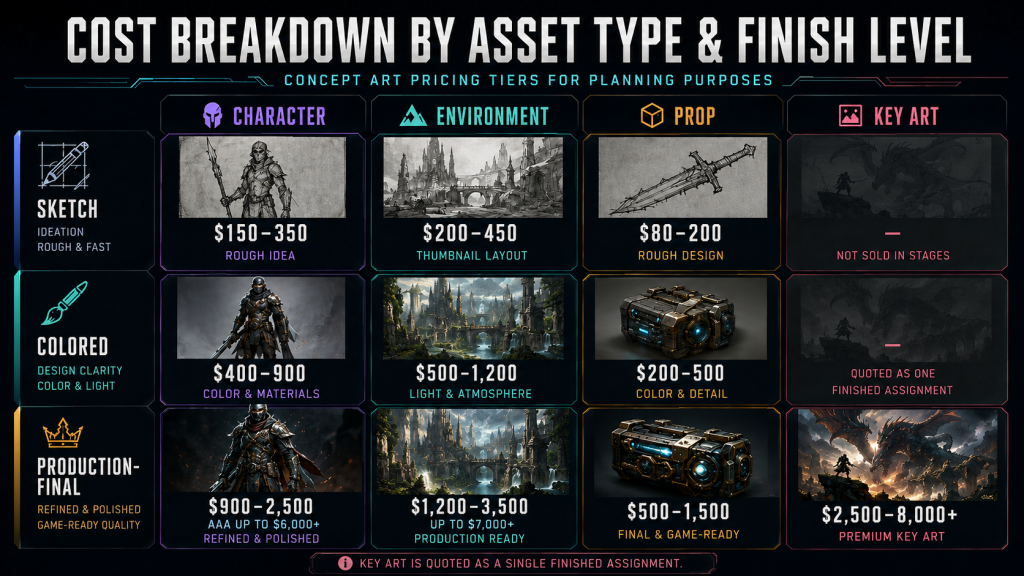
Holding finish level constant and moving across asset type is the clearest way to see where the real spread comes from. The ranges below are illustrative budgeting scenarios for comparing scope levels, informed by published rates and typical mid-core/AAA scoping patterns – not standardized industry rates, a market average, or a Nasty Rodent rate card. Actual quotes can land outside these ranges depending on region, artist seniority, art direction depth, revision policy, and file-delivery terms. Treat them as a starting point for your own budget conversation, not a quote.
| Asset Type | Sketch / Thumbnail | Colored Concept | Production-Final |
| Character | $150 – $350 | $400 – $900 | $900 – $2,500 (indie/AA) · up to $6,000+ (AAA hero) |
| Environment | $200 – $450 | $500 – $1,200 | $1,200 – $3,500 (indie/AA) · up to $7,000+ (AAA key location) |
| Prop | $80 – $200 | $200 – $500 | $500 – $1,500 |
| Key Art / Promo | – | – | $2,500 – $8,000+ |
A few things worth reading carefully in this table. First, key art has no separate sketch or colored-stage entry because it’s quoted as a single finished assignment rather than sold in stages – its internal process still moves through thumbnail, composition, and color-key passes, but the client is billed for the finished deliverable, not each intermediate step. Second, the character and environment upper bounds widen sharply at the AAA tier for the same reason a hero character costs more than a background NPC in 3D production: hero assets combine greater design complexity with deeper stakeholder scrutiny, more revision cycles, and higher marketing visibility, all compounding at once. Third, a prop concept rarely closes the gap with a character or environment concept even at production-final finish, because most props carry fewer interconnected design decisions – the exceptions are hero props with narrative weight (a signature weapon, a key story object), which behave more like secondary characters in terms of scrutiny and revision depth.
Why Key Art Breaks the Pattern
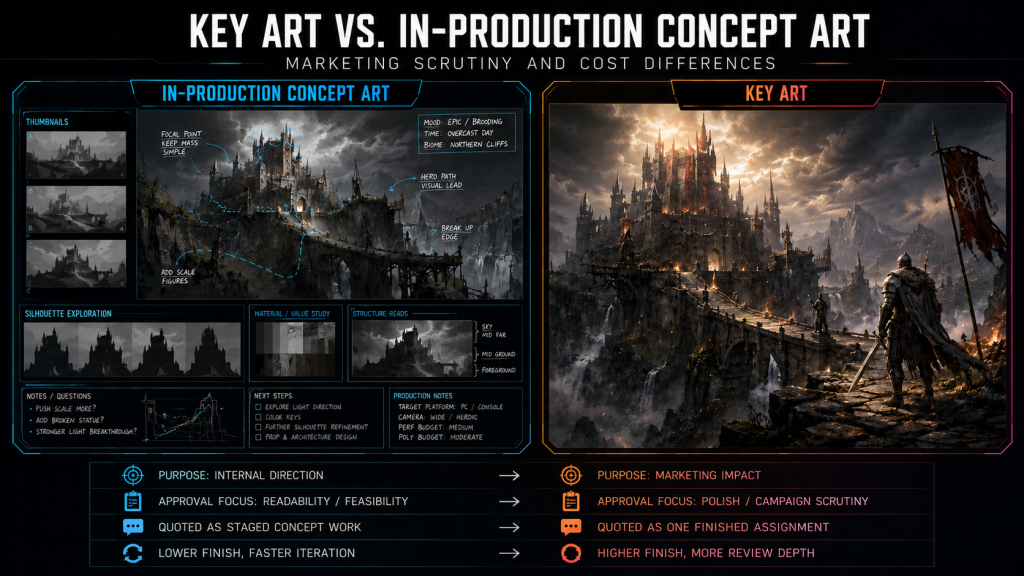
Key art – the promotional illustration used for store pages, trailers, and press kits – doesn’t follow the asset-type logic above, and treating it as “just a more finished concept” is the most common budgeting mistake teams make with this category.
A gameplay concept has to be functional: it needs to translate into 3D or environment art without ambiguity. Key art has a different job entirely – it has to sell the game to someone who has never played it, in a single image, often under the same scrutiny as a movie poster. That changes the brief: composition, lighting, and narrative framing carry as much weight as the subject matter itself, and revision rounds tend to run deeper because marketing, PR, and leadership all weigh in before a piece ships. This is the same dynamic that inflates marketing spend on the production side of a game’s budget more broadly – a pattern we cover in more depth in our breakdown of where game development money actually goes, where some disclosed AAA titles show marketing spend approaching or exceeding development expenditure.
“Editorial illustration created for visual reference purposes. It does not represent a real project, client work, or official software screenshot unless stated otherwise.”
Budget key art as its own line item with its own revision allowance, not as an upgrade tier on top of a character or environment concept.
Factors That Can Push a Quote Outside the Typical Range
Asset type, finish level, iterations, and rights terms explain most of the spread in the table above. A smaller set of secondary factors layers on top of a base quote – and a few of them don’t move price in the direction people assume.
- Casual vs. realistic style. The common assumption is that a simplified, cartoony style costs less than a detailed realistic one. That’s not reliable. Realism adds cost through lighting studies, material rendering, and reference-matching passes. But a disciplined stylized concept isn’t a shortcut – it requires its own invented shape language, a silhouette that reads clearly at a distance, and a color script that holds up across the full cast or environment set. A strong stylized character concept can take as long to defend and refine as a realistic one.
- Narrative importance. A hero character or a signature location carries more scrutiny than a background asset at the same finish level, which is why the AAA upper bounds in the table above widen for hero-tier work specifically rather than for the tier as a whole.
- Stakeholder count. A concept reviewed by one art director moves faster than one reviewed by an art director, a producer, and a publisher in sequence. More reviewers don’t just add approval time – they can also produce overlapping or conflicting notes that need to be reconciled before a round counts as closed.
- Reference quality. A brief with a locked style guide and clear reference material converges faster than one built on “surprise us.” Vague briefs push exploration cost into what looks, on the invoice, like extra revision rounds.
- 2D-only vs. 2D-to-3D hybrid workflow. Some studios build concepts partly in 3D – blockouts, kitbashing, real-time lighting passes – before finishing in 2D. That hybrid approach can reduce iteration time and improve perspective, scale, and lighting consistency, particularly for environments, vehicles, and hard-surface props, though it applies to character work too. It is worth asking a vendor whether their pipeline uses this approach before comparing quotes on turnaround time alone.
Freelance vs. Studio: Where the Number Actually Comes From
Rate variance in concept art is unusually wide even within a single skill tier, and a large part of that comes down to who’s actually setting the number – an individual freelancer negotiating per project, or a studio pricing against a structured pipeline. ArtStation Magazine has cited freelance day rates ranging from roughly $100 to $1,000, illustrating how widely individual pricing can vary with experience, reputation, and negotiating leverage alone – separate from the asset-type and finish-level factors covered above.
That variance is exactly why “concept art cost” and “hire freelancer vs. outsource studio” are two different questions. This guide is about the number itself; the production-risk side of that decision – coordination overhead, style consistency at scale, what happens if a freelancer exits mid-project – is covered in full in our guide to hiring a concept artist versus outsourcing to a studio.
What a Concept Art Quote Should Actually Include
The number on a quote matters less than what’s inside it, and this is where under-scoped quotes often omit deliverables that later become additional work.
A complete quote should state coverage for the finish level it’s actually selling – sketch, colored concept, or production-final – the exact number of revision rounds, and whether the final deliverable includes the working layered file or only a flattened export.
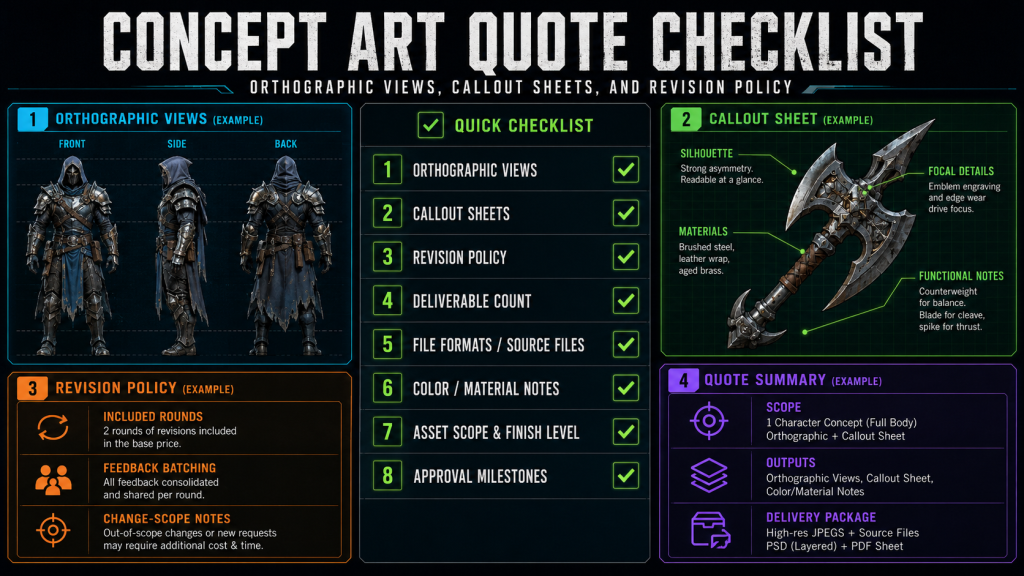
“Editorial illustration created for visual reference purposes. It does not represent a real project, client work, or official software screenshot unless stated otherwise.”
For anything feeding a 3D pipeline, the reference coverage a quote includes changes what that number is really buying: a character or hero prop needs a different depth of turnaround and callout work than a background object needs. We’ve broken down exactly what that reference package should contain, stage by stage, in our guide to character concept art for AAA 3D pipelines – the short version for budgeting purposes is that skipping it is rarely a savings, since the missing information doesn’t disappear. It resurfaces as unscheduled revision cost once 3D production starts, whether that’s modeling or a downstream engine handoff.
Source file ownership is worth confirming explicitly for the same reason. Some studios include the working file by default; others price it separately. Neither approach is wrong, but it needs to be stated in the quote rather than discovered after delivery.
Budgeting a Full Concept Package
A single asset’s price is useful for a spot-check. A pre-production budget needs the package view: how many characters, environments, props, and key art pieces a project actually needs at each finish level, weighted against the ranges above. The same prioritization logic shows up on the 3D side of the budget once concepts lock – our breakdown of 3D character cost by tier and role covers the equivalent hero-vs-background weighting for modeling spend, and the two budgets are worth planning together rather than in isolation.
This is also where prioritization does more for a budget than negotiating a lower per-piece rate. One of the more reliable ways to control a concept package budget is deciding early which assets need production-final reference treatment and which can stop at a colored concept – a secondary prop that never gets a close 3D handoff doesn’t need the same finish level as a hero character. A package that quietly upgrades every asset to “just to be safe” production-final treatment is a common way a concept art line item runs over its planned budget, echoing the same pattern that inflates a full character roster once background assets start getting hero-level revision passes.
About Nasty Rodent
Nasty Rodent is a game art outsourcing studio based in Tallinn, Estonia, working across concept art, 3D characters, environments, props, and UX/UI for mid-core and AAA titles. Concept pricing conversations at Nasty Rodent start from the same type-and-finish framework laid out above – scope is defined by asset type and finish level before a number gets attached. This keeps hero concepts getting the exploration and documentation their production role needs, without background assets quietly absorbing the same budget.
Studios evaluating a production partner can review recent concept and character work in the portfolio.