European Game Art Studio: Why Geography Is a Production Decision
-

Written byDenys Zadoienyi
-

Updated on29.05.2026
-

Time to read14 min


- What EU Jurisdiction Changes in a Game Art Outsourcing Engagement
- Timezone Overlap Is a Production Asset, Not a Scheduling Preference
- Estonia as an EU Jurisdiction: What the Specific Context Provides
- What “EU Jurisdiction” Means for Your Specific Production Risks
- Geographic Trade-offs at a Glance
- Nearshoring as a Production Model, Not Just a Cost Bracket
- How Nasty Rodent Is Positioned Within This Framework
- The European Game Industry as Context for Your Vendor Evaluation
When studios evaluate game art outsourcing partners, the evaluation tends to focus on portfolio, pricing, and production process. Geography enters the conversation as an afterthought — a logistical variable that affects meeting times rather than a structural factor that shapes milestone velocity, legal familiarity, and daily collaboration cadence.
“Editorial illustration created for visual reference purposes. It does not represent a real project, client work, or official software screenshot unless stated otherwise.”
That framing underestimates what location actually changes.
Where a studio operates affects which legal framework governs the contract, how GDPR-relevant data is handled across the engagement, and whether your production team can run real-time review cycles or coordinates asynchronously across a 10-hour gap. Different outsourcing regions optimize for different trade-offs. This article focuses on what European studio location specifically offers — and why those trade-offs matter to outsource managers responsible for production predictability, vendor governance, and milestone reliability.
What EU Jurisdiction Changes in a Game Art Outsourcing Engagement
When you contract a game art studio located inside the European Union, the engagement generally operates within a legal framework that is more standardized and more familiar to international production teams than many offshore alternatives. This is not a guarantee of legal certainty — no jurisdiction provides that — but it does reduce a specific category of operational uncertainty.
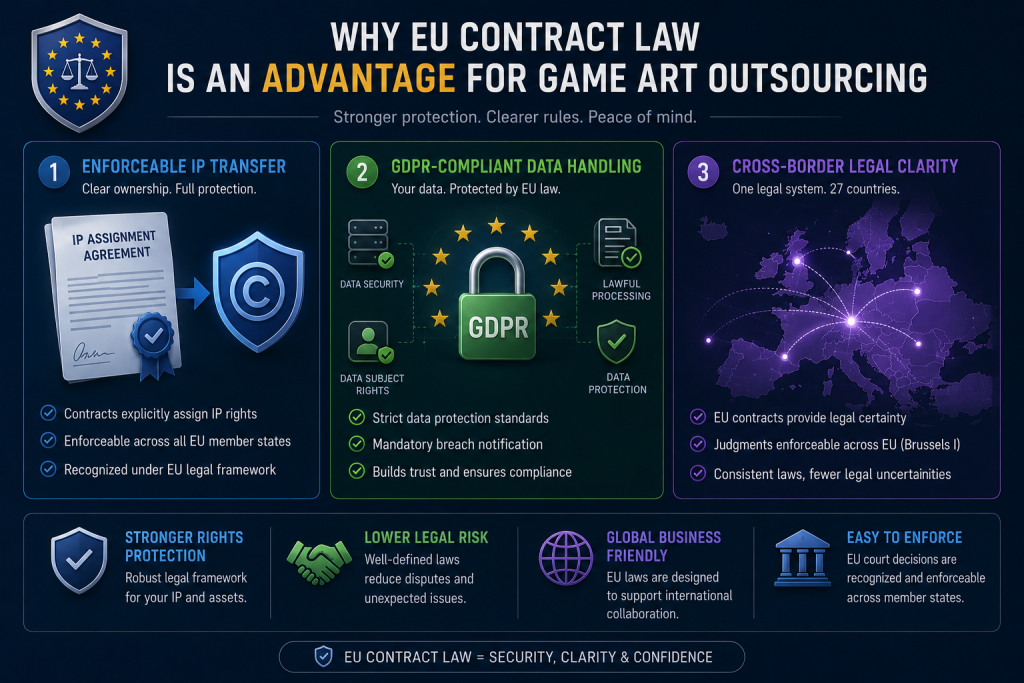
IP transfer within a familiar framework. A work-for-hire clause in a contract with an EU-incorporated studio is governed by a body of intellectual property law that is consistent across 27 member states and well understood by legal counsel in North America, the UK, and Europe. When an IP question arises mid-production, both parties are generally working from compatible legal reference points. The interpretation of “work-for-hire” and IP assignment varies between member states, but the framework is predictable enough that game studios can evaluate their risk position without requiring specialist offshore legal counsel.
For large outsourcing programs executing hundreds of asset transfers across a production cycle, reduced legal ambiguity at the deliverable level has direct production value — it shortens the review cycle for contract issues and reduces the likelihood that IP questions stall a milestone review.
GDPR compliance when it applies. GDPR becomes operationally relevant when a game art outsourcing engagement involves personal data — specifically player research, identifiable playtesting records, audience analytics, or any user-linked behavioral data incorporated into the production workflow. Pure 3D asset production typically does not involve personal data; the question is project-specific. When personal data is in scope, EU-based vendors operate inside a GDPR-regulated framework by default — GDPR compliance is a regulatory obligation for the studio, not a contractual add-on negotiated per engagement. The Data Processing Agreement structure is standardized and familiar to legal teams on both sides.
For engagements that do not involve personal data, GDPR compliance is largely a non-issue — though EU data handling infrastructure still provides a consistent security baseline.
Contract law as a shared reference point. EU contract law provides a consistent framework for dispute resolution, payment enforcement, and breach remedies that legal teams in the US, UK, and Europe can engage without specialist offshore expertise. This does not mean disputes cannot occur or that resolution is always fast — it means that when an issue arises, the path to resolution is more navigable for the parties involved. Different outsourcing jurisdictions present different degrees of this navigability; EU engagements generally score higher on familiarity for the legal teams most game studios already employ.
“Editorial illustration created for visual reference purposes. It does not represent a real project, client work, or official software screenshot unless stated otherwise.”
Timezone Overlap Is a Production Asset, Not a Scheduling Preference
The timezone debate in outsourcing discussions is usually framed as a quality-of-life question: do you want to hold meetings at 7am or 9pm? The operational reality is more significant than that.
In game art production, the velocity of a milestone cycle depends on the feedback loop between the client’s art director or outsource manager and the external team. A feedback round that could close in one working day in a same-timezone engagement may take two or three calendar days when both parties are working non-overlapping hours. Across a multi-month production engagement with weekly milestone cadence, that latency compounds.
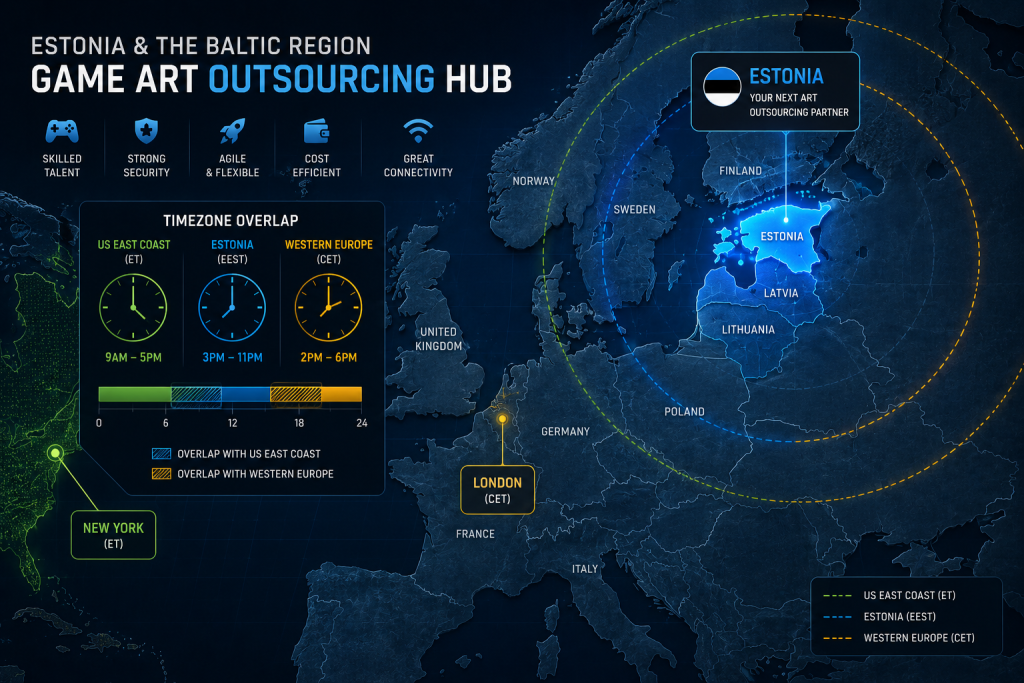
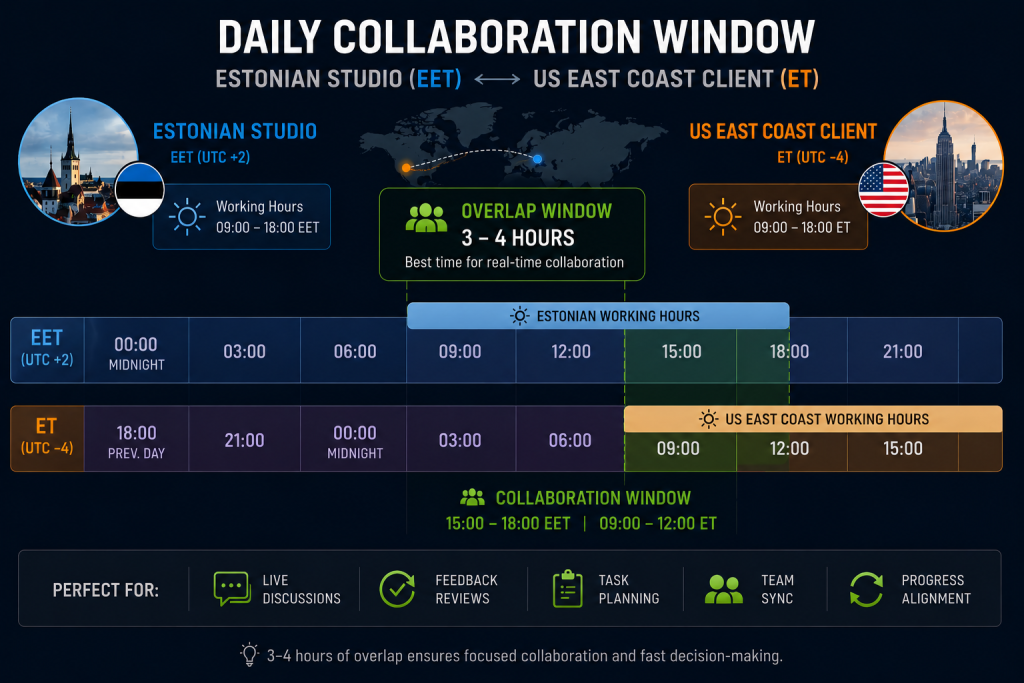
An Estonian studio operates on Eastern European Time — UTC+2 in winter, UTC+3 in summer. For European clients, this means zero to two hours of difference with UK, Germany, Scandinavia, and the Netherlands; real-time collaboration throughout the full working day is standard. For US East Coast clients, the gap is six to seven hours — enough to sustain same-day milestone cycles when the engagement is structured around it.
Here is what a single working day looks like for a US East Coast studio partnered with a Tallinn team:
- Morning production in Tallinn — 09:00–14:00 EET. The external team works through assigned asset production, runs internal QA passes, and uploads milestone deliverables to the shared project environment. The US team has not yet started its day; there is no coordination overhead during this window.
- US East Coast kickoff — 09:00 EST / 15:00 EET. The US studio starts its day. Assets from the Tallinn morning session are already staged in the engine, reviewed internally, and flagged with any producer notes.
- The overlap window — 09:00–12:00 EST / 15:00–18:00 EET. Three to four hours of shared working time. Milestone review calls, change order alignment, and feedback on in-progress deliverables happen in real time — no asynchronous delay, no next-day turnaround.
- US afternoon integration — 13:00–18:00 EST. The US team integrates approved assets into the active build, having closed the feedback loop within a single business day. The Tallinn team’s next session the following morning picks up any integration notes and continues production.
“Editorial illustration created for visual reference purposes. It does not represent a real project, client work, or official software screenshot unless stated otherwise.”
Compare this to a studio operating in Southeast Asia or South Asia, where the time gap with US clients is typically 10 to 13 hours. The overlap window collapses to near zero. Milestone feedback that closes in 24 hours in a European engagement stretches to 48 to 72 calendar hours in a fully asynchronous one. For a production schedule with defined milestone gates, that latency is not a scheduling inconvenience. It is a schedule compression risk that compounds across every delivery cycle.
The European game industry’s capacity for cross-border production reflects a mature outsourcing ecosystem: European studios have historically co-developed and outsourced within the EU, developing collaboration practices that are compatible with the milestone-based review processes that contemporary AAA and mid-core productions require.
Estonia as an EU Jurisdiction: What the Specific Context Provides
Not all EU member states are equal as outsourcing jurisdictions. Estonia has built a specific infrastructure that gives an Estonia-incorporated studio attributes that go beyond baseline EU compliance.
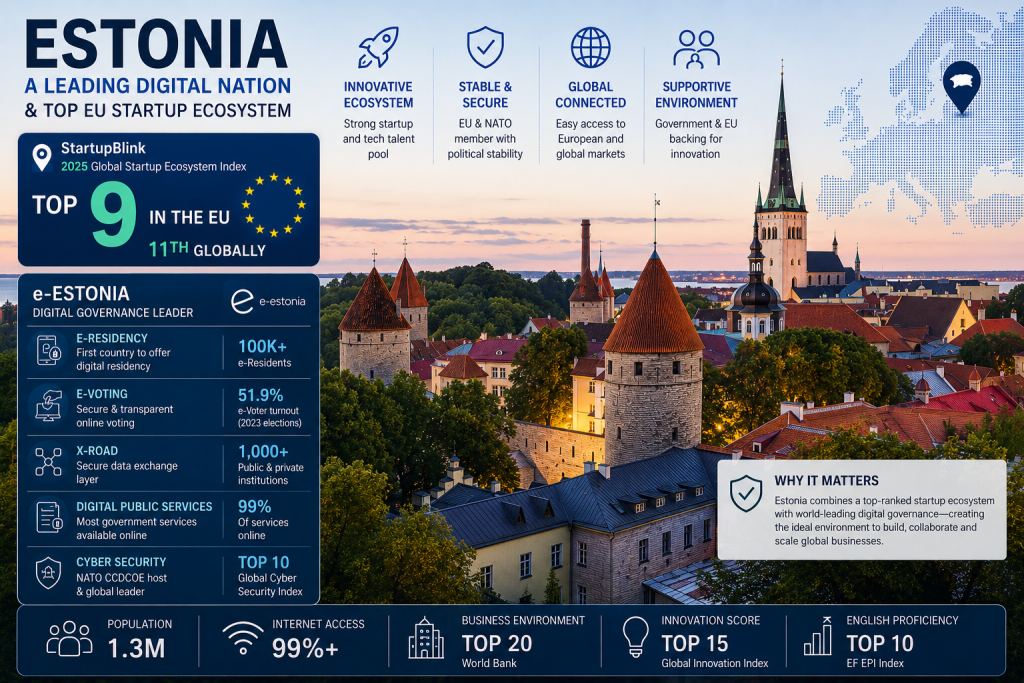
Digital governance and company infrastructure. Estonia pioneered digital governance at the national level — company registration, contract signing, tax filing, and regulatory interaction are conducted through secure digital infrastructure that has been operational for over two decades. For a client studio, this means that the vendor’s operational administration — including document signing for SOW amendments, change orders, and NDA execution — can be executed digitally, without the friction that accompanies paper-based administrative processes in some other jurisdictions. A change order that needs to be signed and executed in 24 hours is feasible in Estonia in a way that is not universally true across outsourcing destinations.
“Editorial illustration created for visual reference purposes. It does not represent a real project, client work, or official software screenshot unless stated otherwise.”
e-Residency and international business confidence. Estonia’s e-Residency program has made the country a recognized jurisdiction for internationally operating businesses. The program has attracted companies from over 170 countries, creating an ecosystem of internationally oriented businesses operating under Estonian law. This context matters for a game art studio: an Estonia-incorporated studio is operating within a legal and administrative environment designed for cross-border business, not adapted to it.
Tallinn’s tech infrastructure. Estonia’s digital governance model — online company registration, digital document signing, and integrated regulatory infrastructure — has been operational for over two decades and is recognized internationally as a benchmark for e-governance. This administrative maturity matters for the practical mechanics of an outsourcing engagement: change orders, NDA amendments, and SOW updates can be executed and signed digitally without the friction that accompanies paper-based processes in some jurisdictions. As a secondary signal, StartupBlink’s 2025 index ranks Estonia 11th globally for startup ecosystem performance and Tallinn in the top 9 EU ecosystems — reflecting the density of technical talent that production studios draw from.

GameDev Estonia and industry association membership. Estonia has a dedicated game development industry association (GameDev Estonia, an EGDF member) operating within the European Games Developer Federation framework. This means the Estonian game industry operates within the same professional standards, co-development practices, and IP governance norms as the broader European industry — not as an outlier jurisdiction adapting to external standards, but as a member of the ecosystem that sets them.
What “EU Jurisdiction” Means for Your Specific Production Risks
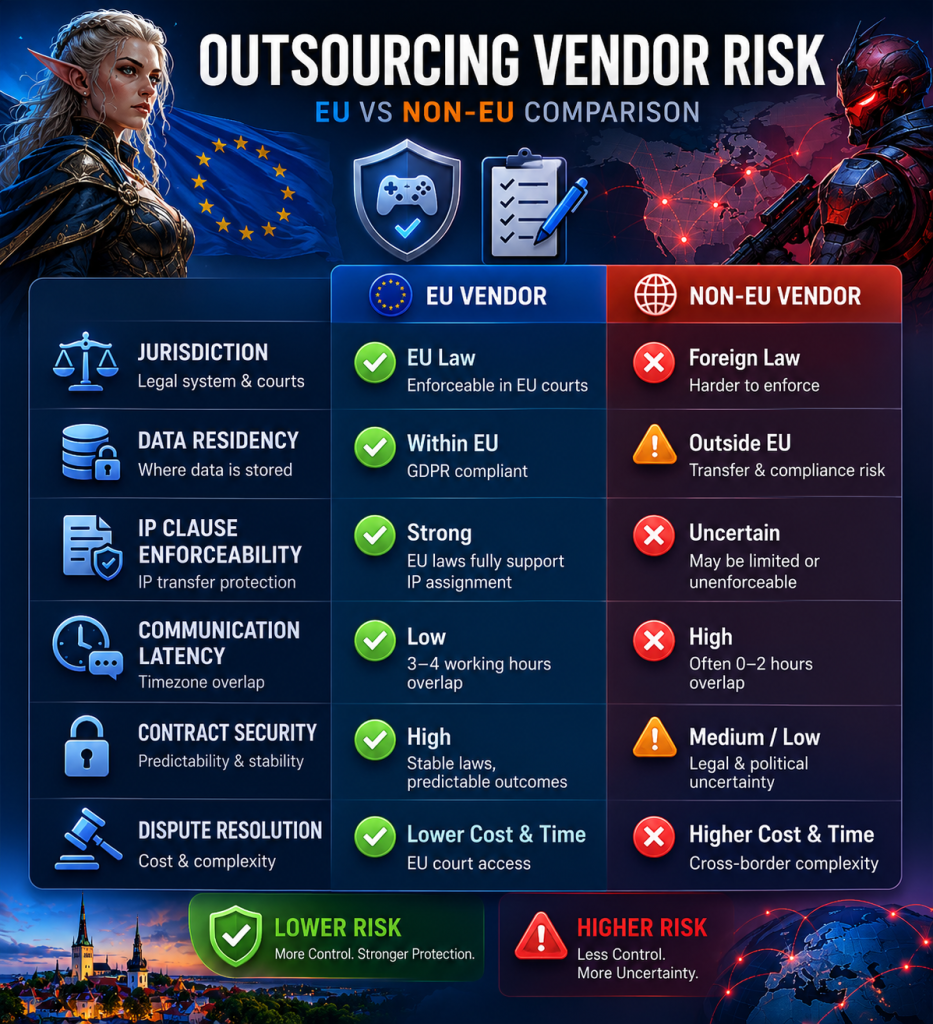
Translating legal and geographic attributes into production-relevant language: here is how EU jurisdiction affects the four most common risk categories in a game art outsourcing engagement.
Risk 1 — IP ownership ambiguity at project end. Without a clear work-for-hire or IP assignment clause, the creator of an asset may retain residual ownership rights under the default law of their jurisdiction. In EU member states, IP assignment clauses have a consistent enough legal interpretation that both parties can evaluate their position without deep specialist knowledge of the vendor’s local law. The specific doctrine varies by member state, but the framework is familiar to the legal teams game studios typically employ. Engagements in less familiar jurisdictions may require additional legal due diligence to achieve the same level of clarity.
Risk 2 — Data handling when personal data is in scope. If any project data flowing through the outsourcing engagement qualifies as personal data under GDPR — player behavior data, audience research, identifiable playtesting records — an EU vendor handles it as a regulatory obligation, and the Data Processing Agreement structure is standardized on both sides. For non-EU vendors handling the same data, equivalent compliance requires additional legal construction and audit from the client side. For engagements involving only 3D asset production with no personal data, this risk category is low regardless of vendor location.
Risk 3 — Dispute resolution speed and familiarity. When a milestone deliverable fails acceptance criteria and the vendor disputes the rejection, the path to resolution runs through the governing law of the contract. EU contract law provides a remedies framework — payment withholding, breach notice, cure periods, escalation to arbitration or court — that legal teams familiar with US, UK, or EU contract practice can engage without needing to acquire specialist knowledge of a distant jurisdiction. The time cost of navigating an unfamiliar legal system compounds a dispute situation that is already damaging the production schedule.
Risk 4 — Vendor stability for multi-month productions. Multi-month outsourcing engagements — the kind that underpin AAA and mid-core productions — carry vendor-stability risk. EU member states generally offer a stable regulatory environment and consistent rule of law, which reduces the probability of production disruption from external factors. This is one dimension of vendor stability; others — team continuity, financial health, staffing depth — require direct evaluation regardless of geography.
“Editorial illustration created for visual reference purposes. It does not represent a real project, client work, or official software screenshot unless stated otherwise.”
Geographic Trade-offs at a Glance
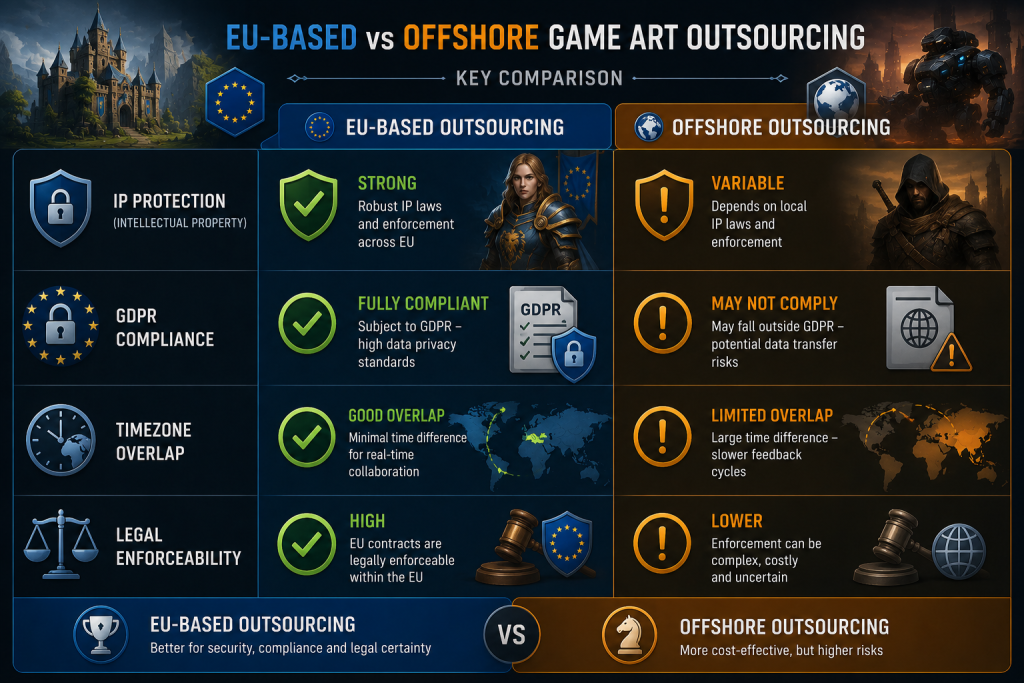
Different outsourcing regions offer different configurations of cost, collaboration ease, legal familiarity, and compliance overhead. The table below frames these as trade-offs rather than rankings — the right configuration depends on the project’s specific requirements.
“Editorial illustration created for visual reference purposes. It does not represent a real project, client work, or official software screenshot unless stated otherwise.”
| Factor | EU-based studio | Offshore vendor (non-EU) |
| Timezone overlap (EU clients) | High — same or adjacent working hours | Low — largely asynchronous |
| Timezone overlap (US East Coast) | Moderate — 3–4 hours daily shared window | Variable — often minimal or zero |
| Real-time milestone reviews | Practical as standard workflow | Requires schedule adaptation |
| IP framework familiarity | Consistent with US/EU legal practice | Varies by jurisdiction |
| GDPR compliance (when applicable) | Regulatory default | Requires additional legal construction |
| Contract dispute navigability | Familiar remedies framework | May require specialist offshore counsel |
| Production latency per milestone | Lower in synchronous model | Higher in asynchronous model |
| Rate relative to in-house (EU/US) | Below Western European/US in-house | Below EU nearshore in most cases |
This table reflects general patterns. Specific vendor evaluation should include team composition, portfolio, process maturity, and references — all of which vary regardless of geography.
Nearshoring as a Production Model, Not Just a Cost Bracket
The nearshoring framework — partnering with studios in geographically and culturally adjacent regions rather than maximizing cost savings through maximum distance — has become the preferred model for studios where collaboration efficiency matters more than marginal rate arbitrage.
For European clients, Estonia and the broader Baltic/Northern European region represent the mature end of the Eastern European game art outsourcing spectrum. The region moved past simple rate arbitrage some years ago; what it offers today is total operational alignment — highly skilled teams at competitive rates, full EU legal compliance, and timezone synchrony that makes daily real-time collaboration the default rather than the exception. The cost differential versus in-house Western European production remains significant; the cost differential versus Southeast Asian offshore outsourcing is narrower, but the operational difference — in legal predictability, communication latency, and compliance overhead — is substantial enough that mid-core and AAA productions increasingly treat it as the deciding factor.
For US clients, particularly those managing AAA or mid-core productions at scale, an EU-based outsourcing partner occupies a specific position: not the maximum cost efficiency option, but the option that minimizes legal complexity, communication latency, and IP risk simultaneously. The 6–8 hour time gap is manageable with structured milestone protocols; the legal framework is compatible with US corporate IP practices; and GDPR compliance is handled without requiring dedicated compliance overhead from the client side.
These considerations become most tangible in structured outsourcing models where milestone governance, technical alignment, and real-time review cycles directly affect delivery reliability. Studios that have invested in defining their acceptance criteria, revision protocols, and communication cadence find that geographic alignment — timezone overlap, legal familiarity, shared production norms — reduces the coordination overhead that otherwise accumulates across a long engagement.
Our full-cycle 3D environment production workflow is built around exactly this model: defined milestone gates, real-time review windows calibrated to client timezone, and EU-governed contractual infrastructure that makes IP transfer and revision scope clearly defined from contract execution to final delivery.
How Nasty Rodent Is Positioned Within This Framework
Operating within the European Union from our base in Estonia, Nasty Rodent combines Western business infrastructure with high-tier production capabilities. Our clients get EU contract law governing every deliverable, more predictable IP transfer governance within a legal framework that is familiar to international production teams, and full GDPR compliance as an operational default rather than a compliance exercise.
Our timezone position — EET, UTC+2/3 — enables genuine real-time collaboration with European clients and structured daily review cycles with US East Coast teams. Engine integration reviews, milestone submission feedback, and change order discussions happen in shared working hours, not in the asynchronous lag of a 12-hour gap.
For studios that need game concept art services or full-cycle 3D production embedded into an EU-compliant, milestone-structured pipeline, the location conversation is not separate from the production conversation — it is part of it.
We don’t eliminate geographical friction by being in a convenient timezone. We eliminate it by being in the same legal ecosystem as the studios we work with, operating under the same IP norms, and building production protocols that are designed for real-time iteration rather than compensating for asynchronous delay.
The European Game Industry as Context for Your Vendor Evaluation
The European video games sector generated €26.8 billion in revenue in 2024, a 4% increase over 2023, according to the VideoGamesEurope and EGDF annual industry report. The industry employs over 114,000 people across the continent. This is not a peripheral production ecosystem adapting to global industry standards — it is a mature, high-capacity market with established production practices, cross-border co-development norms, and a professional infrastructure that is increasingly sought after by US and Asian publishers for exactly the legal and operational reasons this article describes.
When you select an EU-based studio as an outsourcing partner, you are selecting into that ecosystem — with its legal predictability, its collaborative norms, and its production maturity — not just into a vendor relationship with favorable time zone arithmetic.
Nasty Rodent — EU-incorporated game art outsourcing studio, based in Tallinn, Estonia. See our 3D environment production work.