Indie vs AA vs AAA Games: What Production Tier Really Means for Your Art Pipeline
-

Written byDenys Zadoienyi
-

Updated on03.06.2026
-

Time to read18 min

- What Indie, AA, and AAA Actually Mean — and Why the Lines Keep Moving
- Budget, Team, and Timeline: The Structural Comparison
- How Production Tier Shapes Art Requirements — The Part Most Articles Skip
- The Art Production Matrix: What Each Tier Actually Requires
- Where Outsourcing Fits Differently Across the Three Tiers
- Production Tier and Market Reality: What the Data Actually Shows
- How to Identify Which Tier Your Project Actually Belongs To
- Tier-by-Tier Summary: What to Remember
- About Nasty Rodent
- Ready to Scale Your Art Pipeline — Whatever Your Tier
Indie vs AA vs AAA games is not just a question of budget. It is a question of how every creative and technical decision changes when the scope of a project shifts — and for anyone managing a production pipeline, that difference is not abstract.
“Editorial illustration created for visual reference purposes. It does not represent a real project, client work, or official software screenshot unless stated otherwise.”
If you are a producer planning headcount for Q3, the tier of your project determines whether your internal art team can cover the milestone or whether you are already behind on capacity planning. Whether you need two concept artists or twenty. Whether your art director can own the style guide or whether you need a dedicated team of technical artists running LOD passes across four thousand assets.
This guide breaks down the real differences between indie, AA, and AAA game development — not as a ranking of prestige, but as a production framework. What each tier means for budgets, team structure, art pipeline requirements, and where external production support becomes not just useful, but structurally necessary.
What Indie, AA, and AAA Actually Mean — and Why the Lines Keep Moving
Indie, AA, and AAA are production tiers, not quality ratings. An indie game can outsell a AAA release. A AAA game can fail critically. The tiers describe the structural conditions under which a game is made — budget, team, publisher relationship, and the resulting scope of production.
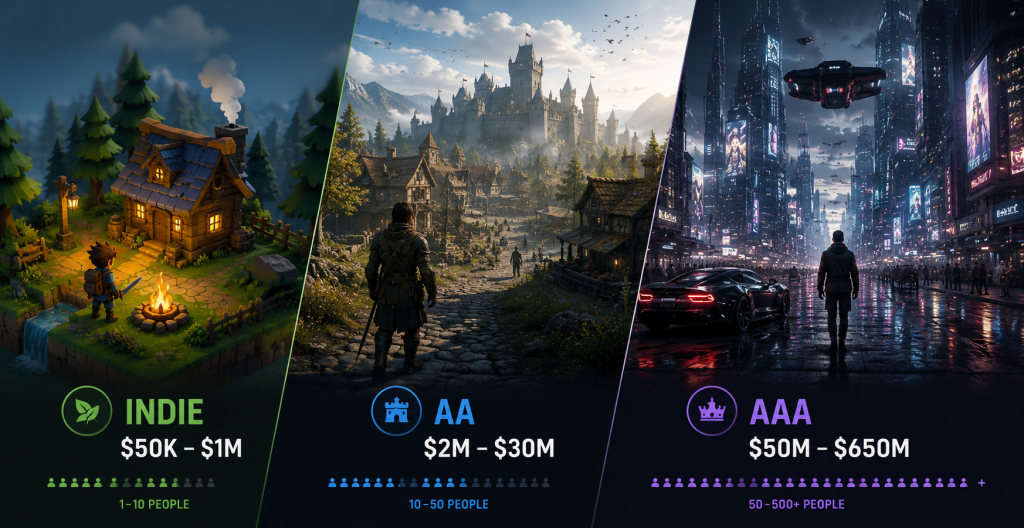
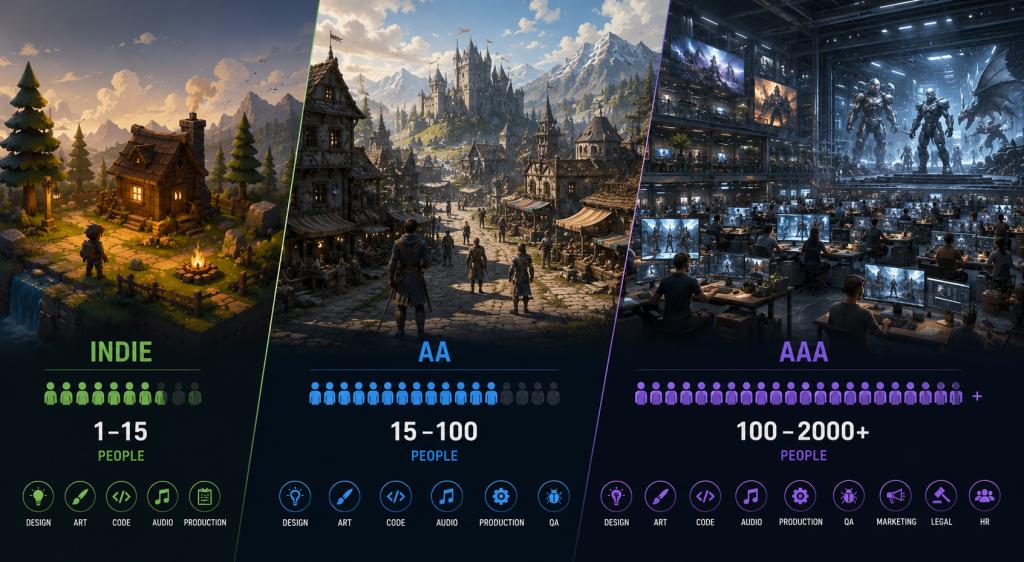
Indie (independent) games are typically developed without significant publisher control over creative direction — or with limited publisher involvement that does not constrain the core vision. The team is small — typically under 15 people, often one to five — working with personal savings, grants, or modest crowdfunding. The budget rarely exceeds $1M for a full project, and in most cases sits well below that figure. What indie development trades in financial runway it gains in creative latitude: no milestone gates driven by a publisher’s quarterly reporting, no mandated feature sets.
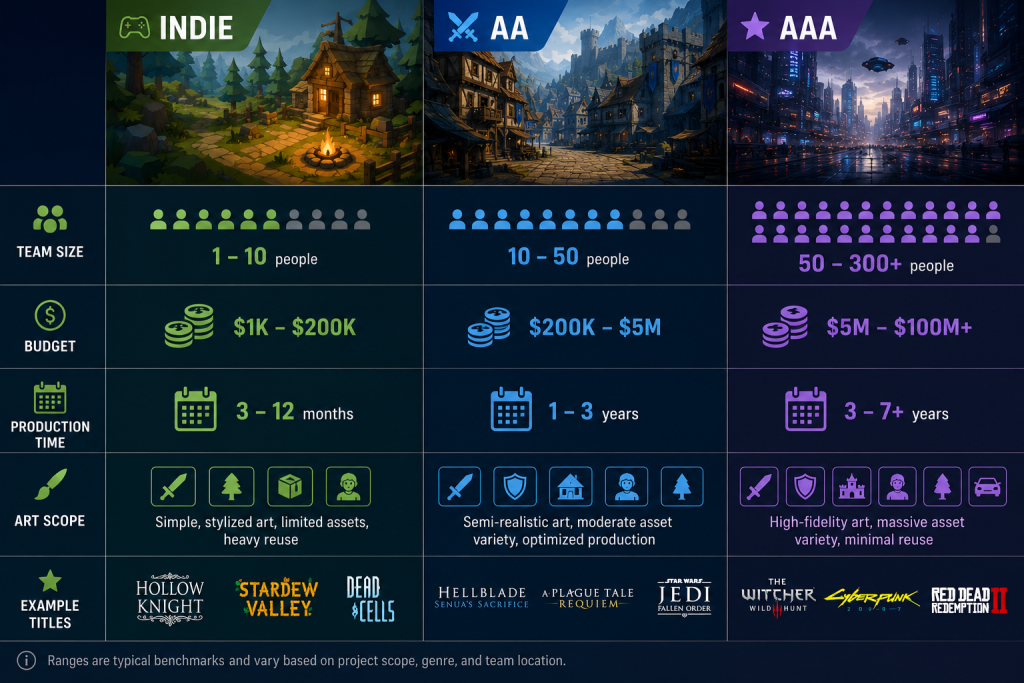
AA (double-A) describes a mid-tier production: more resources than indie, far less than AAA. Teams of 15 to 100 people. Budgets typically between $2M and $30M, though the bracket is wide and evolving. These projects are usually backed by a mid-size publisher or a well-funded independent studio that has earned enough traction to raise serious capital. A Plague Tale: Innocence (Asobo Studio, estimated $5–8M), Hellblade: Senua’s Sacrifice (Ninja Theory, approximately $10M at the upper end of the tier), and Clair Obscur: Expedition 33 ($15–25M, estimated — sitting at what some in the industry sometimes refer to as “Triple-I”, the blurring upper boundary between AA and AAA) are strong examples. AA studios aim for AAA production values in focused scope — and increasingly, they are winning commercially. In 2024, Newzoo reported a 22% year-over-year increase in AA production investment, driven precisely by this combination of high quality and managed financial risk.
AAA (triple-A) represents the highest production tier in the industry. Hundreds of developers. Multi-year cycles — typically three to five years, sometimes extending to seven. Development budgets that start at $50M for smaller AAA titles and regularly exceed $200M for major releases, according to data cited by the UK Competition and Markets Authority. When marketing, distribution, and live-ops costs are included, the all-in investment for a major AAA title in 2024–2025 ranges between $180M and $650M. At this scale, art production commonly represents a substantial share of development spending — commonly estimated in the 20–30% range depending on scope, outsourcing model, and asset complexity — thousands of assets, multiple specialized departments, and a pipeline that must sustain quality across years of iteration.
Did you know that…?
The term “AAA” appears to have emerged informally in the late 1990s — with retailers among the first to use it widely — borrowing language from credit ratings, where triple-A denotes the safest investment. Today, a single AAA marketing campaign can cost more than the entire development budget of many successful AA games.
The difficulty with these definitions in 2025 is that the category boundaries are genuinely blurring. Unreal Engine 5, Unity HDRP, and AI-assisted workflows have lowered the production cost of visual quality substantially — wider access to game engines and development tools is now a primary driver of indie market growth, according to 80 Level’s industry analysis. A focused team of 20 can achieve visual fidelity that would have required 80 people five years ago. This means AA is expanding upward, and the bottom of AAA is contracting. The tier still matters — but it matters more at the production pipeline level than at the surface level of graphics.
“Editorial illustration created for visual reference purposes. It does not represent a real project, client work, or official software screenshot unless stated otherwise.”
Budget, Team, and Timeline: The Structural Comparison
The most common way to explain the tiers is through budget — but budget alone is a poor guide. The more useful frame is what budget enables: how many specialists, how long they can work, and what level of production discipline the project can sustain.
“Editorial illustration created for visual reference purposes. It does not represent a real project, client work, or official software screenshot unless stated otherwise.”
| Metric | Indie | AA | AAA |
| Development budget | Under $1M (often $50K–$300K) | $2M–$30M | $50M–$650M+ |
| Team size | 1–15 people | 15–100 people | 100–2,000+ |
| Production timeline | 6 months – 2 years | 2–4 years | 3–7 years |
| Publisher relationship | Self-funded, grants, or indie publisher | Mid-size publisher or self-funded studio | Major publisher typically required |
| Art team structure | Generalists; one artist covers many roles | Emerging specialization; concept, 3D, tech art separating | Fully specialized departments (rigging, VFX, tech art, character, environment, weapons) |
| Risk model | Personal / creative risk | Commercial risk with managed scope | High commercial risk; failure affects publisher’s financials |
One thing the table does not capture: at the AAA level, a single art milestone gate failure — a significant slip in first-pass approval rate across a character batch — can add substantial QA overhead per milestone. At scale, that compounds across dozens of asset categories. Budget is not just the opening number; it is the buffer you have when things do not go as planned. Indie has almost none. AA has a narrow window. AAA has more, but it is consumed faster than most people outside the pipeline realize.
How Production Tier Shapes Art Requirements — The Part Most Articles Skip
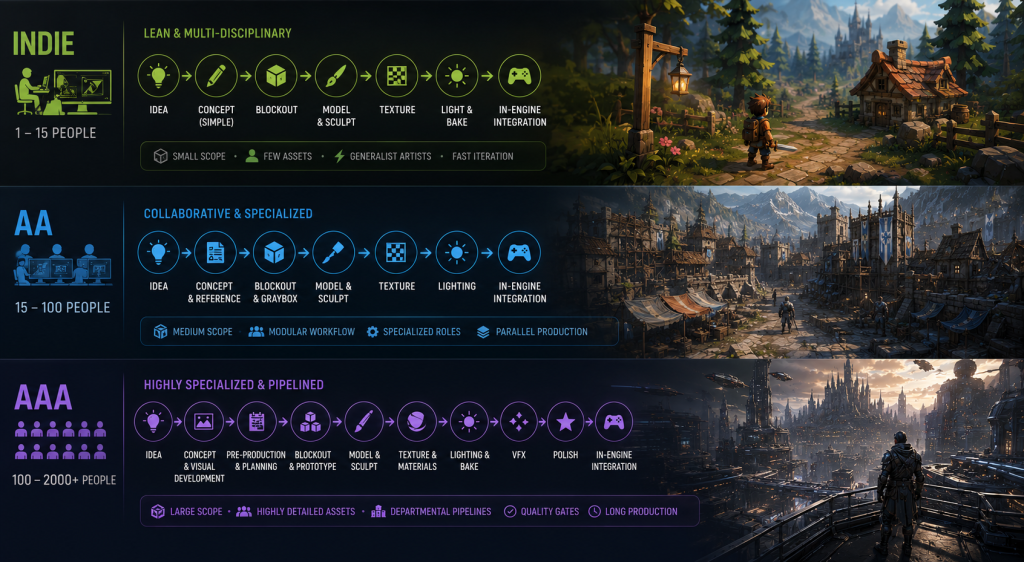
This is where the real difference lives. The tier does not just determine how much money you spend on art — it determines what kind of art you can make, what discipline your pipeline requires, and what the acceptable failure rate is on first deliverable.
“Editorial illustration created for visual reference purposes. It does not represent a real project, client work, or official software screenshot unless stated otherwise.”
Indie Art: Constraint as Creative Strategy
Indie art production is about making the most of limited polycount budgets, limited revision cycles, and — critically — limited personnel. One artist might concept, model, rig, and texture a character from start to finish. This generalist approach produces work fast, but it means every decision about art style is also a decision about production feasibility.
Stylized aesthetics dominate indie for a structural reason: they are more forgiving under constraint. A stylized character at 5,000 to 15,000 triangles can look intentional and polished. The same polycount applied to a realistic human reads as unfinished. This is not a limitation to apologize for — Hollow Knight, Celeste, and Undertale are proof that constraint-driven art direction produces some of the most commercially durable visual identities in the industry.
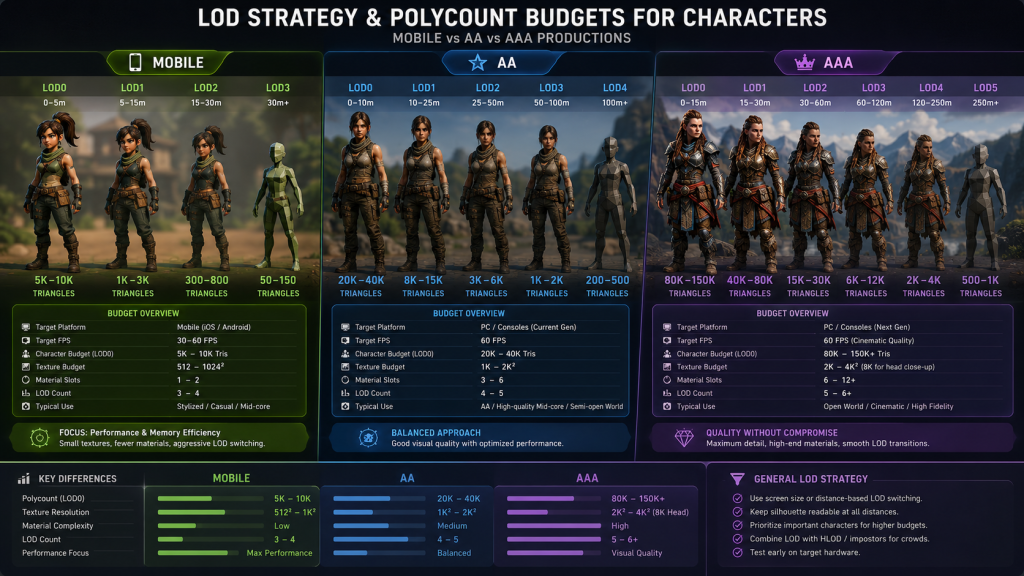
For indie productions using 3D, the typical character sits in the 10,000–20,000 triangle range for a PC/console target. LOD strategy is often simplified: one or two LOD levels rather than the four or five you see in mid-core or AAA. UV layout is pragmatic — a single texture set, 2K resolution, prioritizing the most visible surfaces. The art bible, when it exists, is usually a shared reference folder and a Figma board, not a 60-page technical document.
Where indie art production most commonly breaks down: when a team with a stylized 2D background attempts 3D environments mid-production without a production-ready technical art pipeline. The asset count grows, the baking workflow is improvised, and QA becomes a bottleneck the team did not budget for. The game ships with inconsistent texel density and clipping issues that a dedicated tech artist would have caught in week two.
AA Art: The Production Discipline Middle Ground
AA art production is where specialized roles start to separate out and where production discipline becomes a competitive differentiator rather than a nice-to-have.
An AA team will typically have dedicated concept artists, 3D generalists or specialists (characters, environment, props), a technical artist who owns the baking pipeline and engine integration, and a QA pass process — even if it is lightweight compared to AAA. The art director role becomes a full-time position rather than being shared with lead artist duties.
Character polycount for AA PC/console targets typically falls in the 20,000–60,000 triangle range. LOD pipelines are more structured: three or four levels, with clear budgets at each distance. Texture resolution steps up to 4K for hero assets. Style guides are formal documents, not reference boards — they specify silhouette targets, material behavior expectations, and technical requirements like maximum draw calls per scene type.
One of the defining pressures of AA art production is scope management. AA studios aim for AAA-quality bar in selected areas — often characters and hero environments — while using more efficient production methods elsewhere. This means the art director must make deliberate decisions about where to concentrate visual investment. Every premium art decision in one area is a budget taken from another. That tension shapes every asset brief, every revision cycle.
As a producer planning a mid-core production, you will notice that the AA tier is where outsourcing first becomes a pipeline strategy rather than an emergency measure. Internal teams focus on hero assets and direction-critical work; environmental fill assets, prop variants, and weapon models are excellent candidates for structured outsourcing because they have well-defined technical specifications and repeatable production workflows.
AAA Art: Engineering at Scale
AAA art production is not a scaled-up version of AA. It is a different operational category. The pipeline is managed like a manufacturing process: asset briefs with precise technical specifications, multi-pass review systems, daily sync calls between internal leads and external vendor teams, and automated QA tools that flag issues before a human reviewer touches the file.

Character polycount for AAA can exceed 100,000 triangles for hero characters, with LOD cascades that step down through four to five levels — each precisely budgeted to the draw distance and camera behavior of the engine. A game-ready AAA character typically involves a high-poly sculpt (ZBrush, often), a retopology pass to production mesh (Maya, 3ds Max, or Blender), UV layout, baking (Marmoset Toolbag or equivalent), PBR texturing in Substance Painter, rigging, and engine integration — each step owned by a different specialist, as detailed in this AAA prop pipeline breakdown on Polycount. The concept art brief for a single character can run to multiple pages of callout sheets, model sheets, and reference annotations.
For 3D environment art at the AAA level, modular kit design becomes the primary production methodology at scale. An open-world RPG might have 30,000 to 80,000 unique or semi-unique environment assets. None of that is sustainable without a modular approach and a clear virtualized geometry strategy — whether that means leveraging UE5’s Nanite (which can substantially reduce or eliminate the need for manual LOD authoring for eligible static meshes) or maintaining strict 4–5 level LOD cascades in pipelines where Nanite does not apply: skinned characters, translucent materials, or non-UE5 targets. The environment art team is segmented: biome leads, prop artists, material artists, lighting artists, and technical environment artists who own the performance budget.
The art bible at the AAA level is a living document — versioned, distributed to all external vendors, referenced at every review gate. Style drift is one of the most expensive problems in large-scale art production, because it is discovered late. By the time an outsourced batch of environment props is flagged for inconsistent material behavior, the vendor has often produced several hundred assets to the wrong spec. That discovery, if it happens at milestone three instead of week two, can cost more to remediate than the original vendor contract was worth.
The Art Production Matrix: What Each Tier Actually Requires
“Editorial illustration created for visual reference purposes. It does not represent a real project, client work, or official software screenshot unless stated otherwise.”
| Art Area | Indie | AA | AAA |
| Character polycount | 5K–20K triangles | 20K–60K triangles | 60K–100K+ triangles |
| Texture resolution | 1K–2K per character | 2K–4K per hero | 4K–8K; multi-set |
| LOD levels | 1–2 | 3–4 | 4–5 cascades for non-Nanite assets; Nanite virtualization for eligible static meshes |
| Style guide depth | Reference folder / Figma | Formal style doc | Living document, versioned, distributed to vendors |
| Concept art pipeline | Optional / generalist | Dedicated concept artists | Full pre-production pipeline: mood boards, key art, silhouette passes, color scripts |
| Tech art role | Absent or shared | 1 dedicated tech artist | Full tech art department |
| Outsourcing use | Occasional / emergency | Strategic for defined asset categories | Core production strategy; volume outsourcing standard |
| First-pass approval expectation | Flexible | 60–70% target | 70–80%+ target; slip triggers vendor review |
One observation from working across projects at different scales: the most common art production mistake at the AA tier is applying indie-style generalist workflows to a production volume that requires specialist pipelines. When a character artist is also doing UV layout, baking, and engine import for every asset they produce, the capacity math falls apart at the third milestone. The production does not fail because of talent — it fails because the pipeline was not designed for the scope.
When we at Nasty Rodent onboard into an AA or mid-core production, one of the first things we look at is whether the client’s art brief specifies enough technical parameters to support a scalable outsource relationship. A concept brief that defines silhouette targets, material behavior expectations, and a clear visual target reduces revision cycles substantially — and the game concept art pipeline is where that work begins, not in the 3D production phase.
Where Outsourcing Fits Differently Across the Three Tiers
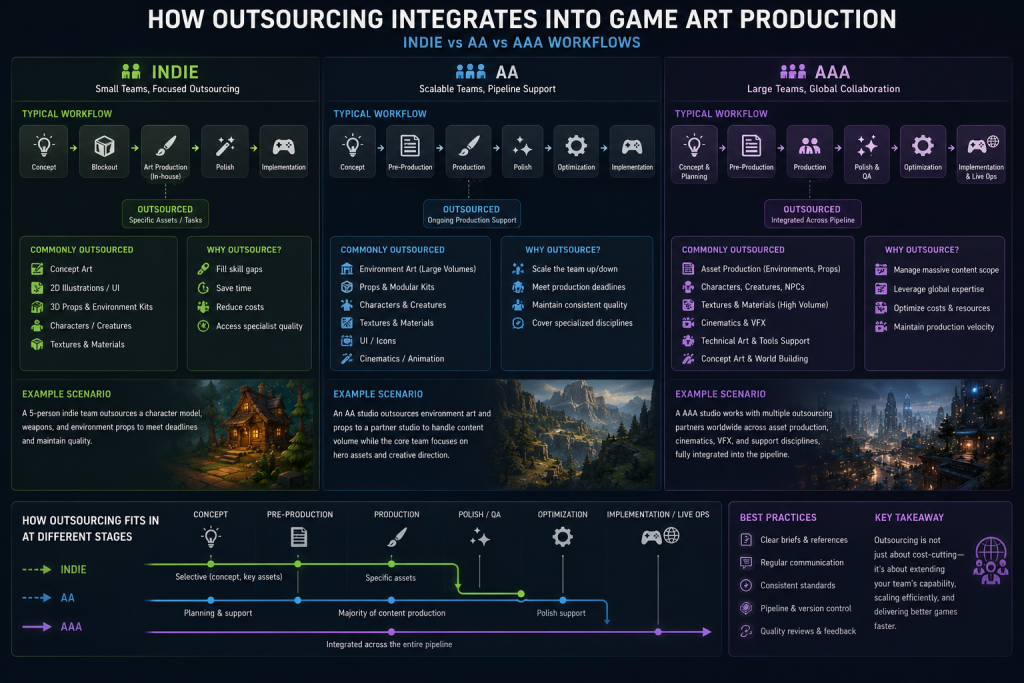
The decision to outsource art is not the same decision at different tiers. It serves different functions, runs at different volumes, and carries different risk profiles.
“Editorial illustration created for visual reference purposes. It does not represent a real project, client work, or official software screenshot unless stated otherwise.”
For indie studios, outsourcing is a capability unlock. A two- or three-person team cannot produce AAA-quality characters internally — but they can produce indie-quality characters at a pace that does not cripple the production schedule. The more strategic use of outsourcing for indie is concept art: establishing a visual identity and style guide before 3D production begins means the internal artists are working to a defined target, not discovering the style mid-pipeline. This is not a luxury. It is risk mitigation.
For AA studios, outsourcing is a capacity tool. The internal team covers hero assets, core gameplay characters, and art direction. The external partner covers defined asset categories with clear technical specs — environment fill sets, secondary character variants, weapon models, vehicle skins. This works well when the client provides a mature style guide and technical brief. It breaks down when the brief is underspecified and the vendor is expected to interpret art direction rather than execute against it.
For AAA studios, outsourcing is infrastructure. Major publishers outsource significant portions of environment art, prop production, and costume variants as a baseline. The goal is not to access skills the studio lacks — a AAA studio has every specialist role in-house. The goal is to extend production capacity during peak milestone periods without proportional headcount growth. The global game art outsourcing market is projected to reach nearly $3.5B by 2032, growing at a 7.5% CAGR, which reflects how thoroughly outsourcing has embedded itself as a core production model at scale — not a supplementary one.
The capability gap between vendors equipped for AAA outsourcing and those suited only for indie volume is real. At the AAA level, production-ready assets must arrive with correct topology, engine-appropriate LOD structure, texture budget compliance, naming conventions that match the client’s pipeline, and first-pass accuracy on technical specs. An outsource partner who is excellent for a stylized indie project may generate significant rework risk if applied to a AAA production without the discipline to match that pipeline.
The 3D character production pipeline at Nasty Rodent is built around the technical requirements of mid-core and AAA productions — polycount targets, LOD strategy, baking pipeline, and engine-ready delivery. The asset brief is the starting point, not the endpoint. What determines delivery quality is the pipeline discipline behind it.
Production Tier and Market Reality: What the Data Actually Shows
The tier a team operates in also shapes the commercial environment they are competing in — and the data on this is worth knowing before making production decisions.
Steam listed over 14,000 new titles in 2024. According to analysis of that dataset, over 70% of games released generated less than $10,000 in their first year. For indie developers, the commercial challenge is not primarily production quality — it is discoverability in an increasingly saturated market. The median indie release is technically more polished than it was five years ago, and commercially harder to surface.
The AA segment is behaving differently. In 2024, Newzoo’s data showed a 22% increase in AA production investment year-over-year. AA titles generate higher average revenue per title than indie games — estimated at approximately 4.4 times more — and subscription platforms like Xbox Game Pass and PlayStation Plus have actively favored AA titles because of their premium polish relative to budget. The AA tier is not a compromise between indie and AAA anymore. For many studios, it is the target.
AAA continues to dominate total market revenue, but the economics of AAA production have become structurally uncomfortable for many publishers. When a game requires $300M+ in total investment and must sell 10 million copies to break even, the risk tolerance narrows sharply. The response across the industry has been a combination of increased live-ops monetization, reduced genre experimentation, and heavier reliance on proven IP — all of which are downstream effects of the cost structure, not failures of creative ambition.
How to Identify Which Tier Your Project Actually Belongs To
Most production decisions go wrong when teams misidentify their tier — usually by planning for a higher tier than their resources can support.
A useful self-assessment:
- How many full-time people can work on this project for two or more years?
- Does the project have a publisher or institutional backer who controls milestone payment?
- What is the asset count for the shipped game — and can your team produce that volume at the required quality bar within the schedule?
- Do you have a dedicated tech artist? If not, who owns baking, LOD pipeline, and engine integration?
- Is your style guide a document other studios could execute from, or is it a mood board?
If the honest answer to most of these is “no” or “we’re working on it,” the production is functioning at a tier below what the design ambition implies. That is not a criticism — it is diagnostic information. The best version of a well-executed indie game will consistently outperform an underpowered AA attempt. The tiers are production tools, not status rankings.
The most common misidentification: a studio with an AA ambition and an indie-sized budget trying to produce AAA-tier visual quality on selected hero assets. The hero assets get the budget. Everything around them does not. The visual inconsistency in the shipped product signals misaligned production planning more clearly than any post-mortem.
Tier-by-Tier Summary: What to Remember
| Indie | AA | AAA | |
| Define it as | Creative independence, constrained resources | Quality ambition within a manageable scope | Engineering-grade production at commercial scale |
| Art approach | Constraint-driven, stylized preferred | Selective premium investment; strong style guide | Full pipeline specialization; LOD + modular kit standard |
| Outsourcing role | Capability unlock | Capacity tool for defined categories | Core infrastructure |
| Key production risk | Scope beyond team capacity | Style guide underspecification | Style drift + vendor misalignment at scale |
| Key metric for success | Creative execution + discoverability | Quality-to-budget ratio | First-pass approval rate + milestone gate performance |
About Nasty Rodent
Whether you are building an indie title, scaling an AA production pipeline, or supporting AAA-level asset volumes, game art requirements change dramatically with scope, timelines, and production complexity. At Nasty Rodent, we work with game teams at different production stages, helping studios scale concept art, 2D/3D assets, environments, props, UI, and visual production workflows without overloading internal teams. Our experience across multiple project scopes — including work with Offworld Industries, Galaxy 4 Games, and The Bearded Ladies Consulting — allows us to adapt art pipelines to different budget levels, production speeds, and technical requirements. If your team needs reliable external production support, partnering with a game art outsourcing studio can help reduce bottlenecks while keeping visual quality consistent.
Ready to Scale Your Art Pipeline — Whatever Your Tier
Understanding where your project sits on the production tier spectrum is the first step to building a pipeline that actually performs at milestone. The second step is making sure your external production partners understand it too.
At Nasty Rodent, we integrate into existing production pipelines quickly — adapting to your technical brief, art direction, and production schedule rather than asking you to adapt to ours. Whether you need concept art to establish the visual foundation before 3D begins, or production-ready 3D characters and environments delivered to engine spec, we tailor the production scope to your project’s tier, pipeline maturity, and technical requirements — not the other way around.
Reach out to discuss your production pipeline — we will review your brief, technical specifications, and production schedule to provide a clear view of where external art support can accelerate delivery and strengthen production consistency without introducing style drift or unnecessary rework.