What Is Concept Art and What Does It Actually Do in Production?
-

Written byDenys Zadoienyi
-

Updated on09.06.2026
-

Time to read18 min

- Why Concept Art Is Not “Early Sketches”
- The Most Common Types of Concept Art in Game Production
- How Concept Art Fits Into the Production Pipeline
- What Makes Concept Art Production-Ready: The Art Director’s Checklist
- Concept Art vs. Production Art: A Distinction That Saves Budget
- From Brief to Handoff: What a Concept Art Outsource Brief Must Contain
- Our Approach to Concept Art at Nasty Rodent
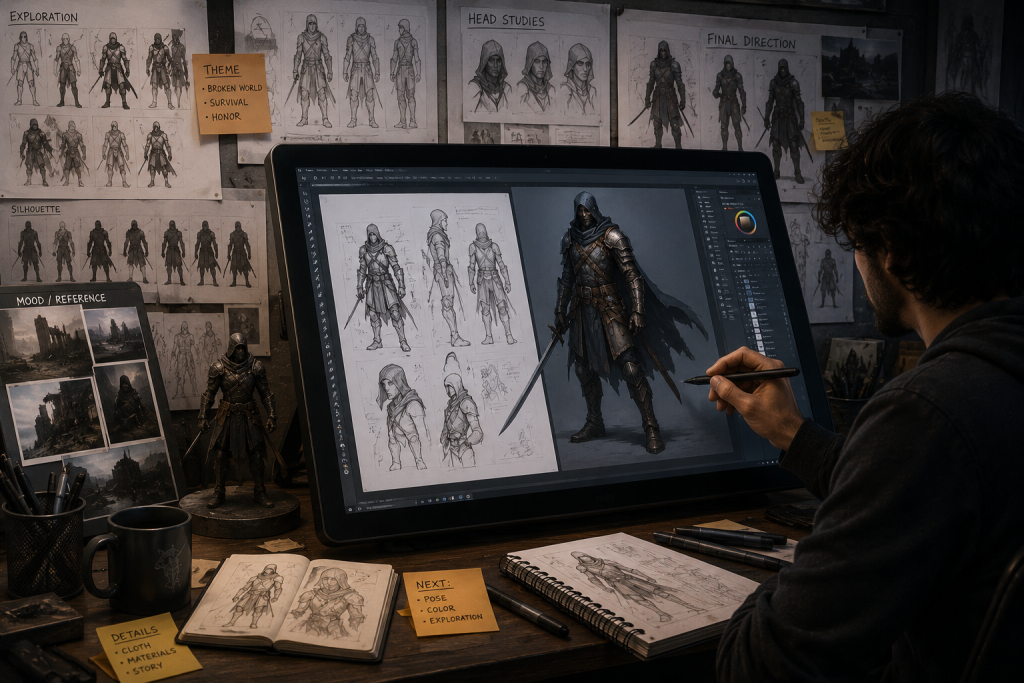
A production without concept art is not a production with fewer assets—it is a production without a shared visual language. Every 3D modeler, texture artist, environment designer, and technical artist is making independent interpretations of the same characters, environments, and objects, and those interpretations will diverge. By the third milestone, the discrepancy between what different team members imagined becomes a rework budget. By the fifth, it becomes a delay.
“Editorial illustration created for visual reference purposes. It does not represent a real project, client work, or official software screenshot unless stated otherwise.”
This is why concept art exists: not as decoration at the start of development, but as the specification system that makes a distributed production team coherent. Understanding what concept art actually does—and what it does not do—is prerequisite knowledge for any art director managing a production pipeline, whether the work is being done in-house, outsourced, or split across both.
This article covers the definition, the core types, the production pipeline position, the production-readiness criteria, and the critical distinction between concept art and production art. It is written for teams building or evaluating game art pipelines, not for newcomers learning to draw.
Concept art is the creation of visual representations of game elements—characters, environments, props, vehicles, creatures, and UI—that do not yet exist in final form, for the purpose of establishing design intent, aligning the production team, and providing reference for downstream disciplines. It is a production tool, not a finished artwork, and its quality is measured by how efficiently it communicates design decisions to the people who have to act on them.
Why Concept Art Is Not “Early Sketches”
The most common misconception about concept art is that it belongs exclusively to the beginning of production—a phase of loose exploration before “real work” starts. This framing misrepresents the function, and in doing so, it generates one of the most expensive mistakes an art director can make: treating concept art as optional once production is underway.
Concept art is a communication infrastructure. It is the visual specification system that tells a 3D modeler what a character’s silhouette must read as at the scale and distance the game actually presents it. It tells a texture artist what surface quality a vehicle should convey before a brush is applied. It tells a level designer which architectural grammar belongs to this faction and which belongs to that one, so that players can orient themselves spatially without reading a sign.
The word “early” creates a false impression that concept art is superseded by production assets. In reality, well-executed concept art remains the reference authority for a production until the asset is final—and on long-cycle projects, it continues to serve as the authoritative source for DLC content, marketing materials, and sequel production years after the original game ships.
What distinguishes concept art from a finished illustration is its function, not its level of polish. A concept sheet can be rendered to a high degree of finish when it needs to communicate material quality, lighting mood, or emotional tone. It can be deliberately rough when the purpose is silhouette exploration or proportional variation. The defining characteristic is always the same: it exists to answer a production question, not to be a final product.
The confusion between “sketch” and “concept” also leads to another error: underspecifying what concept artists are asked to produce. A brief that says “draw a medieval knight character” is not a concept art brief—it is an instruction to make a drawing. A concept art brief specifies the narrative role of the character, the faction they belong to, the visual language that faction uses, the silhouette requirements for in-game readability, the color hierarchy relative to other characters in the same scene, and the constraints from the technical art team. When those specifications are absent, the concept artist produces a drawing. When they are present, the concept artist produces a production reference.
The Most Common Types of Concept Art in Game Production
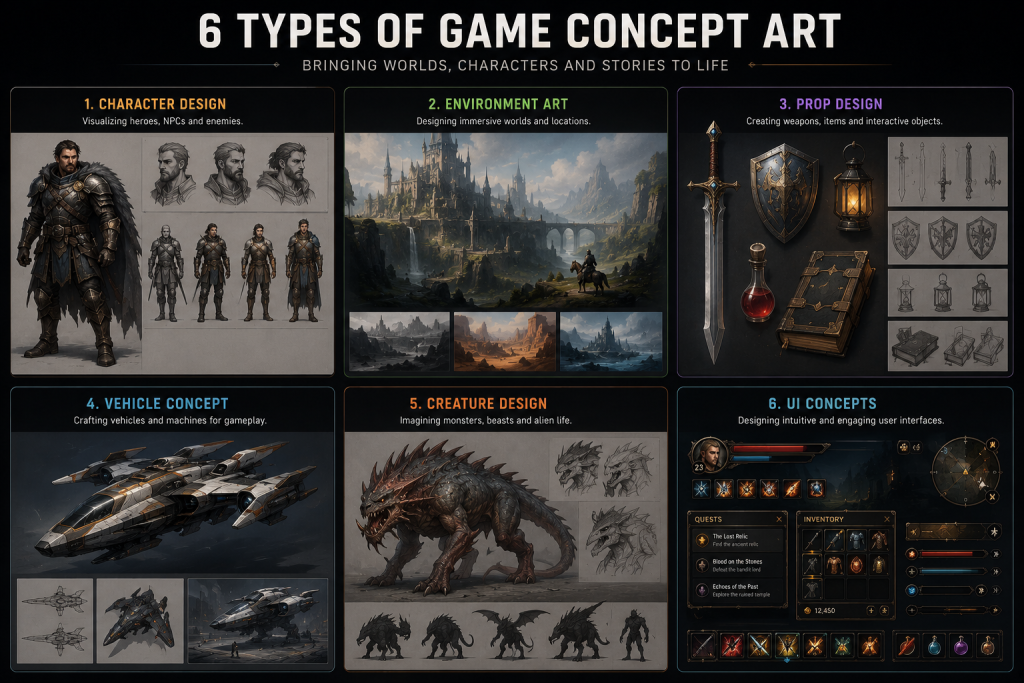
Game concept art is not a single category of output. While pipelines and terminology vary between studios, production work broadly requires different types of concept deliverables at different stages, each with different specifications and handoff requirements. The categories below represent the most common production contexts.
“Editorial illustration created for visual reference purposes. It does not represent a real project, client work, or official software screenshot unless stated otherwise.”
Character concept art establishes the visual identity of every figure that inhabits the game world: protagonists, antagonists, NPCs, creatures, and faction archetypes. Beyond appearance, character concept work is responsible for communicating personality through silhouette and proportion, differentiating characters from one another at a glance, and ensuring that the design is readable at the scale and viewing distance the game engine will actually render it. A character that looks compelling in a concept painting but reads as visual noise in a packed combat scene has failed its brief. Strong character concept art defines shape language—the consistent use of geometric vocabulary (angular vs. rounded, compact vs. elongated) to signal role and temperament before the player processes any detail.
For 3D character design to proceed smoothly, character concept deliverables typically include a turnaround sheet (orthographic front, side, and back views at consistent scale), expression studies for facial animation, color keys showing primary and secondary palette, and variation sheets if the design has faction-specific or cosmetic variants.
Environment concept art visualizes the spaces players inhabit: architecture, landscapes, interiors, skyboxes, and world zones. Its function is dual: it establishes the emotional and narrative tone of each space (what does this place feel like, what has happened here, what kind of world does it belong to), and it provides the technical framework for the 3D environment art team to build from. Effective environment concepts address lighting direction, atmospheric depth, material distribution, and the spatial grammar that distinguishes one zone from another. A dungeon that could be any dungeon is not a production-ready environment concept—it is an illustration.
Prop concept art covers the objects that populate the world: weapons, tools, furniture, interactive objects, collectibles, and environmental storytelling items. Props are often underspecified in production briefs, which is a mistake—a world where every prop could belong to any project has no identity. Prop concept work establishes the design language of a faction or region through the objects its inhabitants use and leave behind.
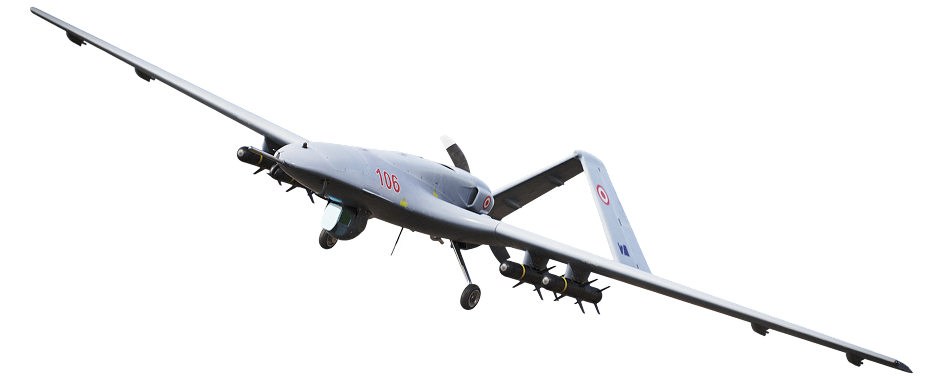
Vehicle concept art handles ground, air, water, and space vehicles, with requirements shaped by whether the vehicle is pilotable, cinematic, or environmental. For playable vehicles, the concept must communicate cockpit ergonomics and player-facing visual feedback, not only exterior silhouette. Design plausibility matters here in ways it does not for character concepting: a vehicle that looks physically implausible disrupts immersion in ways that a stylized character does not.
Creature concept art occupies a specific and demanding subdomain: original entities that have no real-world counterpart and must be believable on their own terms. Creature concepting requires a deeper fluency in anatomy, kinematics, and behavioral signaling than most other concept disciplines. The design has to communicate how the creature moves, how it attacks, what it feeds on, and what place it occupies in the world’s ecosystem—all from a static image.
UI concept art is often one of the most overlooked categories in production briefs and, from a player-experience perspective, arguably one of the most consequential. UI concept work defines the visual language of the interface before it is built: icon families, HUD layouts, menu hierarchies, typography systems, and the art direction that ties the interface to the game world’s aesthetic. A UI that was designed without concept art tends to look like it was assembled from components that belong to different projects—because it was.
Did you know that…?
The modern production role of concept art is commonly traced to early film and animation production systems of the 20th century, where dedicated visual development departments began creating systematic references to align set construction, costume, and design teams around a shared visual authority. One historical lineage frequently associated with this practice is the Hollywood studio system, though the discipline evolved across multiple industries simultaneously. The role migrated into interactive entertainment decades later—but the core function never changed: give every department a shared visual authority so that independent execution produces a coherent result. What changed in games is the scale: a single AAA production today can involve concept work for hundreds or thousands of individual assets over multi-year production cycles.
How Concept Art Fits Into the Production Pipeline
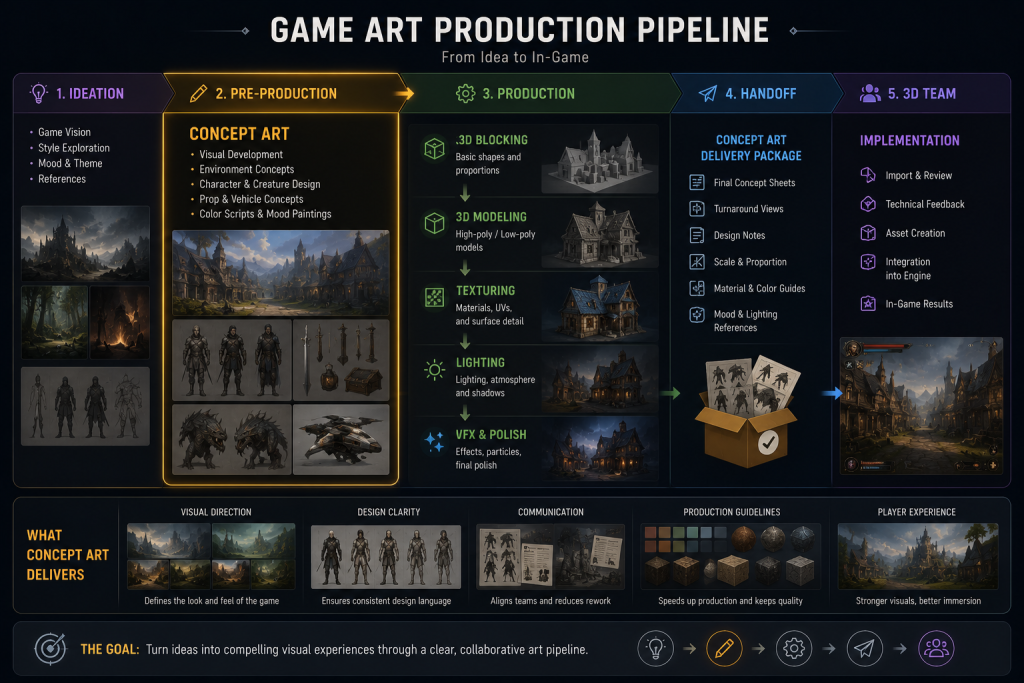
The conventional framing of concept art as a pre-production activity is accurate but incomplete. Understanding where concept art lives across the full production cycle is essential for building a pipeline that doesn’t stall.
“Editorial illustration created for visual reference purposes. It does not represent a real project, client work, or official software screenshot unless stated otherwise.”
In pre-production, concept art does its foundational work: establishing the visual identity of the world, the characters, and the design language that will govern every subsequent asset decision. This is where the art bible is built—the document that captures the style guide, the color system, the shape language conventions, and the material palette the project will use consistently across a multi-year production. Pre-production concept work is exploratory at the start (many iterations, broad variation, deliberate experimentation) and convergent at the end (selected directions refined to production specifications). The transition from exploratory to production-ready concept work is ideally treated as an explicit milestone—reviewed and signed off by the art director—rather than a gradient that blurs into production without a defined handover point.
During production, concept art continues in two modes. First, it provides ongoing reference as new areas, characters, and props are introduced according to the production schedule—concept work for a game’s final zone may not begin until eighteen months into development. Second, it handles design problems that emerge from production: a character’s silhouette that doesn’t read correctly against a specific environment, a weapon design that needs to be revised after playtesting reveals it creates visual confusion, an environment zone that requires a new architectural variant the original brief didn’t anticipate. Treating concept art as complete when production begins is a planning error that guarantees reactive rework.
At handoff, concept art becomes the specification document for downstream disciplines. The quality of the handoff—the completeness of the turnaround sheets, the specificity of the material callouts, the clarity of the technical constraints communicated to the 3D team—determines whether modeling proceeds smoothly or enters a cycle of interpretation and revision. A concept package that requires the 3D artist to make core design decisions is an incomplete package. Those decisions belong in concept, where they are cheap; not in modeling, where they are expensive.
The ArtStation Magazine has covered how the industry’s shift toward 3D in concept art workflows has materially changed the handoff dynamic: concept artists who can produce 3D reference alongside 2D paintings reduce the interpretation gap between concept and modeling, compressing revision cycles at the most expensive stage of production.
What Makes Concept Art Production-Ready: The Art Director’s Checklist
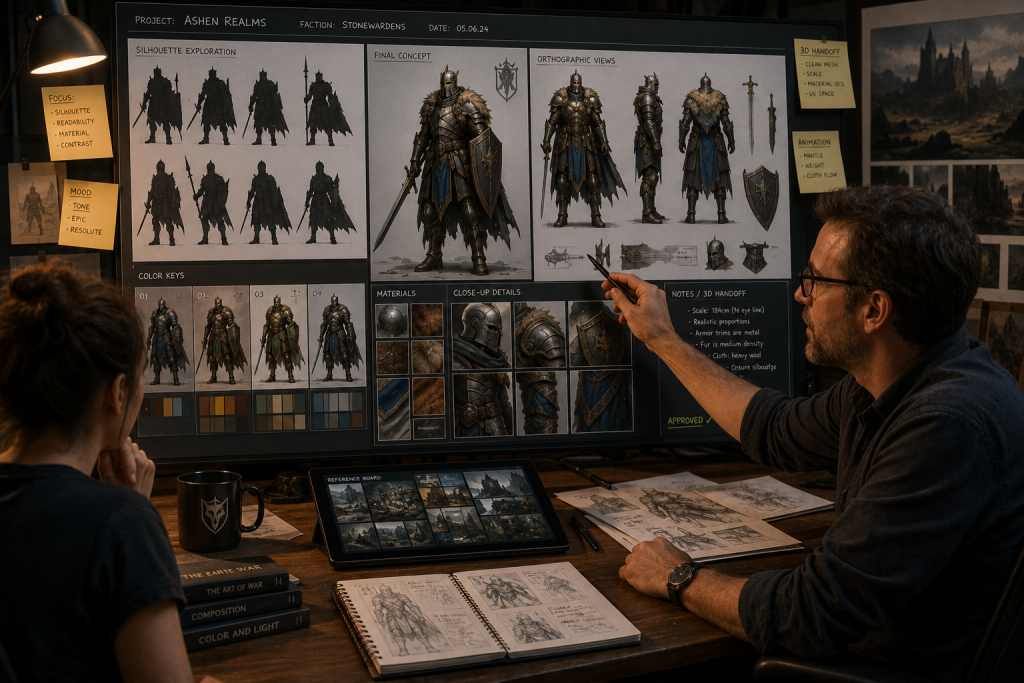
Production-ready concept art is not the same as polished concept art. A beautifully rendered character painting that omits the rear view, the color breakdown, and the proportional reference against the game’s existing characters is not production-ready—it is a visual impression. The distinction matters because downstream artists can’t model from impressions.
“Editorial illustration created for visual reference purposes. It does not represent a real project, client work, or official software screenshot unless stated otherwise.”

The following matrix defines production-readiness criteria across the six concept art types and identifies the red flags that indicate a concept package is not ready for handoff.
| Concept Type | Minimum Deliverables | Common Red Flag |
| Character | Turnaround (front/side/back), color key, scale comparison vs. existing cast, expression sheet (if animated) | Single hero-pose painting with no orthographic views; no scale reference |
| Environment | Establishing shot, lighting direction callout, material distribution map, zone-specific grammar vs. adjacent zones | Mood painting without technical callouts; no material hierarchy |
| Prop | Three-quarter view, functional callouts (moving parts, interaction points), scale reference against character | Hero render only; no scale reference; no callout for interactive elements |
| Vehicle | Exterior turnaround, cockpit/operator-facing view (if playable), functional plausibility notes | Dramatic angle render only; no top-down or rear view; no scale reference |
| Creature | Anatomy study, locomotion notes, attack state visual, scale vs. protagonist | Static pose only; no movement or behavioral reference |
| UI | Icon family with size variants, HUD layout at target resolution, typography system, dark/light mode variants | Single-resolution mockup; no icon grid; no established type system |
The art director review pass for concept art should include four checks that are separate from aesthetic evaluation:
Silhouette readability test. The concept is printed in grayscale and viewed at the scale it will appear in-game at maximum render distance. If the shape is ambiguous or indistinguishable from adjacent characters or objects, the design has failed its primary communication function—regardless of how well it is painted.
Downstream completeness check. The concept package is assessed for whether a 3D artist can begin modeling without making design decisions. Every question that would require a revision request back to the concept team is a gap in the package.
Style consistency audit. The concept is compared against approved reference from the same project to verify that shape language, color hierarchy, and material vocabulary are consistent. Style drift starts at the concept stage and compounds through production.
Technical constraint verification. The concept is checked against the technical art team’s specifications: polycount budget tier, rigging requirements for animated characters, LOD implications of surface detail complexity. Concepts that are technically unachievable at the target platform’s performance budget are not production-ready regardless of their visual quality.
“Editorial illustration created for visual reference purposes. It does not represent a real project, client work, or official software screenshot unless stated otherwise.”
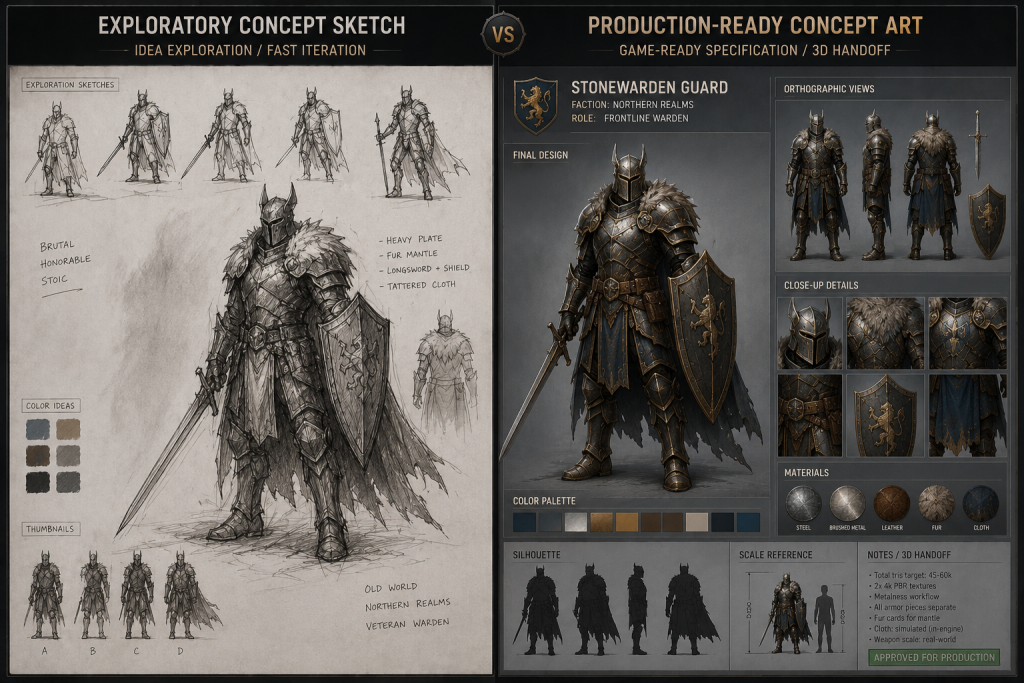
Concept Art vs. Production Art: A Distinction That Saves Budget
The terms “concept art” and “production art” are used interchangeably in many briefs and vendor conversations. This imprecision is a budget risk.
Concept art is exploratory and iterative. Its purpose is to answer design questions, test visual directions, and produce the reference that downstream production will execute against. It is produced in relatively high volume at relatively low cost per piece because most of it will not survive to the final game—that is, by definition, how exploration works.
Production art is execution against approved design. It is the high-resolution final asset: the textured, lit, rigged character that ships in the build; the fully modeled environment that the player walks through; the rendered cinematic frame. It is produced in relatively lower volume at substantially higher cost per piece, because every iteration is expensive.
Confusing the two creates two distinct failure modes. The first is commissioning production-quality work at concept stage: spending production asset budget on concept paintings that are rendered to a higher finish than the production will ever require, while the underlying design questions remain unanswered. The second is expecting concept art to serve as production art: taking an exploratory sketch and handing it to a modeling team as a complete specification, then spending production budget on the interpretation and revision cycles that result.
The distinction also clarifies what outsourcing concept art actually means. When a studio engages a partner offering game concept art services for concept work, the deliverable is a design specification package—not a collection of portfolio-quality illustrations. The quality metric is production utility, not visual finish. A concept package that allows the modeling team to execute without design questions is a high-quality concept package. A beautiful painting that requires three revision cycles before modeling can begin is a low-quality concept package, regardless of its painterly merit.
As concept artists working on AAA projects have described in practitioner interviews on 80.lv, the concept art creation process shifts significantly between production phases: early on, it is about finding the visual language of the world; later, it becomes explicitly problem-oriented—answering specific questions the production team needs resolved. Both phases are concept art, but they serve different functions and require different outputs.
From Brief to Handoff: What a Concept Art Outsource Brief Must Contain
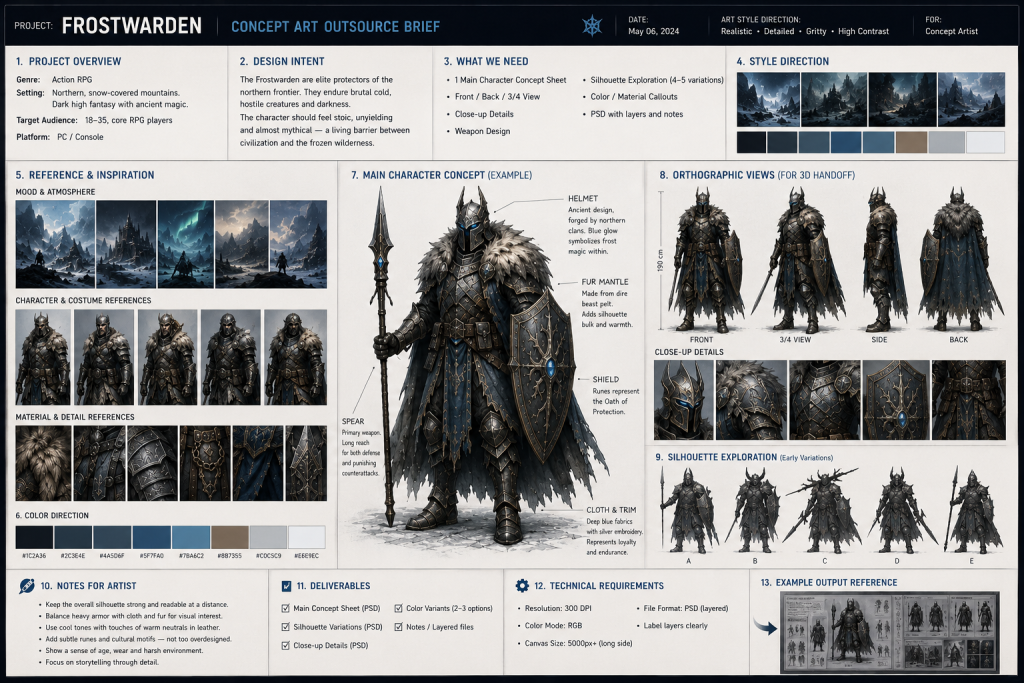
The failure mode most common in outsourced concept art is not low-quality execution—it is under-specified briefs. A studio that sends a vendor “please design a medieval knight character” and receives a drawing it did not want has produced that outcome itself. The vendor executed what was asked. The ask was wrong.
A production-grade concept art brief for an outsource partner contains six categories of information:
“Editorial illustration created for visual reference purposes. It does not represent a real project, client work, or official software screenshot unless stated otherwise.”
Narrative and role context. Who is this character, what is their function in the game’s world, and what should the player understand about them from appearance alone? This is not a design constraint—it is the foundation from which every design constraint derives. A villain whose authority should be legible from distance requires different design choices than a villain whose threat should only become apparent up close.
Visual language specification. What shape grammar governs this faction, region, or character tier? What color hierarchy does this project use—and where does this asset sit within it? If the project has an existing art bible, which sections of it apply directly? This prevents the concept artist from making visual language decisions that conflict with work already approved on the project.
Technical constraints. What is the polycount budget tier for this asset? Are there rigging requirements that affect silhouette design? What are the LOD implications of surface detail density? What is the target render distance at which this asset will primarily be seen in-game? These constraints should arrive from the technical art team and be embedded in the brief before it reaches the concept artist.
Reference package. Mood references, style references, material references, and negative references (visual directions explicitly to avoid) should be provided alongside written descriptions. A concept artist working from written description alone is doing interpretive work that belongs to the art director. The brief should narrow the interpretive space to the degree that the concept artist’s creative work is focused on solving the specified design problem, not inferring what problem they are supposed to be solving.
Deliverable specification. What exactly is expected at the end of the concept phase? A turnaround sheet and color key for a character? An establishing shot and material callout map for an environment? The exact format, file specifications, and handoff requirements should be in the brief, not discovered at delivery.
Revision protocol. How many rounds of revision are included, what constitutes a revision vs. a scope change, and who is the approving authority? Concept art without a defined revision protocol generates unlimited iterations—the second most common reason outsourced concept projects overrun.
When these six categories are present in a brief, concept art outsourcing becomes a reliable production mechanism. When any one is absent, the concept phase becomes an extended negotiation between the studio’s unexpressed vision and the vendor’s reasonable interpretation of an incomplete specification.
At Nasty Rodent, our concept art work begins with a brief audit—not with execution. Before a single sketch is produced, we map the brief against these six categories and identify what is missing. When the brief is complete, concept production is fast, directed, and produces packages that 3D teams can execute against without ambiguity. When it is incomplete, we flag the gaps before work begins rather than discover them in review. That distinction is the difference between a concept phase that closes on schedule and one that extends indefinitely.
Our Approach to Concept Art at Nasty Rodent
The work described in this article—brief auditing, production-ready packages, technically constrained design—is the standard we apply to every concept art project. Whether the scope is a single character pass or a full visual development package for a new IP, our process starts with the brief, not with the canvas.
If you are building or evaluating a concept art pipeline and want to understand what production-ready deliverables look like in practice, our portfolio shows the full range—from character turnarounds for mid-core titles to environment and creature packages for AAA productions. For deeper reading on related topics across 3D production, art direction, and game art outsourcing, our game art blog covers the full production stack.
For studios ready to scope a concept art engagement, reach out for a production fit call. We’ll review your brief, identify the gaps, and outline what a complete concept package for your project requires. No commitment needed to have that conversation.