UE5 MetaHuman: Photoreal Characters Without the Pipeline – and What That Actually Means
-

Written byDenys Zadoienyi
-

Updated on24.06.2026
-

Time to read15 min

- What MetaHuman actually is – and what it gives you from day one
- MetaHuman Creator: what you control, what you don’t
- Beyond the Creator: Mesh to MetaHuman and the custom sculpt workflow
- MetaHuman Animator and the performance capture pipeline
- The performance cost: LOD, grooms, and what happens at scale
- Technical matrix: MetaHuman vs custom character pipeline
- When MetaHuman is the right call – and when it isn’t
- About Nasty Rodent
MetaHuman is one of the few tools in the game development ecosystem that genuinely delivers on its headline promise: photoreal, fully rigged digital humans available inside Unreal Engine 5 without building a traditional character pipeline from scratch. A character that would have required weeks of modeling, rigging, texturing, and lookdev can be assembled in hours. That is real, and it matters.
What MetaHuman does not do is replace art direction. The rig is provided. The fidelity level is set. The integration with Lumen and Nanite is handled. The creative decisions that make a character belong to a specific game – the visual target, the stylization level, the narrative expression in a face – remain the art director’s responsibility regardless of what pipeline produced the mesh.
This guide covers how UE5 MetaHuman actually works in production: what the framework gives you, where Creator’s customization ceiling sits, what the Mesh to MetaHuman workflow enables beyond that ceiling, and what art directors need to know about runtime performance before committing MetaHuman characters to a mid-core or AAA title.
What MetaHuman actually is – and what it gives you from day one
MetaHuman is a complete character framework built into Unreal Engine 5. The core of it is a rigged, textured, LOD-managed digital human assembled from a library of photogrammetry scans, ready to be exported into a UE5 project and animated. As of UE5.6, MetaHuman Creator is fully integrated into the engine rather than running as a separate web application, which means the entire creation and editing workflow lives inside UE5 without a browser dependency.
What the framework delivers at the point of assembly is substantial. Every MetaHuman character comes with a skeletal mesh for the head and body, a facial rig driven by a DNA file containing hundreds of control curves and blend shapes for expression, a groom system for strand-based hair, an LOD sync component that manages level-of-detail transitions across the character’s components simultaneously, and a Blueprint that handles runtime animation retargeting and IK setup. The facial rig specifically – built on the same technology Epic uses for its own cinematic productions – would represent months of rigging work if built from scratch on a custom character.
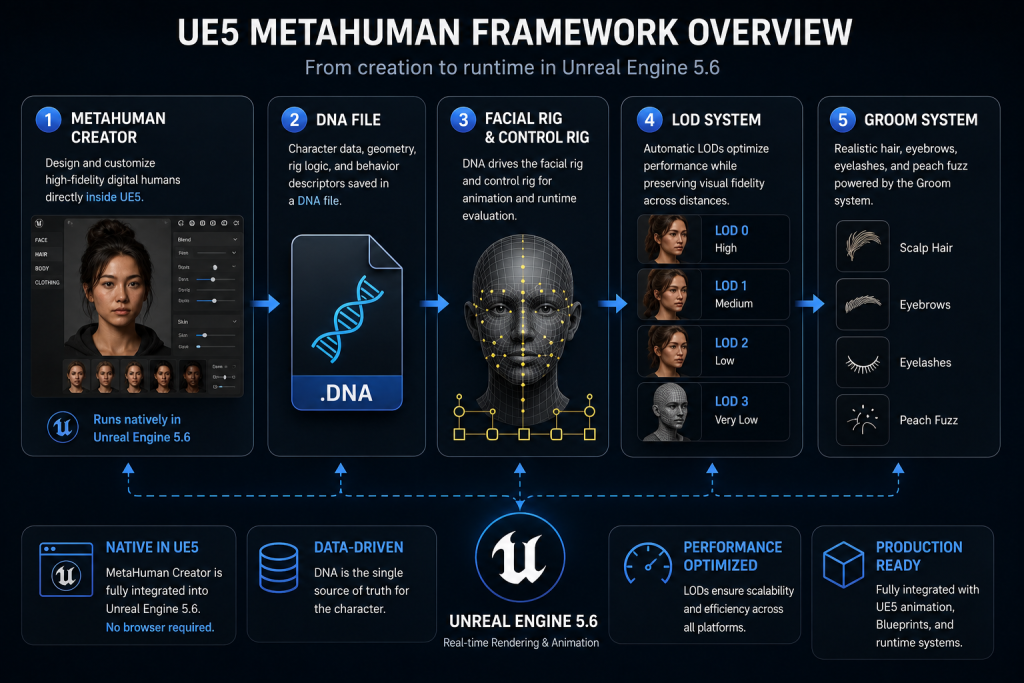
“Editorial illustration created for visual reference purposes. It does not represent a real project, client work, or official software screenshot unless stated otherwise.”
The integration with Unreal Engine 5’s rendering features is native and tested. MetaHuman characters respond correctly to Lumen’s global illumination and reflections, which means the lookdev you evaluate in the editor under dynamic lighting is representative of how the character will look in the final game – without the manual lightmap baking cycles that pre-UE5 character pipelines required. Ongoing improvements to Nanite support for animated skeletal meshes continue to reduce the cost of detailed character geometry in UE5 productions, though production readiness varies by version and project configuration.
The practical implication for a studio entering a new project: the barrier to having a high-fidelity, animation-ready human character in a working UE5 scene is measured in hours, not weeks. That is the correct framing for what MetaHuman provides – not a replacement for character artistry, but the elimination of the technical infrastructure that character artistry traditionally had to build first.
MetaHuman Creator: what you control, what you don’t
MetaHuman Creator works by blending between photogrammetry scan data. The system provides sliders, blend controls, and preset selection for facial structure, body proportions, skin appearance, eye color, hair grooms, and clothing – all within a physically plausible human range. The results are consistently photorealistic because the underlying data is photographic.
What that means in practice is that Creator’s customization space is bounded by physical plausibility. You can produce any face that could plausibly exist on a real human. You cannot produce a face with enlarged eyes, exaggerated cheekbones beyond realistic proportions, an elongated jaw, or any other departure from photographic human anatomy. The tool’s constraint is also its strength: the reason every MetaHuman character looks photorealistic is that it is built from real scan data, and deviating from that data breaks the photoreal result.
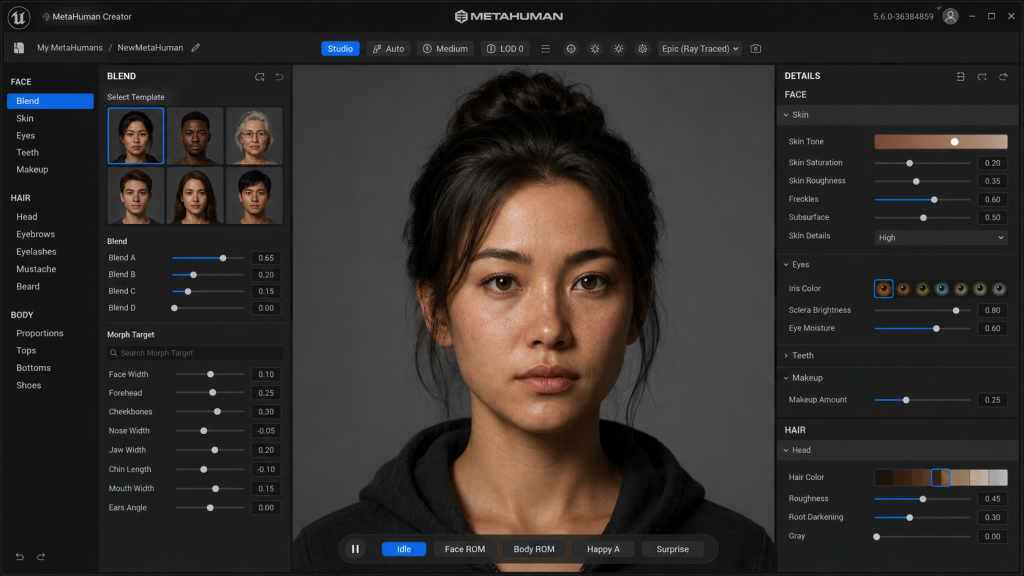
“Editorial illustration created for visual reference purposes. It does not represent a real project, client work, or official software screenshot unless stated otherwise.”
For an art director working on a photoreal or near-photoreal title, this is not a limitation – it is the deliverable. The character looks correct under every lighting condition, in every camera angle, with expression fidelity that a custom pipeline would take significant additional time to match. The visual target aligns with what Creator produces.
For an art director working on a stylized title, Creator’s photorealism boundary becomes a problem that requires a different approach. Sandfall Interactive, the team behind Clair Obscur: Expedition 33, found this directly during production. After switching their entire character pipeline to MetaHuman during the UE4-to-UE5 transition, they needed characters that matched their stylized visual target rather than photographic plausibility. As the studio’s co-founder and lead programmer Tom Guillermin noted publicly, the team had to “find some hacks to resculpt the characters and preserve the rigs on the faces” – a production challenge that led them to develop custom external sculpt workflows before Mesh to MetaHuman formalized that path. The MetaHuman pipeline worked, but it required significant art direction investment beyond what Creator alone provides.
The practical takeaway for an art director: MetaHuman Creator is the right starting point when your visual target is photoreal or stylized-realistic. It is an incomplete solution when your visual target requires non-photographic proportions, exaggerated expressions, or any departure from human anatomy – and the gap between Creator’s output and your visual target is exactly where external customization work begins.
Did you know that…?
MetaHuman’s DNA file – the core data structure that drives the facial rig – contains thousands of parameters governing facial deformation and animation behavior. The same DNA architecture is used across Epic’s internal cinematic productions, the MetaHuman Animator performance capture pipeline, and every game title built on the framework. When Sandfall Interactive’s Clair Obscur: Expedition 33 shipped in April 2025, its entire character pipeline ran on MetaHuman DNA rigs – meaning the expressive faces players praised were driven by the same underlying system that Epic uses for its own high-end productions, deployed by a team of approximately thirty developers.
Beyond the Creator: Mesh to MetaHuman and the custom sculpt workflow
Mesh to MetaHuman is the production path that addresses Creator’s stylization ceiling. It allows a custom 3D mesh – sculpted in ZBrush, derived from a photogrammetry scan, or built in any external modeling tool – to be converted into a MetaHuman character with a fully functional facial rig. The resulting character retains MetaHuman’s animation infrastructure while using geometry that was created outside Creator’s plausibility constraints.
The workflow proceeds in several stages. A custom head mesh is prepared – cleaned of non-facial geometry, optimized to a manageable density (excessively dense photogrammetry scans should be decimated before submission, as high-frequency scan noise can degrade the Identity Solve quality), aligned to a neutral forward-facing pose. It is submitted through the Mesh to MetaHuman plugin in UE5, which performs an identity solve: the system wraps the MetaHuman template topology to the custom mesh and derives a DNA file that describes how the custom face moves under expression controls. The resulting character is assembled in Creator or UE5 directly.
The critical technical constraint in this workflow is topological. Mesh to MetaHuman wraps its template topology over the custom mesh rather than accepting arbitrary topology as input. Extreme deviations from human head proportions – very large or small eyes, significantly elongated skulls, non-human facial structure – will produce deformation artifacts at expression extremes because the rig’s corrective blend shapes were calibrated for human range. Moderate stylization works reliably; strong stylization requires additional corrective work in Maya using the DNACalib library.
The Mafia: The Old Country production, documented in Hangar 13 and 2K’s presentation at Unreal Fest Stockholm 2025, represents the most rigorous AAA case study of this pipeline currently public. The documented workflow ran: facial scan or sculpt → Mesh to MetaHuman identity solve → Creator tweak → DNA Calibration export → Substance Designer texture integration. This is the production-standard path for studios that need MetaHuman’s animation infrastructure at AAA fidelity while maintaining full artistic control over character appearance. For art teams building familiarity with how AAA studios approach the texturing and lookdev stage of custom MetaHuman characters, 80.lv regularly publishes detailed production breakdowns from working character artists at this level.
For studios working with the character concept art services stage of a production, the implication is direct: concept art for MetaHuman-based characters should account for the topology constraints of the DNA solve from the beginning. Proportions that deviate significantly from human anatomy need to be flagged at concept, not discovered at the Mesh to MetaHuman stage.
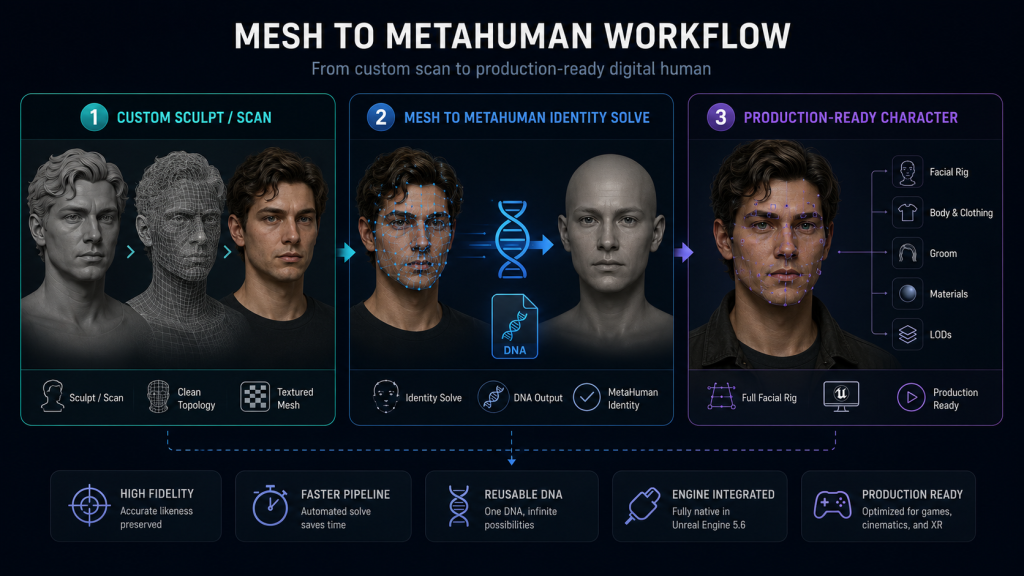
“Editorial illustration created for visual reference purposes. It does not represent a real project, client work, or official software screenshot unless stated otherwise.”
MetaHuman Animator and the performance capture pipeline
MetaHuman Animator is Epic’s offline facial performance capture system. It takes video footage of a human performer – shot on an iPhone, on a mono camera, or on stereo HMCs – and processes it into a facial animation sequence on a MetaHuman rig. The solve runs in UE5 rather than in an external tracking tool, which means the animation output is native to the project and requires no translation step.
The practical difference between MetaHuman Animator and a live capture setup with Live Link Face is fidelity versus speed. Live Link Face using iPhone ARKit provides real-time preview and rapid iteration – useful for blocking animation, previsualization, or production environments where the team needs immediate feedback. MetaHuman Animator provides a higher-fidelity offline solve, processing recorded footage to extract a more detailed expression result than ARKit’s real-time blend shape estimation. For hero shots and narrative cinematics, Animator is the standard; for NPC ambient animation and secondary character work, Live Link Face is often sufficient.

As Epic’s MetaHuman documentation notes, the framework is designed as a complete system: Creator for character assembly, the DNA file for rig definition, Animator for performance capture, and the LOD sync for runtime management. Understanding which component handles which stage of the pipeline prevents the common confusion between what requires artistic intervention and what the framework handles automatically.
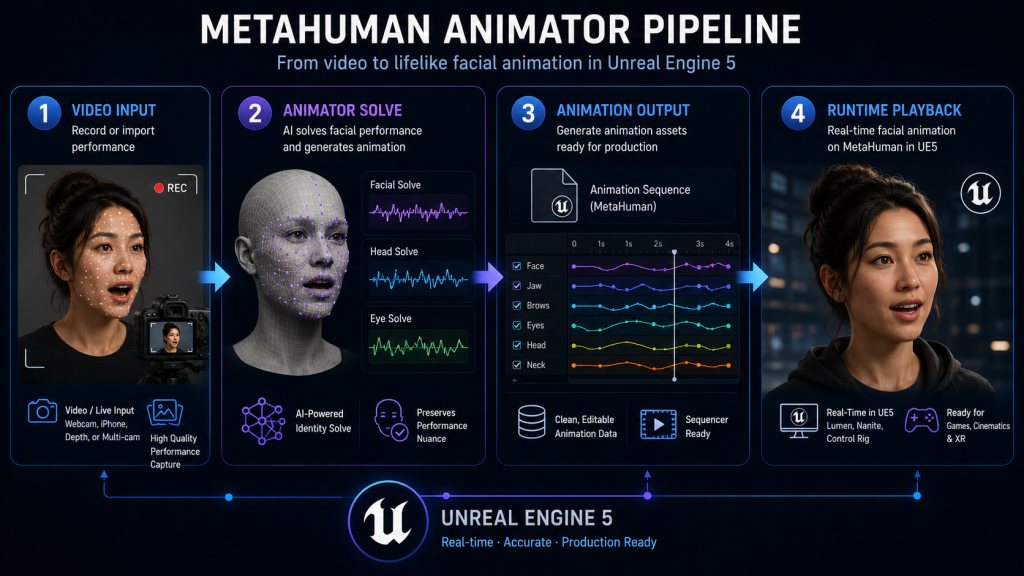
“Editorial illustration created for visual reference purposes. It does not represent a real project, client work, or official software screenshot unless stated otherwise.”
The implications for an art director reviewing animation: MetaHuman Animator’s output quality depends on the quality of the footage input and the quality of the underlying DNA. A character whose face was sculpted far outside human proportions will show rig deformation artifacts under strong expression, regardless of how clean the Animator solve is. The connection between concept art decisions, mesh preparation, and animation fidelity runs through every stage of the pipeline.
The performance cost: LOD, grooms, and what happens at scale
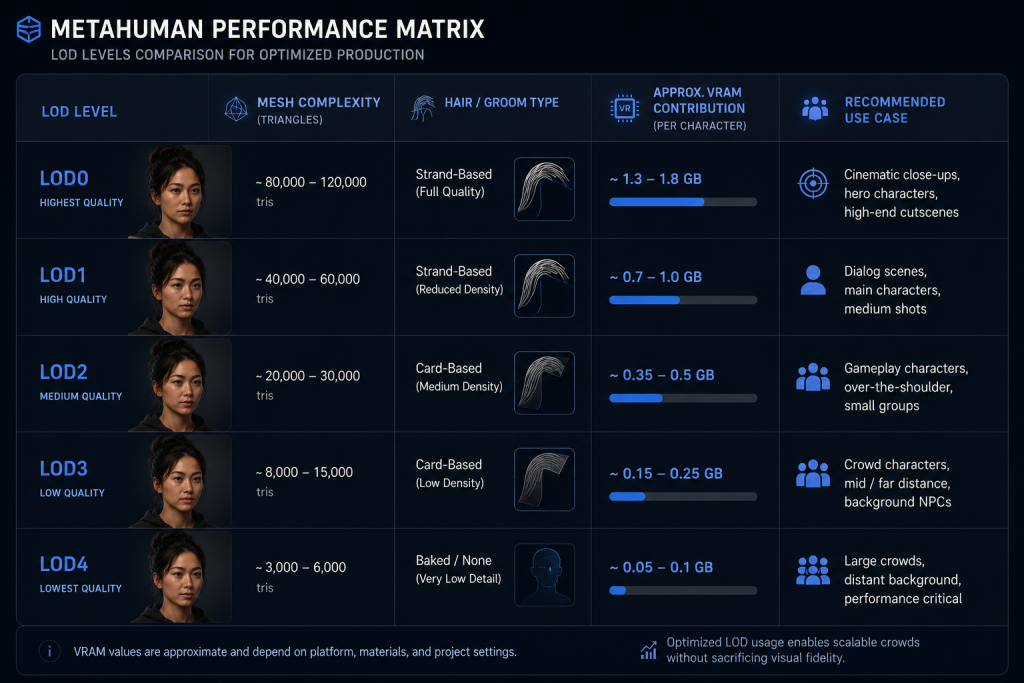
MetaHuman’s default LOD0 – the highest fidelity level – is not designed for multiple simultaneous on-screen characters. This is the performance reality that production teams encounter when they move from a single hero character in a scene to crowds, multiplayer characters, or any scenario requiring more than a handful of MetaHumans visible simultaneously.
The groom system is the most significant performance factor. Strand-based hair in MetaHuman uses Groom components that, as of UE5.7, maintain their LOD data fully resident in VRAM rather than streaming or evicting it. Community benchmarks have demonstrated substantial VRAM overhead from MetaHuman groom systems in large-scale scenes – a constraint that becomes significant well before most production VRAM budgets are otherwise under pressure. An Epic engineer confirmed the underlying issue directly: “There is no existing code dedicated for crowd usage. We are working on this at this stage.” UE5.8’s experimental MetaHuman Crowd plugin, scheduled for June 2026, addresses this with a modular assembly pipeline and automatic transition between high-fidelity individual actors and instanced skeletal meshes at distance.
For the body corrective bones that drive secondary facial and neck deformation, the optimization path is well-established: disabling Body Correctives and Neck Correctives delivers measurable FPS recovery in MetaHuman-heavy scenes. The Skeletal Mesh Merge plugin provides significant improvement in game-thread cost for multi-character scenes.
Understanding the LOD cascade matters for art directors scoping hero versus background character budgets. LOD0 is appropriate for close-camera hero characters with dialogue and expressions. LOD2 and LOD3 progressively reduce mesh complexity and switch from strand hair to card-based hair. LOD4 and below collapse the character to a significantly simplified representation suitable for crowd use. The character asset optimization workflow decisions made at the geometry preparation stage – how the high-poly head sculpt is baked down, how UVs are laid out for the MetaHuman texture system – directly affect how cleanly the LOD transitions read at each distance.
“Editorial illustration created for visual reference purposes. It does not represent a real project, client work, or official software screenshot unless stated otherwise.”
Technical matrix: MetaHuman vs custom character pipeline
| Dimension | MetaHuman Framework | Custom Character Pipeline |
| Setup time to animation-ready character | Hours (Creator) to days (Mesh-to-MetaHuman) | Weeks to months depending on fidelity target |
| Facial rig quality | Production-grade; DNA-based; expression-ready | Depends entirely on rigging investment |
| Stylization range | Photoreal to stylized-realistic; bounded by human anatomy | Unlimited |
| Visual target control | High within the photorealistic range; limited for non-human proportions | Complete |
| Animation infrastructure | Provided: Control Rig, blend shapes, ARKit/Animator compatibility | Must be built or licensed |
| LOD management | Provided: LOD Sync component, automatic cascade | Must be authored per asset |
| Groom (hair) system | Provided: strand-based groom with LOD | Must be built; varies by tool |
| Engine exclusivity | UE5 only (license prohibits interactive use in Unity or other engines) | Engine-agnostic |
| Customization depth | Creator to Mesh-to-MetaHuman to ZBrush + DNA Calibration (progressive complexity) | Unlimited from day one |
| Crowd performance at LOD0 | Poor; not designed for multi-character simultaneous use | Optimizable per project requirements |
| Performance capture compatibility | Native: MetaHuman Animator + Live Link Face | Requires custom retargeting setup |
| Art direction investment | Lower for photoreal targets; higher for stylized targets | Consistent regardless of target |
When MetaHuman is the right call – and when it isn’t
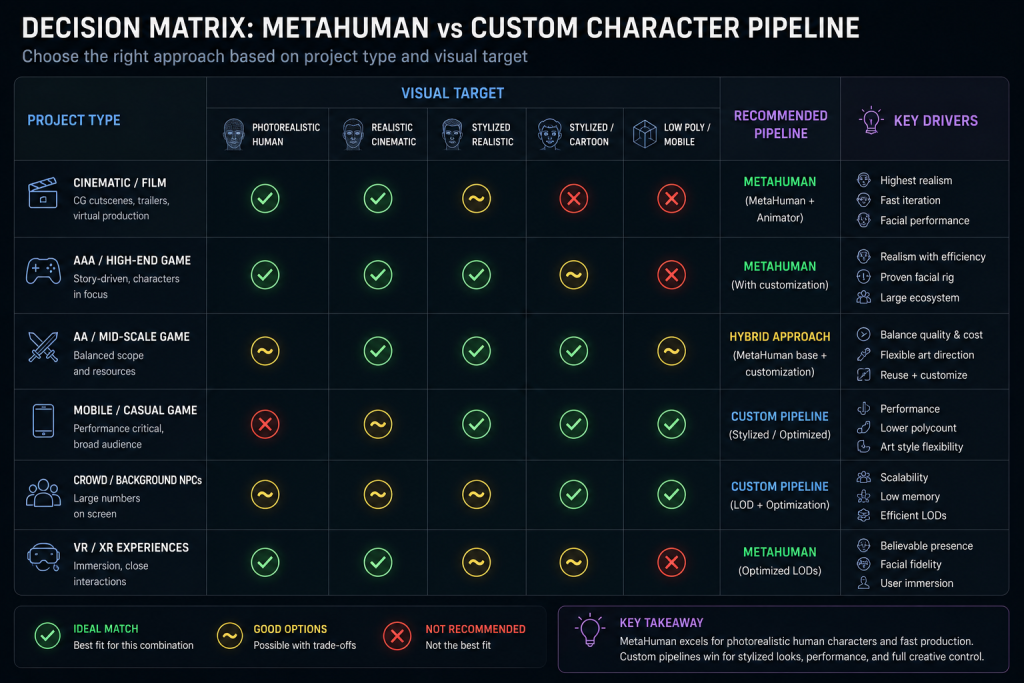
MetaHuman is the correct choice when:
The visual target is photoreal or stylized-realistic, and the team does not have an existing character pipeline. MetaHuman dramatically reduces the rigging and lookdev infrastructure cost that a custom character pipeline would otherwise require. A small to mid-size studio – Sandfall Interactive’s approximately thirty-person team is the canonical example – can achieve AAA-quality character fidelity without the rigging department that would otherwise require it. The trade-off is accepting MetaHuman’s anatomy constraints and building a customization workflow around them.
The production uses performance capture. MetaHuman Animator is the most accessible facial performance capture pipeline available in game production. If the game requires dialogue-driven cinematics with believable facial performance and the team does not have an established mocap pipeline, MetaHuman provides the infrastructure from day one.
The project requires rapid prototyping of human characters. Even for projects that will eventually use a custom pipeline, MetaHuman Creator allows a visual direction to be established quickly. An art director can generate multiple character directions in a day, evaluate them in the target engine under Lumen lighting, and make informed decisions before committing to full custom production.
The title is shipping on UE5 and character needs are primarily heroic, close-camera, narrative-driven. For games where human characters are central but appear primarily in conversation scenes, cinematics, or close-camera gameplay, MetaHuman’s LOD0 fidelity is the correct asset tier, and the crowd performance constraints are not relevant to the production.
MetaHuman is the wrong choice – or requires significant supplementary work – when:
The visual target requires non-photographic proportions. Large eyes, exaggerated anatomy, any stylization that moves beyond what a real human face can display will require external sculpt workflows and DNA Calibration. This is achievable but represents a meaningful additional investment that should be scoped into the production schedule.
The title requires large simultaneous crowds of human characters. Until MetaHuman’s crowd tooling matures beyond its current experimental state, productions requiring dozens of simultaneous high-fidelity human characters in a scene face real performance constraints. The optimization paths exist but require technical art investment that a simpler character pipeline might not need.
The production targets multiple engines or requires engine portability. MetaHuman’s EULA prohibits use of MetaHuman assets in interactive applications outside UE5. A studio that builds its character pipeline on MetaHuman and later needs to port to another engine will need to rebuild characters from scratch.
Art direction continuity requires complete ownership of the character topology. Custom pipelines built around studio-specific basemeshes and proprietary rigging solutions provide complete control over every technical decision. When long-term IP ownership and technical independence are strategic priorities, that degree of control has value that MetaHuman’s convenience does not replace.
“Editorial illustration created for visual reference purposes. It does not represent a real project, client work, or official software screenshot unless stated otherwise.”
For studios working with external art partners on game-ready environment production alongside their character work, the MetaHuman vs custom pipeline decision has a direct implication for the art bible: MetaHuman-based character pipelines require that the environment art’s lookdev be calibrated against MetaHuman’s specific material response under Lumen, rather than a generic PBR target. That calibration needs to be documented in the style guide before environment production begins.
About Nasty Rodent
MetaHuman has dramatically reduced the technical barriers to creating photoreal digital humans, but production-ready characters still require artistic direction, customization, and integration into the broader game pipeline. At Nasty Rodent, we help studios move beyond templates by creating character art that aligns with gameplay, narrative, and visual identity requirements. Whether a project uses MetaHuman, a traditional character pipeline, or a hybrid approach, the goal remains the same: characters that support the experience rather than simply populate the world.
Our clients include Offworld Industries, The Bearded Ladies Consulting, Reburn, Whimsy Games, Galaxy 4 Games, and Benner Games. If you are evaluating MetaHuman for an upcoming production or need character art that works across MetaHuman and custom pipeline workflows, get in touch.