Hard Surface vs Organic Modeling: Pipeline Differences That Matter in Production
-

Written byDenys Zadoienyi
-

Updated on26.06.2026
-

Time to read9 min

- Why the Textbook Definition Fails in Production Review
- Where the Two Pipelines Actually Diverge: Blockout to Bake
- Topology Rules: Deformation Discipline vs Shading Discipline
- The Stage-by-Stage Production Matrix
- Hybrid Assets: Where One Model Demands Both Skill Sets
- What the Split Means for Team Planning and Review Cycles
- Hard Surface vs Organic at a Glance
- How to Choose the Right Approach for Your Asset
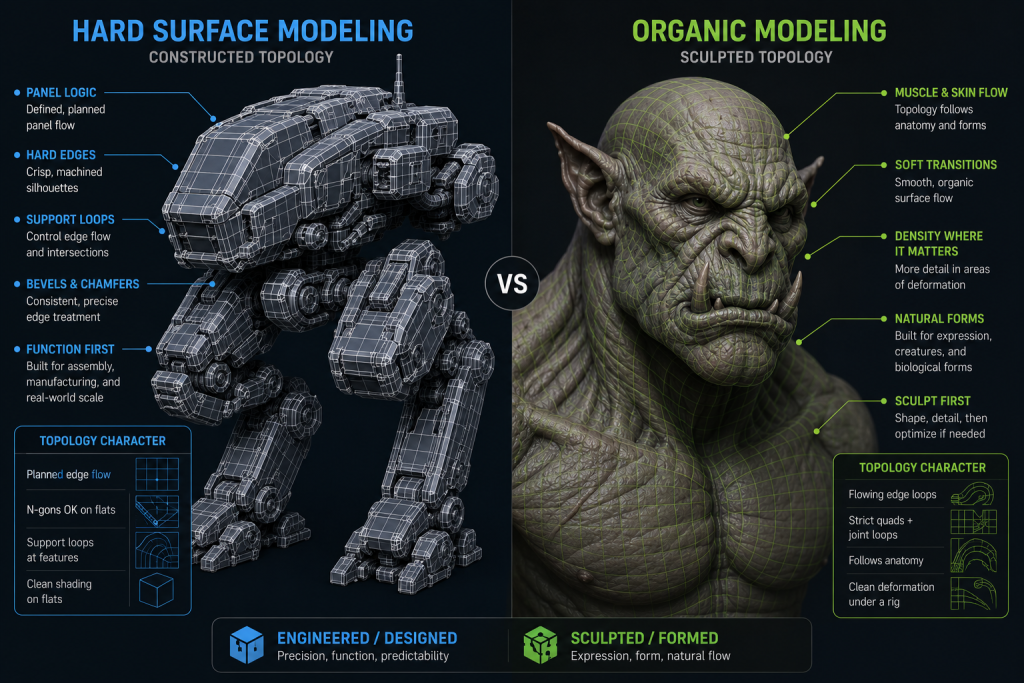
Hard surface vs organic modeling looks like a beginner’s classification question, yet it decides how your production schedule behaves three milestones from now. The split determines which artists you book, how many polish passes a hero asset survives, and why a creature and a rifle with identical polycounts have entirely different review histories. If you’re an art director planning asset batches for a mid-core or AAA project, the definitions matter far less than the pipeline consequences – exactly what most guides skip.
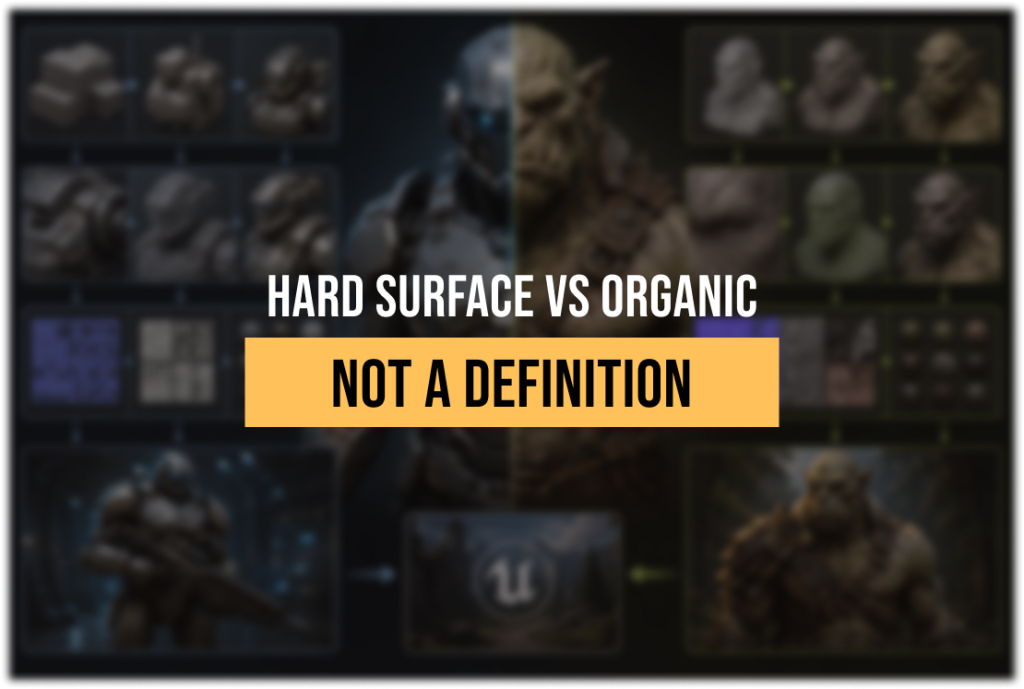
“Editorial illustration created for visual reference purposes. It does not represent a real project, client work, or official software screenshot unless stated otherwise.”
Definition. Hard surface modeling builds rigid, non-deforming objects – weapons, vehicles, machinery, architecture – through controlled polygonal geometry, bevels, and Booleans. Organic modeling builds forms that bend, stretch, or grow – characters, creatures, foliage – through digital sculpting followed by retopology. The practical first-pass dividing line in game production is deformation: anything a rig will bend is treated as organic.
Why the Textbook Definition Fails in Production Review
“Man-made versus living” collapses on the first real asset list. A canvas tent is man-made and deforms like skin; a rock is natural and behaves like a crate. The hard surface vs organic 3D modeling split that holds up in review is not about what the object is – it’s about what the engine and the rig will do to it.
We classify by three production questions: will the mesh deform under a skeleton or cloth sim, does the silhouette rely on machined precision or anatomical flow, and will surface detail come from modeled geometry or a sculpted high-poly. A tent scores organic on all three despite being stitched in a factory; a beetle’s chitin shell scores hard surface on two of three despite being alive.
Misclassify, and the cost shows up downstream. Assign a hard surface specialist to a cloth-heavy NPC and the topology fights the rig in week three: clean in a static viewport, pinching the moment an animator bends an elbow. In my experience reviewing outsourced batches, this misassignment drives most “the model won’t animate” escalations – and in the ticket it reads as a quality problem, which it isn’t.
Where the Two Pipelines Actually Diverge: Blockout to Bake
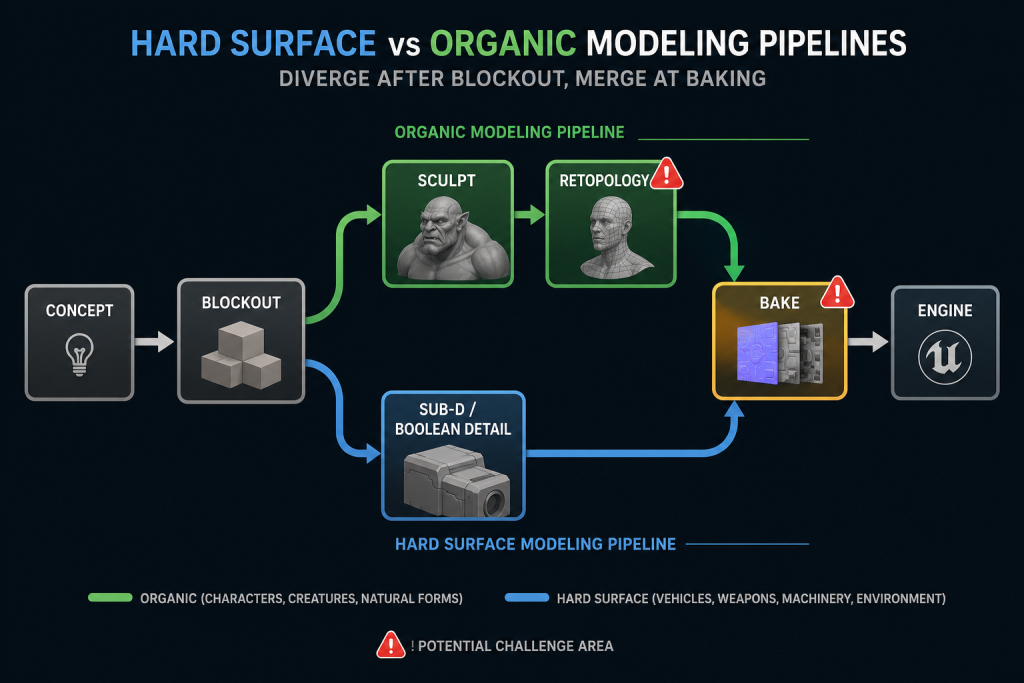
Both game asset modeling techniques start and end the same way; everything interesting happens in between. Blockout is shared territory – rough proportions, silhouette readability, scale against the level. After approval, the paths split.
An organic modeling game art pipeline runs sculpt-first: the blockout goes into ZBrush or Blender’s sculpt mode, gains millions of polygons of anatomy and skin detail, and only then gets a clean, animation-ready mesh rebuilt on top – a step covered in our guide to retopology in 3D modeling. Form comes first, structure second.
Hard surface modeling game art workflows invert that order. Structure comes first: controlled mid-poly or sub-d geometry with bevels, support loops, and Booleans, because machined shapes punish improvisation. Sculpting appears only for damage, welds, or cast metal. An organic artist thinks in muscle flow; a hard surface artist thinks in panel logic and edge width consistency.
The paths reconverge at the bake: high-poly detail is projected onto the low-poly game mesh as normal maps, and from there both asset types follow one road – UVs, texturing, LODs, engine integration.
The business impact. For an art director, the divergence is a planning constraint, not trivia. On our recent character and weapon batches, organic hero assets consumed 2 to 3 times more review cycles than hard surface props of comparable polycount, because sculpt quality and deformation each need their own approval gate. A rifle can go blockout-to-bake with one lookdev pass; a creature rarely survives fewer than three. Budgeting both classes with one timeline is how a milestone that looked safe on paper slips by two weeks: the schedule averaged two pipelines that don’t average. Treat them as separate capacity lines with separate review cadences, and the slip disappears.
Did you know that…?
The industry has never agreed on where the boundary sits. Polycount threads going back two decades defend at least three competing definitions – man-made vs living, deforming vs static, sculpted vs constructed. That disagreement isn’t sloppiness; it’s evidence the categories were always proxies for pipeline decisions – which is how production teams should read them.
Topology Rules: Deformation Discipline vs Shading Discipline
Topology is where the disciplines stop being variations of one craft. Organic topology serves deformation: quads dominate, edge loops follow muscle flow, and joints get concentric loop rings so elbows bend without collapsing – principles documented in the Polycount community’s topology reference, still our leads’ standard audit checklist for character meshes. Stray triangles across a shoulder are a deformation bug waiting for the rigger.
Hard surface topology serves shading. Since the mesh never bends, quad purity matters less – an n-gon on a flat panel is harmless. What’s unforgiving is edge flow around curvature: support loops too close produce razor-sharp highlights; too far, and the bevel reads mushy under engine lighting. Organic forms forgive small topology sins – the eye accepts irregularity in nature. A vehicle door forgives nothing – every shading artifact catches the light in lookdev.

“Good topology” therefore means opposite things in the two reviews. We’ve rejected organic meshes with immaculate quads because the loops ignored anatomy, and approved hard surface meshes full of n-gons because the shading was flawless on the target platform. The checklist follows the discipline, not a universal rule.
The Stage-by-Stage Production Matrix
Each stage, how the two disciplines handle it, and the red flag that predicts a failed review:
| Pipeline stage | Hard surface | Organic | Red flag in review |
| Blockout | Panel and silhouette logic, exact scale | Gesture, proportion, anatomy landmarks | Silhouette unreadable at gameplay camera distance |
| Detail pass | Sub-d/mid-poly, bevels, Booleans, kitbash | High-poly sculpt, alphas, skin/surface noise | Detail that won’t survive the bake resolution |
| Retopology | Often skipped or light cleanup | Mandatory full rebuild over the sculpt | Game mesh inherited from decimated sculpt |
| UV strategy | Straightened shells, hard edge splits | Continuous shells along anatomy, hidden seams | Seams crossing visible deformation zones |
| Baking | Cage control, skew correction on floaters | Projection distance tuning over curved forms | Wavy normals on machined edges; seams ghosting |
| Rig readiness | Pivot points, separated movable parts | Edge loops at every joint, deformation test | No test pose before delivery |
| LOD chain | Aggressive reduction, silhouette preserved | Conservative joints, careful loop removal | LOD1 already breaking the bend at the knee |
Baking earns the extra sentence: both asset types fail there for opposite reasons – hard surface bakes fight projection skew on angled surfaces, organic bakes fight ray misses across deep curvature. Marmoset’s Toolbag baking guide documents the mechanics – the projection traces the high-poly from a cage, which is why cage setup discipline differs per asset class.
“Editorial illustration created for visual reference purposes. It does not represent a real project, client work, or official software screenshot unless stated otherwise.”
Hybrid Assets: Where One Model Demands Both Skill Sets
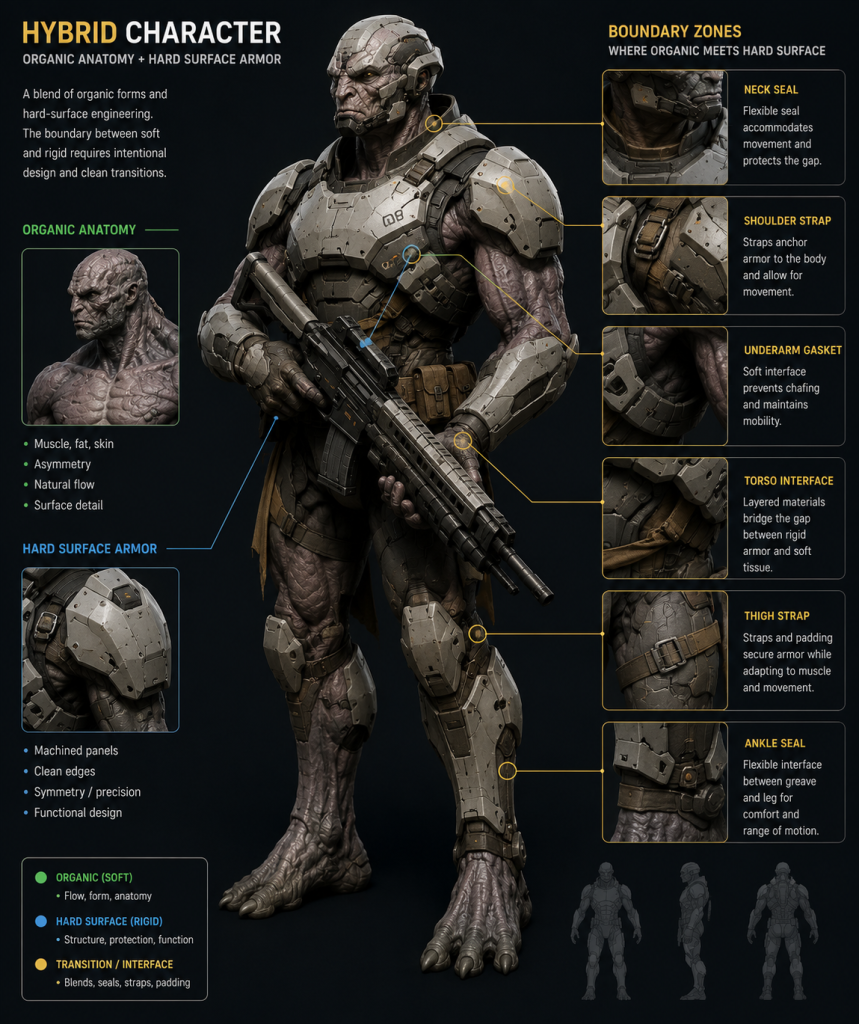
The cleanest test of the classification is the asset that refuses it. A soldier in exoskeleton plating, a creature with grafted machinery, a knight in articulated armor – hybrid character modeling is the production norm in mid-core and AAA work. The anatomy underneath deforms; the plating on top must read as machined metal while riding on a deforming body.
“Editorial illustration created for visual reference purposes. It does not represent a real project, client work, or official software screenshot unless stated otherwise.”
The workflow splits inside a single asset: we sculpt the body organic-first, retopologize for the rig, then build armor as separate hard surface elements attached to bones or driven by the body mesh. The hard part is the boundary – straps, seals, and contact lines where soft meets rigid. Get the attachment wrong and the armor intersects the chest on the first run animation; get the shading wrong and the plate reads as painted skin. Our 3D character production workflow treats those boundary zones as a separate review item because neither a pure sculptor nor a pure hard surface artist owns them by default.
Weapons attached to characters carry the same logic in miniature: a rifle is pure hard surface in isolation, but its sling and first-person constraints pull it halfway into the other camp – one reason a dedicated hard surface weapons pipeline keeps its own spec for movable parts and pivot hierarchies rather than a generic prop checklist.
What the Split Means for Team Planning and Review Cycles
Specialization is real, and pretending otherwise costs money. An artist who ships beautiful sci-fi crates is not two weeks from a believable face; anatomy is a years-long discipline, and so is panel design. Most senior modelers we’ve hired lean clearly one way.
Three planning consequences follow. Staff asset batches by class, not headcount: five generalists do not equal three organic plus two hard surface specialists when the list is forty creatures and sixty props. Give each class its own review cadence – organic assets need a sculpt gate and a deformation gate that props don’t have. And write the art bible sections separately: silhouette readability and PBR consistency mean different checks per class, and a shared one-page standard is how style drift sneaks in asset by asset.
Our approach
Most pipeline failures above share one root: the two disciplines were planned as one. At Nasty Rodent we run them as parallel tracks under a shared lookdev standard – each class reviewed by its own lead, hybrid boundary zones checked separately, assets delivered rig-tested rather than viewport-pretty. Result: fewer surprise revisions after the first animation pass.
Hard Surface vs Organic at a Glance
| Criterion | Hard surface | Organic |
| Typical assets | Weapons, vehicles, props, architecture | Characters, creatures, foliage |
| Core method | Controlled poly modeling, sub-d, Booleans | Digital sculpting, then retopology |
| Topology priority | Clean shading on rigid surfaces | Clean deformation under a rig |
| Quad strictness | Relaxed; n-gons acceptable on flats | Strict; quads and joint loops required |
| Detail source | Modeled geometry, bevels, kitbash | Sculpted high-poly, alphas |
| Hardest stage | Bake skew on machined edges | Retopology and deformation testing |
How to Choose the Right Approach for Your Asset
Run the deformation test first: if a rig or cloth sim will bend the mesh, plan it as organic regardless of what the object is made of. Then check the silhouette source – machined precision points to hard surface workflows even on natural objects. Plan hybrids as two tracks inside one asset, with boundary zones named in the brief.
And if your asset list mixes forty creatures with sixty rifles and one team, the honest next step is a capacity conversation, not a longer crunch. Send us your asset list – we’ll return a class-by-class estimate with review gates mapped, so the schedule reflects two pipelines, not an average that fits neither.