Unity vs Unreal Engine 5: Choosing for AAA Production
-

Written byDenys Zadoienyi
-

Updated on29.06.2026
-

Time to read10 min

- What the Engine Choice Actually Decides
- Rendering: Nanite and Lumen vs HDRP
- Content Pipeline: What Each Engine Demands From Your Assets
- The Economics: Licensing, Hiring, and Iteration
- Side-by-Side: The Production Matrix
- Which Engine for Which AAA Project
- Unity vs Unreal Engine 5 at a Glance
- Choosing Without Regret
Unity vs Unreal Engine 5 is usually framed as a graphics debate, but for a AAA project it’s a decision about cost structure, hiring, and what every asset in your content plan will look like for the next three years. The engine sets your licensing math, your talent pool, your lighting iteration speed, and the technical spec of every model your internal and external teams deliver. If you’re a producer locking budgets for a multi-year project, screenshot comparisons matter far less than production consequences – and that’s where the generalist guides go quiet.
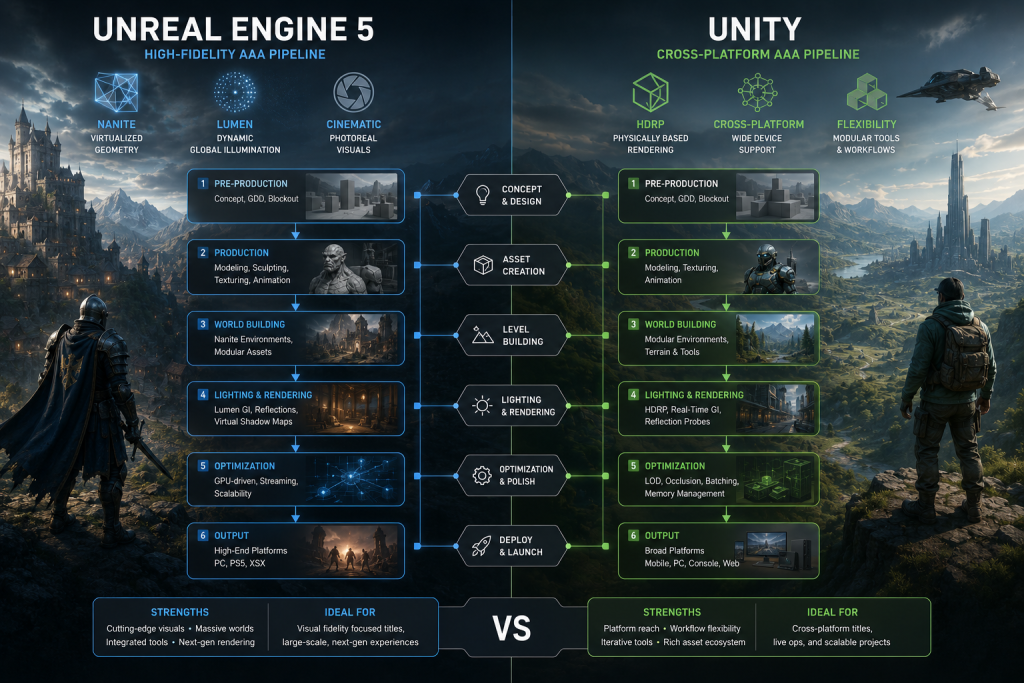
“Editorial illustration created for visual reference purposes. It does not represent a real project, client work, or official software screenshot unless stated otherwise.”
Definition. Unity vs Unreal Engine 5 is the choice between two leading commercial game engines: Unity (C#-based, seat-licensed, strongest in cross-platform breadth) and Epic’s Unreal Engine 5 (C++-based, royalty-licensed, built around the Nanite geometry and Lumen lighting systems for high-fidelity real-time worlds). For AAA production, the practical difference lies in pipelines and economics, not raw capability.
What the Engine Choice Actually Decides
The myth is that Unity vs Unreal Engine 5 for AAA games is a quality ceiling question: Unreal for beautiful games, Unity for everything else. Both engines have shipped AAA-grade titles, and Unity’s own documentation positions HDRP for exactly that tier. What the choice actually fixes is less glamorous: where your money goes, who you can hire, and what your content pipeline demands from every asset.
In our experience supporting studios on both sides, teams rarely regret the feature list. They regret discovering in month eight that lighting iteration runs three times longer than planned, or that every outsourced batch needs a spec rewrite because the engine rewards geometry the vendor didn’t assume. The engine is not a renderer bolted on at the end; it’s the thing your production schedule quietly bends around.
The business impact. The decision lands differently at different revenue scales. Unreal is free until a product crosses $1 million in gross revenue, then takes a 5% royalty; Unity charges per seat, with Pro at $2,310 per seat per year as of January 2026. Run the arithmetic on your forecast: a 100-seat team pays Unity roughly $231,000 a year however the game sells, while a title earning $50 million pays Epic around $2.45 million in royalties. Pre-revenue, royalty looks generous; post-hit, seats look cheap. For a producer, this is the rare line item you can model precisely before a single asset exists – one of the few engine arguments with a numerically right answer per project.
Rendering: Nanite and Lumen vs HDRP
The comparison of Unreal Engine 5 Nanite and Lumen vs Unity rendering is where the philosophies diverge most visibly. Nanite virtualizes geometry so the engine streams film-density meshes directly; Lumen provides dynamic global illumination without baked lightmaps. As of UE 5.7, the system extends further: Nanite Foliage renders distant vegetation as pixel-scale voxels within a 60 fps console budget, Nanite Assemblies cut storage by instancing parts, and MegaLights moved into beta-documented in the Unreal Engine 5.7 release notes. Lumen is consolidating onto a hardware ray-tracing path, collapsing the lighting setup question to one answer instead of a software/hardware fork.
The Unity HDRP vs Unreal Engine 5 contrast is not about whether Unity can hit the visual bar-HDRP delivers physically based lighting, ray tracing, and volumetrics, and has carried photoreal projects. The difference is defaults and labor. UE5 turns its flagship systems on out of the box and asks you to optimize them down to your platform; Unity hands you a leaner base and asks you to build fidelity up, often with custom engineering at AAA scale. Both routes reach the target; they bill different specialists for different hours.
For an art director, the practical split is iteration rhythm. Lumen means lighting moves with the scene: an environment artist drags the sun, the bounce updates live, and lookdev review happens in minutes against final lighting. An HDRP project mixing baked and real-time lighting gets predictable performance and fine-grained control, but a lighting change can mean a rebake before the team sees truth on screen. Neither is wrong; one of them needs to be in your milestone math.
Did you know that…?
The most consequential engine event of recent years wasn’t a rendering feature. In September 2024, Unity canceled its per-install Runtime Fee before it ever took effect – a near-unprecedented retreat from announced pricing, forced by industry backlash. The episode is why engine economics, not just engine tech, now sits in every serious evaluation.
Content Pipeline: What Each Engine Demands From Your Assets
This is the section the generalist comparisons skip, and it’s where a UE5 vs Unity AAA production pipeline decision changes daily work. Nanite rewrites the economics of environment and prop geometry: high-poly meshes go into the engine close to source density, traditional LOD chains shrink or disappear for statics, and the optimization conversation moves from polycount to materials, overdraw, and memory. A rock that once shipped as a 5,000-triangle game mesh with four LODs can ship as the sculpt. That sounds like saved labor, and partly is – but the discipline shifts to UV efficiency, texel density, and draw-call-friendly material atlases, which is where game-ready 3D prop creation specs now get won or lost.
Unity-targeted assets keep the classical discipline: explicit LOD chains, polycount budgets per platform tier, and lightmap-friendly UVs when baked lighting is in play. Neither spec is harder; they’re different, and a vendor batch built for one engine’s assumptions lands wrong in the other.

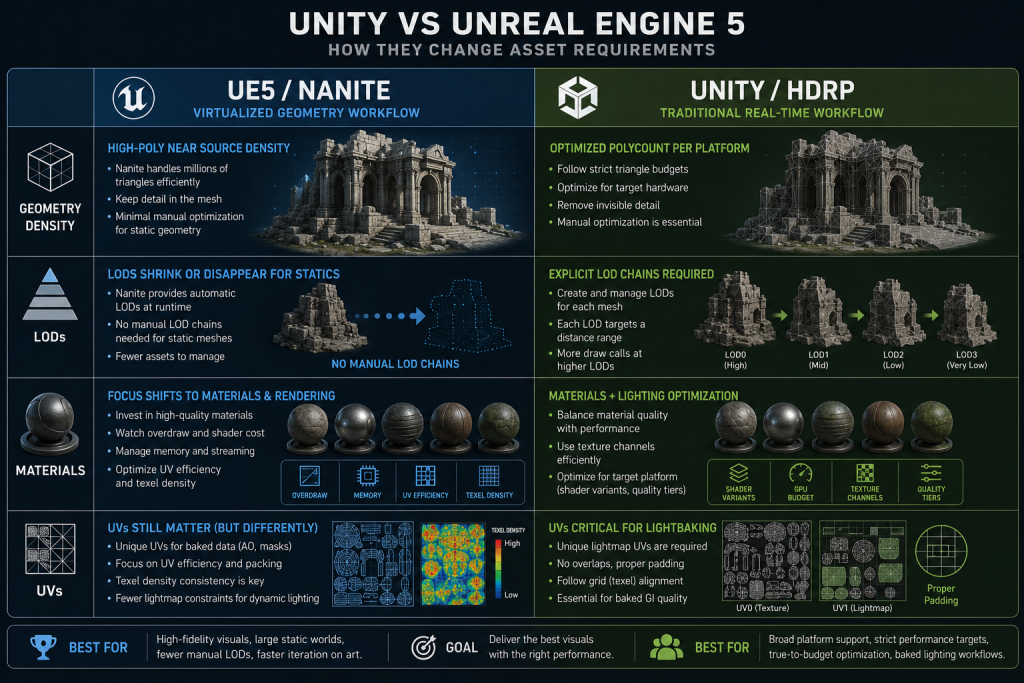
“Editorial illustration created for visual reference purposes. It does not represent a real project, client work, or official software screenshot unless stated otherwise.”
Characters obey their own rules in both engines. Nanite’s skeletal-mesh support is still maturing, so production characters keep shipping through classical deformation pipelines – clean animation topology with retopology as a non-negotiable stage, a discipline we break down in our guide to retopology in 3D modeling. UE5 adds MetaHuman as an in-editor authoring path that accelerates baseline realistic humans while pulling art direction toward its rig conventions; Unity projects typically source bespoke characters. Either way, AAA character art production stays engine-aware from the first blockout: bone budgets, shader models, and hair systems differ enough that “we’ll port it later” is a schedule risk, not a plan.
Choosing between Unity and Unreal Engine 5 is not only a technical decision – it directly affects environment production, optimization workflows, material setup, and asset integration requirements. Nasty Rodent helps studios build production-ready environments for both UE5 and Unity HDRP pipelines, delivering assets that meet real-world performance budgets and visual targets from prototype through full production. Whether your project requires photorealistic worlds, stylized environments, or large-scale open-world content, our team adapts the pipeline to the engine instead of forcing production into a predefined workflow.
The Economics: Licensing, Hiring, and Iteration
Licensing first, with 2026 numbers. Unreal: free below $1 million gross revenue per product, 5% royalty above, with a $1,850-per-seat annual option for teams not shipping on the runtime. Unity: seat subscriptions, with Pro moving to $2,310 per seat per year in January 2026 and Havok Physics unbundled from subscriptions starting with Unity 6.3 LTS – covered in 80.lv’s report on Unity’s 2026 pricing update. The structural difference matters more than the digits: Unity is a fixed, forecastable cost; Unreal is a success tax. Map both against your revenue scenarios, not each other in the abstract.
Hiring is the quieter cost. Unity’s C# lowers the entry bar and broadens the pool, which matters when a producer must scale by twenty engineers in a quarter. Unreal’s C++ pool is deeper at the senior systems level and thinner overall, partly offset by Blueprint letting designers and technical artists build logic without engineering hours. Industry analyses of Steam’s 2024 releases put the two engines behind roughly four of five games shipped there – Unity leading in release count, Unreal in units sold. Steam isn’t the AAA market, but as a talent-pool proxy it’s directionally honest.
Iteration cost is the one that surprises teams. UE5’s defaults are heavy, and undertuned projects pay in shader compilation stutter and CPU headroom; budgeting a technical art pass per milestone is the honest plan. Unity’s lighter base runs sooner but reaches AAA fidelity through custom subsystems – engineering headcount by another name. We’ve watched both lines blow up schedules, just in different months.
Side-by-Side: The Production Matrix
| Production area | Unreal Engine 5.7 | Unity 6.3 LTS | What it means for production |
| Geometry | Nanite virtualized meshes, Assemblies, Foliage voxels | Classical mesh + LOD chains, DOTS for scale | UE5 cuts LOD labor on statics; Unity keeps explicit polycount control |
| Lighting | Lumen GI on a consolidating hardware RT path; MegaLights in beta | HDRP: baked + real-time mix, ray tracing optional | Live lighting iteration vs controlled, bake-assisted predictability |
| Characters | MetaHuman in-editor; Nanite skinning maturing; retopo required | Bespoke pipelines; HDRP skin/hair stacks | Faster baseline humans vs fuller stylistic freedom |
| Scripting | C++ core, Blueprint visual layer | C#, optional ECS/DOTS | Senior-heavy hiring vs broader pool, faster onboarding |
| Licensing | Free to $1M, then 5% royalty; $1,850/seat non-runtime | Pro $2,310/seat/yr; Personal under $200K | Success-scaled cost vs fixed forecastable cost |
| World scale | World Partition streaming, open-world tooling | Custom streaming or third-party at AAA scale | Built-in path vs engineered path for open worlds |
| Asset spec risk | Materials, overdraw, memory budgets | Polycount, LODs, lightmap UVs | Vendor briefs must name the engine before the first batch |
Which Engine for Which AAA Project
Asking which engine for AAA game development has no single answer; project archetypes do.
| Project type | Stronger default | Why |
| Photoreal open world | Unreal Engine 5 | Nanite + Lumen + World Partition solve the three hardest problems out of the box |
| Stylized mid-core, multi-platform | Unity | URP/HDRP tiering and cross-platform reach keep one art target across device classes |
| Live-service with long content tail | Either – decided by team DNA | Content pipeline stability and hiring outlook outweigh launch-day rendering |
| Cinematic character-driven title | Unreal Engine 5 | MetaHuman, animation tooling, and the hardware RT lighting path compound |
Treat the table as a prior, not a verdict. A studio with a decade of Unity infrastructure often ships faster staying put than chasing Nanite; a team of UE veterans will out-deliver an unfamiliar “better fit.” The engine you can staff, profile, and debug at 2 a.m. beats a feature column you can’t.
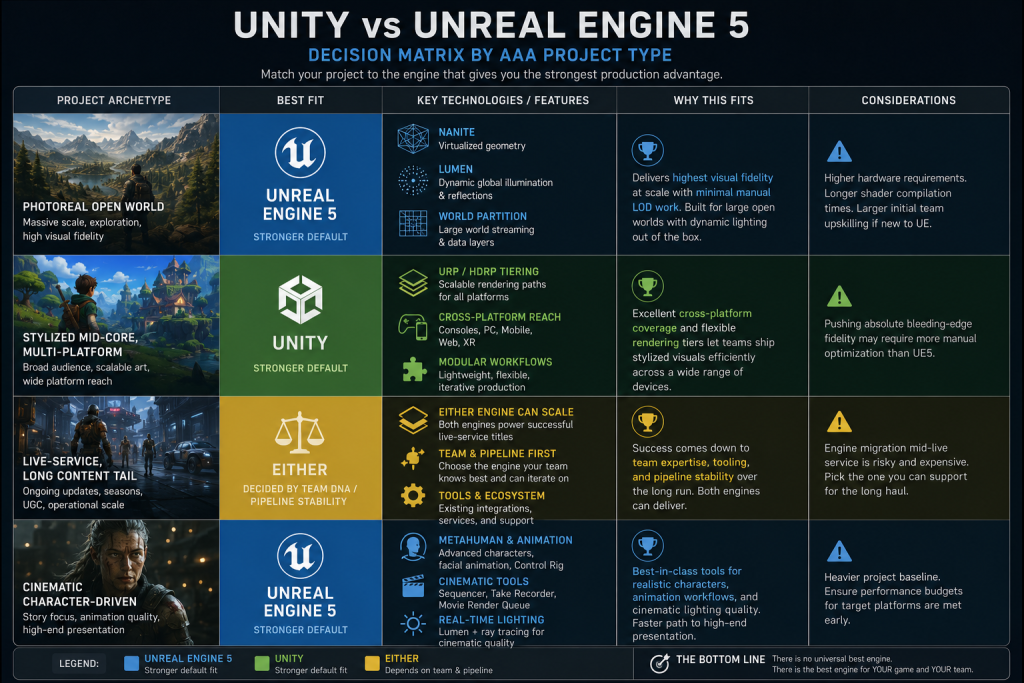
“Editorial illustration created for visual reference purposes. It does not represent a real project, client work, or official software screenshot unless stated otherwise.”
Unity vs Unreal Engine 5 at a Glance
| Criterion | Unreal Engine 5 | Unity |
| Language | C++ with Blueprint visual scripting | C# |
| Rendering flagship | Nanite geometry, Lumen GI | HDRP (high-end), URP (scalable) |
| Cost model | 5% royalty after $1M per product | Per-seat subscription |
| Sweet spot | High-fidelity 3D, open worlds | Cross-platform breadth, mobile-to-PC |
| Source access | Full source available | Source available on Enterprise terms |
| Current line | UE 5.7 | Unity 6.3 LTS / 6.4 |
Choosing Without Regret
Run the decision in this order: revenue model against licensing math, hiring market against your scaling plan, content pipeline against the assets your game consists of – and only then the demo reel. Most wrong engine choices we’ve seen weren’t wrong on features; they were wrong on what the team could staff and iterate.
And if the asset side is the unknown in your equation, it’s testable cheaply: send us one environment or prop brief and the target engine, and we’ll return the spec we’d build to – budgets, LOD strategy, material approach – so you see what your choice costs in art production terms before committing a milestone to it.