Character Concept Art: Step-by-Step for AAA 3D Pipeline
-

Written byDenys Zadoienyi
-

Updated on02.07.2026
-

Time to read10 min

- Why “Looks Great” Isn’t the Same Review as “Buildable”
- The 5-Stage Character Concept Art Process for AAA Pipelines
- Technical Matrix: Concept Art Deliverables by Stage
- Where Concept Art Handoffs Break Down
- What Belongs in a Production-Ready Turnaround Package
- How We Do This at Nasty Rodent
- From Locked Concept to 3D – What Happens Next
- Getting the Handoff Right the First Time
Character concept art gets judged the same way a portfolio piece gets judged – is it a good drawing – and that’s exactly the wrong test for a AAA pipeline. A good drawing tells you what a character looks like from one angle, in one pose, in the artist’s head. A production-ready concept tells a modeler what to build without five follow-up questions. Confuse the two and the gap doesn’t disappear at handoff – it moves downstream, resurfaces as guesswork during sculpting, and gets expensive by the time it reaches a milestone review.
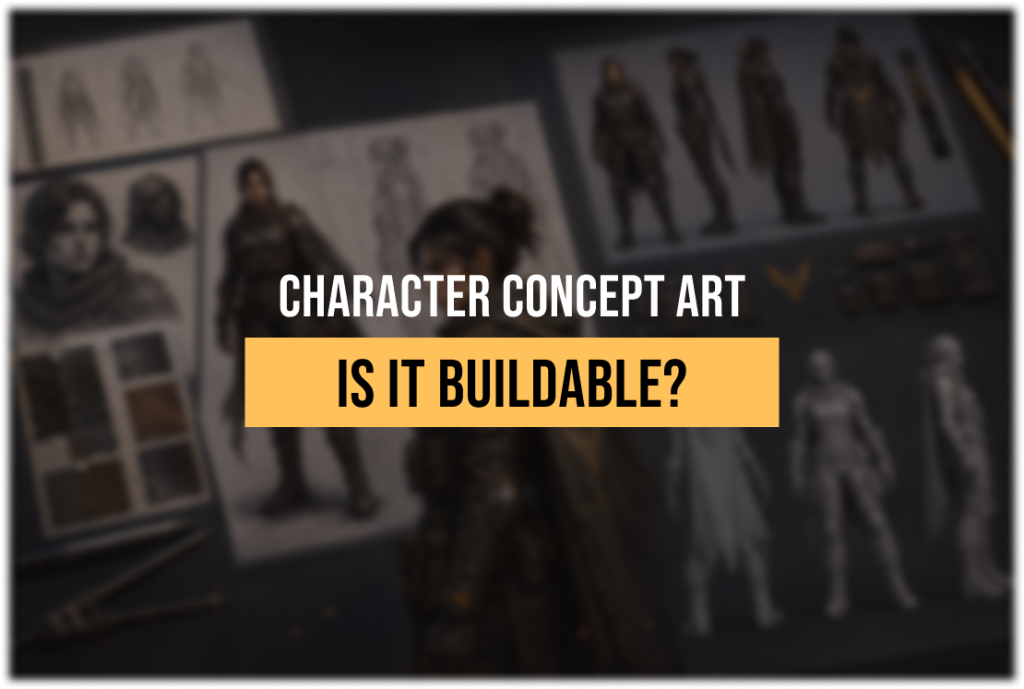
Character concept art is the visual production specification that defines a character before 3D production starts – silhouette, proportions, costume logic, material callouts, and enough angle coverage that a modeler isn’t guessing. It’s the first production step of the 3D character pipeline, not a standalone illustration handed over and forgotten. What separates it from a portfolio piece is exactly this: a portfolio piece has to look finished. A production concept has to be buildable.
Why “Looks Great” Isn’t the Same Review as “Buildable”
An art director reviewing character concept art is usually checking one thing first: does it match the visual target, does the silhouette read, is this the character we want. That’s the right review – for style. It’s not the review that catches whether a modeler can actually build the thing without inventing details that were never decided.
The gap shows up in a specific, recurring way: the concept is drawn from a single three-quarter angle with a strong render finish, it gets approved because it looks like key art, and then the 3D team starts modeling with no back view, no material breakdown, and no note on which straps are functional versus decorative. The modeler has to imagine the back themselves. On an indie project that’s a minor inconvenience. On an AAA pipeline with a locked schedule, it’s a source of constant revisions – every guess the modeler makes is a guess the art director eventually has to correct.
On concept briefs we scope for mid-core and AAA teams, this is one of the most common gaps: a concept gets treated as finished art rather than as a technical handoff document, because nobody separated the style review from the buildability review.
The 5-Stage Character Concept Art Process for AAA Pipelines
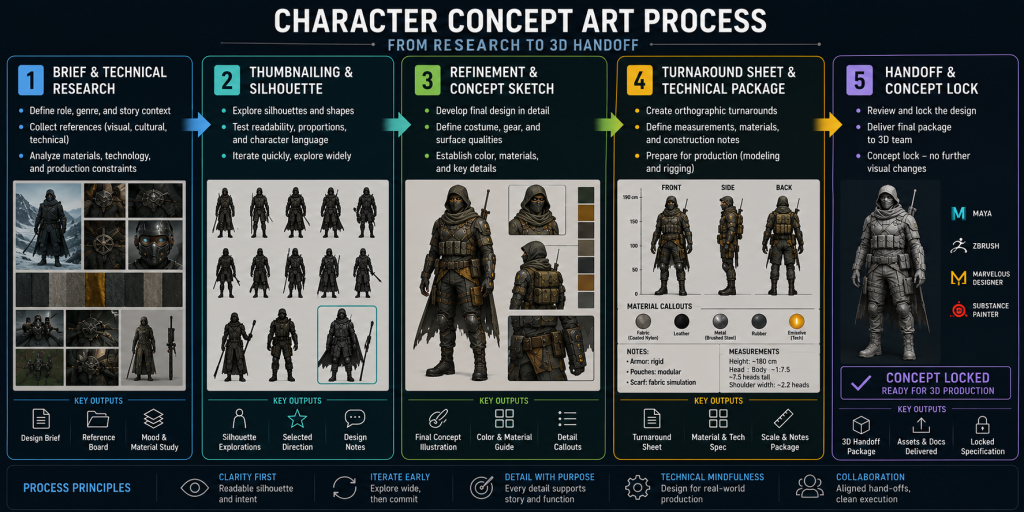
A production-ready concept doesn’t happen in one pass. It moves through five stages, and skipping any of them shows up later as rework someone else has to absorb.
Stage 1 – Brief and Technical Research. Before a single thumbnail, the concept artist needs the actual constraints: the character’s role and personality, target platform, polycount and rigging expectations if known, and the existing visual language of the project. Research at this stage means reference gathering – anatomy, materials, real-world equipment analogues – not style inspiration alone. A brief that skips technical constraints produces a concept that looks right and builds wrong.
Stage 2 – Thumbnailing and Silhouette Exploration. Small, fast, low-detail sketches exploring multiple silhouette directions. This is the cheapest stage to iterate in and the most expensive to skip – a silhouette decided here in minutes takes hours to unwind once it’s rendered and colored. The test that matters: does the shape read as a black silhouette on a white background, with no color or detail to lean on.
Stage 3 – Refinement and Concept Sketch. The chosen thumbnail gets developed into a full concept sketch – proportions locked, costume logic worked out, color and material direction established. This is where most external reviews (client, art director, publisher) happen, and where “looks great” gets confirmed. It is not yet buildable on its own.
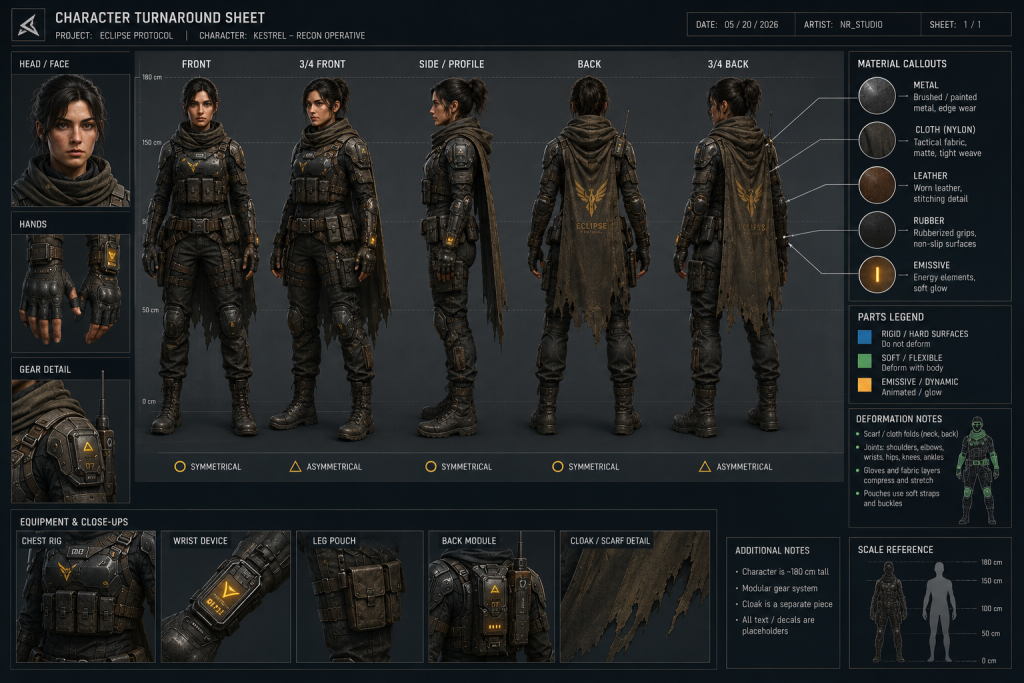
Stage 4 – Turnaround Sheet and Technical Package. This is the stage a pure illustration process usually skips, and it’s the one that actually makes a concept production-ready. Minimum coverage: front, side/profile, and back views, with a three-quarter view added when the design has complex depth, asymmetry, or layered equipment. Close-ups cover the face, hands, and any complex costume or equipment elements. Material callouts note what’s metal, cloth, leather, or emissive. Annotations flag non-obvious details – what’s rigid versus soft, what needs to deform, what’s symmetrical versus not.
“Editorial illustration created for visual reference purposes. It does not represent a real project, client work, or official software screenshot unless stated otherwise.”
Stage 5 – Handoff and Concept Lock. The package moves to the 3D team with a defined lock status – not “mostly approved,” but locked, meaning the art director has signed off on silhouette, proportions, surface complexity, and visual target against the project’s art bible and style guide. Mature AAA-style pipelines often keep the concept artist engaged past this point, available for blockout review and silhouette feedback, rather than treating handoff as a clean break. From here, the locked concept becomes the brief for 3D character modeling – or, when the design includes standalone equipment, weapons, or wearable gear treated as separate assets, for 3D prop modeling running in parallel.
“Editorial illustration created for visual reference purposes. It does not represent a real project, client work, or official software screenshot unless stated otherwise.”

Technical Matrix: Concept Art Deliverables by Stage
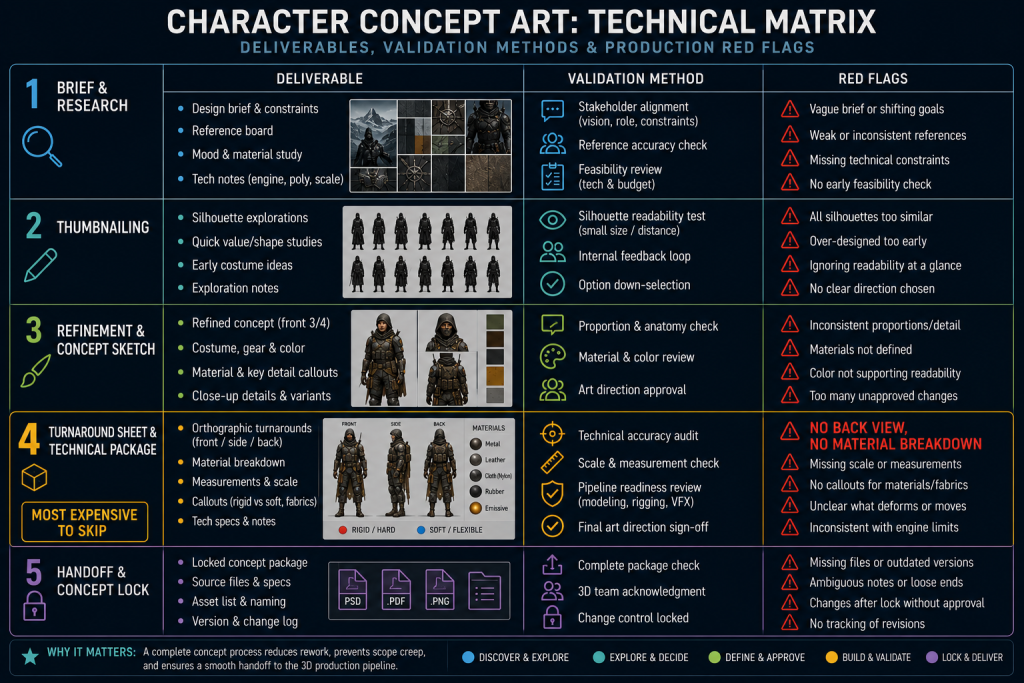
| Stage | Deliverable | Validation Method | Red Flags |
| Brief & Research | Reference sheet, technical constraints doc | Art director + producer sign-off | Concept starts before constraints exist |
| Thumbnailing | 5–10 silhouette variations | Black-silhouette readability test | Jumping straight to a single rendered direction |
| Refinement | Full concept sketch, one primary angle | Style/visual target review | Treated as final without turnaround coverage |
| Turnaround Package | Front/side/back views, material callouts | Modeler pre-read for buildability gaps | No back view, no material breakdown |
| Handoff & Lock | Locked concept + annotated technical notes | Formal concept lock sign-off | “Mostly approved” treated as locked |
“Editorial illustration created for visual reference purposes. It does not represent a real project, client work, or official software screenshot unless stated otherwise.”
The row that costs the most when skipped is the turnaround package. A concept sketch without a back view or material callouts isn’t incomplete art – it’s an incomplete spec, and the missing information doesn’t disappear. It gets filled in by whoever touches the asset next, usually with less context than the concept artist had.
Where Concept Art Handoffs Break Down
The break usually isn’t dramatic. A concept gets approved on schedule, the 3D team starts blockout, and questions start arriving one at a time: is this buckle functional, does the cloak have physics, is the visor transparent or opaque. Individually, each question is a two-minute Slack message. Across a full character, they add up to a parallel design process happening during production instead of before it – and every answer that changes a decision made in the concept means rework on whatever was already built against the old assumption.
Skipping the turnaround-and-annotation stage doesn’t save time – it moves the cost downstream and multiplies it. A missing back view caught at thumbnail stage costs nothing; the artist just draws another angle. The same gap discovered mid-sculpt can cost a day or more of rework once volume and proportions were already built around a guess, and if that guess reaches a milestone review before anyone catches it, the fix now touches modeling, texturing, and the review schedule at once.
For an art director, this shows up as repeated “quick clarification” requests that quietly consume review time meant for the next character in the queue. For a producer tracking the schedule, it shows up as a modeling stage that’s taking longer than scoped for reasons that never make it into a status report as “concept was incomplete” – because by the time it’s visible, it looks like a modeling problem, not a concept problem.
What Belongs in a Production-Ready Turnaround Package
Five checks separate a finished-looking concept from a production-ready one:
- Does it show front, side, and back views as a baseline, with a three-quarter or close-up view added for complex or layered areas, rather than leaving the back to inference?
- Are materials called out by type, not just implied by color and shading? Metal, cloth, leather, and emissive surfaces read differently under a real-time shader than under painted rendering.
- Are functional versus decorative elements marked? A strap that needs to move with a rig is a different asset than one that’s sculpted static.
- Is scale referenced against something known – a hand, a standard prop, another character in the roster – so proportions don’t drift in translation to 3D?
- Does the concept artist stay reachable past handoff, at least through blockout review, instead of the concept becoming an orphaned file the moment it’s approved?
If two or more of these are missing, the concept is likely to be treated as more finished than it actually is, and the gap will surface as informal, unscheduled clarification work during modeling instead of a planned review step.
How We Do This at Nasty Rodent
At Nasty Rodent, character concept art is treated as the first production step of the 3D character pipeline, not as a standalone illustration. Our concept art services help studios define silhouettes, costume logic, material callouts, turnaround sheets, and visual rules that 3D artists can actually build from. For mid-core and AAA teams, this reduces interpretation gaps between art direction, modeling, texturing, rigging, and engine delivery. If your character roster needs to move from idea to production-ready 3D assets without style drift, Nasty Rodent’s concept art services can support the pipeline from early concept exploration to final asset handoff.
From Locked Concept to 3D – What Happens Next
A locked concept is the input to the 3D character pipeline, not the end of the process. We’ve broken down the full seven-stage path from concept lock to a game-ready skeletal mesh in Unreal Engine 5 – the stages, the decisions, and the mistakes that cost milestone gates once a character moves past concept. For studios running a stylized roster specifically, keeping concept and 3D under one art direction discipline is what prevents an entire cast from drifting off-style one small correction at a time.
Turnaround sheets built for handoff, not just presentation, are common practice across the industry once a character moves toward production – character artists routinely work at the intersection of concept, technical, and animation teams precisely because a concept that only communicates to other concept artists isn’t finished yet. Artist pipeline breakdowns show the same pattern from the 3D side: blocking and silhouette come before any high-detail sculpting begins, which is the 3D-side mirror of thumbnailing on the concept side – the cheap iteration has to happen before the expensive detail work, on both sides of the handoff.
Getting the Handoff Right the First Time
The studios that avoid mid-production concept clarification loops don’t add more review meetings – they add one missing deliverable: a turnaround package with material callouts before the concept is called locked. That single addition is what turns a good drawing into a document a 3D team can actually build from without guessing.
If you’re an art director scoping a character roster for an upcoming production, a 30-minute visual style match call with a senior concept lead is a fast way to see how a vendor’s concept-to-3D handoff actually works, not just how their portfolio looks. A rough character count and platform target are enough to start that conversation. And if the open question isn’t process but capacity – building an internal concept team versus bringing in outside support for a roster – that’s a separate decision covered in our breakdown of hiring a concept artist versus outsourcing to a studio.