Hire Concept Artist vs Outsource Concept Studio: What Actually Changes in Your Pipeline
-

Written byDenys Zadoienyi
-

Updated on27.05.2026
-

Time to read13 min

- What “Hiring a Concept Artist” Really Means in Production Terms
- The Hidden Cost Map: What Each Model Fails to Show You Upfront
- When a Single Freelance Concept Artist Is the Right Call
- What a Concept Art Outsourcing Studio Actually Provides (And What It Doesn’t)
- The Decision Framework: 7 Signals That Determine Which Model Fits
- Hidden Decision: What Happens When the Freelancer Leaves Mid-Pipeline
- What to Look for in a Concept Art Outsourcing Studio Before You Commit
- The Comparison at a Glance
- Did you know that…?
- The Call Worth Making Before Pre-Production Locks
There’s a version of this decision that looks simple on paper. You need concept art. You either find one person or you find a team. The work gets done.
That version skips the part where a freelancer disappears before milestone 2, or where an outsource studio delivers beautiful work that doesn’t talk to your engine, your style guide, or your technical spec. It skips the part where you’re three weeks into rework, your first-pass approval rate has dropped, and the next milestone is four weeks out.
If you are an outsource manager or procurement lead at a mid-core or AAA studio, this is exactly the kind of decision that looks tactical until it becomes operational risk. The question isn’t whether to hire or outsource. The question is what each model actually does to your pipeline, your vendor scorecard, and your delivery cycle — and whether you’ve priced that in before signing anything.
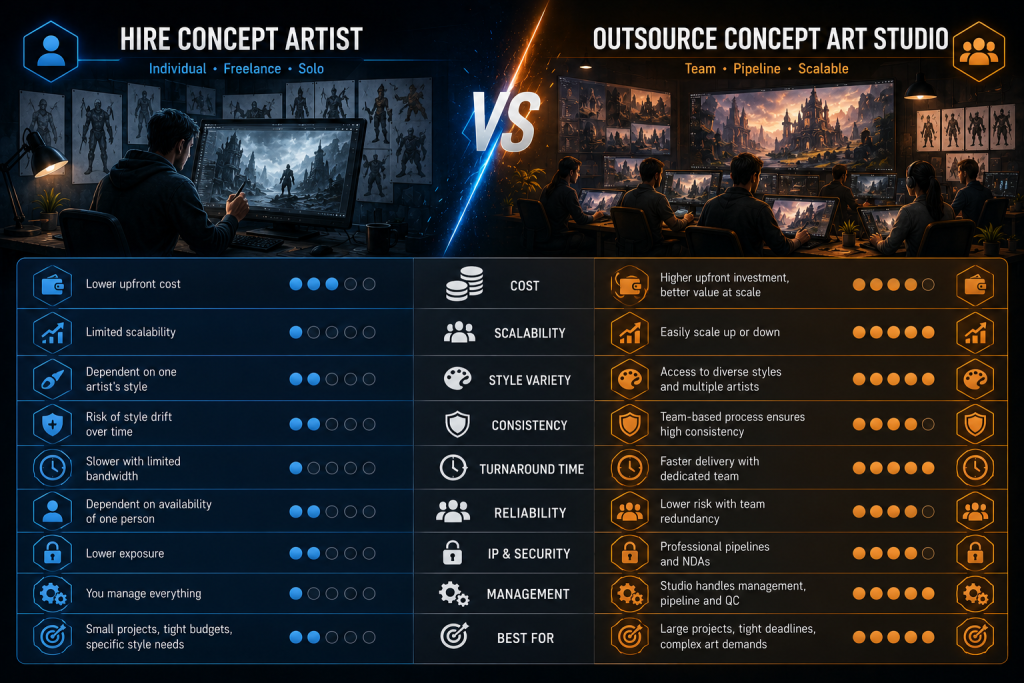
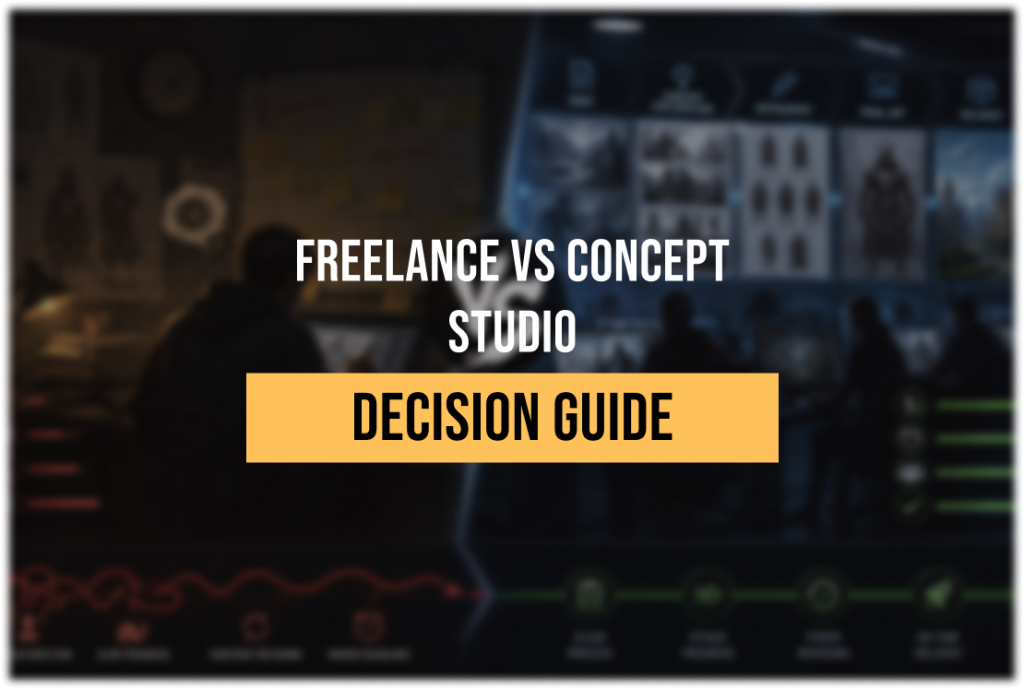
“Editorial illustration created for visual reference purposes. It does not represent a real project, client work, or official software screenshot unless stated otherwise.”
What “Hiring a Concept Artist” Really Means in Production Terms
The phrase “hire a concept artist” covers three structurally different arrangements, and conflating them is one of the most common sources of planning failure at the decision stage.
Freelance engagement means a single artist on a per-asset or per-hour basis. You own the relationship, the briefing process, the revision loop, and the QA. If the artist goes silent, gets sick, or takes another project — that’s your problem to absorb. Freelance hourly rates for concept art in game development range from $25 to $500, depending on seniority and specialization. The wide spread matters: a mid-tier freelancer at $60/h on a 200-hour character roster is $12,000. A senior artist at $120/h for the same scope is $24,000 — and the senior typically costs less in total revisions and rework time.
Outstaffing means hiring an individual artist through a vendor who handles all administrative and HR overhead. You manage the artist day-to-day; the vendor manages payroll, equipment, and HR compliance. This is closer to having an embedded team member than a classical outsource arrangement.
Studio outsourcing means engaging an external team as a production unit. You hand them a brief and a style reference, agree on milestone gates and delivery format, and the studio handles the internal pipeline — art direction, QA, version control, revision cycles. The studio owns the production risk for what they committed to deliver.
These three models are not interchangeable. Treating them as a single “hire vs outsource” question is where vendor strategy starts going sideways.
The Hidden Cost Map: What Each Model Fails to Show You Upfront
Most cost discussions stop at rate cards. That’s where the comparison breaks down.
When you hire a freelance concept artist, the visible cost is the hourly or per-asset rate. The invisible costs are what you spend managing the relationship, maintaining output consistency, absorbing delivery risk, and recovering from attrition. A single experienced freelancer typically delivers strong work on a narrow scope. When scope grows — more characters, environment variations, creature designs, vehicle passes — you’re either queuing work sequentially behind one artist or building a roster of freelancers that you then need to coordinate yourself. That coordination overhead lands on your team. It doesn’t show up in the freelancer’s invoice.
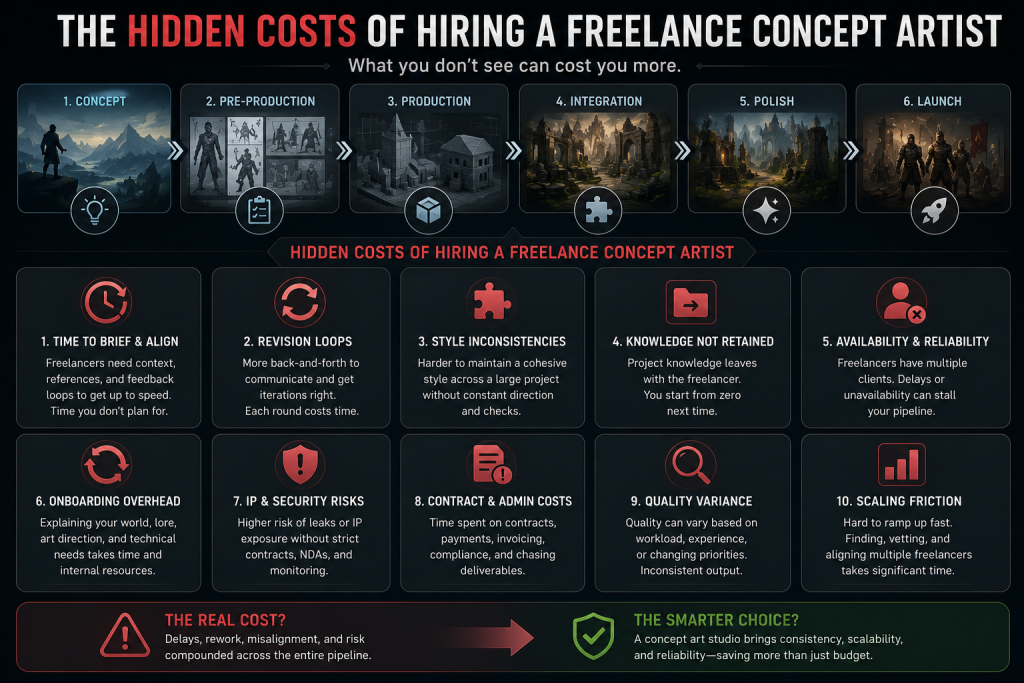
“Editorial illustration created for visual reference purposes. It does not represent a real project, client work, or official software screenshot unless stated otherwise.”
The vendor onboarding cycle for a freelancer is shorter on paper — a few portfolio reviews, a paid test, an NDA, and you’re moving. But every time scope shifts or a freelancer exits, you’re restarting that cycle. Studios that have been through multiple freelancer replacements on a single project know that the cumulative onboarding cost — time, alignment, style drift correction — can easily exceed 20–30% of the original engagement budget.
With a concept art outsourcing studio, the visible cost is higher: studio rates typically run $35–60/h blended, with project or milestone-based packaging. But the studio absorbs the coordination overhead, the internal QA, the revision tracking, and the communication SLA. You’re buying delivery predictability, not just hours.
The calculation that matters most is this: when first-pass approval rates slip, the difference in QA cycles and revision rounds changes the effective cost of the engagement entirely. Fifteen to twenty-five additional working days of QA per milestone is not a stylistic inconvenience — it’s a hard production cost that belongs in your risk register.
When a studio comes to us at Nasty Rodent after a failed freelance engagement, the first thing we map is where style consistency broke down. More often than not, it wasn’t the artist’s skill. It was the absence of a structured briefing protocol and milestone QA on the client’s side — and that’s a solvable problem, but it costs time to fix mid-production.
When a Single Freelance Concept Artist Is the Right Call
A freelance concept artist is the correct choice in a well-defined set of scenarios. Being honest about where they work matters as much as knowing their limitations.
Early ideation and style exploration. Before a style guide exists, a skilled freelancer can run multiple visual directions fast. You’re buying creative exploration, not production consistency. The economics make sense: you’re not commissioning 80 assets, you’re commissioning 8–12 mood frames.
Isolated, low-dependency scope. A few character sheets, a set of prop concepts, a single environment pass for a specific level. Tasks where style inconsistency carries low risk because the output isn’t defining the visual system of the game.
Supplementing an internal team. If you have an art director in-house who can review, align, and brief the freelancer at every cycle, many of the coordination risks disappear. The internal art direction becomes the glue that holds style consistency in place.
Budget constraints on an indie or small mid-core project. At this tier, the volume doesn’t justify a studio engagement. A careful freelancer selection — paid test, clear brief, defined revision scope — can deliver production-quality results within budget.
What breaks this model is scope growth, team fragmentation, and the absence of internal art oversight. If your concept art scope is above 50–60 assets, if your art director is managing multiple workstreams simultaneously, or if you’re pre-production on a title where the visual system is still being defined — freelance is not the lower-risk option. It only feels like it.
What a Concept Art Outsourcing Studio Actually Provides (And What It Doesn’t)
The outsource studio model is often described in terms of what you get: access to a team, a structured pipeline, multiple disciplines under one roof. That framing is accurate but incomplete. Understanding what you get operationally is more useful for a vendor decision.
You get a structured production pipeline. A professional concept art outsourcing studio operates with internal art direction, QA review checkpoints, version control, and milestone-gated delivery. The individual artist working on your brief is supported by a lead who aligns the output with your style guide — not just their personal interpretation of it.
You get defined communication and escalation paths. A reputable studio assigns a dedicated project manager (PM) to your engagement. You have a single point of contact for briefing, feedback, and revision. When a problem occurs at milestone 3, you’re not chasing a freelancer on Slack — you’re working within an established escalation path.
You get IP protection built into the contract structure. Work-for-hire clauses, full IP assignment, and NDA protocols are standard in studio contracts. Milestone-gated payment structures — typically 30% upfront, installments at delivery points, final payment on acceptance — keep contractual leverage on your side throughout the engagement.
You get scalability without hiring overhead. If your concept scope expands from 40 to 120 assets mid-pre-production — which happens more often than production plans suggest — a studio can absorb that scale without you re-entering the market for additional freelancers.
What you don’t get automatically is creative ownership of the direction-setting process. A studio executes against a brief. The creative strategy — what the visual system should communicate, where the style boundaries are, what the hero asset needs to feel like in the context of the broader IP — that stays with your art director or lead. Outsourcing concept art production is not the same as outsourcing art direction. Studios that blur this line, or clients who assume the studio will solve undefined creative questions, are where the engagement model breaks down.
The Decision Framework: 7 Signals That Determine Which Model Fits
Neither model is universally correct. The right choice is a function of your project’s specific variables. Use these signals as a structured assessment before the vendor conversation starts.

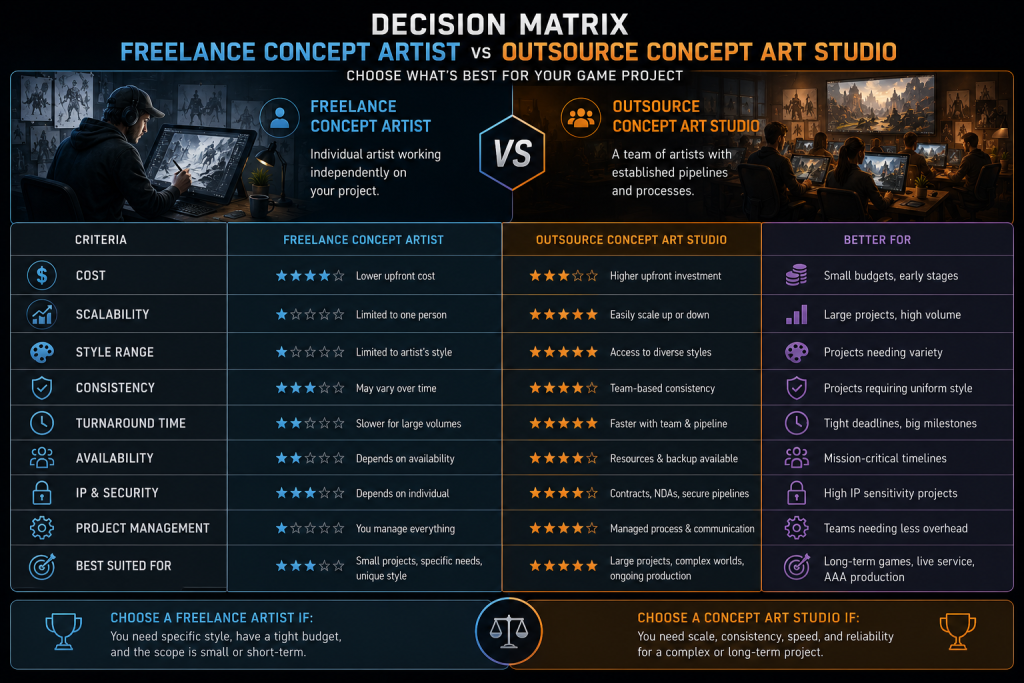
“Editorial illustration created for visual reference purposes. It does not represent a real project, client work, or official software screenshot unless stated otherwise.”
| Signal | Points to Freelancer | Points to Studio |
| Asset volume | Under 40–50 concept assets total | Above 50 assets, multiple types |
| Internal art direction | Strong in-house AD with bandwidth | AD at capacity or absent |
| Style guide status | Early exploration, no guide yet | Style guide defined, consistency required |
| Production timeline | Flexible, non-milestone-critical | Milestone-gated, delivery dates fixed |
| Scope stability | Scope is locked and unlikely to grow | Scope may expand during production |
| IP sensitivity | Low — early ideation, not core IP | High — characters, environments, key assets |
| Budget structure | Per-asset or hourly, no retainer | Project-based, milestone payments preferred |
No single signal is a hard determinant. A project with a locked scope, a strong art director, and 30 assets is a clear freelancer scenario. A project where three of those conditions flip — expanding scope, AD at capacity, milestone-gated delivery — is where the studio model pays for itself.
As a producer building a Q3 capacity plan, it’s worth running this assessment before the production budget is locked rather than during it. The cost of switching models mid-pipeline — finding, onboarding, and aligning a new vendor — can reach a significant share of the original engagement cost in time and coordination overhead alone.
Hidden Decision: What Happens When the Freelancer Leaves Mid-Pipeline
This is the scenario that vendor decision frameworks consistently underweight. A freelancer exits your project. It happens — for reasons that range from a better offer to a personal crisis to schedule overload. The question isn’t whether it can happen. It’s how much it costs when it does.
Style continuity breaks. A new freelancer, even a strong one, doesn’t carry the visual memory of the previous work. The first two to three weeks of a replacement engagement are typically spent reverse-engineering the established style — reviewing existing assets, aligning on callout sheets that may or may not exist, and producing test work that gets rejected because the interpretation is slightly off. This is style drift, and it’s expensive in revision cycles and QA reject rates.
Onboarding resets. Every new artist needs to be briefed, NDAs signed, test work completed and reviewed. Vendor onboarding — even for a freelancer — takes five to ten working days in a structured setup. In an unstructured one, it takes longer.
Contractual protection is limited. Unless your freelance agreement explicitly addresses substitution, continuity of style, and milestone accountability — and most don’t — you have limited contractual leverage when a freelancer exits before delivery.
A well-run outsourcing studio addresses all three by design. If a lead artist on your project is unavailable, the studio absorbs the handover internally. Your timeline and SLA commitments don’t change. That’s not a soft benefit — it’s the operational argument for the studio model when production continuity is on the line.
What to Look for in a Concept Art Outsourcing Studio Before You Commit
The portfolio conversation is necessary but insufficient. Visual quality tells you the ceiling. It doesn’t tell you what the studio delivers on milestone 4, a Tuesday, after two rounds of client revisions and a scope adjustment.
The questions that expose operational maturity are different:
What is your first-pass approval rate on concept art deliverables? A studio that tracks this metric has a QA process. A studio that doesn’t track it — or describes its quality verbally without measurement — is running on hope, not process.
Who is the dedicated PM on our engagement, and what is their escalation path? The answer should be specific: a name, a role, a defined response SLA. “We’ll assign someone when we start” is not an answer.
How do you handle style guide evolution mid-project? Visual briefs change. A studio that has a defined protocol for brief updates — a formal change request, a callout review, a test asset before batch production resumes — has been through this before. A studio that says “we adapt” hasn’t explained how.
What does your onboarding protocol look like for the first two weeks? The first two weeks of a studio engagement determine whether the rest of the production is smooth. A structured studio has a documented onboarding flow: style brief review, test asset, calibration round, milestone plan. If the studio can’t describe it, that’s a signal.
For outsource decision-makers building a preferred vendor list, these questions function as a vendor capability assessment — one that separates studios with repeatable process from studios with good marketing.
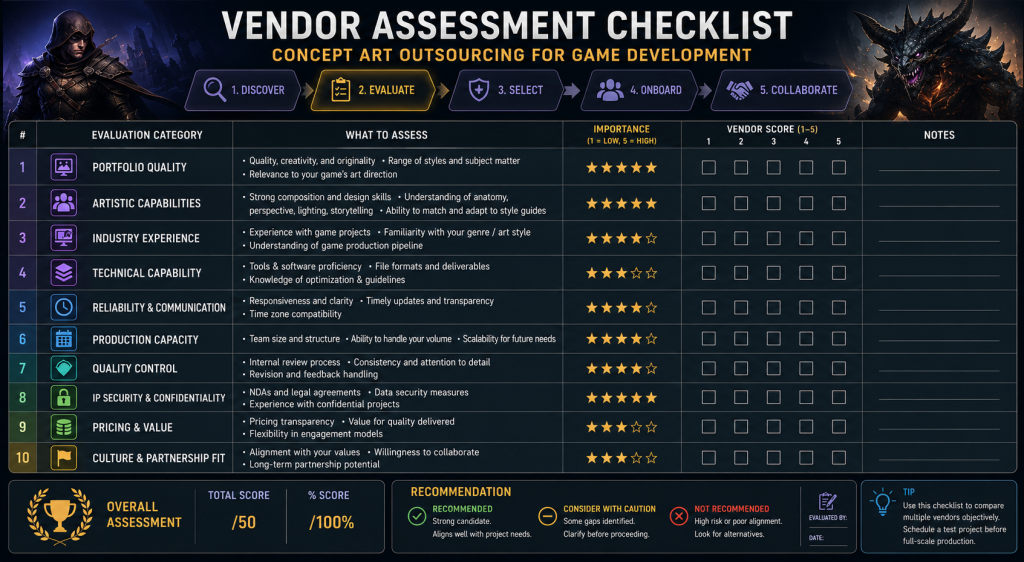
“Editorial illustration created for visual reference purposes. It does not represent a real project, client work, or official software screenshot unless stated otherwise.”
At Nasty Rodent, our outsource concept art production is built on a milestone-structured workflow with dedicated PM coverage and a defined brief-to-delivery protocol. For projects where visual development extends into environment and world-building, our production-ready environment design pipeline works in parallel with concept art at scale.
The Comparison at a Glance
| Factor | Freelance Concept Artist | Concept Art Outsourcing Studio |
| Cost entry point | Lower ($25–$120/h typical range) | Higher (blended $35–$60/h+, project-based) |
| Coordination overhead | On you | On the studio |
| Style consistency at scale | Depends on single artist’s output | Maintained by internal art direction |
| IP and NDA protection | Contract-dependent, varies | Standard — built into studio agreements |
| Vendor onboarding cycle | 5–10 days for single artist | 2–4 weeks for full studio engagement |
| Scalability | Limited to one artist’s capacity | Scales with project scope |
| Delivery predictability | High variability | Milestone-gated, tracked |
| Replacement risk | High — single point of failure | Absorbed internally by studio |
| Communication SLA | Informal | Defined, with dedicated PM |
Did you know that…?
The 2025 GDC State of the Industry Report recorded that 41% of game developers experienced layoffs in the preceding year — up from 35% in 2024. Studios are cutting fixed headcount and converting production capacity to variable cost through outsourcing. The shift isn’t philosophical. It’s financial arithmetic applied to production risk.
The Call Worth Making Before Pre-Production Locks
The hire-vs-outsource decision has a window. It’s open before your art direction is committed, before your milestone plan is built around one model, and before your internal team has shaped workflows around whoever you chose first.
After that window closes, changing models is a production event, not a vendor swap.
What we offer at Nasty Rodent is a free vendor capability assessment — delivered within 48 hours. You tell us your scope, your style direction, your platform tier, and your milestone structure. We return a vendor scorecard with a projection of first-pass approval rate, time-zone overlap, and communication SLA benchmarked against your RFP. No commitment required to receive it.
If you are building a preferred vendor list for concept art production and want to know whether Nasty Rodent fits your pipeline — this is where that conversation starts.
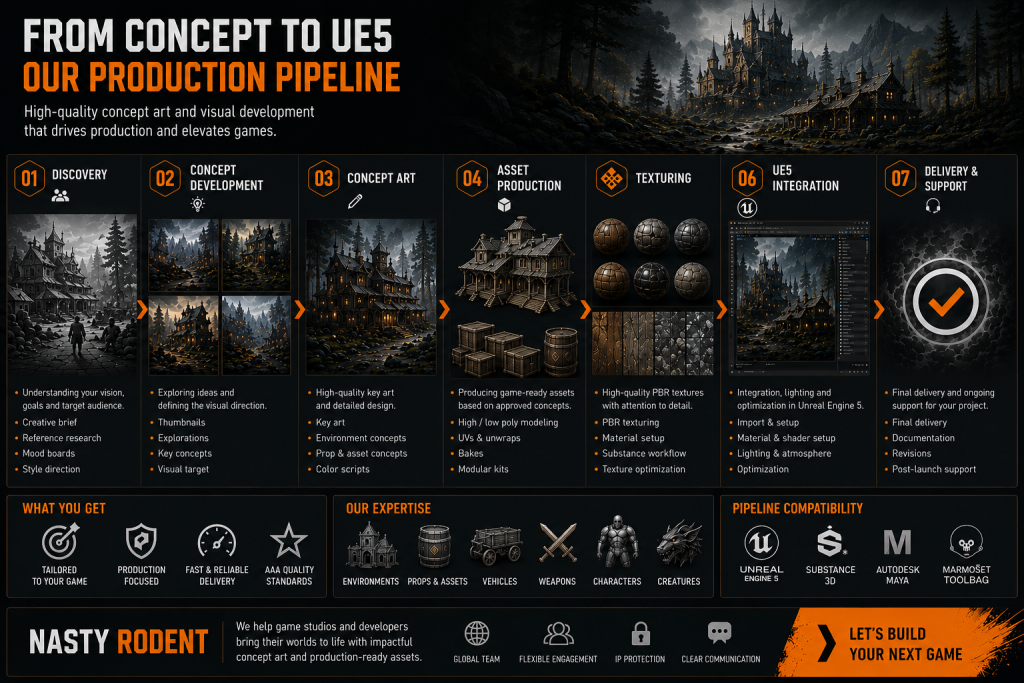
“Editorial illustration created for visual reference purposes. It does not represent a real project, client work, or official software screenshot unless stated otherwise.”
Or explore our full production portfolio to see how concept art integrates with character and environment pipelines:
For studios at an earlier stage of vendor evaluation, the Nasty Rodent blog covers production strategy topics across concept art, 3D, and UE5 workflows.