Game Production Roles: Producer, Lead, Director, Tech Art
-

Written byDenys Zadoienyi
-

Updated on18.06.2026
-

Time to read19 min

- What Game Production Roles Actually Mean
- The Game Producer: Owning How the Game Gets Made
- The Game Director: Owning What the Game Is and Why
- The Art Director and Creative Director: Two Kinds of Visual Authority
- The Lead: Discipline Ownership in the Middle of the Hierarchy
- The Technical Artist: The Role That Prevents Production Disasters
- The Role That Connects Them: The Outsource Producer
- How Studio Scale Changes Everything
- Decision Authority Matrix
- How These Roles Work With External Art Partners
- Game Production Roles at a Glance: Comparison by Function
- Conclusion: Clarity of Role Is a Production Asset
Game production roles are among the most frequently misunderstood titles in the industry — not by outsiders, but by the developers working alongside them.
“Editorial illustration created for visual reference purposes. It does not represent a real project, client work, or official software screenshot unless stated otherwise.”
Ask five engineers what the producer on their team actually does. You will get five different answers. Ask whether the game director or the executive producer has final say on a feature cut, and watch the room divide. The confusion isn’t incompetence — it’s structural. These roles evolved at different speeds across different studios, and their boundaries were never standardized the way engineering disciplines were.
That ambiguity has consequences. When a producer thinks their job is to update Jira and run standups, while the director expects someone managing scope and protecting the team’s capacity — projects slip. When a lead artist and an art director both think they own visual approval — assets get revised in circles. When nobody on the team can explain what the technical artist should escalate to engineering versus handle independently — the pipeline becomes a bottleneck.
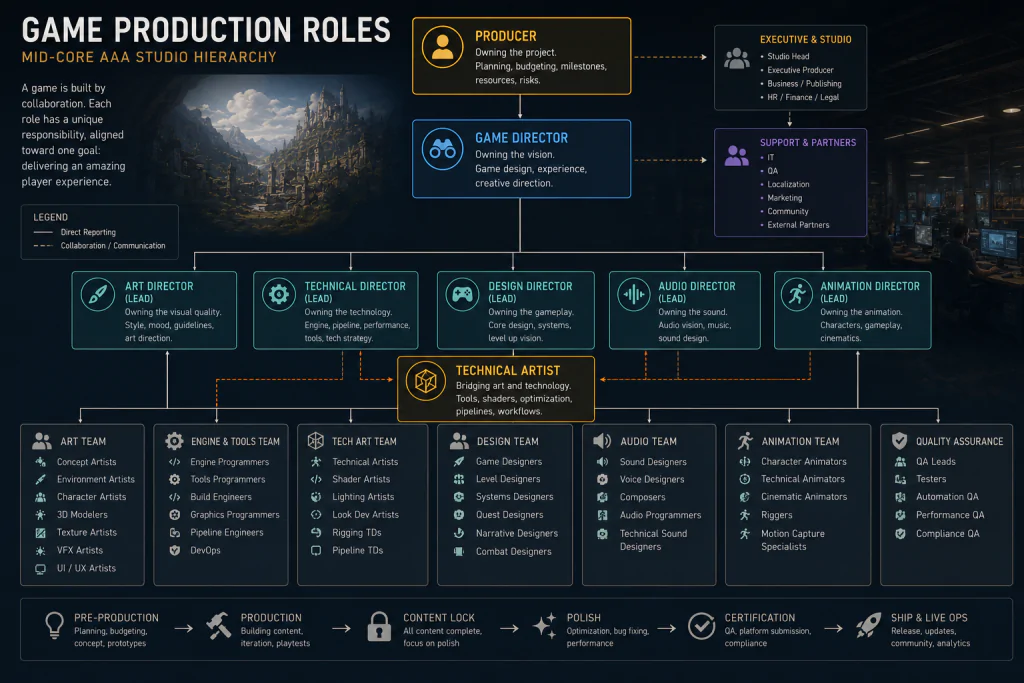
This guide breaks down the core game production roles — Producer, Game Director, Art Director and Creative Director, Discipline Lead, and Technical Artist — by what each role actually owns, where authority begins and ends, and what goes wrong when the role is absent or misaligned.
What Game Production Roles Actually Mean
Game production roles are the formalized decision-making responsibilities that distribute ownership of scope, schedule, creative direction, and technical execution across a development team — and the gaps between them are where most production failures originate.
Every game that ships does so because someone owned each of these functions: someone decided what the game would be, someone decided how it would be built, someone decided when each piece was good enough, and someone made sure the tools and pipelines didn’t collapse under the weight of the production. In small teams, one person holds several of these responsibilities simultaneously. In AAA, each function has a title, a reporting line, and a performance review cycle attached to it.
The role taxonomy discussed here follows the dominant pattern at mid-core and AAA studios operating in 2026. Titles vary between organizations — what one studio calls a Game Director, another calls Creative Director, and a third calls just Director — but the underlying functional responsibilities are consistent enough to discuss systematically.
The Game Producer: Owning How the Game Gets Made
The producer’s job is to own the process, not the product. That distinction sounds simple. In practice, it’s the most consistently misunderstood boundary in game development.
As gamedeveloper.com has documented, the confusion stems from two competing models of what a producer is. In one model — inherited partly from film, partly from early games — the producer is the boss: the person with creative authority and final say over content. In the other model, which has become dominant at mid-core and AAA studios, the producer is a service role: the person responsible for making sure everyone else can do their job.
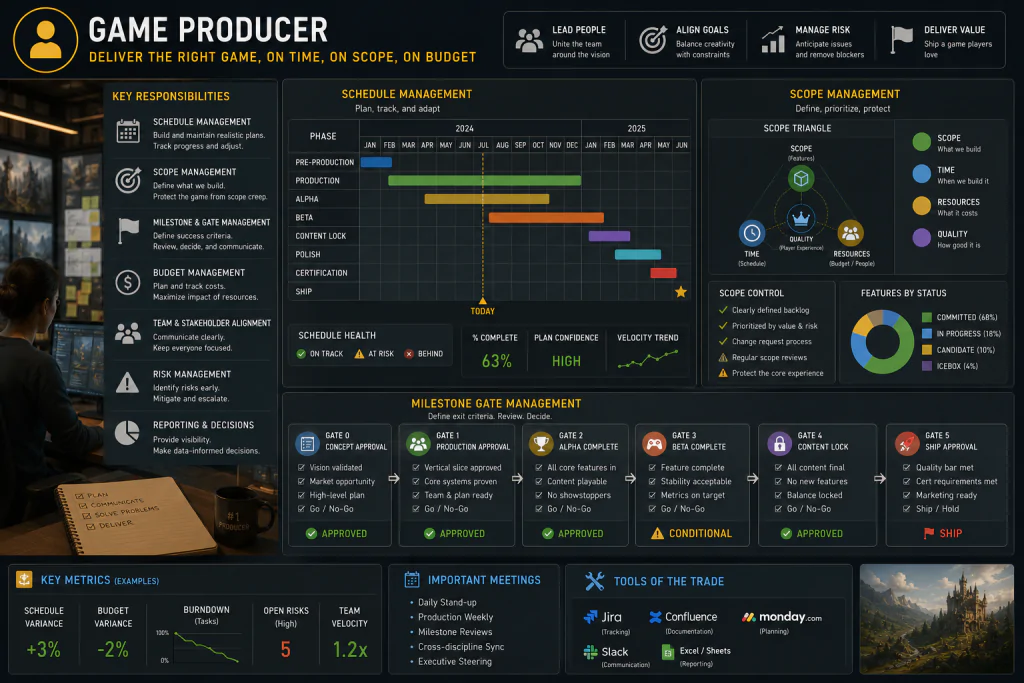
The second model is the dominant one across most mid-core and AAA studios today. A producer owns three things: scope (what the team is committing to build), schedule (when each piece is due), and capacity (whether the team can actually deliver what the schedule requires). Every other responsibility flows from these three.
“Editorial illustration created for visual reference purposes. It does not represent a real project, client work, or official software screenshot unless stated otherwise.”
What a Producer Does That Isn’t Scheduling
The scheduling misconception — that production is just “paperwork” — consistently produces underpowered production pipelines. What producers actually do that matters:
Dependency management. A mid-core production has hundreds of assets with interdependent delivery sequences. An environment kit can’t be textured before the style guide is signed off. A character can’t be rigged before modeling is complete. A producer maps these dependencies, identifies the critical path, and ensures that downstream teams aren’t blocked by upstream delays they didn’t know were coming.
Risk identification and escalation. A producer’s job is to find the problems before the milestone gate — not at the gate review, and certainly not after. This means maintaining enough visibility into every discipline’s actual progress (not reported progress) to surface risks while there’s still time to address them. In our production experience, the studios that consistently hit milestone gates are the ones where producers have direct working relationships with every discipline lead, not just with the heads of department.
Vendor and outsource coordination. At mid-core and AAA scale, a significant portion of art production runs through external partners. The Producers Guild of America’s formal game production credit documentation identifies the Outsource Producer as a distinct function: managing relationships with external vendors, coordinating asset delivery, and ensuring outsourced work integrates into the main project without creating downstream technical debt. Whether that’s a dedicated role or part of a producer’s broader responsibilities, someone on the production side needs to own the vendor relationship — including brief quality, first-pass approval tracking, and escalation paths when delivery slips.
The insulator function. A producer acts as a buffer between the development team and everything that would pull developers off their primary work: marketing requests for one-off assets, executives wanting status reports, cross-team dependencies that need negotiation. A team that loses its producer mid-production doesn’t just lose scheduling — it loses the person who was quietly preventing a dozen interruptions per week.
Did you know that…?
Shigeru Miyamoto’s formal title at Nintendo for much of his career was not designer or director — it was producer. His oversight of franchises like Super Mario and The Legend of Zelda operated through the production function: ensuring creative standards were maintained across teams while letting individual directors lead each title’s specific vision.
The Game Director: Owning What the Game Is and Why
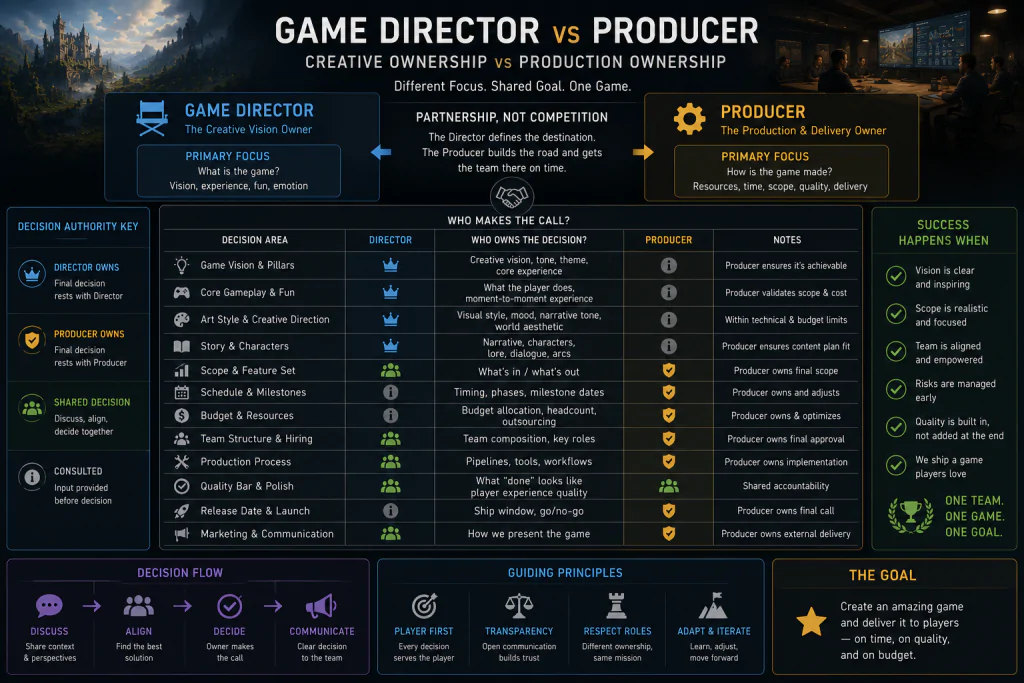
If the producer owns how the game gets made, the game director owns what it is and why it should exist in the form it does. This is creative and experiential authority — and it sits entirely separately from production authority, even when both roles report to the same executive.
The game director’s primary function is to define and maintain the unified vision of the project. That vision has to be specific enough to guide thousands of individual decisions made by dozens of people across months or years of development, without the director personally approving each one. A director who needs to be in every decision is not directing — they’re creating a bottleneck. A director who is too abstract to provide concrete guidance is not directing — they’re generating drift.
The Three Things a Game Director Decides
Vision pillars. The game director defines the core experiential goals: the things the game must be, stated specifically enough to arbitrate disagreements. «Fast, readable combat where player skill is always the differentiator» is a vision pillar. «Fun for everyone» is not. Vision pillars are the framework through which the director delegates creative authority downward — an art director, a design lead, a narrative lead can each make hundreds of decisions independently as long as those decisions can be measured against the pillars.
Content arbitration. When disciplines conflict — design wants a mechanic that requires more art passes than the schedule allows, or narrative wants a cinematic that engineering says will break the engine build — the director is the final authority on what stays, what changes, and what gets cut. This requires the director to have enough literacy in every discipline to understand the actual tradeoff, not just the summary each team presents.
Quality bar. The director defines what «good enough» means at each stage of production and enforces that standard at key review moments. A game that ships below the director’s stated quality bar is a director failure as much as a production failure.
Where Producer and Director Authority Divide
The clearest articulation: the producer cannot unilaterally decide to change the creative direction to save schedule. The director cannot unilaterally decide to expand scope without production approval. When this boundary erodes in either direction — a director who treats schedule as the producer’s problem while continuing to expand features, or a producer who forces content cuts without the director’s sign-off — production breaks down in predictable ways.
“Editorial illustration created for visual reference purposes. It does not represent a real project, client work, or official software screenshot unless stated otherwise.”
The Art Director and Creative Director: Two Kinds of Visual Authority
Art Director and Creative Director are often treated as interchangeable titles. They are not.
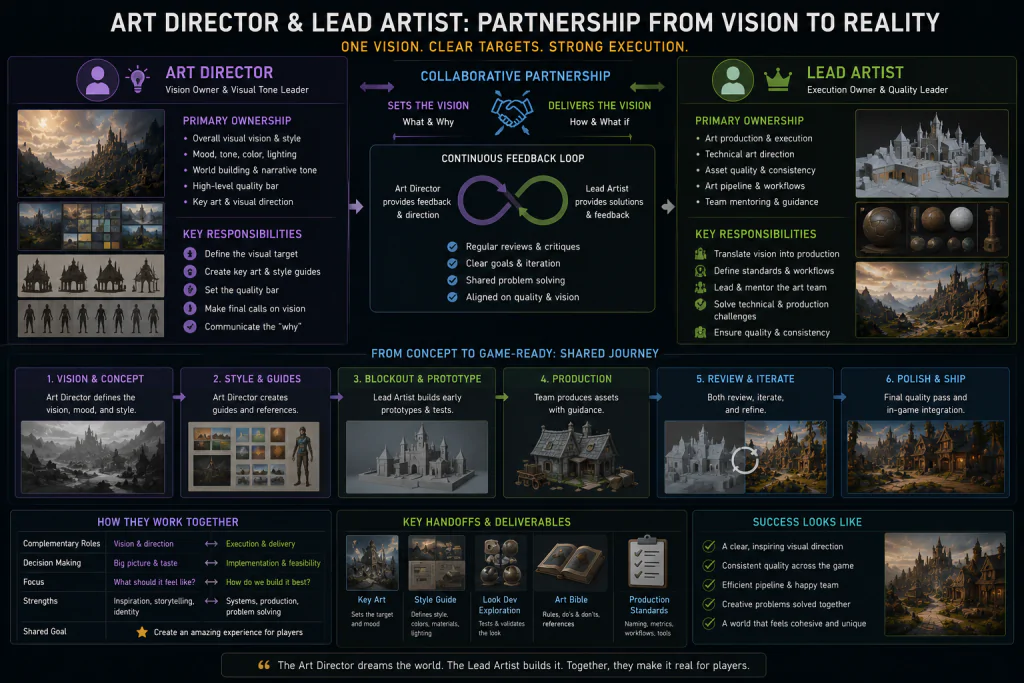
The Art Director owns visual execution authority: defining the look of the game through style guides, reference packages, and approval of art assets at production quality. An Art Director knows what each surface should look like, what the lighting targets are, what the character silhouette language is, and whether the third environment location drifts from the first. Their authority is specific and visual.
The Creative Director owns the broader experiential and thematic identity: the emotional tone, the narrative framing, the relationship between art, audio, design, and story in creating a unified player experience. A Creative Director doesn’t review individual asset quality — they review whether the assembled experience communicates the intended feeling.
In practice at mid-core studios, these roles frequently merge into a single Art Director who carries both responsibilities. At AAA scale, they are separate positions with distinct reporting structures and review cadences. The failure mode when they’re conflated at AAA scale: an Art Director who is excellent at per-asset quality review gets pulled into thematic and narrative alignment conversations they’re not positioned to arbitrate, while the holistic creative direction loses a dedicated owner.
What the Art Director Actually Reviews
Not every asset. An Art Director at production scale cannot personally approve 800 environment assets across a mid-core title. What they actually own:
- Style guide authorship and maintenance. The style guide is the Art Director’s primary tool for distributing visual decision-making. A weak style guide forces the Art Director into every decision. A strong one lets leads and senior artists make consistent decisions independently.
- Milestone quality reviews. Formal review passes at defined production gates, not continuous individual-asset approval.
- Vendor visual alignment. When external art partners are producing assets, the Art Director’s style guide and reference materials are what the vendor works from. The quality of this handoff — including clarity of reference, specificity of technical requirements, and feedback on first-pass batches — directly determines whether outsourced assets integrate cleanly or require costly rework cycles.
The Lead: Discipline Ownership in the Middle of the Hierarchy
The Lead role — Lead Artist, Lead Environment Artist, Lead Animator, Design Lead, Lead Programmer — is the most structurally critical and least glamorous position in game production.
Leads sit between the art director’s vision and the production floor’s execution. They translate quality targets into specific technical requirements. They own the day-to-day functioning of their discipline team: task assignment, review of in-progress work, identification of technical problems before they reach the art director or producer, and mentorship of junior team members.

“Editorial illustration created for visual reference purposes. It does not represent a real project, client work, or official software screenshot unless stated otherwise.”
Gamedeveloper.com’s documentation on lead artist methodologies identifies the core technical responsibilities clearly: the lead handles art processes, tools, geometric and texture budgets, task definitions, and scheduling of tasks within the discipline. They communicate with the lead programmer and the producer to identify risk in the production pipeline. They protect the art team from counter-productivity.
The Lead Is Not a Senior Artist Who Reviews Work
The most common lead failure mode: hiring the strongest individual contributor in the discipline into the lead role, and expecting that seniority in craft translates to seniority in coordination. It often doesn’t. A lead who spends 80% of their time producing assets and 20% reviewing others’ work is an expensive senior artist, not a functioning lead. The lead’s primary output is team velocity — the rate at which the discipline is producing quality work — not their personal asset count.
How the Lead Interfaces with External Partners
When a studio outsources a discipline’s production to an external vendor, the lead on the internal side owns the technical specification for that work: polycount budgets, UV requirements, naming conventions, delivery format, and QA criteria. A lead who can’t articulate these requirements in a written brief is creating ambiguity that will show up as first-pass rejection rates and rework cycles on the other side. In our production experience working with leads across multiple mid-core and AAA productions, the single most reliable predictor of outsource success is brief quality — and brief quality is a lead responsibility.
The Technical Artist: The Role That Prevents Production Disasters
The Technical Artist is one of the most undervalued roles in mid-core and AAA production, and the one whose absence creates the most invisible damage.
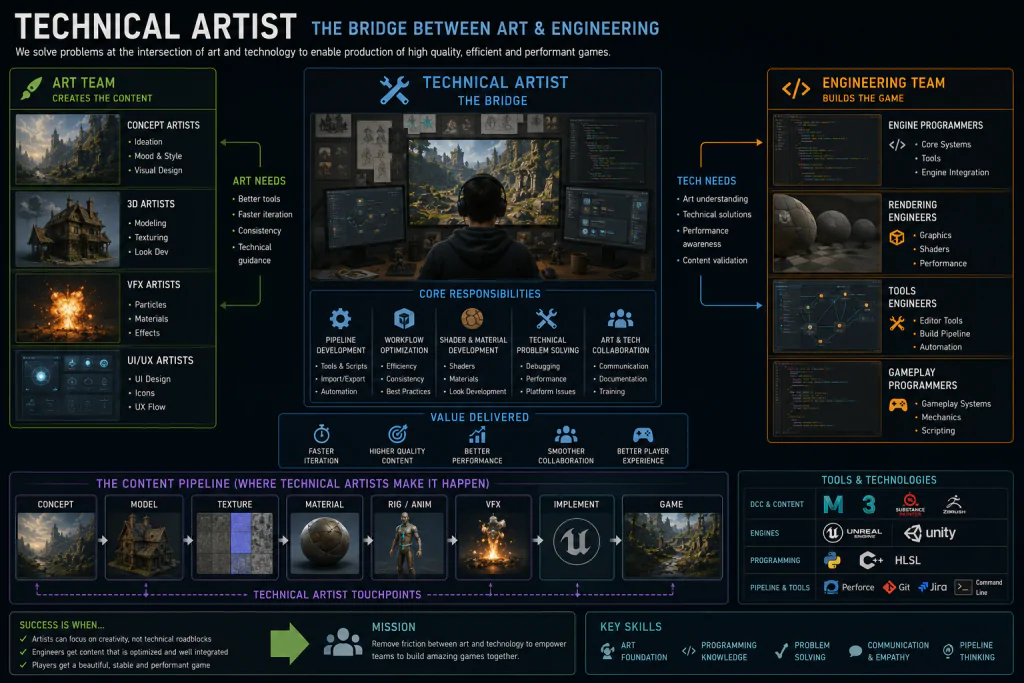
The Technical Artist’s function, as articulated in Volition’s foundational analysis of the role on gamedeveloper.com, is to serve as the pipeline and systems architect sitting between the art team and the engineering team. They are not primarily a content creator. They are not primarily an engineer. They are the person who understands both domains well enough to design the workflows, tools, and handoff protocols that let the other roles function efficiently.
“Editorial illustration created for visual reference purposes. It does not represent a real project, client work, or official software screenshot unless stated otherwise.”
What this looks like in practice:
Shader and material development. When an Art Director defines a visual target that requires a specific material behavior — surface weathering that responds to lighting in a particular way, or a stylized water shader — the Technical Artist translates that artistic requirement into a technically feasible, performance-compliant shader that artists can use without writing code.
Pipeline architecture. Every asset that moves from a DCC tool (Maya, ZBrush, Substance Painter) into the game engine passes through a pipeline: export settings, naming conventions, folder structures, LOD generation, collision setup. When that pipeline is poorly designed, every single asset in production is affected. The Technical Artist designs and maintains that pipeline, identifying inefficiencies and implementing fixes before they compound across hundreds of assets.
The tech-art bridge in vendor workflows. This is where the Technical Artist’s role becomes directly relevant to outsource production. When external art partners deliver assets into a studio’s engine, those assets must conform to the studio’s technical requirements: correct mesh topology for the target LOD strategy, UV layout matching the studio’s texel density standards, material setups compatible with the master material library. The Technical Artist defines these requirements, validates incoming assets against them, and resolves integration problems that content review alone doesn’t catch. Studios working with external art vendors without a Technical Artist managing the integration layer consistently report higher rework rates and slower asset integration timelines.
The Role That Connects Them: The Outsource Producer
At mid-core and AAA studios running significant outsource pipelines, a role distinct from the general producer often emerges: the Outsource Producer or Outsource Coordinator.
This role owns the operational relationship with external vendors: managing the brief handoff, tracking delivery against agreed schedules, coordinating feedback cycles, and ensuring that outsourced assets meet the quality and technical standards defined by the Art Director and Technical Artist before they reach the integration pipeline.
The Producers Guild of America’s production credit documentation formally recognizes this function, noting that the Outsource Producer manages relationships with external partners and third parties responsible for creating specific parts of the game, coordinating with external vendors to ensure outsourced work meets quality standards and integrates into the main project.
A studio without a dedicated owner for this function — where outsource coordination is handled ad hoc by whoever is available — reliably produces specific failure patterns: unclear briefs that generate high first-pass rejection rates, feedback that contradicts itself between rounds because different internal reviewers are commenting without coordination, and integration delays because vendor assets haven’t been validated against technical requirements before delivery acceptance.
How Studio Scale Changes Everything
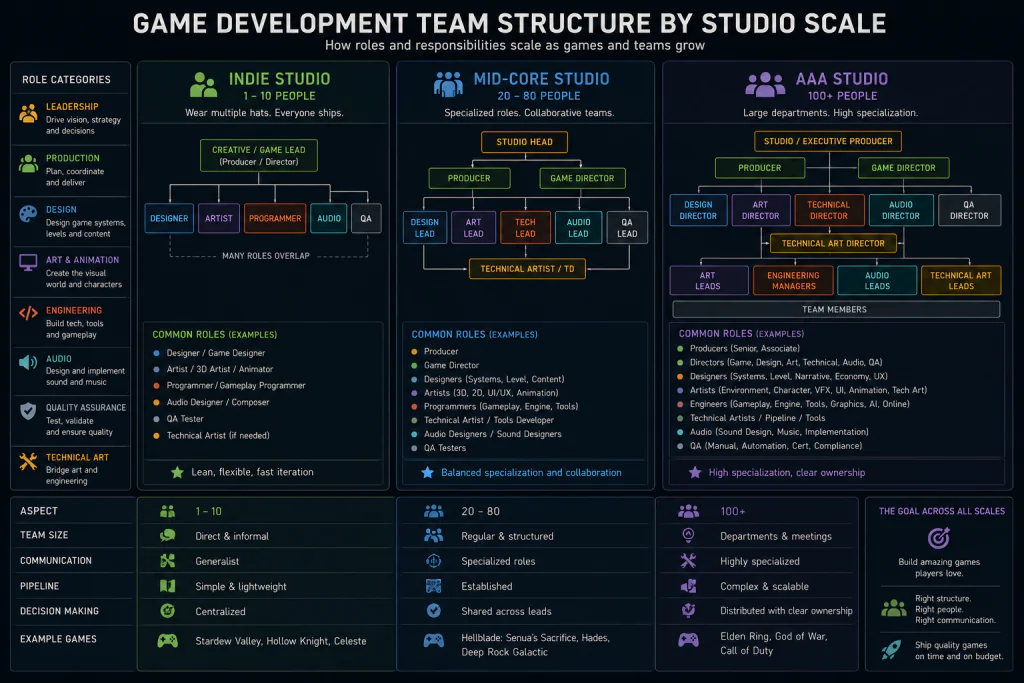
The roles above don’t exist in fixed form — they expand, contract, and merge based on studio size. Understanding this is essential for any producer or studio lead hiring for these positions or evaluating a vendor’s team structure.
“Editorial illustration created for visual reference purposes. It does not represent a real project, client work, or official software screenshot unless stated otherwise.”
| Studio Scale | Typical Role Consolidation | Primary Risk |
| Indie (2–10 people) | One person holds Producer + Director; one artist may be Lead + Tech Art | Single point of failure on every decision; no separation of creative and production authority |
| Small studio (10–30) | Producer and Director separate; Lead roles emerging; Tech Art often a senior artist doing tech work informally | Leads promoted from craft before coordination skills are established; Tech Art responsibility falls to engineers by default |
| Mid-core (30–80) | Full producer layer, Art Director, dedicated Leads per discipline, at least one Technical Artist | Leads become bottlenecks when scope increases faster than the team; Tech Art under-resourced relative to pipeline complexity |
| AAA (80–300+) | Full specialization: Executive Producer, Producers per feature area, Game Director, Creative Director, Art Director, Discipline Directors, Lead per sub-team, Technical Art team | Coordination overhead grows faster than production capacity; role boundaries become political; communication latency between vision and execution |
The practical implication for a producer running a mid-core production: you are operating at the scale where every role gap creates a specific, predictable problem. A mid-core studio without a dedicated Technical Artist is engineering performance issues it won’t find until late in production. A mid-core studio where the Art Director is also functioning as a Lead is either under-reviewing assets or over-producing them personally. A mid-core studio without a clear outsource ownership function is creating vendor management problems that will compound on every milestone.
Decision Authority Matrix
| Role | Owns | Does Not Own | Red Flags When Missing |
| Game Producer | Scope, schedule, capacity, risk escalation, vendor coordination | Creative direction, content decisions, visual quality bar | Missed milestone gates; scope creep unchecked; outsource assets arriving out of spec without anyone managing the gap |
| Game Director | Creative vision, content arbitration, quality standard | Production timeline, budget, team capacity | Feature drift; inconsistent player experience; teams making creative decisions in a vacuum |
| Art Director | Visual target, style guide, art quality reviews | Production scheduling, pipeline architecture, engineering feasibility | Style drift across locations; outsourced assets inconsistent with in-house; art reviews consuming too much director time |
| Discipline Lead | Team velocity, brief quality, in-progress QA, pipeline compliance | Creative direction, hiring decisions (typically), budget | Assets entering final review with unresolved technical problems; outsource briefs too vague to produce correct first-pass |
| Technical Artist | Pipeline architecture, shader development, asset integration, tool development | Content creation volume, creative direction | High rework rates on outsourced assets; integration delays; engineers pulled into art pipeline problems |
How These Roles Work With External Art Partners
Understanding what these roles actually own also clarifies how an external art vendor should interface with each of them — and why integration breaks down when the interface is unclear.
Producers handle the operational relationship: milestone schedules, delivery tracking, feedback turnaround SLAs, and escalation paths when delivery is at risk. An external vendor that escalates creative feedback to the producer is communicating to the wrong person. An external vendor that escalates a schedule risk to the Art Director is also communicating to the wrong person.
Art Directors define what the work should look like and own style guide sign-off. The external team works from the Art Director’s reference package. First-pass rejection rates are a direct measure of how clearly the Art Director’s standards were communicated before production started, not just how capable the external team is.
Leads own the technical brief — the specific, measurable requirements the vendor’s assets must meet. Polycount targets per asset category, UV conventions, naming structure, delivery format, LOD specifications. A vendor receiving a Lead-authored brief that is complete and unambiguous will produce higher first-pass approval rates than a vendor working from a brief assembled informally from multiple sources.
Technical Artists validate incoming assets against integration requirements before acceptance. Studios that skip this validation step — accepting assets based on visual review alone and discovering technical non-compliance during engine integration — pay for that shortcut in rework time that is typically two to four times the cost of the original validation.
Asset Import Pipeline: Maya/Blender → UE5/Unity
Every engagement starts with a role mapping conversation: who is the producer managing the vendor relationship, who is the Art Director whose style guide we’re working from, who is the Lead authoring the technical brief, and who is the Technical Artist validating our deliveries. Studios that can answer those four questions clearly at kickoff consistently run more efficient outsource pipelines. Our experience across projects including Squad, Ready Or Not, Mutant Year Zero: Road to Eden, Starship Troopers: Extermination, and Miasma Chronicles has made that conversation a prerequisite for every engagement.
If your production structure needs art direction standards that transfer cleanly to an external team, or a vendor that understands how technical art connects design, content production, and engine implementation, let’s talk about how we fit into your specific team structure.
[BANNER: about-us-bottom]
Game Production Roles at a Glance: Comparison by Function
| Role | Primary Focus | Key Deliverable | Reports To | Works Most Closely With |
| Game Producer | Process, schedule, capacity | Shipped game on time and in scope | Executive Producer / Studio Head | Director, all Leads, vendors |
| Game Director | Creative vision, content decisions | Unified player experience | Executive Producer / Studio Head | Producer, Art Director, Design Lead |
| Art Director | Visual standard, style guide | Consistent visual target across all art | Game Director | Leads, Technical Artist, external vendors |
| Creative Director | Thematic and experiential identity | Emotional and narrative coherence | Game Director / Studio Head | Art Director, Narrative Lead, Audio Director |
| Discipline Lead | Team velocity, brief quality, daily QA | Discipline output meeting spec | Art Director / relevant Director | Technical Artist, Producer, junior team members |
| Technical Artist | Pipeline architecture, shader and tool development | Efficient, compliant asset pipeline | Technical Director / Lead Technical Artist | All art disciplines, Engineering |
Conclusion: Clarity of Role Is a Production Asset
A game development team where everyone understands what each role owns — and what it doesn’t — moves faster, makes better decisions under pressure, and runs more efficient vendor relationships than one where those boundaries are ambiguous.
The producer who knows their authority is scope and schedule, not creative content, can enforce milestone gates without becoming a creative dictator. The art director who has a strong style guide can delegate visual decisions to leads without losing consistency. The technical artist who has clear ownership of the pipeline can prevent integration failures before they compound. The lead who can write a precise technical brief can get correct first-pass work from external vendors instead of expensive revision cycles.
If your production is planning a Q3 environment or character art push and you want to run a 48-hour pipeline compatibility check — send us your technical brief and current asset spec, and we’ll tell you exactly where the integration points between your pipeline and ours are, what we’ve seen go wrong in similar configurations, and what we’d propose to address it.
Send us your production brief → | Or schedule a 30-minute call with our art lead directly.