Pre-Production in Game Development: What to Lock Down Before Production
-

Written byDenys Zadoienyi
-

Updated on12.06.2026
-

Time to read12 min

- Why treating pre-production as “just planning” breaks the project
- What to actually lock down in pre-production
- The pre-production deliverable matrix — and where it goes wrong
- Where the trap hides: discovery phase vs pre-production
- The vertical slice: the gate into full production
- How to scope pre-production without over- or under-investing
- How we approach pre-production at Nasty Rodent
- Discovery vs pre-production vs production at a glance
- How to get pre-production right
The pre-production phase in game development is where a project’s budget, schedule, and risk profile are actually decided — long before the first production asset is ever built. By the time a team is in full production, most of the expensive decisions have already been made. They were made here, in the phase that looks the least like “making a game” and matters the most to whether the game ships.
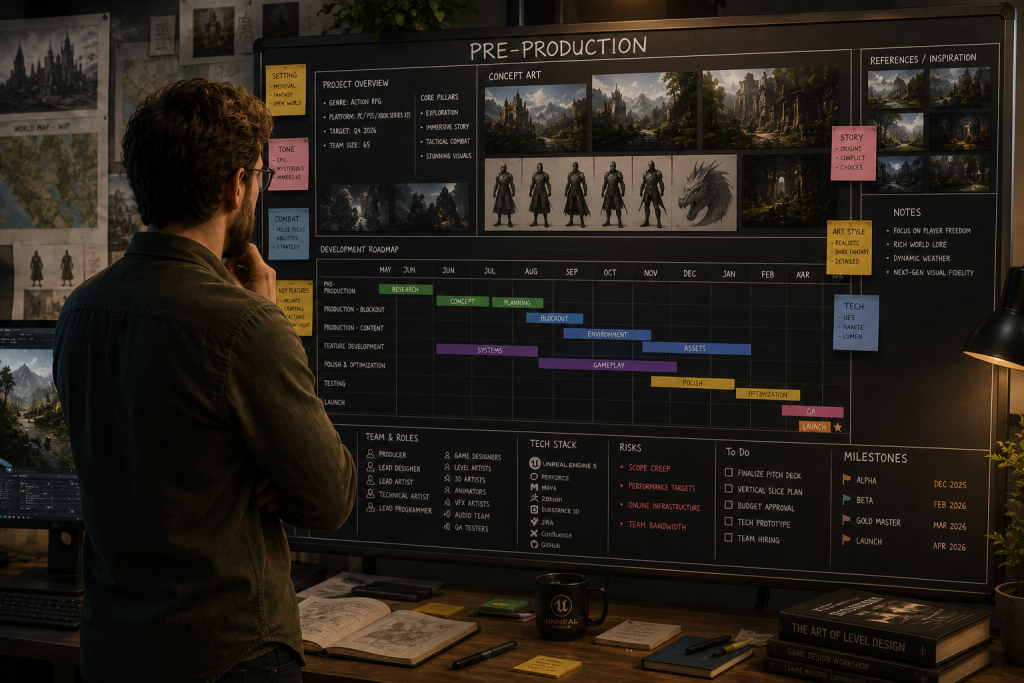
“Editorial illustration created for visual reference purposes. It does not represent a real project, client work, or official software screenshot unless stated otherwise.”
Denys Zadoienyi — Production Lead, Nasty Rodent. A decade supporting mid-core and AAA art pipelines across full-cycle production. I’ve watched well-funded projects stall at the first milestone gate because pre-production was treated as a formality instead of the place where scope and risk get bought down. [LinkedIn profile — operator to insert]
Pre-production is the planning phase of a game project: the stage where a team turns an idea into a validated concept, a game design document (GDD), early prototypes, and a production plan. Its goal is not to build the game but to prove the game is worth building — and to define exactly how it will be built once full production begins.
Why treating pre-production as “just planning” breaks the project
The most common mistake I see is a team that treats pre-production as a box to tick before the “real” work starts. They write a GDD, sketch some concept art, and rush into production because the calendar is pressuring them. Then, eight to twelve weeks into production, cracks begin to show: a core mechanic that read well on paper isn’t fun, an art style that looked striking in a single frame doesn’t hold up across a full environment, and a scope that felt achievable quietly doubled.
Here is what that costs a producer in practical terms. Depending on scope and studio model, producers often estimate pre-production at roughly 10–20% of the total timeline — though the range varies significantly across indie, mobile, live-service, and AAA projects. The point isn’t the exact percentage; it’s that a relatively small slice of calendar disproportionately determines the rest.
When that slice is skipped or compressed, the rework doesn’t disappear. It migrates downstream into full production, where every hour is more expensive because the team is fully staffed and the dependencies are deeper.
On the projects we’ve supported, a scope or vision problem caught during pre-production might cost a few prototype weeks; the same problem caught after content production has ramped can cost a milestone gate and force a partial restart. A vendor switch or pipeline reset mid-production routinely runs to a meaningful fraction of the original budget — not because anyone was careless, but because the decision that caused it was made in the wrong phase. For a producer, that is the difference between a defensible risk register and a conversation with stakeholders you do not want to have.
What to actually lock down in pre-production
Pre-production is not a vague “ideation” period. It produces concrete deliverables that a producer can review, sign off, and use to scope the production plan. In my experience, the teams that move into production cleanly are the ones that treat each of these as a gate, not a suggestion.
Common outputs of game pre-production often include:
- Design pillars — the three to five non-negotiable ideas the game cannot exist without. Pillars are the scope razor; every later feature request gets measured against them.
- Game Design Document (GDD) — the living blueprint of what the game is, how it plays, and why it’s fun. It evolves, but its core has to be stable before production.
- Validated prototypes — playable proof that the core mechanics work. Not polish; proof.
- Concept art and an art bible (visual style guide) — the visual target and the rules that keep it consistent. This is where the game’s look is committed, and it feeds directly into character art production and the environment work that follows.
- A production plan, budget, and schedule — capacity, headcount, milestones, and a contingency buffer mapped to the real scope, not the optimistic one.
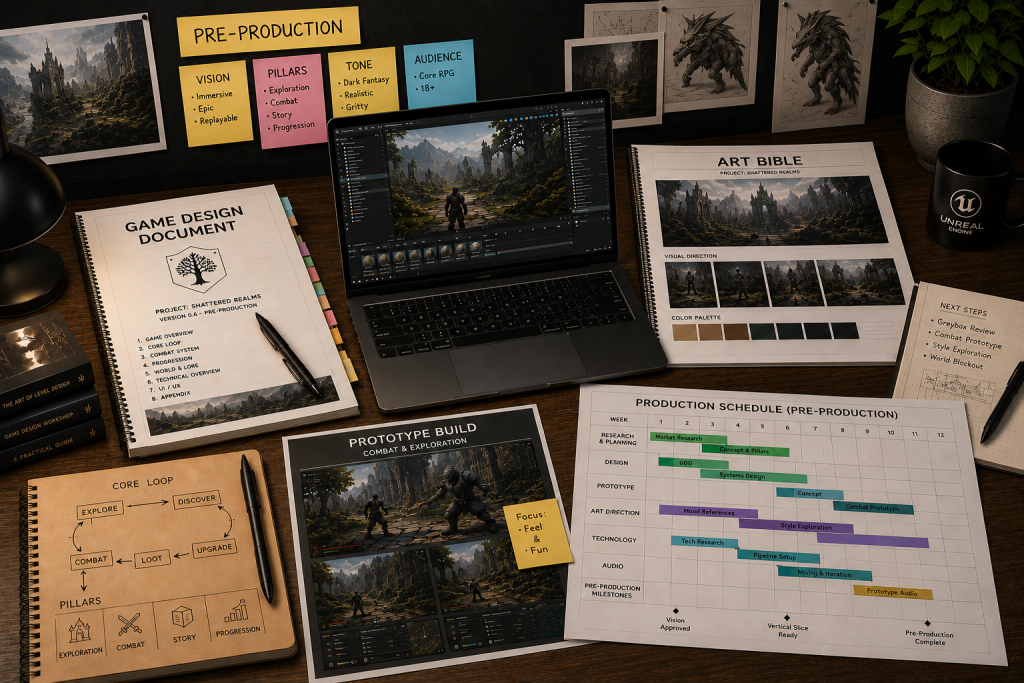
“Editorial illustration created for visual reference purposes. It does not represent a real project, client work, or official software screenshot unless stated otherwise.”
A useful discipline here comes straight from production postmortems. A widely shared write-up on Maxis’s Spore development captured the mindset bluntly: when you are in pre-production, “you’re not making the game.” The prototypes you build are meant to be thrown away — their job is to answer a question and buy down risk, not to become final assets. Teams that forget this turn pre-production into slow, expensive early production, and lose the entire point of the phase.
Did you know that…?
the throwaway prototype is a feature, not a waste. The Spore team famously built and discarded an elaborate early prototype, then rebuilt the core idea as a crude two-dimensional version that one person finished in about a month — and learned more from the cheap one. Cheap, fast, and disposable is the whole economic argument for pre-production.
The pre-production deliverable matrix — and where it goes wrong
Each deliverable has a clear purpose and an equally clear failure mode. This is the table I’d hand a producer who wants to know what “good” looks like at a glance — and what the red flags are when a review is approaching.
| Deliverable | What it proves | Good signal | Red flag |
| Design pillars | The game has a defendable core | 3–5 pillars, each one sentence, used to reject features | Pillars are vague adjectives (“fun”, “immersive”) that reject nothing |
| GDD | Shared understanding of the design | Living doc, owned, referenced in reviews | A 100-page doc written once and never opened again |
| Prototype | The core loop is actually fun | Throwaway builds answering specific questions | “Prototype” is secretly first production, polished and precious |
| Concept art / art bible | The visual target is achievable | Style holds across multiple assets, not one hero frame | One stunning frame, no rules for consistency |
| Production plan & budget | The scope is fundable and schedulable | Capacity, milestones, and contingency mapped to real scope | Schedule built on the optimistic scope with no buffer |
If two or more of these columns are showing red flags, that is not a polish problem to fix later. It is a signal that the project is not ready to leave pre-production — and pushing it forward anyway is the decision that surfaces as a failed gate review a quarter from now.
Where the trap hides: discovery phase vs pre-production
The terms discovery phase and pre-production get used interchangeably across the industry, and the conflation hides a real distinction that matters to a producer’s planning. The cleanest way I’ve heard it framed: discovery is about asking the right questions; pre-production is about committing to the right answers.

The discovery phase in game development is the earliest, lowest-commitment slice — sometimes run as a standalone engagement. It clarifies the vision, validates the market, checks technical feasibility, and aligns stakeholders on what the game is and whether it’s worth pursuing. It is deliberately cheap relative to the cost of building the full game, and its outputs — a GDD draft, concept art, wireframes, a rough production plan — are designed to be portable. A studio can run discovery, hand you everything it produces, and you can decide to build in-house, take it to another partner, or stop. That optionality is exactly why discovery exists: it de-risks the biggest decision before any serious money is committed.
Pre-production then takes those answers and turns them into a production-ready foundation: stable pillars, a validated prototype, a committed visual target, and a schedule the team will actually be held to. In many studios — especially indie and smaller teams — the two phases overlap heavily or merge into one, but a useful production distinction holds: discovery leans toward whether and what, pre-production toward how and how much. A producer who collapses the two into one rushed step loses the cheapest opportunity they will ever have to kill a bad idea or reshape a risky one. This is also the stage where early environment production planning pays off — deciding how worlds will be built before the build actually starts.
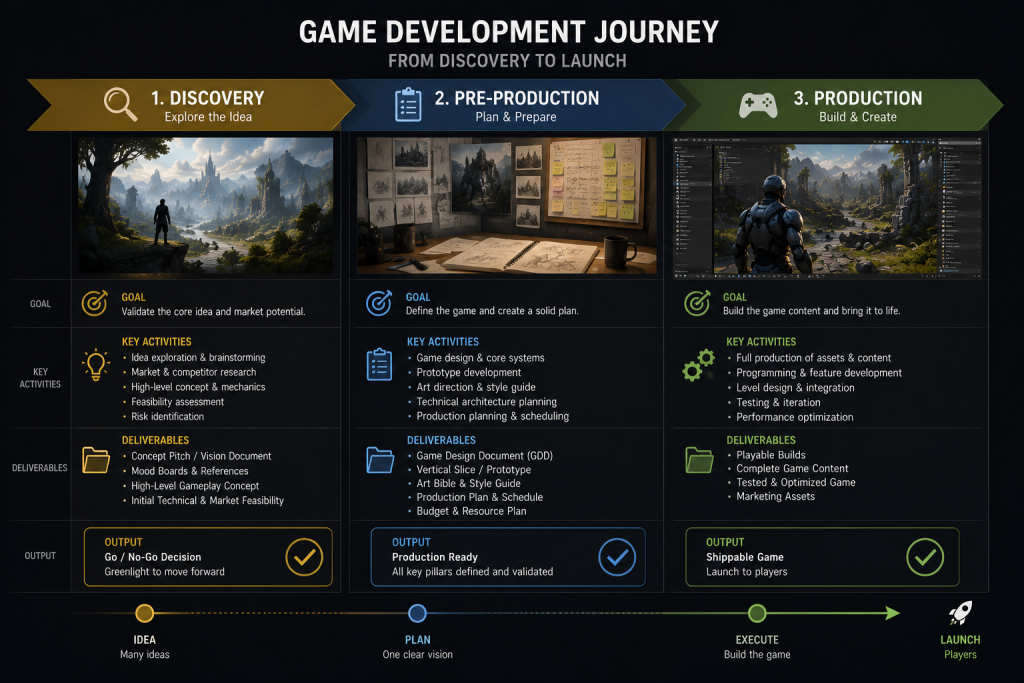
“Editorial illustration created for visual reference purposes. It does not represent a real project, client work, or official software screenshot unless stated otherwise.”
The vertical slice: the gate into full production
The single most useful artifact for a producer in this phase is the vertical slice — a short, near-final-quality section of the game that contains the real core loop, real art, and real systems working together. It is the proof that the team can deliver the quality the GDD promises, and it is the basis for the most important estimate in the project: how long and how much the rest of the game will take.
More to the point, the vertical slice functions as a decision gate. A GDC talk from Volition framed it exactly this way — the vertical slice (or proof of concept) is the tool a team uses to decide whether it is ready to move from pre-production into full production. It has to satisfy both internal confidence and external stakeholders, and it demonstrates that the team understands what it’s making and how to make it. On many projects, funding has to be secured by the end of the vertical slice; miss that, and the team can run out of runway before production even properly begins.
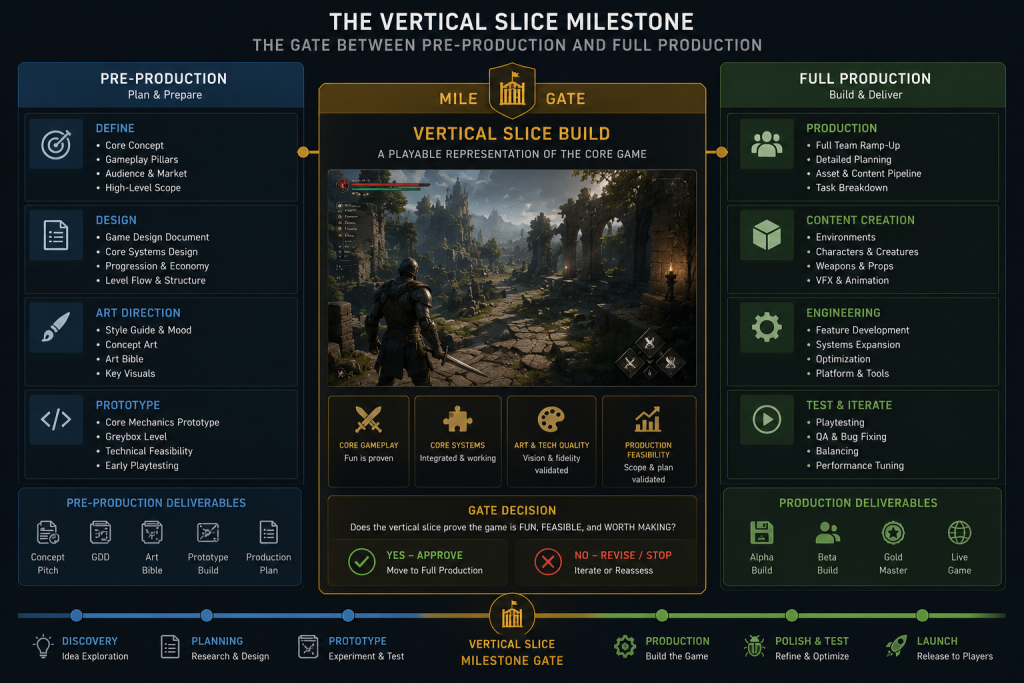
“Editorial illustration created for visual reference purposes. It does not represent a real project, client work, or official software screenshot unless stated otherwise.”
For a producer, this is where pre-production stops being abstract. The vertical slice is the green-light gate: pass it, and you have a defensible production plan, a real schedule, and a risk register you can stand behind. Skip it, and you are committing a fully staffed team to a scope nobody has actually proven.
How to scope pre-production without over- or under-investing
The honest answer is that there is no universal duration — the phase scales with project complexity, ranging from a few weeks on a small title to the better part of a year on an ambitious one. What you can control is discipline. A few principles I’d give any producer planning this phase:
- Time-box it, but tie the box to gates, not the calendar. On many mid-core and AAA pipelines, the gate that ends pre-production is a successful vertical slice review, not a calendar date. If the date arrives first, that’s information, not a reason to skip the gate.
- Keep the team small and senior. This is a producer, a few programmers, concept artists, and a tech lead — not the full crew. The expensive headcount ramps after the gate, not before.
- Build several cheap prototypes, not one expensive one. Break the game into its core systems and prototype them separately. Throw most away.
- Decide your resourcing model here, not later. The art volume your concept implies rarely matches the headcount you actually have. Whether you close that gap by hiring, by deciding between an in-house team and an outsourcing partner, or with a hybrid model is a pre-production decision — making it under production pressure is how teams end up with the wrong structure for the project in front of them.
- Treat the move into production as a contract. When pre-production hands off to production, the pillars, the asset spec, and the schedule become the agreement every downstream team works against. A clear, gated 3D character production pipeline is what keeps that handoff from quietly accumulating rework at the worst point in the schedule.
How we approach pre-production at Nasty Rodent
I described the trap above — pre-production rushed, the visual target half-committed, the scope optimistic — because we see the consequences when teams come to us mid-production to recover. Nasty Rodent is a full-cycle game art studio based in Tallinn, Estonia (Nasty Rodent OÜ), and the way we engage early is built to close exactly that gap.
When a team is still shaping its concept, we work as the visual side of discovery and pre-production: concept art, style exploration, and an art bible that turns a vague look into a production-ready visual target, plus early planning for how those assets will actually be built. That kind of work depends on a visual direction being locked before pipelines scale — something we’ve done across mid-core and AAA projects such as Squad, Ready or Not, and Mutant Year Zero: Road to Eden.
For a producer, the payoff is a cleaner handoff into production: a full-cycle game art pipeline where the concept validated in pre-production survives all the way to the final asset, instead of drifting once the team scales.
If you’re shaping a concept right now, that’s where we start. Our game concept art services are structured to feed straight into the production pipeline rather than sit in a folder.
Discovery vs pre-production vs production at a glance
| Stage | Core question | Main deliverable | Who’s involved | Exit gate |
| Discovery | Should we build this, and what is it? | GDD draft, concept art, feasibility, rough plan | Small core + stakeholders | Decision to proceed |
| Pre-production | How do we build it, and how much? | Pillars, GDD, prototypes, art bible, production plan | Producer, small senior team | Vertical slice review |
| Production | Build the full game | All levels, assets, features | Fully staffed team | Content complete / alpha |
How to get pre-production right
The teams that ship are not the ones with the biggest pre-production budgets — they’re the ones that treat the phase as a series of gates: pillars that reject features, prototypes that answer questions, a visual target that holds, and a vertical slice that earns the green light. Get those right and full production becomes execution against a plan you can defend. Get them wrong and production becomes an expensive search for the answers you skipped.
If you’re scoping pre-production now and the art volume your concept implies doesn’t match the team you have, that’s the conversation worth having early. We can run a short pipeline-compatibility review of your concept and target spec against how we build production assets — where the visual direction is solid, where the gaps are, and what a clean handoff into production would look like. No budget and no commitment required; just send a rough brief and we’ll come back with a concrete read.