What Is Unreal Engine 5? Features, Workflow Changes, and Production Impact
-

Written byDenys Zadoienyi
-

Updated on11.06.2026
-

Time to read27 min


- Why UE5 Is Not an Upgrade—It’s a Different Production Model
- Nanite: Virtualized Geometry and What It Changes for Art Production
- Lumen: How Fully Dynamic Global Illumination Works in Practice
- The Supporting System Stack: Virtual Shadow Maps, TSR, World Partition, and the Rest
- MetaHuman, PCG, Substrate, and MegaLights: The Maturing Toolset
- What UE5 Means for Game Art Production Teams
- Where UE5 Has Limits: An Honest Assessment
- Feature Status Matrix: UE5.7 Production Readiness
- Our Approach to UE5 Art Production at Nasty Rodent
What is Unreal Engine 5? In brief: UE5 is Epic Games’ real-time 3D creation platform, released in 2022, that fundamentally changed how game environments are built, lit, and delivered. Its core technologies—Nanite virtualized geometry and Lumen dynamic global illumination—remove two of the most constraining bottlenecks in game art production: the manual LOD pipeline and the pre-baked lighting cycle. For studios building high-fidelity games, it has become one of the primary platforms for AAA and high-fidelity game production at scale.
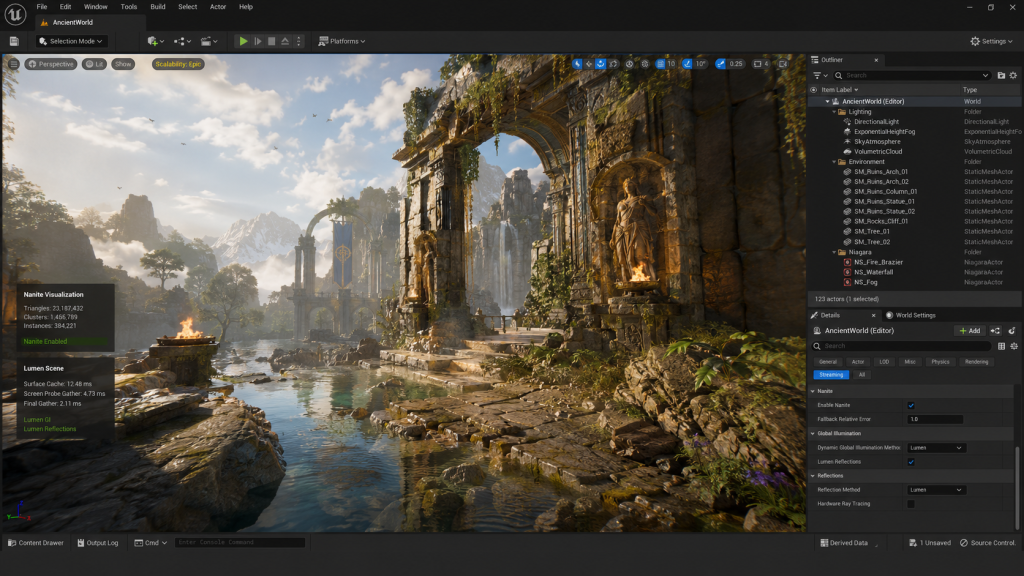
“Editorial illustration created for visual reference purposes. It does not represent a real project, client work, or official software screenshot unless stated otherwise.”
In Unreal Engine 4, a game environment artist’s day had a predictable rhythm: build the scene, bake the lightmaps—a process that could run for hours on complex scenes—wait, review the result, discover that the light placement no longer works, move a light, bake again. Every iteration on lighting was a batch process. Every new area required a new lightmap UV channel. Every high-polygon asset required manual level-of-detail variants. The more detailed the world, the more engineering overhead separated the creative decision from the visible result.
Unreal Engine 5 changes that rhythm. Lighting updates instantly. High-polygon source assets import directly. Manual LOD creation for static geometry is no longer required. These are not incremental improvements to UE4’s workflow—they are the removal of constraints that defined how game art production was structured for a decade. Understanding what UE5 actually is, what each of its major technologies does, and where its current limits lie is now prerequisite knowledge for any art director, technical art lead, or outsource manager working on a production that targets the platform.
This guide covers the complete feature set of Unreal Engine 5 through the current production cycle, with explicit attention to the production-ready status of each major system, the art pipeline implications that most introductory guides omit, and an honest accounting of where UE5 is still maturing.
Unreal Engine 5 is Epic Games’ fifth-generation real-time 3D creation platform, released in full production-ready form in April 2022 and actively updated through the 5.x series. It is a complete development environment for games, film, architecture visualization, and interactive media, built around a set of rendering and world-building technologies—most prominently Nanite virtualized geometry and Lumen global illumination—that fundamentally alter the relationship between asset complexity, lighting fidelity, and real-time performance. UE5 is now widely adopted across AAA and high-fidelity game production pipelines, with adoption accelerating significantly across the industry since 2023.
UE5 at a glance — what each major system removes or adds:
- Nanite → removes manual LOD creation for static geometry; assets import at film-quality polygon counts
- Lumen → removes pre-baked lightmap cycles; global illumination updates in real time
- Virtual Shadow Maps → removes shadow map resolution tradeoffs; film-quality shadows at scale
- World Partition → removes open-world streaming architecture limits; enables continuous large worlds
- MetaHuman → production-ready digital human pipeline with facial animation and rigging built in
- PCG Framework → procedural environment population at production scale (production-ready as of UE5.7)
- Substrate → modular, physically accurate material authoring replacing UE4’s legacy shading model (production-ready as of UE5.7)
Each section below covers what these changes mean in practice for art production teams.
Why UE5 Is Not an Upgrade—It’s a Different Production Model
The most important thing to understand about UE5 is the thing that most comparisons with UE4 understate: the change is not primarily about visual quality, though visual quality is higher. The change is about what constraints no longer exist in the production pipeline—and the new constraints that have replaced them.
In UE4, the core production assumptions were: geometry must be managed through manual LOD systems; lighting must be pre-baked for static scenes; shadow quality is a balance between map resolution and performance cost; and the polygon budget for any scene is a hard ceiling the art team must design around. Every one of these assumptions is false in UE5 for typical modern production scenarios.
The geometry constraint is gone for static assets. Nanite handles virtualized rendering of high-polygon geometry, meaning an environment asset with several million polygons renders at effectively the same performance cost as one with tens of thousands—provided the material is opaque or masked, and the asset meets Nanite’s specifications.
The lighting bake cycle is gone for dynamic scenes. Lumen provides fully dynamic global illumination and reflections that update in real time. Moving a light source produces an immediate visual result. Time-of-day transitions do not require rebaking. The feedback loop that previously took hours now takes milliseconds.
The shadow map resolution tradeoff is gone for supported hardware. Virtual Shadow Maps maintain film-quality shadow resolution at scale, rendering only the shadow detail relevant to the current view rather than pre-computing a fixed-resolution shadow map for the entire scene.
The LOD pipeline for static mesh assets is substantially reduced. For Nanite-enabled static meshes, the engine handles continuous level-of-detail automatically through cluster streaming. Artists no longer need to produce manual LOD variants for environment props and architectural elements.
What has replaced these old constraints is a new set of requirements that art directors must understand: Nanite has specific material restrictions; Lumen has hardware requirements and remains impractical for most VR shipping scenarios; World Partition requires streaming discipline from the start of production; and several of the most exciting new systems—Nanite Foliage, MegaLights—are still experimental or in beta in recent UE5 releases. The production model changed, but it did not become constraint-free.
Nanite: Virtualized Geometry and What It Changes for Art Production
Nanite is UE5’s virtualized micropolygon geometry system, and it is the technology that most directly reorganizes how game art is created and delivered. Understanding it at production depth—including its constraints—is essential for any team building assets destined for a UE5 pipeline.
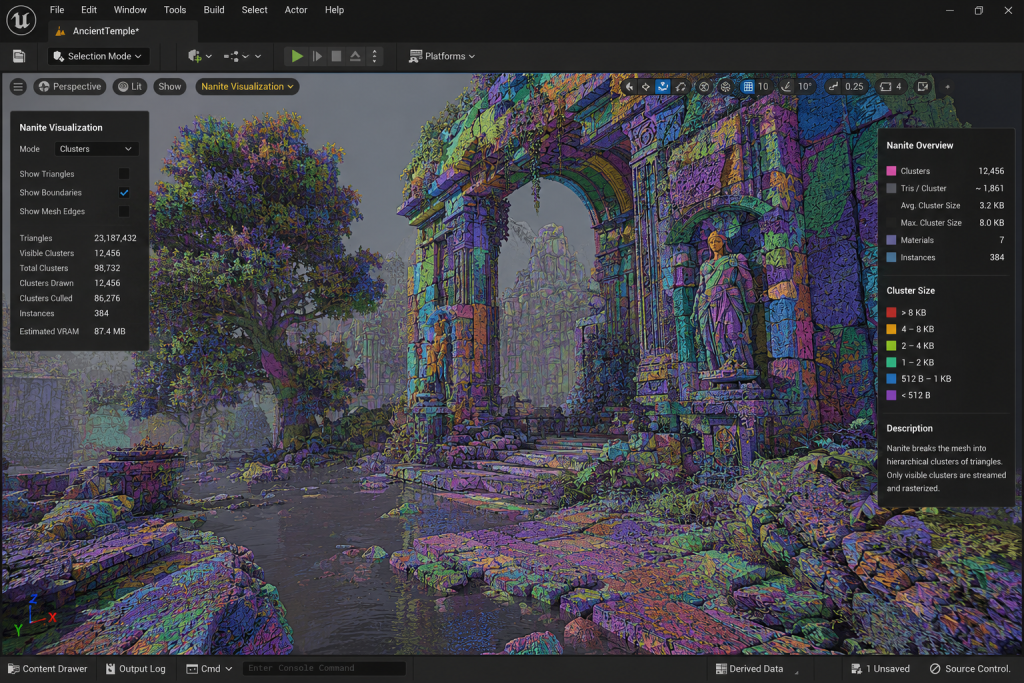
How Nanite works. Nanite renders geometry using a continuous level-of-detail system driven by a per-pixel cluster streaming mechanism. Rather than rendering a mesh’s full polygon count at any distance, Nanite’s cluster-based renderer determines, on a per-pixel basis, what level of geometric detail is needed to produce one pixel of output—and streams exactly that detail from the mesh cluster hierarchy. The result is that an asset with several million polygons and an asset with fifty thousand polygons render at comparable GPU cost when viewed at equivalent screen coverage, because both are being reduced to the same effective pixel-level detail by the streaming system.
“Editorial illustration created for visual reference purposes. It does not represent a real project, client work, or official software screenshot unless stated otherwise.”
The practical consequence for asset production is significant. Environment artists can import high-fidelity sculpts, photogrammetry scans, and film-quality source assets directly into UE5 without creating manual LOD chains for static geometry. The artist models at the detail level the asset requires; Nanite handles the runtime representation. This removes a substantial category of production labor—LOD creation, LOD review, LOD QA—from the environment art pipeline for static props and architectural elements.
For Unreal Engine environment art services, this changes both the asset specification and the review process: assets are no longer evaluated against LOD transition quality, but against Nanite cluster generation, material type, and per-pixel rendering cost in context.
What Nanite currently supports. Per the official Nanite documentation, Nanite supports materials with Opaque and Masked blend modes. Opaque materials represent the optimal path—they are processed through Nanite’s software raster bin in a single pass and are fully efficient. Masked materials (foliage, fences, fabric with alpha cutouts) are supported but each masked material requires its own raster bin, meaning more rendering passes and higher overhead. This is a production-relevant constraint: heavily masked geometry in dense open-world foliage scenes is one of the most common Nanite performance issues teams encounter in mid-core AAA production.
Translucent materials—glass, water surfaces, particle effects—are not supported by Nanite. Assets with translucent materials fall back to the standard rasterizer when Nanite is enabled. This means prop libraries for game environments with significant transparent content (architectural visualization, underwater scenes, exterior glass-heavy architecture) must explicitly account for which assets are Nanite-eligible and which are not.
Spline meshes, foliage with skeletal animation (via the Nanite Foliage experimental system), and deforming geometry with World Position Offset are supported with varying degrees of maturity. Nanite Foliage—the system that allows dense animated vegetation to use virtualized geometry rendering—shipped as experimental in UE5.7. It is not yet production-ready for shipping titles.
What Nanite changes for the outsource brief. When a studio outsources environment or prop art for a UE5 production using Nanite, the asset specification changes. The brief should no longer request multiple LOD variants for static props. Instead, it should specify: whether Nanite is enabled for this asset class; the target material blend mode (opaque preferred, masked accepted with documented justification); polygon density guidelines that produce clean cluster generation (consistent tri density in detail areas, no degenerate geometry); and the validation steps the supplier is expected to perform before delivery. You can read a detailed breakdown of these requirements in our guide to what is Nanite in Unreal Engine 5.
Did you know that…?
The “Lumen in the Land of Nanite” tech demo that Epic Games used to debut UE5 in May 2020 was not running on a game console or a high-end PC workstation—it was running in real time on a PlayStation 5 development kit, at approximately 1440p with dynamic global illumination via Lumen, without pre-baked lighting of any kind. The geometry in the cave environment contained geometry of film-quality complexity, with individual rock formations containing millions of polygons. The demo was a deliberate demonstration that the constraints that had defined real-time game rendering for the previous decade—manual LODs, baked lighting, polygon budgets—could be architecturally removed, not merely pushed further. It was released more than two years before UE5 shipped in production-ready form.
Lumen: How Fully Dynamic Global Illumination Works in Practice
Lumen is UE5’s fully dynamic global illumination and reflections system, and it represents the largest workflow change in game environment lighting since the introduction of pre-computed lightmaps. Understanding what Lumen does—and what it cannot do—determines whether a project can adopt it as the primary lighting path or needs to maintain a hybrid or baked approach.
What Lumen solves. In UE4 and earlier engines, achieving realistic indirect lighting in a game environment required pre-computing lightmaps: a time-intensive offline process that calculated how light bounced between surfaces and stored the result as texture data baked onto each static mesh. Once baked, that lighting data was fixed. Moving a light source required a new bake. Adding a window to let in more daylight required a new bake. A time-of-day system with a moving sun required either a bake per time-of-day increment (extremely expensive in storage) or a dynamic sky system with no bounced light—which looked less realistic.
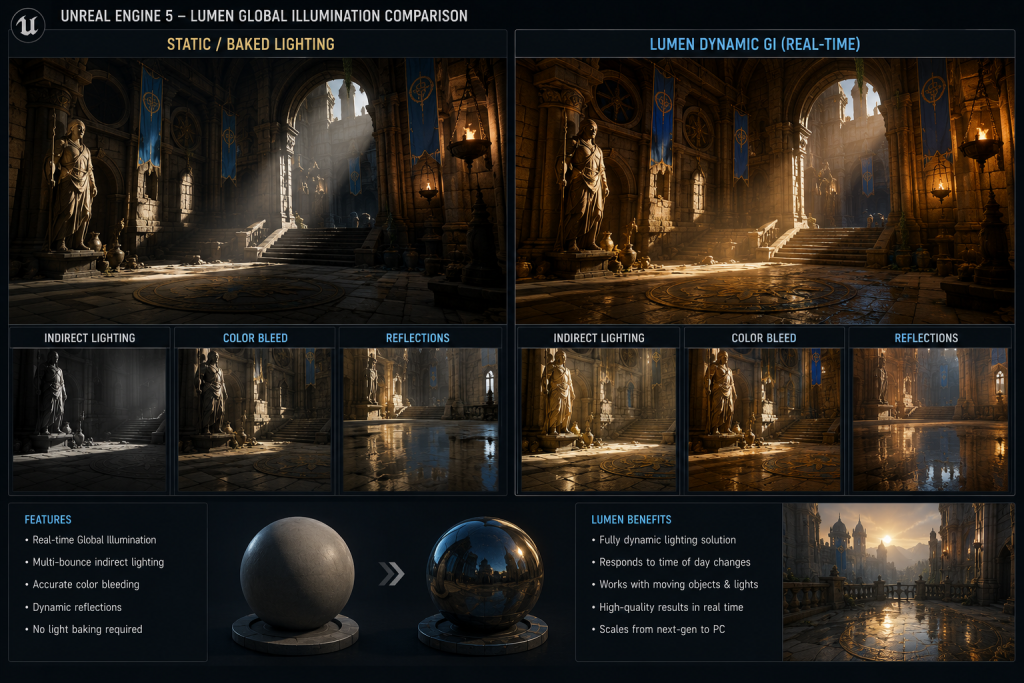
Lumen solves this through a combination of software and hardware ray tracing that runs at runtime. As documented in the official Lumen Global Illumination documentation, Lumen renders diffuse interreflection with infinite bounces and indirect specular reflections in large, detailed environments at scales ranging from millimeters to kilometers. Light bounces off surfaces, picks up the color of those surfaces (color bleed), and illuminates adjacent geometry accordingly—all updated in real time as light sources move.
“Editorial illustration created for visual reference purposes. It does not represent a real project, client work, or official software screenshot unless stated otherwise.”
The production implication is immediate and significant: environment artists and lighting artists work with live feedback. A directional light moved to represent a different time of day produces correct indirect lighting immediately. A new prop added to a room changes how light bounces in that space immediately. The iteration loop that previously required a multi-hour bake between feedback cycles now has no inherent latency.
How Lumen renders. Lumen uses two ray-tracing methods, selectable per project and scalable per platform. Software Ray Tracing uses signed distance fields derived from mesh data—it runs on a broader range of hardware (NVIDIA GTX 1070 or equivalent minimum) and is the default path for performance targets that include last-generation PCs. Hardware Ray Tracing uses dedicated ray-tracing acceleration in RTX 2000-series or higher NVIDIA cards, or AMD RX-6000 series, and provides higher quality—particularly for specular reflections and fine shadow detail in indirect light. Both modes support Lumen’s target of 60 FPS on PlayStation 5 and Xbox Series X at the High scalability level.
Lumen works in close coordination with Temporal Super Resolution (TSR): Lumen renders global illumination at a lower internal resolution (targeting 1080p) and TSR upsamples the result to 4K output. This is not a quality compromise—it is how the system is architecturally designed. Rendering Lumen at native 4K would require lower quality settings to maintain frame targets; TSR allows high Lumen quality with production-viable performance.
What Lumen does not support. For VR applications, Lumen’s support remains severely limited in practice. Epic added initial stereo rendering support for Lumen on PC using the Deferred renderer as early as UE5.1, but the official Lumen documentation still explicitly states that VR is not currently supported—because the high frame rates and dual-eye rendering requirements of VR (typically 90 FPS per eye) make the performance cost of dynamic global illumination unviable for most shipping VR titles. Developers have reported running Lumen in PC VR contexts on high-end hardware, but this is not a recommended path for production and should not be planned as a shipping feature for VR games. VR projects on UE5 that require reliable performance across a range of headsets should use alternative lighting paths. Mobile VR is not supported. Mobile platforms have limited Lumen support via Android Vulkan, but most mobile targets cannot sustain Lumen’s hardware requirements. For cross-gen titles targeting last-gen consoles, Lumen is similarly unavailable—these platforms require UE4-era lighting approaches (baked lightmaps, distance field ambient occlusion) maintained in parallel with a UE5/Lumen path for current-gen targets.
The critical corollary for art direction: lightmap UV channels (the second UV channel required for baked lighting) are not needed for Nanite + Lumen pipelines on current-gen targets. When Lumen is enabled, precomputed static lighting contributions are automatically disabled. For cross-gen or mobile targets that require baked lighting, lightmap UVs must still be authored and delivered as part of the asset package.
The Supporting System Stack: Virtual Shadow Maps, TSR, World Partition, and the Rest
Nanite and Lumen are UE5’s headline technologies, but they are supported by a set of systems that are equally important for production. Understanding what each does clarifies why UE5 represents a different production model rather than an upgraded UE4.
Virtual Shadow Maps (VSM) replace UE4’s cascaded shadow maps with a virtualized approach. Rather than rendering fixed-resolution shadow maps for the entire scene, VSM maintains a large virtual shadow map and renders only the shadow detail visible to the current camera. This allows film-quality shadow resolution—crisp shadows on distant buildings, fine self-shadowing on detailed Nanite geometry—without the resolution/performance tradeoff that made UE4 shadow maps a constant balancing act. VSM is the default shadow system in UE5 and is designed specifically to complement Nanite geometry, which can contain surface detail that cascaded shadow maps at typical resolutions could not accurately shadow.
Temporal Super Resolution (TSR) is UE5’s built-in hardware-agnostic upsampling system—the engine’s counterpart to NVIDIA DLSS or AMD FSR, but implemented at the engine level and working across platforms and graphics card vendors without third-party dependency. TSR renders the scene at a lower internal resolution and uses multi-frame temporal data to reconstruct a high-quality output at the target display resolution. As noted in Epic’s documentation, this is not merely a performance optimization—it is a core part of how UE5’s rendering pipeline is architected. Lumen, VSM, and other high-quality systems are designed to run at sub-native resolution with TSR upsampling providing the final output quality. For cross-platform titles, TSR provides a single-implementation path to near-native 4K quality on both NVIDIA and AMD hardware and on consoles.
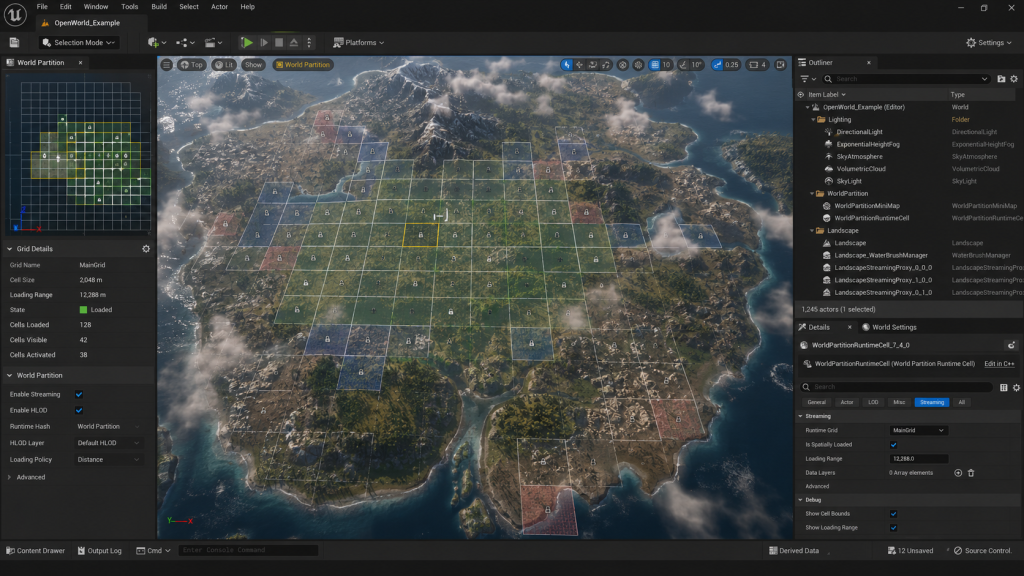
World Partition is UE5’s solution to the perennial problem of large open-world games: how do you manage a world that is too large to fit in memory, with many team members working on different regions simultaneously? World Partition automatically divides the world into a streaming grid. Only the grid cells relevant to the current camera position are loaded into memory. Team members working on different regions of the same world can do so in parallel without file merge conflicts, because UE5’s One File Per Actor system stores each actor as an individual file, eliminating the level-file conflicts that plagued multi-team UE4 open-world development. Data Layers allow the same world to contain multiple variants—day and night versions, different game states—as stacked layers that share world coordinates without duplicating content.
“Editorial illustration created for visual reference purposes. It does not represent a real project, client work, or official software screenshot unless stated otherwise.”

Chaos Physics is UE5’s native physics simulation system, replacing the PhysX library that UE4 depended on (and that Epic no longer licenses). Chaos provides rigid body dynamics, soft body simulation, destruction, and cloth physics—all integrated into the engine’s simulation pipeline without external dependencies. For art teams, the practical implication is that physics-simulated assets (destructible geometry, cloth on characters, rope and chain elements) can be simulated and previewed directly in the UE5 editor without additional setup.
Niagara VFX is UE5’s particle and visual effects system, available in UE4 but substantially matured in UE5. Niagara is a programmable, data-driven VFX framework that allows artists and technical artists to create effects ranging from simple particle emitters to complex physics-driven simulations. Its GPU simulation capabilities allow large-scale particle effects that would be prohibitive on the CPU, which is relevant for environment art teams adding large-scale environmental effects (dust storms, rain, foliage movement) to UE5 worlds.
Blueprint Visual Scripting remains the backbone of UE5’s accessible programming model. Blueprint allows game logic, UI systems, animation state machines, and interactive gameplay elements to be created through a visual node-based graph without writing C++ code. In AAA studios, Blueprint continues to be used for rapid iteration on animation triggers, event scripting, and system prototyping, even when final implementation is in C++. For artists working in UE5—particularly those building interactive environment showcases, animated sequences, or level scripting—Blueprint provides programming capability without requiring programming expertise.
Mass AI is UE5’s crowd simulation system, designed to simulate thousands of AI characters simultaneously—each with independent behavior—at real-time performance on current-gen hardware. Traditional AI systems in UE4 activated NPCs only when a player entered their vicinity. Mass AI simulates crowd-scale behavior across the entire world, enabling large-scale crowd scenes, urban environments with thousands of pedestrians, and herd-scale creature behavior that was previously only possible in pre-computed cinematics.
MetaHuman, PCG, Substrate, and MegaLights: The Maturing Toolset
UE5’s feature set has expanded significantly through the 5.1–5.7 patch series. Several systems that shipped as experimental or early access have reached production-ready status; others remain in active development. Understanding the current production status of each system prevents planning errors where teams assume a feature is production-ready before it actually is.
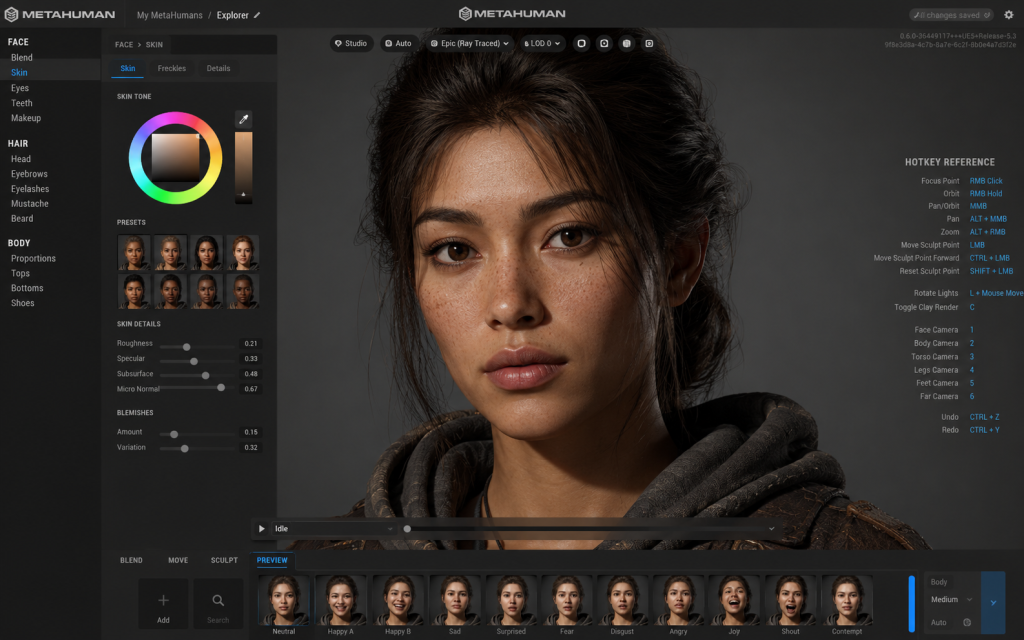
MetaHuman Creator provides a cloud-based character creation workflow that produces high-fidelity digital human characters with production-ready rigging for facial animation, body motion, and hair. MetaHuman characters come with a standardized skeleton compatible with UE5’s animation system, full blend shape support for facial performance capture, and Groom-based hair that uses Niagara physics simulation. They represent the baseline expectation for human characters in UE5 productions that target photorealism.
“Editorial illustration created for visual reference purposes. It does not represent a real project, client work, or official software screenshot unless stated otherwise.”
For 3D character art services for Unreal Engine, MetaHuman defines the technical standard for character fidelity and rigging compatibility. Custom characters built for UE5—those with unique designs, non-photorealistic styles, or IP-specific visual language—are typically evaluated against MetaHuman’s technical specifications for facial rigging, LOD management, and Groom integration. MetaHuman Creator gained Linux and macOS plugin support in UE5.7, and its Python and Blueprint APIs for scripting character assembly were significantly expanded, making it more accessible for technical art automation pipelines.
PCG—Procedural Content Generation Framework reached production-ready status in UE5.7 after several releases in experimental and early access states. PCG allows artists and level designers to define rule-based systems that populate environments automatically: scatter foliage according to slope and altitude rules, place modular architecture pieces along splines, generate biological variation in creature herds, or build road networks that adapt to terrain. PCG runs on the GPU for performance-critical operations and integrates with Nanite, World Partition, and Data Layers. In UE5.7, the PCG framework received nearly twice the performance improvement compared to UE5.5, a new PCG Editor Mode with spline drawing and paint tools, and a Procedural Vegetation Editor plugin (itself still experimental) for custom Nanite-ready tree generation.
The production significance: teams building large open worlds—the genre that most clearly benefits from UE5’s full technology stack—can now rely on PCG as a shipping-quality tool for environment population. This reduces the manual placement labor that was previously a major cost driver for large-scale open world art production.
Substrate is UE5’s next-generation modular material authoring and rendering framework, which also reached production-ready status in UE5.7. Substrate replaces UE4’s legacy shading model with a system that allows multiple material behaviors to be layered within a single material: a surface can simultaneously simulate fabric, wet fabric, dried mud, and specular highlights, with physically accurate blending between each layer and correct response to Lumen’s dynamic lighting. Substrate is built to scale across platforms from high-end PC down to mobile, maintaining consistent visual results and physical accuracy.
For technical artists and material specialists, Substrate represents a significant shift in how materials are authored. The layered approach allows materials with genuinely complex surface behavior—the kind of layered complexity common in film production—to be created and maintained in a production pipeline without the workarounds that UE4’s single-shading-model system required.
MegaLights is described by Epic as “Nanite for lighting”—a system that allows thousands of dynamic shadow-casting lights to be rendered efficiently in a single scene. MegaLights was introduced as experimental in UE5.5 and promoted to beta status in UE5.7. In a demo scene, Epic demonstrated over 1,700 ray-traced dynamic lights rendering simultaneously, which represents an increase of two to three orders of magnitude over what was practically feasible in UE4. MegaLights is not yet production-ready as of UE5.7 and should not be planned as a shipping feature for titles targeting a 2025–2026 release window—but it represents the direction of UE5’s lighting architecture and is relevant for productions with longer development horizons.
Nanite Foliage is a related experimental system that applies Nanite’s virtualized geometry rendering to animated foliage—dense trees, grass, and other vegetation that moves with wind and skeletal animation. It ships in UE5.7 as experimental, using a combination of instancing, voxelization, and GPU-driven animation to render large open-world vegetation at significantly lower performance cost than traditional foliage systems. Like MegaLights, it is not production-ready for shipping titles in the near term but signals the roadmap direction for open-world environment production.
What UE5 Means for Game Art Production Teams
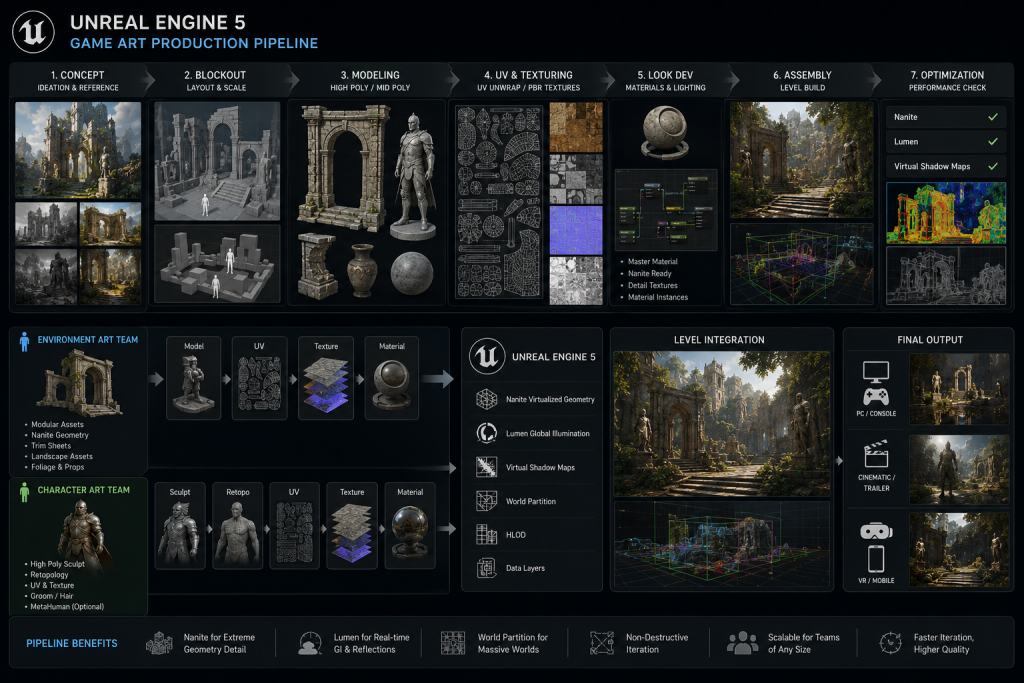
Every technology described above has specific implications for how game art is created, reviewed, and delivered. The following is a production-focused synthesis of what UE5 changes for environment art, character art, and technical art teams—and what it demands of each.
“Editorial illustration created for visual reference purposes. It does not represent a real project, client work, or official software screenshot unless stated otherwise.”
For environment art teams, UE5 changes the asset specification and the review criteria simultaneously. Assets no longer require manual LOD chains for static geometry—but they do require Nanite-specific validation: cluster generation review, material blend mode audit (opaque vs. masked vs. translucent), and context-scene performance profiling to catch materials that create unexpected raster bin overhead. The environment team’s relationship with the lighting team also changes: because Lumen updates dynamically, lighting is no longer a late-phase review gate after a long bake cycle. Instead, lighting feedback is available throughout the environment art process. This requires art directors to build lighting review into the environment art pipeline as a continuous activity rather than a milestone event.
UV workflows change for Nanite + Lumen projects on current-gen targets. Lightmap UV channels are not required when Lumen provides the lighting. Primary texture UV layouts are still required, as is rigorous texel density management—Nanite does not affect texture resolution requirements. For cross-gen projects maintaining both a Lumen path and a baked-lighting path, both UV channels must be delivered. This distinction must be explicit in the asset brief.
The scale at which environment content can be created increases substantially. World Partition enables continuous worlds far larger than what UE4’s level streaming architecture could support without prohibitive engineering overhead. For teams building open-world titles, this means the world design scope can expand to match the creative vision rather than being constrained by streaming architecture limits.
Practitioners building environments in UE5 have noted that the integration of Nanite with tools like Megascans and the Quixel library allows photogrammetry-derived assets to be used directly, without the polygon reduction that was mandatory for UE4. As documented in practitioner breakdowns on 80.lv covering UE5 environment art workflows, the practical shift is not just technical but creative: environment artists are no longer spending significant time managing asset optimization budgets and can direct more energy toward visual detail, composition, and material quality.
For character art teams, UE5’s key production changes center on MetaHuman compatibility, Groom hair integration, and the animation system’s real-time preview capabilities. Characters built for UE5 productions are expected to be compatible with the engine’s Control Rig system for procedural animation, Groom for hair and fur, and the retargeting system that allows motion capture data to drive custom skeletons. Characters that are not reviewed against these requirements in the concept and model phases tend to produce expensive engineering rework later.
Nanite support for characters is more limited than for static environment assets. Gameplay characters—those animated at runtime—do not use Nanite in the conventional sense, because Nanite is designed for static or near-static geometry. Character LODs remain part of the character art pipeline. The place where Nanite becomes relevant for character work is in hero props, armor accessories, and scene-dressing characters that are static in the world; these can be Nanite-enabled.
For technical art teams, UE5 demands new proficiency in a toolset that did not exist in UE4: Nanite visualization and profiling, Lumen performance scalability tuning, Virtual Shadow Map budget management, PCG node graph construction, and Substrate material layer authoring. Technical art is the bridge between the creative team’s artistic intent and the engine’s rendering capabilities—and in UE5, that bridge must span a broader technical surface than in UE4.
The outsource implication: when a studio brings in external art production support for a UE5 project, the brief must specify which UE5 systems the assets will interact with, and the supplier must demonstrate familiarity with those systems’ requirements. An environment art supplier that produces beautiful assets without Nanite-aware validation, material type awareness, and Lumen-compatible material authoring will produce assets that require significant engine-side rework before they can ship. At Nasty Rodent, UE5 environment production follows a three-step validation: Nanite enablement and cluster visualization review, material type audit against the asset’s intended lighting context, and GPU profiling in a representative scene to catch per-material rendering cost before delivery.
Where UE5 Has Limits: An Honest Assessment
UE5 is the most capable real-time 3D platform available as of 2025—but it has specific limitations that production teams must account for, and that a complete guide cannot omit.
Hardware requirements are meaningful. Lumen’s full quality mode requires an NVIDIA RTX 2000-series GPU or AMD RX-6000 series GPU or better. Teams targeting a broad PC audience must plan for Lumen scalability settings or fallback lighting paths on hardware that does not meet these requirements. Mobile and VR targets require substantially different lighting architectures. VSM and Nanite require DirectX 12 or Vulkan; DirectX 11 support falls back to older shadow and geometry systems.
VR is not well-served by Lumen. Although initial stereo support exists on PC with the Deferred renderer, Lumen’s performance cost makes it impractical for most VR shipping titles. VR requires 90+ FPS per eye, and the overhead of dynamic global illumination at those frame rates is not viable on current hardware for most VR use cases. VR developers using UE5 should plan on alternative lighting solutions. This is a current practical limitation rather than a near-term roadmap resolution.
Mobile support is partial. Nanite is not supported on mobile targets. Lumen has limited mobile support via Android Vulkan but is not viable for the broad mobile device market. Teams building cross-platform titles that include mobile must maintain separate asset and lighting pipelines for mobile targets, which adds production overhead.
Experimental features require caution. Nanite Foliage, the Procedural Vegetation Editor, and several animation system features in UE5.7 carry explicit experimental status from Epic. This means they may change API, change behavior, or be removed between versions. Planning shipping features around experimental systems creates technical debt and potential migration costs.
The learning curve is steeper than UE4 for some disciplines. Blueprint remains as accessible as in UE4, but the new systems—PCG node graphs, Substrate material layers, Nanite performance profiling, Lumen scalability tuning—require dedicated technical art and engineering knowledge that UE4 did not demand. Studios transitioning from UE4 should budget explicit onboarding time for technical staff, not assume that UE4 experience transfers completely.
Licensing and terms. Unreal Engine is available under a royalty-based licensing model: free to use, with Epic collecting a 5% royalty on lifetime gross revenue above a $1 million threshold per product. This is the standard model. Custom licensing arrangements are available for large publishers and platform holders. The licensing model is a material business consideration for smaller studios that were previously accustomed to Unity’s per-seat pricing—understanding the economic structure of the license is part of the decision framework for engine adoption.
Feature Status Matrix: UE5.7 Production Readiness
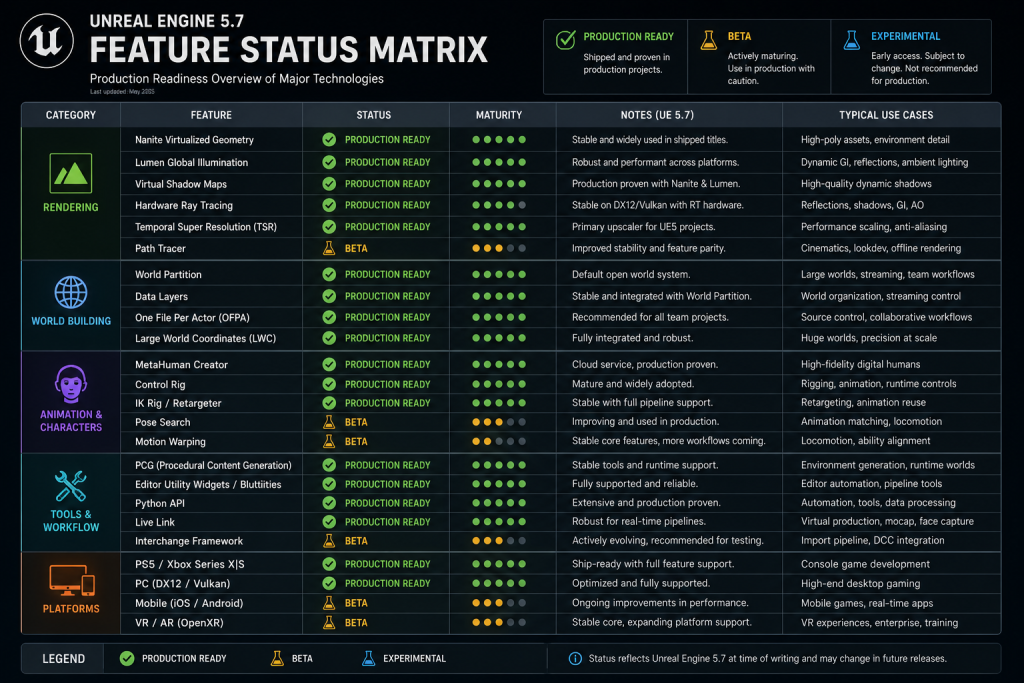
The following table reflects the official production-readiness status of UE5’s major systems as of version 5.7, released November 2025.
“Editorial illustration created for visual reference purposes. It does not represent a real project, client work, or official software screenshot unless stated otherwise.”
| Technology | Category | Status (UE5.7) | Notes |
| Nanite (opaque/masked geometry) | Rendering | ✅ Production-ready | Translucent materials excluded; foliage experimental |
| Lumen GI + Reflections | Rendering | ✅ Production-ready | VR and mobile limitations; hardware RT requires RTX 2000+ |
| Virtual Shadow Maps | Rendering | ✅ Production-ready | Default shadow system; DirectX 12 / Vulkan required |
| Temporal Super Resolution | Rendering | ✅ Production-ready | Engine-native, hardware-agnostic upsampling |
| World Partition | World-building | ✅ Production-ready | Required for large open worlds; One File Per Actor included |
| MetaHuman Creator | Characters | ✅ Production-ready | Python/Blueprint APIs expanded in UE5.7 |
| Chaos Physics | Simulation | ✅ Production-ready | Replaces PhysX; cloth, destruction, rigid body |
| Niagara VFX | Effects | ✅ Production-ready | GPU simulation for large-scale effects |
| Substrate Materials | Materials | ✅ Production-ready | Reached production-ready in UE5.7 |
| PCG Framework | World-building | ✅ Production-ready | Reached production-ready in UE5.7; PVE editor still experimental |
| MegaLights | Rendering | 🔶 Beta (UE5.7) | Thousands of dynamic lights; not yet shipping-ready |
| Nanite Foliage | Rendering | 🔬 Experimental (UE5.7) | Animated dense foliage via Nanite; API may change |
| Procedural Vegetation Editor | World-building | 🔬 Experimental (UE5.7) | Built on PCG; experimental plugin |
For studios planning productions, this matrix defines the boundary between what can be relied upon as a stable shipping foundation and what requires contingency planning.
Our Approach to UE5 Art Production at Nasty Rodent
UE5’s production model is only as efficient as the asset pipeline built around it. High-polygon imports without Nanite validation, dynamic lighting pipelines without material type audits, and open worlds without streaming discipline all produce the same result: rework at the most expensive stage of production.
Our environment and character art pipelines are built around UE5’s actual requirements, not its marketing summary. Assets go through Nanite visualization review, material type documentation, and in-context GPU profiling before delivery. For cross-gen titles, lightmap UV channels and baked-lighting fallback paths are specified in the brief and delivered alongside the primary Nanite/Lumen pipeline assets. For more on our UE5 technical approach across asset types and production scales, explore our game art blog.
For studios in early production planning for a UE5 title—defining asset specifications, UV requirements, material type guidelines, and Nanite enablement criteria—the right moment to align on the pipeline is before asset creation starts, not after the first delivery reveals gaps in the specification. Reach out to define the UE5 production pipeline before work begins.