Unity vs Unreal Licensing: What Each Engine Actually Costs Your Project
-

Written by Denys Zadoienyi
-

Updated on30.07.2026
-

Time to read11 min

Unity vs Unreal Engine licensing costs come down to two fundamentally different bets: Unreal asks for a cut of your success, Unity asks for a fixed fee regardless of how the game performs. Neither is simply “cheaper” – which one costs more depends entirely on your revenue, your team size, and how long your project runs before it ships.
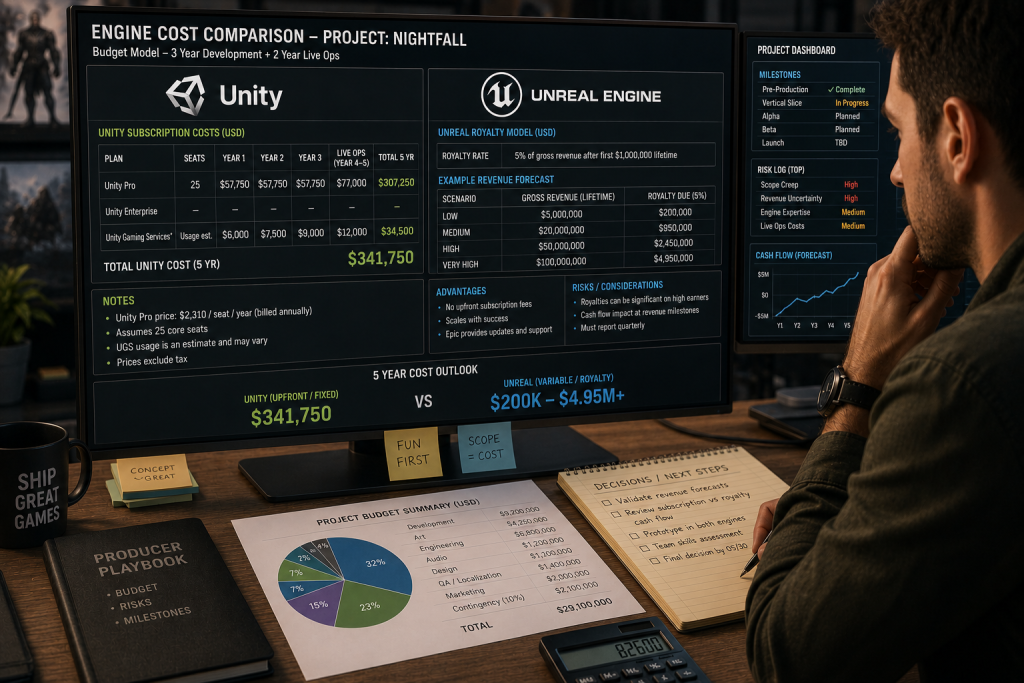
“Editorial illustration created for visual reference purposes. It does not represent a real project, client work, or official software screenshot unless stated otherwise.”
That distinction matters more than the two-line summary most comparisons give it. A producer scoping a budget needs to know not just the headline numbers – 5% royalty, $2,310 per seat – but where the break-even point actually sits for a project like theirs, what the licensing terms actually exclude, and what happens if those terms change mid-production, which has already happened once this decade.
The Two Licensing Models, in Plain Terms
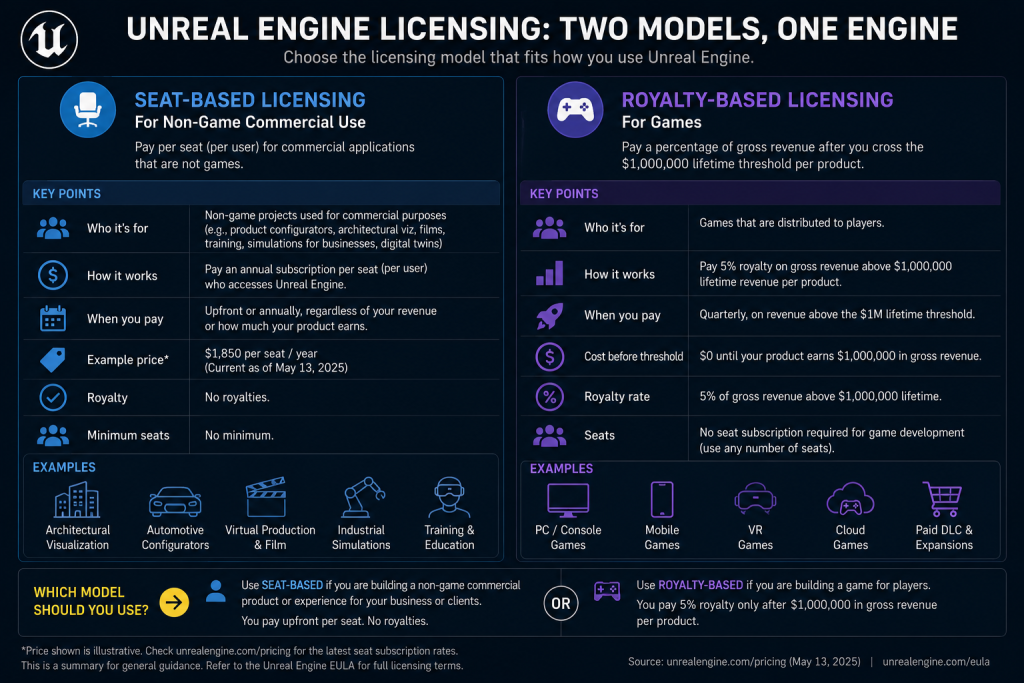
Unreal Engine runs on a royalty model. The engine is free to download and use, full source code included – for a broader look at what that source access and the rest of the engine’s toolset actually cover, see our complete guide to Unreal Engine 5. Once a game or application built on Unreal Engine crosses $1 million in lifetime gross revenue, Epic Games collects a 5% royalty on revenue above that threshold, subject to a few specific exclusions worth knowing about: revenue generated through the Epic Games Store or Fab Marketplace is excluded from the royalty calculation entirely – as a separate exclusion from the $1 million lifetime threshold, not merely revenue that doesn’t count toward reaching it – and no royalty payment is due for any calendar quarter in which the product earns under $10,000, though that quarter’s revenue still counts toward the lifetime total. Since January 1, 2025, Epic’s Launch Everywhere with Epic program also offers a reduced 3.5% rate – instead of the standard 5% – for titles that launch on the Epic Games Store simultaneously with or before other stores, in exchange for giving the Epic Games Store equivalent promotional prominence in marketing.
Epic’s licensing page is explicit that the $1 million threshold is lifetime revenue attributable to the product, not an annual or calendar-year figure – a nuance worth flagging up front, because a fair amount of content on this topic gets it wrong. A game that earned $900,000 in its first year and $300,000 in its second doesn’t reset to zero – it crosses the $1 million mark partway through year two, and royalties apply to whatever exceeds that threshold from that point forward.
Unity runs on a seat-subscription model. Unity Personal is free for individuals and organizations with revenue or funding under $200,000 in the past 12 months. Cross that threshold and Unity Pro becomes mandatory – not optional – at $2,310 per seat per year when prepaid annually (or $210 per seat per month on the monthly plan, which works out higher over a year) as of the January 2026 price update. Organizations with $25 million or more in annual revenue or funding are required to move to Unity Enterprise, which is custom-priced rather than published.
What Happened to Unity’s Runtime Fee – and Why It Still Matters
Any current comparison has to address this, because it changed how many studios think about licensing risk, not just licensing cost.
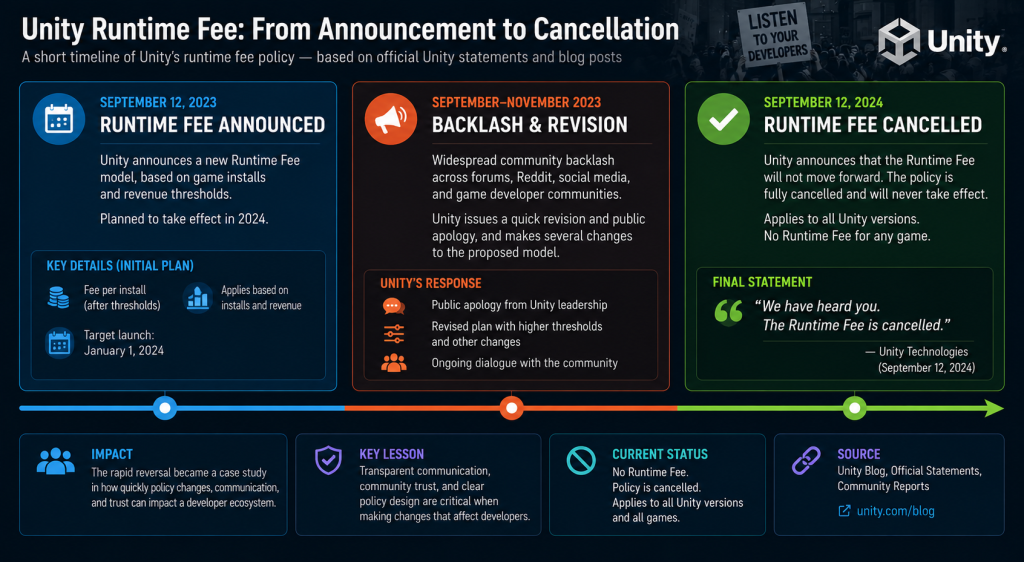
In September 2023, Unity announced a Runtime Fee – a charge triggered per game install above certain revenue and volume thresholds, layered on top of existing subscription costs. The backlash from developers was immediate and severe enough that Unity’s leadership publicly apologized within days and revised the policy – raising the exemption threshold and removing the mandatory splash-screen requirement. Roughly a year later, on September 12, 2024, Unity canceled the Runtime Fee entirely, stating it had never actually been implemented for any shipped game, and reverted fully to the seat-based subscription model. A separate set of subscription price changes took effect January 1, 2025, and a further 5% increase – the one that brought Pro to its current $2,310 per seat – took effect January 12, 2026; these are ordinary annual pricing updates, not a continuation of the Runtime Fee episode.
“Editorial illustration created for visual reference purposes. It does not represent a real project, client work, or official software screenshot unless stated otherwise.”
For a producer, the specific number that mattered in 2023 isn’t the point anymore – the fee is gone, and it was never applied to any Unity game. What matters going forward is what the episode revealed about licensing risk independent of any specific price: Unity had held a contractual clause for years protecting developers from being forced onto adverse mid-project terms changes, and it quietly removed that clause months before announcing the Runtime Fee. That sequence – protection removed, then a disruptive change announced – is worth factoring into a multi-year engine commitment the same way you’d weigh a vendor’s contract-stability track record, regardless of which engine currently looks cheaper on paper.
Unreal Engine hasn’t had an equivalent public reversal, but its terms aren’t fixed in stone either – Epic has changed royalty terms before, most recently by lowering the rate to 3.5% for Epic Games Store launches. A studio locking into a multi-year Unreal commitment is making the same kind of forward bet on contractual stability that Unity customers made before anyone had reason to expect a Runtime Fee. Neither engine’s current pricing page is a guarantee of what a five-year production will actually pay by the time it ships.

Break-Even Scenarios: Where the Cost Actually Crosses
These are illustrative calculations built from the documented pricing above, not industry benchmarks. For comparability, they use Epic’s standard 5% royalty rate and don’t model the Epic Games Store and Fab Marketplace exclusions, the $10,000 quarterly revenue exclusion, or a negotiated custom license – all of which could lower the effective Unreal cost in a real project. They also count Unity Pro seats as the number of people actively using the Unity Editor, not total project headcount – a producer, writer, or concept artist who never opens the Editor isn’t a paid seat.
“Editorial illustration created for visual reference purposes. It does not represent a real project, client work, or official software screenshot unless stated otherwise.”
Small studio below both applicable thresholds. A four-person studio with under $200,000 in total revenue and funding over the trailing 12 months, building toward a product that stays below $1 million in lifetime gross revenue, owes no licensing fee under either standard model. At this stage, technical fit matters more than licensing cost – but note that Unity’s threshold is about the organization’s total revenue and funding, not the specific game’s revenue, so a studio with other income streams can cross into Pro territory even if this particular project hasn’t earned anything yet.
Mid-size team, revenue crossing into royalty territory. A team requiring six Unity Pro seats, two-year project, reaching $1.5 million in lifetime revenue: Unreal’s royalty under the standard rate is 5% of the $500,000 above the threshold – $25,000 total. Unity Pro for six seats over two years runs roughly $27,720 (at $2,310 per seat per year, annual prepaid). At this revenue band, the two models land close enough that the decision should be driven by technical and pipeline factors, not licensing cost.
Larger team, strong commercial success. A project requiring ten Unity Pro seats over a three-year cycle that reaches $10 million in lifetime revenue: Unreal’s standard-rate royalty is 5% of $9 million – $450,000. Unity Pro for ten seats over three years is roughly $69,300. Under these simplified assumptions, Unity’s fixed-seat model is substantially cheaper at this revenue level, since the subscription cost doesn’t scale with how well the game sells – though a studio in this position should also check whether Epic’s Store exclusion or the 3.5% Launch Everywhere rate would apply to their specific release plan before treating the $450,000 figure as final.
Long-tail mobile or live-service title. A team requiring twelve Unity Pro seats, running a free-to-play mobile title over four years that accumulates $6 million in lifetime revenue through in-app purchases and advertising, assuming the full amount is attributable royalty revenue under Epic’s standard agreement: the royalty is 5% of $5 million – $250,000. Unity Pro for twelve seats over four years runs roughly $110,880. This scenario matters because live-service and mobile revenue accumulates gradually rather than in one release-day spike – a title can cross the $1 million lifetime threshold well into its ongoing operation rather than at launch, so royalty exposure can begin while the product is still being actively supported and updated.
The pattern across all four: Unreal’s cost scales with commercial success, Unity’s cost scales with seat count and time. A studio confident in strong revenue should model both curves against its own numbers before committing – the crossover point moves depending on seat count, project length, and how quickly revenue accumulates after launch. None of these numbers account for the technical and pipeline differences between the two engines covered elsewhere on our blog – licensing cost is one input to an engine decision, not the whole decision.
What the Headline Numbers Leave Out
“Licensing cost” is not the same as total cost of engine ownership. This article models standard licensing exposure – royalties and seat subscriptions – because that’s the piece that differs most sharply between the two engines and the piece producers ask about most directly. It doesn’t cover payroll for engineers who know the engine, build infrastructure, plugin and marketplace spend, platform certification costs, or the cost of migrating a team’s existing pipeline to a new engine. Those costs matter for a full production budget, but they don’t move in lockstep with the licensing model the way royalties and seat fees do, so we’ve kept this piece scoped to licensing specifically.
Non-game commercial use follows a separate, narrower track than “any non-game use pays $1,850.” Epic’s seat-based license applies specifically when all of the following are true: the use is commercial, the organization has generated more than $1 million in the past 12 months, and the product being built does not rely on Unreal Engine code at runtime in a way that’s licensed to third-party end users. Studios doing architectural visualization, film production, or internal training tools that meet those conditions pay $1,850 per seat per year. But a non-game application that does incorporate engine code at runtime and gets licensed out to end users can still fall under the royalty model instead – the distinction is about how the product is built and distributed, not simply whether it’s “a game.”
“Editorial illustration created for visual reference purposes. It does not represent a real project, client work, or official software screenshot unless stated otherwise.”
Contractor licensing can expand the effective seat count on Unity. Unity’s tier-eligibility rules apply to people using the Editor on behalf of an organization, and in some cases to contractors delivering Unity-based work for a client – the relevant financial threshold can be the client’s or organization’s, not the individual contractor’s. A freelance artist who personally earns well under $200,000 may still need to work under a Pro seat if the organization or client they’re serving doesn’t qualify for Personal. This has real implications for outsourced or hybrid teams where headcount fluctuates by milestone, and it’s a line item that’s easy to miss when a budget is modeled against core in-house headcount alone.
Engine choice is also a vendor-alignment decision, not just a licensing one. If part of your production runs through an outsourcing partner, their production experience with your chosen engine affects onboarding time and first-pass approval rates independent of what the engine itself costs to license. A vendor with a mature Unreal pipeline but only limited Unity experience – or the reverse – turns a “free” or “cheap” licensing decision into a more expensive integration timeline than the licensing math alone would suggest. We go into that side of the decision in our Unity HDRP vs Unreal Engine 5 pipeline comparison, which focuses on the technical and production-pipeline side of the same choice rather than the financial one covered here.
The licensing decision and the build-vs-outsource decision aren’t independent. A producer weighing in-house hiring against outsourced production is already running cost models that this licensing math should feed directly into – engine royalty or subscription cost sits alongside the in-house vs outsource comparison as one more input to the same budget, not a separate conversation held later. And whoever owns that budget conversation on your side – usually the producer role we map out in our guide to game production roles – is the person who should be running these break-even numbers before the engine gets locked in.
Modeling engine licensing cost against your specific revenue trajectory – or figuring out how that choice interacts with an outsourced production plan – is worth doing before the engine is locked in, not after a milestone gate makes switching expensive.
At Nasty Rodent, we run production pipelines in both Unreal Engine and Unity across mid-core and AAA engagements – our portfolio includes production work in both. Licensing terms should always be verified against Epic’s and Unity’s current agreements before you budget against them; our role is to help studios understand how engine choice affects art production, vendor integration, staffing, and outsourced delivery costs.
Talk to a producer about how your engine choice affects outsourced production costs – a straightforward conversation about vendor stack fit, not just the licensing math.