Turning a Props and Weapons Asset List Into a Kit You Can Schedule and Reuse
-

Written byDenys Zadoienyi
-

Updated on02.09.2026
-

Time to read11 min

- Why “How Many Props and Weapons” Undercounts the Kit
- Two Dimensions: Kit Structure and Reuse Scope
- What Actually Goes Into a Kit: Base Pieces, Attachments, and Variants
- From Asset List to Kit Count: A Worksheet
- Reuse Planning Across Titles: Where a Kit Pays for Itself Twice
- Case Notes: What This Looks Like in Practice
- Scope, Capacity, and the Quote Request
Props and weapons scope estimation is the process of translating an asset list into a kit structure – base pieces, modular attachments, and variants – plus a reuse plan across current and future titles, before a schedule or a quote gets built against it. An asset list that reads “40 weapons and 60 props” isn’t a scope. It’s a headcount, and a headcount hides a question that strongly affects production workload: how much of that count is genuinely new geometry, and how much is a variant or a modular combination of something already being built.
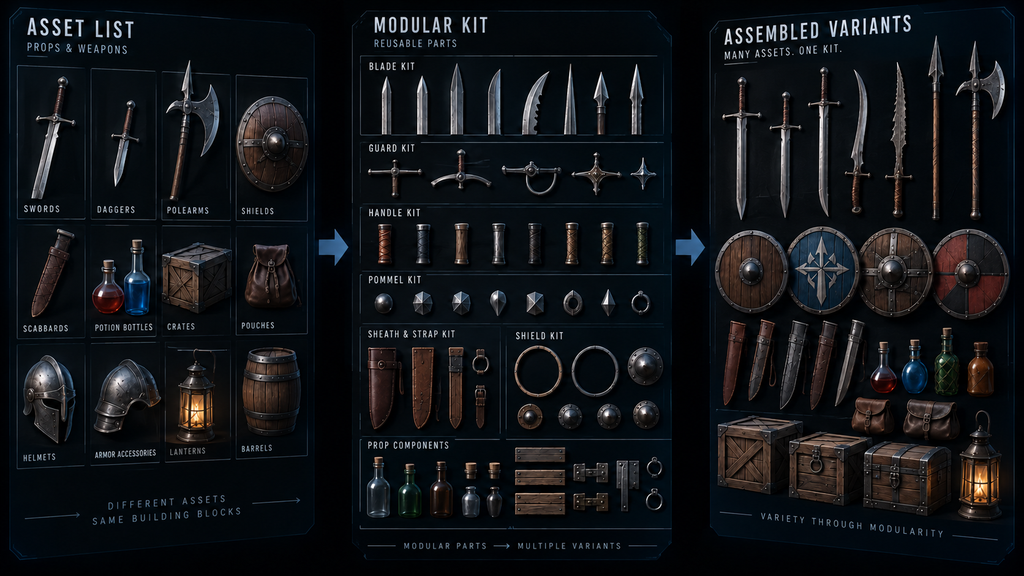
“Editorial illustration created for visual reference purposes. It does not represent a real project, client work, or official software screenshot unless stated otherwise.”
Most asset lists skip that question, and the gap shows up later – in a quote padded for uncertainty because the brief doesn’t distinguish unique builds from derivatives and variants, or in a second project for the same client that gets scoped from zero when existing assets were never evaluated for possible reuse.
Why “How Many Props and Weapons” Undercounts the Kit
A producer building an asset list for a new milestone tends to count by line item: 12 rifles, 8 melee weapons, 30 environment props. That count feels complete. It isn’t, because a modular weapon system with a base receiver and 6 attachment variants can produce more finished configurations than a list of 12 standalone weapons – while requiring fewer fully bespoke base builds than the configuration count suggests. The reverse is also true: a props list that looks short on paper can hide several genuinely bespoke hero props that carry disproportionate cost.
The gap comes from treating “kit” and “list” as the same thing. A kit is a production structure – a base piece plus the attachments, materials, and variants built around it. A list is just the set of names someone needs represented in the game. Scoping a props or weapons asset list means converting the list into the kit structure that actually determines how much modeling, texturing, and validation work exists behind it.
Two Dimensions: Kit Structure and Reuse Scope
Sizing a props or weapons asset list well means checking two things independently, the same way character rosters need tier and anatomy class checked separately rather than folded into one number.
Kit structure is what a single kit contains once it’s broken down: how many base pieces are genuinely unique, how many attachments or modular components extend those base pieces, and how many material or skin variants sit on top of the result. A weapon kit built around one base receiver with a barrel, stock, and sight attachment system can represent a dozen visually distinct configurations from a much smaller unique-geometry count – the kind of modular attachment planning covered in more technical depth in our AAA weapon production pipeline breakdown. This article doesn’t repeat that technical ground; it’s about counting the kit correctly before that pipeline starts, not about the UV or triangle-budget decisions once it does.
Reuse scope is a separate question: how much of this kit’s value extends past the current title. A base weapon mesh, a modular prop set, or a material library built for one project may reduce new production work on a later title if contractual reuse rights, art direction continuity, technical targets, and asset specifications remain compatible – reuse depends on more than just whether the geometry still looks right, since licensing terms, naming and rig conventions, and platform budgets can all block it even when the visuals would transfer cleanly. This is the dimension a single-project asset list never surfaces, because it only becomes visible once a client’s second title is being scoped and someone has to decide how much of the existing kit still applies.
Neither dimension replaces the other. A kit can be tightly modular within one project and still have little or no permitted reuse across titles (a licensed IP’s exact weapon models may be restricted by the license or by project-specific art direction, though a sequel under the same rights and client can be a different story), or it can be a simple kit with high reuse potential across a client’s catalog (a generic sci-fi prop set built with no title-specific branding). Scoping an asset list means checking both, not assuming a well-structured kit automatically means high reuse, or that reuse potential automatically means the current kit is simple.

What Actually Goes Into a Kit: Base Pieces, Attachments, and Variants
Once an asset list exists, breaking it into a kit structure means sorting every line item into one of three roles, for weapons and for props separately, since the two disciplines modularize differently.
For weapons, the base piece is typically the receiver or core body; attachments are barrels, stocks, sights, magazines, and other swappable components; variants are material finishes, wear states, or faction skins applied on top of a given base-plus-attachment combination. First-person weapons often carry unusually strict camera-context requirements – a first-person weapon and the same weapon seen third-person or in inventory can have meaningfully different fidelity and UV needs – though hero and inspectable props can be just as camera-sensitive, so this isn’t a rule unique to weapons. This is exactly the kind of production detail our weapon pipeline breakdown covers in full.
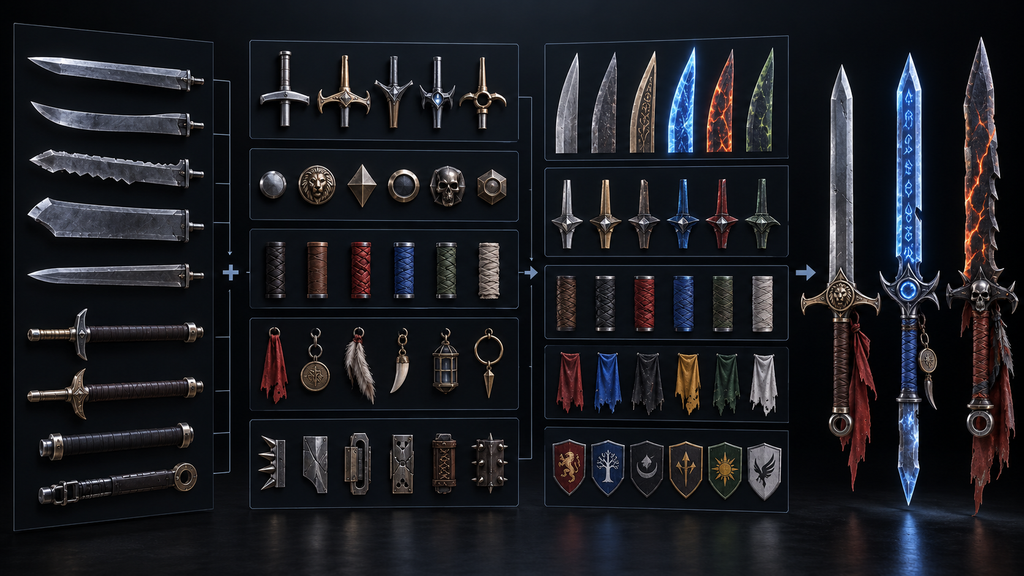
“Editorial illustration created for visual reference purposes. It does not represent a real project, client work, or official software screenshot unless stated otherwise.”
For props, the base unit may be a standalone asset or a reusable module within a larger modular prop kit – a single hero mesh, or a structural piece like a wall segment, connector, or trim module that combines with others; modular components are the interchangeable parts that extend that base (a crate’s lid, a container’s contents, a structure’s wall segments); variants are material or damage-state differences layered on the same geometry. Reusable, moderate-detail props built for repetition across a level behave very differently in scope terms than a small number of hero props built for close-range scrutiny – a distinction our AAA props pipeline breakdown treats in technical detail, including typical triangle ranges by prop role.
The point of sorting an asset list this way isn’t to replace either of those technical pipeline references – it’s to establish, before the pipeline starts, which line items are base pieces that need real modeling attention and which are attachments or variants that extend an existing base with typically less work than a fully bespoke build, depending on attachment complexity.
From Asset List to Kit Count: A Worksheet
The mechanical step that turns this framework into a usable estimate is a worksheet, filled per asset list entry rather than eyeballed across the whole list at once.
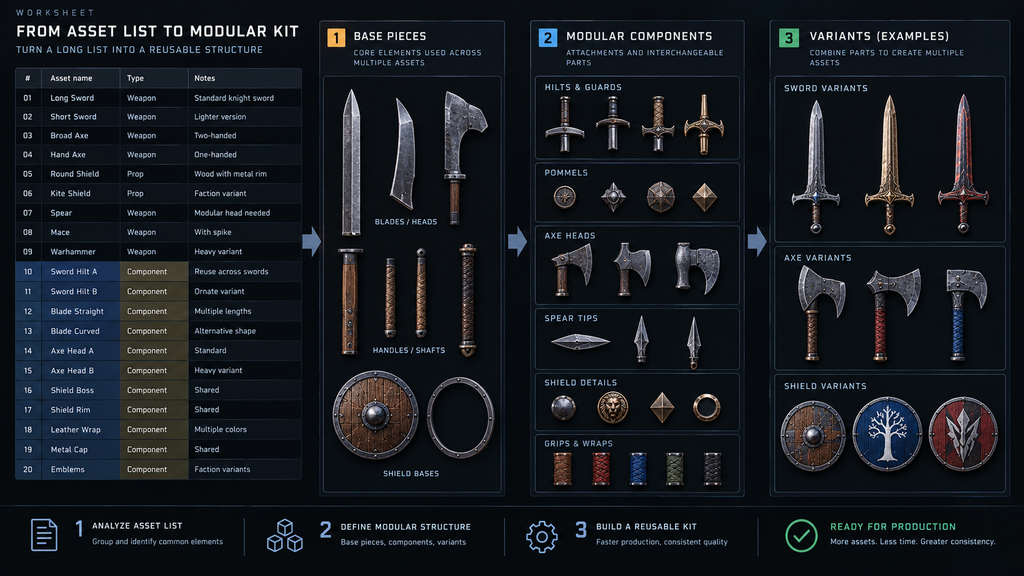
“Editorial illustration created for visual reference purposes. It does not represent a real project, client work, or official software screenshot unless stated otherwise.”
| Field | What it captures |
| List entry | The name or role as it appears on the design brief |
| Discipline | Weapon / prop / shared (used as both) |
| Fidelity / asset tier | Hero / reusable / background |
| Base or derivative | New unique base piece / attachment on an existing base / material variant |
| Modular components | Which parts are swappable, and across how many other list entries |
| Variant count | Material, skin, or damage-state differences on top of the base |
| Concept / reference state | Locked / partial reference / to-be-defined |
| Mechanical / animation requirements | Moving parts, reload, interaction |
| Camera / interaction context | FPP / TPP / inspectable / cinematic / background / inventory-only |
| Texture / material spec | Texture sets, shader and material expectations |
| LOD requirement | Count and target, project-specific |
| Collision / physics | Simple / custom / interactive |
| Destructibility / damage states | Especially relevant for props |
| Reuse candidate and rights status | Yes / no / TBD, permitted / unknown / restricted, with a note on what would need to change for a different title |
| Technical target | Platform and engine |
| Assumption status | Confirmed / assumed / to-be-confirmed, with an owner named |
The reuse column may not change the current asset count, but an explicit reuse requirement can affect how the kit is designed – and therefore its current production cost, since building toward reuse (generalized naming, non-title-specific materials, documented pivots) is itself a design decision made during the current project, not a free byproduct of it.
Reuse Planning Across Titles: Where a Kit Pays for Itself Twice
Reuse planning becomes concrete once a client is working across more than one title, since it’s the second project that actually tests whether the first kit’s structure holds up outside its original context. A generic sci-fi weapon or prop base, built without title-specific branding baked into the geometry, is in a fundamentally different position than a base built around one game’s exact visual identity – and that difference is invisible on the first project’s asset list, because reuse value only becomes real once there’s a second brief to apply it to.
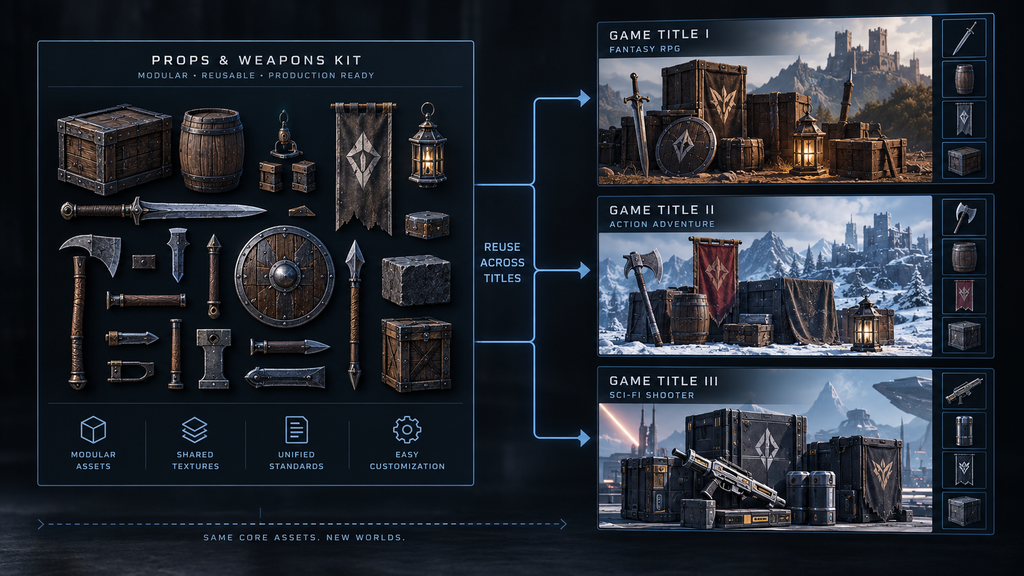
“Editorial illustration created for visual reference purposes. It does not represent a real project, client work, or official software screenshot unless stated otherwise.”
The honest version of this planning isn’t “build everything reusable by default” – over-generalizing a base piece for hypothetical future reuse adds cost to the current project for a benefit that may never materialize. It’s closer to: flag which base pieces and material libraries are structurally reuse-candidates as they’re built, without over-engineering them for a reuse case that hasn’t been confirmed, and revisit that flag when – and if – a second brief for the same client actually arrives.
Nasty Rodent has worked with The Bearded Ladies across several titles, including Mutant Year Zero: Road to Eden, Miasma Chronicles, and Corruption 2029. A multi-title client relationship like this is the kind of situation where reuse eligibility is worth checking explicitly, although this does not imply that assets were reused between these projects.
Case Notes: What This Looks Like in Practice
On Squad, a military simulation title for Offworld Industries, Nasty Rodent delivered concept art, unique skins, and final weapon and vehicle assets. Squad provides a useful public example of a weapon system built around interchangeable attachments such as optics, grips, suppressors, and other modular components – a real illustration of the kit-structure question at scale, though the specific base-piece count or kit breakdown Nasty Rodent used internally on the project isn’t detailed here.
On Starship Troopers: Extermination, also for Offworld Industries, Nasty Rodent contributed props and environment assets and assisted with location development. A location-driven UE5 title of this type illustrates a common reuse question worth asking on any project with repeated structural pieces: whether structural modules and repeated prop families – barricades, crates, terrain-scatter props, as a general example – should be treated as unique assets per location or as parts of a shared kit. This example is general and does not describe the actual asset breakdown Nasty Rodent used on Starship Troopers: Extermination.
Worked example: a hypothetical 40-line weapon and prop asset list
| Asset list says | Kit-structure interpretation |
| 12 rifles | 2 base weapon builds + a shared attachment set + material/skin variants |
| 8 melee weapons | 6 unique base builds + 2 material variants |
| 20 environment props | 4 base pieces (crate, barrier, container, scatter debris) combined modularly with material variants |
| Faction skins across the above | Variants layered on existing bases, not new builds |
The asset list reads as “40 items.” The kit underneath is closer to 12 genuinely unique base builds, a modular attachment and material system, and a variant layer – which is what a schedule and a quote should actually be built against. This example is illustrative only and does not represent the asset breakdown of Squad, Starship Troopers: Extermination, or any other named project.
Scope, Capacity, and the Quote Request
A kit-structured, reuse-flagged asset list is what lets a studio quote with fewer assumptions than a flat list of names – it narrows the range rather than eliminating the need for assumptions entirely, since some structural questions (final camera context, final platform target) may still be open at brief stage. A rough asset list is still workable for an initial estimate; a kit-structured one simply produces a tighter one.
The worksheet also surfaces a capacity question before the quote goes out: if a kit spans many base pieces across weapons, props, and vehicles moving through modeling, texturing, and engine integration at once, the question shifts from “how much would this kit cost” to whether that volume is better absorbed by an internal team or by outsourced production capacity built for parallel throughput – a decision that the cost and capacity model in our weapon outsourcing guide can help frame, without repeating that calculation here.
Once the kit is structured and the reuse candidates flagged, Nasty Rodent’s props and weapons production teams can quote against the worksheet directly – base pieces, modular components, variants, and whatever reuse value carries in from a prior title.

Let's work
together


in mind?
From 3D characters and environments to weapons, props, concept art and game UI/UX: ten years deep, 40+ artists strong, zero fluff. Tell us what you are making and get a free, no-pressure estimate.
estimate