In-House vs Outsource Game Art: How to Make the Right Call for Mid-core Projects
-

Written byDenys Zadoienyi
-

Updated on19.05.2026
-

Time to read13 min

- The Real Cost of In-House Art Production
- The Real Cost of Outsourcing Game Art
- The Game Art Outsourcing Strategy Decision Framework
- Agency vs Freelance: A Subset of the Outsource Decision
- Scaling Game Art Production: The Hybrid Model
- The Hidden Cost Map: What Mid-core Studios Miss
- A Decision Checklist for Mid-core Producers
- The Call Is a Production Decision, Not a Philosophy
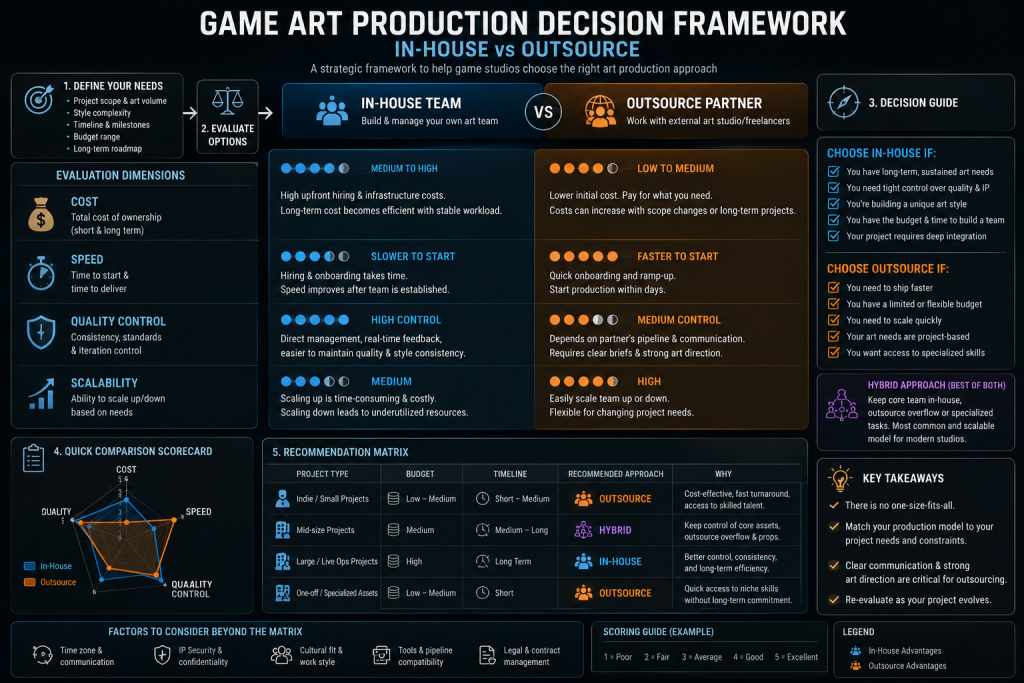
The in-house vs outsource game art decision isn’t a preference. It’s a production constraint problem. How many artists do you need, for how long, at what fidelity, and at what point in the schedule — and can your current team structure deliver that without breaking the budget or the milestone gate?
“Editorial illustration created for visual reference purposes. It does not represent a real project, client work, or official software screenshot unless stated otherwise.”
For mid-core studios, this question recurs every project cycle. The team that shipped the last title has been partially reabsorbed into new work, headcount has shifted, and the new project’s art volume doesn’t match the headcount you actually have. Every producer has sat with that gap. The question is whether closing it through hiring, through outsourcing, or through a combination of both is the right call for the specific project in front of them.
This article gives you the framework to make that call — not a universal answer, but the decision variables that determine which model actually works for your production context.
The Real Cost of In-House Art Production
Building an in-house art team is the highest-control, highest-fixed-cost option. The benefits are genuine: direct communication, consistent visual feedback loops, deep integration with design and engineering, and accumulated institutional knowledge that carries forward project to project.
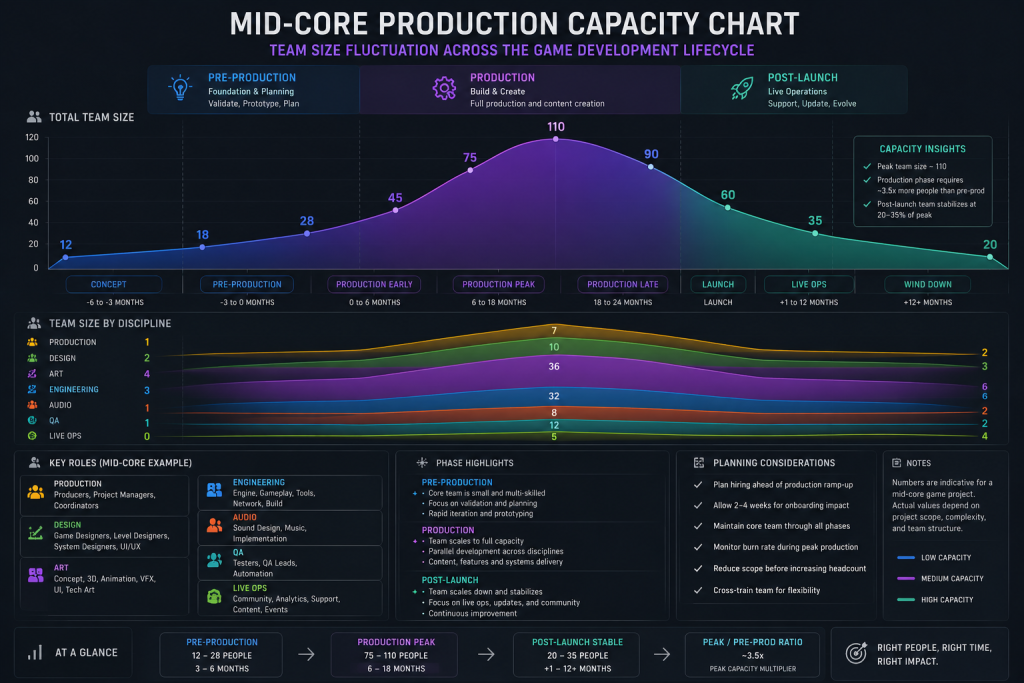
The cost structure, however, is fixed regardless of production phase. A mid-core studio with eight in-house artists carries eight salaries, eight benefits packages, equipment, software licenses, and management overhead — in pre-production, in production, in crunch, and in the quiet months after ship. When the project needs twenty artists for a six-month content push and eight for everything else, the in-house model either leaves you understaffed at peak or overstaffed at baseline.
The hidden costs compound this. Hiring a senior 3D character artist takes two to four months from opening a position to the artist contributing at full capacity — recruitment time, notice period, onboarding, and ramp-up on the project’s specific pipeline and style guide. If you need capacity in eight weeks, a new hire isn’t your answer. And if production wraps and the project no longer requires that headcount, the studio carries the cost of retention or absorbs the disruption of reduction.
As one veteran outsourcing manager noted on Game Developer, the cost-savings logic of outsourcing is often misread as purely financial: in practice, the strategic gain is production flexibility, not budget reduction — what looks like savings gets reinvested into more content or better internal compensation almost immediately. In-house builds depth. It doesn’t build elasticity.
The Real Cost of Outsourcing Game Art
Outsourcing is frequently framed as the lower-cost option. This is partially true and easily misunderstood.
The direct rate for outsourced game art — the day rate or per-asset price in the SOW — is typically lower than equivalent in-house capacity. But the total cost of outsourcing includes what experienced producers call secondary costs: your time spent reviewing, your art lead’s time managing revisions, the correction cycles when a vendor’s first-pass approval rate is below your internal standard, and the ramp-up cost as an external team learns your style guide, naming conventions, and pipeline requirements.
A vendor with a lower day rate that consistently returns assets requiring two additional revision rounds ends up costing more than a vendor with a higher day rate and a 75–80% first-pass approval rate. The difference isn’t the rate — it’s the management overhead that rate generates. This is the math that experienced outsource decision-makers run before signing an MSA, not after their first milestone review. Game Developer’s analysis of secondary outsourcing costs makes the point directly: the true cost of outsourcing includes every hour spent reviewing and revising, not just the asset invoice.
For mid-core production, the outsourcing model offers three concrete advantages over in-house:
Elasticity. You can scale art capacity to production phase without carrying fixed headcount. Pre-production requires twenty artists; post-ship requires two. An outsourcing partner absorbs that variance. Your in-house team doesn’t.
Specialization. Mid-core titles often need skill sets that aren’t cost-effective to maintain in-house year-round: technical character artists with UE5 rigging expertise, lookdev specialists for hero asset validation, hard-surface modelers for specific prop categories. An outsourcing studio maintains those specializations across multiple client projects, spreading the cost of expertise across its portfolio. Accessing that expertise for a six-week scope is fundamentally different from hiring a senior specialist for a two-year contract.
Schedule compression. When a milestone gate is approaching and the internal team is at capacity, outsourcing provides the fastest path to additional production output. A studio with an established vendor relationship and a current MSA can onboard a new scope in days, not weeks. A new hire can’t do that.
The Game Art Outsourcing Strategy Decision Framework
The in-house vs outsource decision isn’t binary — it’s a set of four questions. Answer them honestly for the specific project and the right model becomes apparent.
Question 1: What is your peak-to-baseline art demand ratio?
If your project requires roughly the same number of artists for its full production duration, in-house is viable. If your peak art demand is two or three times your baseline requirement — a common pattern for mid-core titles with distinct content pushes — outsourcing absorbs the variance more efficiently than hiring for peak and managing headcount reduction at baseline.
“Editorial illustration created for visual reference purposes. It does not represent a real project, client work, or official software screenshot unless stated otherwise.”
Question 2: What is your timeline for additional capacity?
If you need additional art output within eight weeks, outsourcing is the only realistic option. Hiring at speed means accepting candidates who aren’t optimal, paying recruitment premiums, and accepting reduced output during onboarding. A trusted vendor with a current MSA and an established art direction brief can be producing milestone-ready assets within two weeks of scope agreement.
Question 3: What is the institutional knowledge dependency of the work?
Art that requires deep integration with proprietary systems, undocumented game mechanics, or visual direction that exists only in the art director’s head is poorly suited for outsourcing — not because external teams can’t execute it, but because the onboarding cost to get them to execution speed approaches the cost of doing it in-house. Art that can be fully specified in a style guide, a brief, a callout sheet, and a sample asset batch is well-suited for outsourcing. Concept art for hero characters often falls in the first category; environment props and secondary character assets often fall in the second.
Question 4: What is the consequence of a first-pass approval rate below 70%?
If assets that fail first-pass review break the milestone schedule — if there’s no buffer for a second revision round — then your outsourcing relationship needs to be with a vendor whose approval rate you’ve tested on a paid art test before committing to production scope. A vendor scorecard built on three to five test assets tells you more than a portfolio. The portfolio shows peak capability; the test shows operational reliability under your specific brief and feedback cadence.

Agency vs Freelance: A Subset of the Outsource Decision
Once the decision to outsource is made, a secondary question surfaces: do you work with a game art agency or with individual freelancers?
Freelancers offer lower rates per hour and higher direct communication with the artist producing the work. The trade-off is coordination overhead — each freelancer is a separate management relationship, a separate contract, a separate point of failure. A five-person freelancer arrangement for a single content batch requires the same management infrastructure as a five-person internal team, without the institutional continuity of either. When one freelancer drops out mid-production, there’s no internal redundancy.
Game art agencies offer a built-in team structure, internal QA, and a single point of accountability — the vendor relationship is managed at the studio level, not the individual artist level. The per-asset rate is higher, but the management overhead per-asset is lower. For mid-core production with strict milestone gates, agencies reduce the single-point-of-failure risk that makes freelancer arrangements fragile at scale.
The decision between agency and freelance maps directly to the volume and duration of the scope. For a discrete, short-duration task — ten props, three weeks — a freelancer is efficient. For an ongoing content pipeline across multiple milestones — sixty environment assets over four months — an agency with a dedicated team and a structured revision process is more reliable. As the game art outsourcing sector evolves, clients are increasingly consolidating into fewer, long-term partnerships with studios they trust, rather than managing many small vendor relationships — a shift that reflects the management overhead reality of fragmented outsourcing.
Scaling Game Art Production: The Hybrid Model
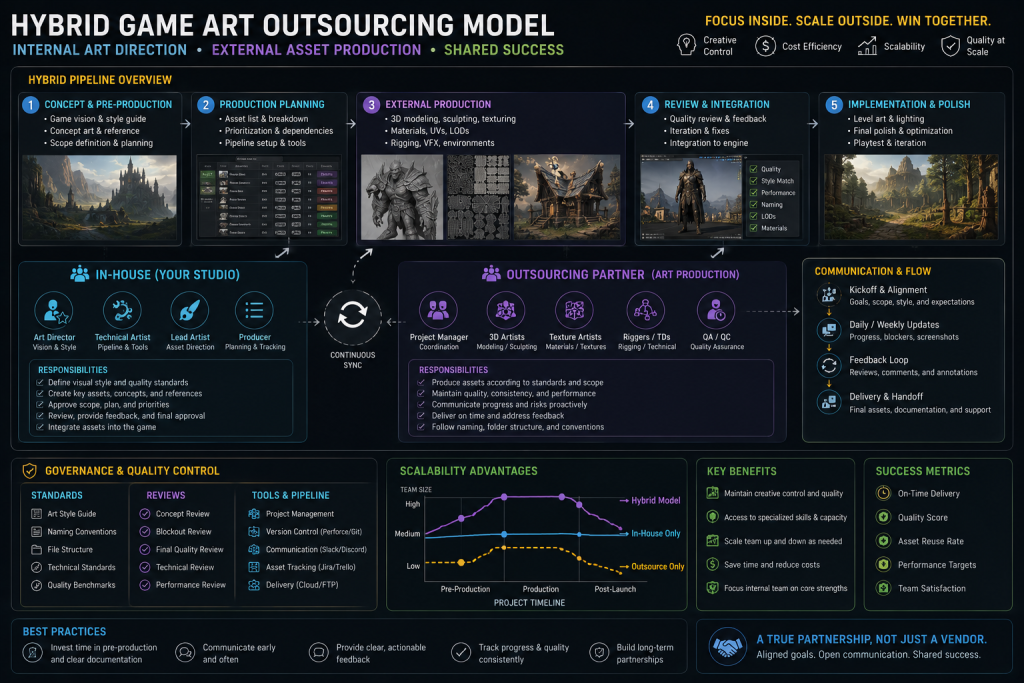
For most mid-core studios, the productive answer to in-house vs outsource is neither — it’s a hybrid. The in-house team holds art direction, style definition, hero asset production, and milestone review. The outsourcing partner handles volume production: environment props, secondary character variants, texture passes on established material tiers, LOD generation for approved hero assets.
This model works because it distributes work by institutional knowledge dependency, not by asset type. High-dependency work stays internal. Low-dependency, high-volume work goes external. The art director maintains visual control without managing every asset personally. The outsourcing partner operates on a complete style guide, a clear brief format, and an established revision protocol — reducing the management overhead that makes outsourcing expensive at small volumes.
“Editorial illustration created for visual reference purposes. It does not represent a real project, client work, or official software screenshot unless stated otherwise.”
The operational requirements for the hybrid model are worth naming explicitly:
A complete style guide before external work begins. A style guide that exists in the art director’s head is not a style guide for outsourcing purposes. It needs to be documented: material tiers, color scripts, texel density targets, polycount budgets, naming conventions, UV layout standards, and sample assets for each category. The cost of building this documentation is recovered on the first revision cycle that doesn’t happen because the brief was complete.
A vendor with a structured onboarding protocol. An outsourcing partner that requires your art lead to hand-hold every first-pass review is not a production-ready partner for a mid-core pipeline under schedule pressure. The partner should be able to review their own work against your style guide before submission — and flag edge cases proactively, not after your feedback cycle.
A revision protocol with a defined escalation path. How many revision rounds are included in the SOW? What happens when a third round is needed? Who approves scope changes? These questions, unresolved at contract stage, become expensive in the middle of a content push.
For mid-core studios managing 3D character outsourcing,environment art production, or concept art pipeline, the hybrid model gives internal teams the capacity headroom that pure in-house can’t sustain across a full production cycle — without surrendering the art direction control that makes a game’s visual identity coherent.
The Hidden Cost Map: What Mid-core Studios Miss
Producers managing their first major outsourcing engagement consistently underestimate the same cost categories. None of these are unavoidable — but they all require advance planning.
Onboarding cost. Every new vendor relationship requires time before the vendor is operating at full production speed on your brief. That onboarding window — typically two to four weeks for a structured agency, longer for individual freelancers — is not billable production output. It’s investment in a relationship that pays off over the full engagement duration. Factor it into the first milestone’s scope, not the billing.
Art direction management overhead. Outsourcing doesn’t eliminate art direction time — it changes its form. Instead of walking across the room to give feedback, your art lead is writing revision notes, attending review calls, and maintaining the documentation that keeps the vendor on-target. At scale, this can consume 15–25% of an art lead’s weekly capacity during active outsourcing phases. That’s not a cost to avoid; it’s a cost to budget.
Vendor switch cost. Replacing a vendor mid-production is the highest-cost outsourcing decision a producer makes. The new vendor needs to onboard, ramp up, and validate their work against an established style guide — while production continues. Switching vendors at the second milestone of a four-milestone production adds weeks of delay and revision cost that wasn’t in the schedule. The lesson is not “never switch vendors” — it’s “validate vendors before committing production scope, not after.”
IP and confidentiality structure. For mid-core titles with unreleased visual direction, outsourcing requires NDAs and IP assignment clauses that are clear, mutual, and signed before assets are shared. This is a legal administration cost, not a production cost — but discovering that your vendor agreement doesn’t include adequate IP assignment at the end of production is considerably more expensive than addressing it at the start.
A Decision Checklist for Mid-core Producers
Before finalising the in-house vs outsource call on your next project, run through these questions:
- Is your peak art demand more than 50% higher than your baseline team capacity? If yes, in-house alone won’t cover it.
- Do you need additional capacity in less than eight weeks? If yes, only outsourcing delivers at that timeline.
- Can the target scope be fully specified in a style guide and brief? If yes, it’s outsourceable. If no, assess the onboarding cost honestly.
- Have you run a paid art test with the vendor before committing production scope? If no, first-pass approval rate is unknown — and your milestone schedule is carrying that risk.
- Does your SOW include revision round limits, escalation paths, and IP assignment? If no, stop before signing.
- Have you budgeted onboarding time and art direction management overhead as real production costs? If no, your budget is undercounting the true outsourcing cost.
None of these questions have universal answers. They have answers relative to your project, your team, your timeline, and your milestone structure. The framework doesn’t make the decision for you — it makes sure the decision is based on the actual production constraints, not on assumptions about what outsourcing costs or what in-house can deliver.
The Call Is a Production Decision, Not a Philosophy
Studios that treat in-house vs outsource as an identity question — “we’re a studio that keeps art in-house” or “we always outsource volume” — consistently make the wrong call for at least one project cycle. The correct model for a given project depends on its specific capacity gap, timeline, style guide maturity, and vendor relationship maturity. Those variables change project to project.
The producer who runs the framework honestly — who knows their peak-to-baseline art demand ratio, who has validated their vendor’s first-pass approval rate on a paid test, who has budgeted onboarding and management overhead as real costs — makes a better decision than the producer who makes the call based on what worked last time.
Mid-core production is defined by its resource constraints. The studios that scale successfully through those constraints are the ones that treat outsourcing as a production tool with specific operating parameters — not a cost-saving measure, not a compromise, and not a last resort.
Scaling a mid-core project requires the right balance of in-house control and outsourcing flexibility. At Nasty Rodent, we work as a full-cycle partner — from initial concept art through 3D characters, environments, props, and weapons. Based in Tallinn, Estonia, our team of 40+ has delivered production-ready art for Squad, Ready Or Not, Mutant Year Zero, Starship Troopers: Extermination, and Miasma Chronicles — working within established pipelines or bringing our own structure where it’s needed.