Unity HDRP vs Unreal Engine 5 for 3D Production: Choosing Your Engine
-

Written byDenys Zadoienyi
-

Updated on20.05.2026
-

Time to read15 min

- Introduction
- What HDRP and UE5 actually are in 2026
- The Fidelity Ceiling: where each engine actually peaks
- Lookdev Workflow: what your art director will actually live with
- Asset Pipeline and Polycount Budget: what your 3D team needs to know
- Comparison Snippet Table
- Integration Overhead and Production Risk
- How this decision actually gets made on a real project
- Why this comparison matters more in 2026 than it did in 2024
- Bottom line: choose your engine against your real production reality
- About the engine selection conversation
Introduction
The Unity HDRP versus Unreal Engine 5 comparison stopped being a clean technical match-up in February 2026. That’s when Unity confirmed what many tech leads had suspected for over a year: HDRP is moving into maintenance mode. No new features are planned. Engineering effort consolidates around URP. Nintendo Switch 2 support and stability fixes are what HDRP teams will get going forward — nothing else.
Meanwhile, Unreal Engine 5.7 shipped in December 2025 with Nanite Foliage, MegaLights, Nanite Voxels, and Substrate moving to production-ready. The visual ceiling on the UE5 side keeps moving up. The visual ceiling on the HDRP side has just been formally pinned to where it stands today.
This reframes the question for any art director or tech art lead evaluating engines for a new project. The decision is no longer “which engine produces better screenshots.” It’s: which engine matches my production cycle, my fidelity target three years from greenlight to ship, and the lookdev workflow my team can actually sustain. That’s the comparison this piece walks through — feature by feature, pipeline by pipeline, with the production realities your team will face once you commit.
What HDRP and UE5 actually are in 2026
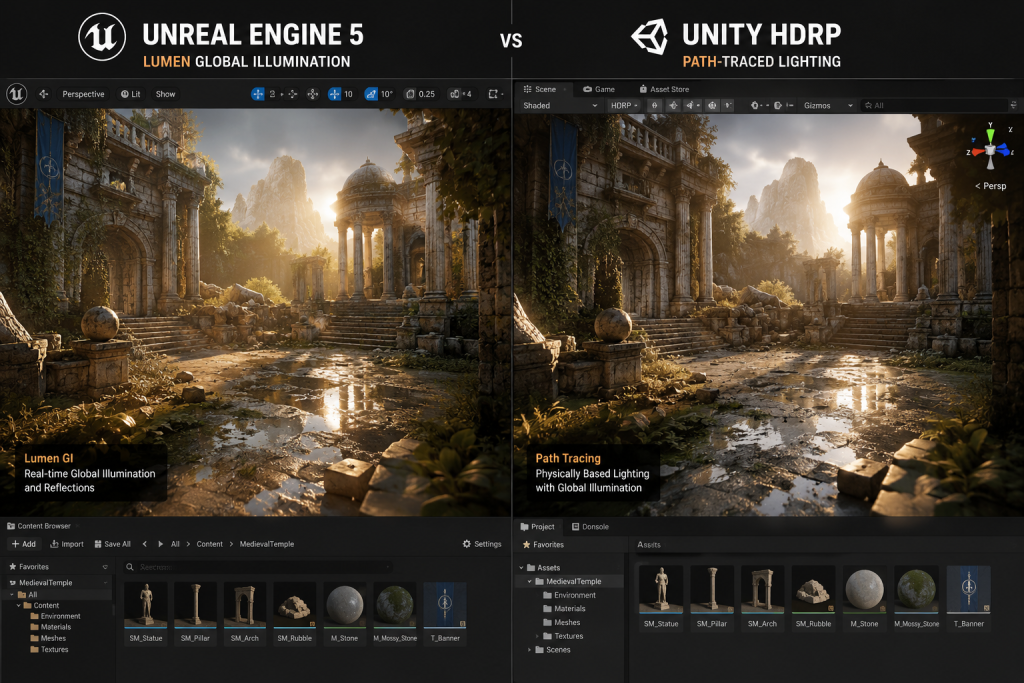
Unity HDRP (High Definition Render Pipeline) is one of two Scriptable Render Pipelines shipped by Unity, designed for high-fidelity 3D rendering on console and PC. It supports rasterized, ray-traced, and path-traced techniques, physically based lighting in real-world units, and advanced shaders covering subsurface scattering, anisotropy, hair, fabric, and multilayered materials. As of 2026, it’s feature-frozen — locked at the capability set of Unity 6 LTS.
Unreal Engine 5 is Epic’s flagship real-time engine, built around two pipeline-redefining systems: Nanite, a virtualized micropolygon geometry system that streams film-quality meshes without manual LOD authoring, and Lumen, a fully dynamic global illumination and reflections solution. UE5.7 (December 2025) extended Nanite to foliage and skeletal assemblies, added MegaLights for high light counts, and moved Substrate (modular material authoring) to production-ready status.
The two engines now sit on opposite trajectories. That trajectory matters more than feature parity on any given day.
“Editorial illustration created for visual reference purposes. It does not represent a real project, client work, or official software screenshot unless stated otherwise.”
The Fidelity Ceiling: where each engine actually peaks
Visual fidelity comparisons that crown a single winner usually compare a hero shot in one engine to a hero shot in the other. That’s not how a three-year production cycle works. What matters is the ceiling — the upper bound of what a senior lookdev team can extract with reasonable effort.
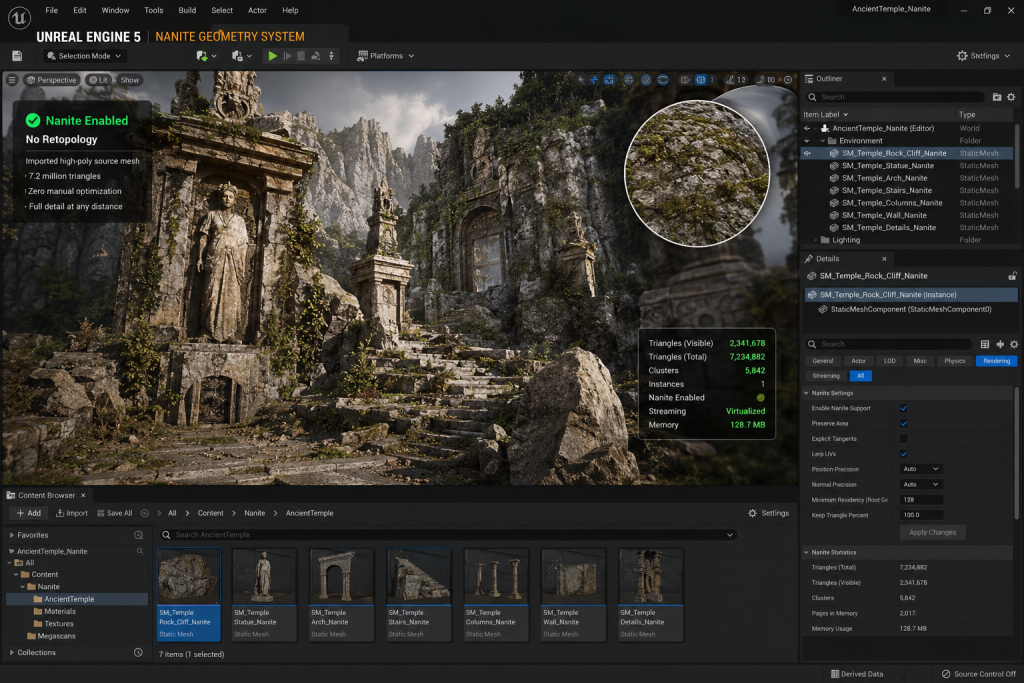
UE5’s fidelity ceiling in 2026. Nanite removed the polycount conversation for static and (since 5.7) skeletal and foliage assets. A senior environment artist can import multi-million-poly meshes from ZBrush or photogrammetry pipelines and skip retopology for visual-only assets — keeping clean topology only where deformation requires it. Lumen handles indirect lighting without bake cycles, which compresses lighting iteration from days to minutes. MetaHuman gives a credible starting point for hero characters that bypasses months of head-modeling. The ceiling is high enough that a smaller team can hit a fidelity bar previously locked to studios with hundreds of artists — Sandfall Interactive’s Clair Obscur: Expedition 33 is the most-cited 2025 demonstration of this.
“Editorial illustration created for visual reference purposes. It does not represent a real project, client work, or official software screenshot unless stated otherwise.”
The trade-off shows up under load. Shader compilation stutter and traversal stutter have become known UE5 release-day complaints across multiple 2024–2025 titles. These aren’t unsolvable, but they require a tech artist who understands PSO precaching, shader variant management, and World Partition streaming budgets. The fidelity ceiling is real; reaching it without a stutter-ridden ship is where most studios underestimate the investment.
HDRP’s fidelity ceiling in 2026. HDRP is not visually behind UE5 in the way community shorthand often suggests. Its hybrid rasterization plus ray tracing approach, full path tracing on DX12, advanced shader stack covering hair and translucency, and physically based lighting in Lux/Lumen/EV give a senior lighting artist genuine high-end control. Games like V Rising and PGA Tour 2K25 demonstrate the production endpoint.
What’s different now is the feature ceiling is locked. Whatever advanced techniques shipped with Unity 6 LTS — that’s the toolkit. If UE5.8 ships next year with rendering breakthroughs your competitors adopt, HDRP teams won’t have a parallel feature. For a six-month polish project that’s irrelevant. For a 36-month AAA cycle, that’s a strategic input.
The practical implication for 3D production. If your visual target was set at “AAA mid-2025 fidelity,” both engines can deliver it. If your visual target is “best-in-class fidelity at ship date three years out,” UE5’s trajectory is the safer bet. The Nasty Rodent team has shipped 3D environment asset packs for both pipelines, and the production envelope feels different from week one — UE5 work is forward-leaning, HDRP work is consolidating around a known endpoint.
Lookdev Workflow: what your art director will actually live with
Lookdev — the iterative process of getting an asset’s material, shading, and lighting response to match the art target — is where engine differences become daily friction or daily flow. This is the section your art director cares about most.
UE5 lookdev in practice. Material authoring lives in the node-based Material Editor, with Substrate (5.7 production-ready) layering on top for complex layered surfaces — automotive paint with metalflake under clearcoat, weathered metals with rust over base, skin with multilayer subsurface. Lumen previews indirect lighting in real time inside the editor; what you see in the viewport is close to shipped output. The round-trip from DCC tool to engine to art-direction review has compressed significantly compared to UE4.

“Editorial illustration created for visual reference purposes. It does not represent a real project, client work, or official software screenshot unless stated otherwise.”
Where lookdev friction shows up: large material graphs can become hard to debug, parameter explosion across instances is common, and the Substrate transition for existing projects requires planning. Hero character lookdev — skin, hair, eyes — leans heavily on MetaHuman if you want to hit AAA-tier facial fidelity quickly, and customizing past the MetaHuman defaults takes a senior character artist who knows the system’s anchor points.
HDRP lookdev in practice. Shader Graph is the primary authoring tool, with the HDRP-specific Lit shader exposing a deep parameter set: subsurface scattering, anisotropy, iridescence, real-time tessellation, layered materials. The lighting volume system is one of HDRP’s strongest art-director tools — local lighting overrides per area let lighting artists craft mood per region without fighting global settings. Path tracing on DX12 lets you produce reference frames inside the engine for shot validation.
Lookdev friction on HDRP: the setup overhead is real — getting a project configured correctly with the right volume framework, exposure model, and material types takes longer than UE5’s defaults. Custom shaders require deeper Shader Graph familiarity than URP equivalents. Excessive shader variants from incorrect material setup is a known cause of stuttering — a competent tech artist is non-negotiable on a serious HDRP project.
The art-director question that matters. Both engines can hit your visual target. The honest question is which lookdev rhythm matches your team. UE5 rewards artists who can keep their head in the engine and iterate visually. HDRP rewards teams with strong technical-art discipline who want fine-grained control over the lighting stack. For 3D character pipelines, we see this split most clearly — UE5 character lookdev tends to be MetaHuman-anchored and faster to first-pass approval; HDRP character lookdev tends to be more bespoke and reaches its peak with senior shader authoring.
Asset Pipeline and Polycount Budget: what your 3D team needs to know
The polycount conversation has bifurcated between the two engines, and your asset pipeline should reflect that from day one.
UE5 with Nanite. For static meshes, Nanite Foliage assemblies, and (since 5.7) Nanite Skinning targets, polycount budgets are largely a non-conversation for visual-only assets. Import the high-poly. Nanite handles streaming and detail based on screen-space coverage. This doesn’t mean import discipline disappears — UV layout still matters for texturing, normal maps still serve close-up shots and any non-Nanite fallback path, and Nanite-incompatible features (translucency on Nanite, displacement, certain blueprint workflows) still demand manual LOD authoring. Hero characters with rigging still need clean topology around deformation areas.
The practical pipeline shift: retopology stops being mandatory for environment hero assets but stays mandatory for animated characters, anything needing translucency, and any asset that will pass through legacy non-Nanite shading paths. Your 3D props pipeline effectively splits into two tracks — Nanite-friendly (skip retopology, optimize texel density and UVs) and Nanite-fallback (full classical optimization).
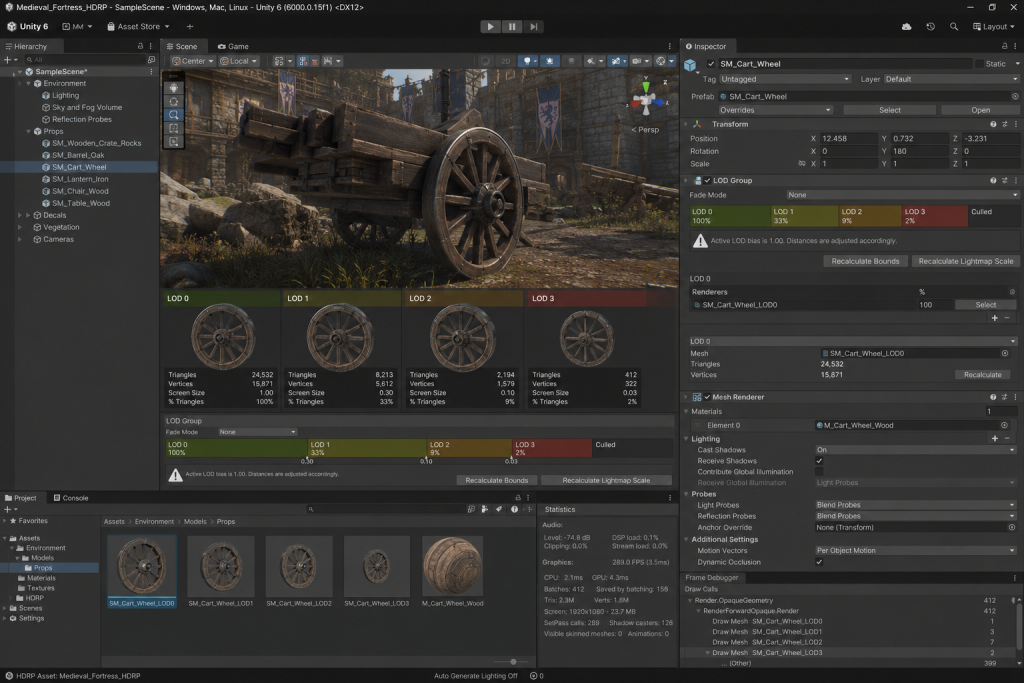
HDRP with traditional pipeline. Polycount budgets matter. LOD authoring is mandatory at scale. Texel density discipline, draw call reduction through batching, occlusion culling setup — the classical 3D production pipeline applies in full. This is not a disadvantage on its own; mature classical pipelines are predictable, well-documented, and don’t require artists to learn new mental models for what “the engine handles” versus “the artist handles.” A studio with deep classical asset pipeline expertise will be productive immediately.

“Editorial illustration created for visual reference purposes. It does not represent a real project, client work, or official software screenshot unless stated otherwise.”
The pipeline cost is in human attention. Where UE5 lets a senior environment artist push 10 million polygons into the editor and trust the system, HDRP requires that same artist to think about budgets per region, target platform LOD distances, and material instance batching. For mobile-friendly tiers within HDRP (Switch 2, lower-spec PCs), this discipline is essential anyway.
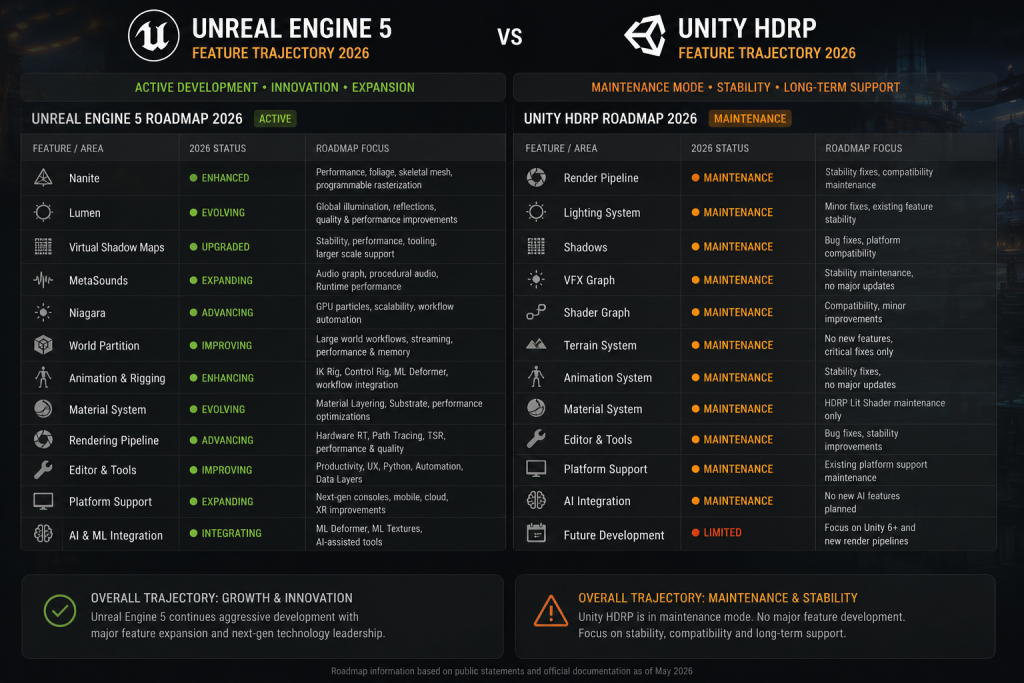
Critical Documented note for 2026. Unity has stated that HDRP development is now constrained to stability and Nintendo Switch 2 support. Major asset pipeline innovations — equivalents to Nanite Foliage or Substrate — are not on the HDRP roadmap. Studios committing to HDRP for new productions should plan around the current feature set being the final feature set for the lifetime of their project.
Comparison Snippet Table
| Dimension | Unity HDRP (Unity 6, 2026) | Unreal Engine 5.7 (2026) |
| Geometry pipeline | Classical LOD authoring; polycount budgets enforced | Nanite for static, foliage, skeletal (since 5.7); near-zero polycount discipline for compatible assets |
| Global illumination | Real-time GI via ray tracing (DX12), path tracing for reference frames | Lumen — fully dynamic, software and hardware ray-traced |
| Lighting iteration | Volume overrides per area; bake-or-realtime hybrid | Real-time, bake-free; what you see in editor is what ships |
| Hero characters | Custom rigging and shading, advanced Lit shader (SSS, hair, eyes) | MetaHuman anchor, custom from there |
| Material authoring | Shader Graph with HDRP-specific shaders | Material Editor + Substrate (5.7 production-ready) |
| Feature development trajectory (2026+) | Maintenance only — Switch 2 + stability | Active — 5.7 shipped Nanite Foliage, MegaLights, PCG framework |
| Platform reach | PC, current-gen console, Switch 2 (2026) | PC, current-gen console, improving mobile |
| Typical AAA reference titles | V Rising, PGA Tour 2K25, Harold Halibut | Black Myth: Wukong, Hellblade II, Clair Obscur: Expedition 33, Avowed |
| Known release-day risks | Shader variant stutter if misconfigured | Shader compilation stutter, traversal stutter on streaming |
| Best fit (3D production lens) | Studios with classical pipeline expertise, defined feature scope, mid-cycle projects | Studios targeting forward-fidelity ceiling, 24–48 month cycles, environment-heavy art direction |
Integration Overhead and Production Risk
Every engine choice comes with integration overhead — the work between “we picked an engine” and “our team can actually produce assets the project needs.” This is rarely modelled honestly in early planning.
UE5 integration overhead. Onboarding a 3D artist from a Unity-only background to a productive UE5 environment realistically takes weeks to a few months, depending on tooling depth (Blueprints vs C++, World Partition workflows, Nanite-friendly asset prep). A tech artist needs longer — PSO precaching strategy, shader variant management, Niagara VFX, and Substrate authoring are senior-level domains. Studios that underestimate this ramp-up often hit their first milestone gate behind schedule because asset delivery looked fine but engine integration took a tech artist longer than planned.
The ongoing production risk on UE5 lives mostly in the streaming and shader stutter family — release-day problems that surface only at scale, not in dev builds. Mitigation exists (PSO collection, profiling discipline, controlled hitches during loading), but it’s tech-artist work that has to be budgeted from milestone one, not patched in pre-cert.
HDRP integration overhead. A team with existing Unity expertise transitions to HDRP with less friction than to a different engine entirely, but the move from Built-in or URP to HDRP is not trivial — shader workflows differ, lighting setup differs, and previously usable assets often need rework. For a team coming from another engine entirely (say, a UE4 team moving to HDRP), expect ramp-up costs similar to a fresh engine adoption.
The 2026-specific risk is strategic, not technical. Committing to HDRP for a 36-month production means committing to the feature set Unity has already shipped. If the project’s visual target depends on a rendering breakthrough that arrives in UE5.9 or 6.0 next year, you don’t have a corresponding feature on the HDRP side. This is a risk type that doesn’t show up in a feature comparison from one month’s vantage point — it shows up across the production lifecycle.
Vendor stack alignment. Whichever engine you select, your outsource partners’ depth in that engine becomes a milestone-gate-level concern. An outsource team that lists “Unity and Unreal Engine” but has 90% of recent shipped work in one of them isn’t equivalent capacity for the other. The honest conversation with any vendor — including ours — starts with “show me three recent projects in the exact engine we’re choosing, and walk me through the asset pipeline you used.” If the answer is thin, that’s the answer regardless of marketing. Our recent portfolio leans into both engines, but the breakdown isn’t symmetric — and we’d rather be honest about that than oversell parity that doesn’t exist.
How this decision actually gets made on a real project
Engine selection rarely happens on technical merit alone. From what we’ve seen in mid-core and AAA studio conversations, the decision pivots on four practical inputs.
Existing team gravity. If your studio has 20 senior Unity engineers and a tech art team with five years of HDRP experience, switching to UE5 means buying back that expertise at significant cost. The right move is often to commit harder to HDRP for the next project and re-evaluate at the project after. Conversely, a UE4-heavy team has minimal friction moving to UE5.
Visual target relative to project length. If your target is “this generation’s high-fidelity bar” and your ship date is 18 months out, both engines work. If your target is “best-in-class at ship” and ship is 36+ months out, the trajectory advantage matters — UE5 is more likely to give you tools your competitors will be using by then.
Pipeline tolerance for change. UE5 with Nanite, Lumen, and Substrate is a significant mental model shift for artists trained on classical pipelines. Some teams flourish in the new paradigm; others find it disorienting. HDRP rewards traditional discipline. Knowing which culture your studio actually has — not the one you wish you had — matters.
Vendor and outsource stack. Most mid-core and AAA studios use outsource capacity for some part of art production. The engines your trusted vendors are deepest in is a real input. A vendor switch mid-pipeline because of engine mismatch is among the most expensive operational failures a producer can face.
Why this comparison matters more in 2026 than it did in 2024
This isn’t the same comparison it was two years ago, and treating it as such will lead a planning conversation in the wrong direction.
In 2024, the choice between HDRP and UE5 was reasonably described as a feature trade-off: UE5 had Nanite and Lumen, HDRP had path tracing and tighter shader control, both were under active development, both were viable for AAA. A studio could pick based on team familiarity and not worry about the trajectory question.
In 2026, the trajectory question is the foreground. UE5 is in active feature development with major releases every 12–18 months and a clear forward roadmap. HDRP is in maintenance, with stability and Switch 2 as the next 24 months of work. That doesn’t make HDRP wrong for every project — V Rising and PGA Tour 2K25 ship beautifully on it — but it changes how a tech art lead has to think about a multi-year commitment.
“Editorial illustration created for visual reference purposes. It does not represent a real project, client work, or official software screenshot unless stated otherwise.”
Studios making this decision today should make it with the 2026 reality fully on the table, not against the 2024 mental model. That includes being honest with outsource partners and vendors: any pipeline plan written against an assumption of future HDRP feature parity with UE5 is built on a foundation Unity has formally withdrawn.
Bottom line: choose your engine against your real production reality
The Unity HDRP vs Unreal Engine 5 question in 2026 doesn’t reduce to “which has better graphics.” Both engines can hit AAA visual targets. The decision pivots on:
- Project length vs feature trajectory — UE5 keeps adding capability, HDRP doesn’t.
- Team gravity — your senior staff’s existing depth is a real input, not a soft factor.
- Pipeline culture — Nanite-first mental models vs classical asset discipline.
- Vendor stack alignment — your outsource partners’ real depth in each engine.
A 36-month AAA cycle aimed at a moving visual ceiling leans UE5. A six-to-eighteen-month project with a defined visual scope and a strong existing HDRP team can ship beautifully on HDRP — knowing that the toolkit is now fixed at its current state.
Either way, the decision is worth making with your tech art lead, your producer, and your outsource partners in the same room. Anyone who tells you the engine question has a universal answer is selling something other than honest production advice.
About the engine selection conversation
Picking between Unity HDRP and Unreal Engine 5 sets the boundaries of every art production decision that follows it — lookdev tooling, asset pipeline structure, optimization strategy, vendor selection. At Nasty Rodent, we work production pipelines in both Unreal Engine 5 and Unity (HDRP and URP), handling everything from geometry preparation and lookdev through to final engine delivery. If your art direction is being finalized and you’re trying to figure out what hand-off looks like on the vendor side for either engine — that’s where the conversation usually starts. Our portfolio leans into both pipelines, the team has shipped against both, and we’d rather walk through specifics than oversell engine-agnostic capacity.