Unreal Engine 5 for AAA: Why Studios Choose UE5
-

Written byDenys Zadoienyi
-

Updated on03.07.2026
-

Time to read9 min

- What Actually Changed Between UE4 and UE5 – and Why It’s Not Just Visual
- The Real Reason AAA Studios Switch: Cost, Tooling, and Talent – Not Just Graphics
- Technical Matrix: What Each UE5 System Changes in Production
- Where UE5 Adoption Creates New Production Risk
- What This Means for Your Art Pipeline
- Proprietary Engine vs Unreal Engine 5 for AAA Production
- Deciding If the Switch Is Worth It for Your Production
Unreal Engine 5 for AAA production gets sold on Nanite and Lumen – the demo reel technology, virtualized geometry and real-time global illumination that make a State of Unreal keynote look effortless. That’s only part of why studios move their next AAA title onto UE5. The engine decision rarely happens on graphics alone – it’s about what a studio stops having to build, hire, and maintain once it stops carrying the full weight of its own engine.
Unreal Engine 5 is Epic Games’ real-time 3D engine, built around Nanite virtualized geometry and Lumen dynamic global illumination, that AAA studios increasingly choose over building or maintaining a proprietary engine. The technology is the visible part. The decision studios are actually making is a production and cost one: whether a licensed, actively developed engine gets a team to a better-looking, better-scheduled game than years of in-house engine maintenance would.
What Actually Changed Between UE4 and UE5 – and Why It’s Not Just Visual
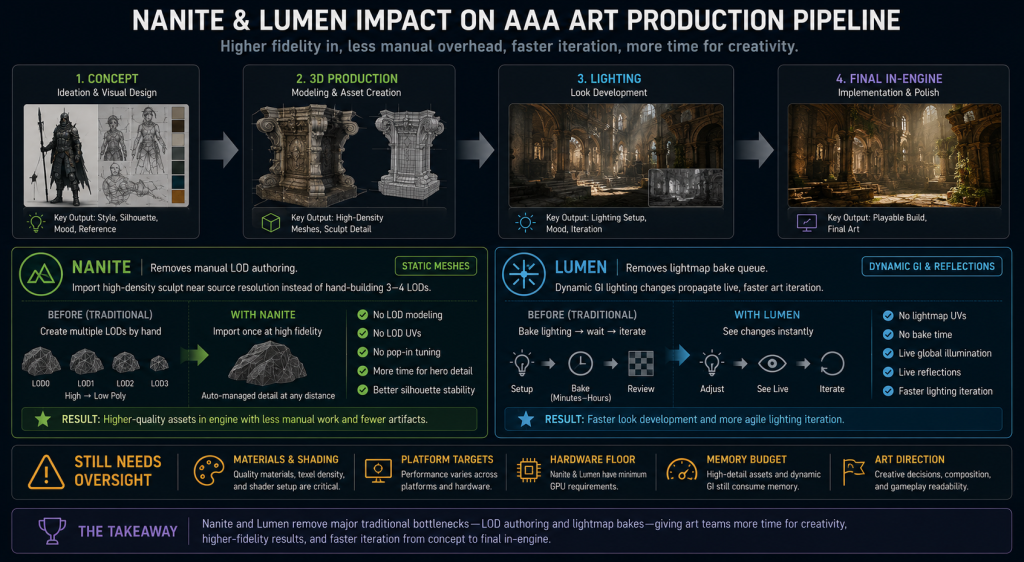
Nanite reduces the manual LOD authoring workload for supported static meshes and platforms – an artist can import a high-density ZBrush sculpt close to source resolution instead of hand-building three or four levels of detail. Lumen reduces dependence on baked lightmap workflows for projects that use dynamic global illumination – lighting changes propagate without a bake queue blocking the art team’s iteration speed, on the assets and scenarios Lumen supports. World Partition gives large open worlds a grid-based streaming framework instead of fully manual sublevel management. MetaHuman compresses the starting point for a credible AAA-tier digital human – base mesh, rig, and facial setup – well below the weeks a from-scratch hero character normally takes.
None of these are visual features first. They’re production-pipeline accelerators – each one reduces a manual step or changes where that work happens, and each one changes what pipeline integration looks like between concept, 3D production, and final in-engine delivery. That’s the actual sales pitch, and it’s aimed at a producer’s schedule as much as at the visual fidelity an art director cares about.
The Real Reason AAA Studios Switch: Cost, Tooling, and Talent – Not Just Graphics
The decision is rarely about cost alone. It’s usually a broader production calculation: engine maintenance cost, tooling maturity, the size of the available hiring and vendor pool, how far Epic’s own technical roadmap carries the engine forward, and whether the studio wants to keep funding engine infrastructure internally for another console generation.
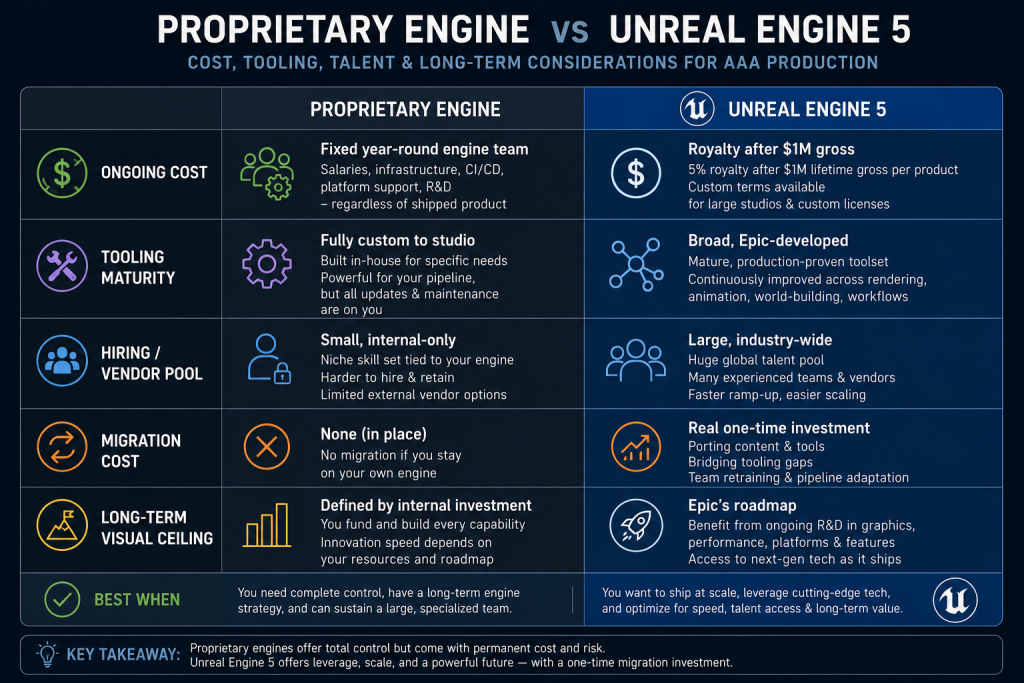
Maintaining a proprietary AAA-capable engine means carrying an engine team year-round – programmers whose job is tooling and rendering infrastructure, not shipping the game in front of them. That team doesn’t shrink between projects; it’s a fixed cost whether the studio ships one game every three years or four. Under Epic’s standard public license, royalty-bearing titles generally don’t owe royalties until a game crosses $1M in gross revenue; large AAA studios and publishers frequently negotiate custom licensing or partnership terms on top of that baseline, so the real comparison isn’t “free versus expensive” but variable licensing cost against a permanent internal engine organization. Either way, it changes how a production budget gets allocated between engineering headcount and content creation from year one – and it comes with a hiring pool and vendor pool built around one of the industry’s most widely used engines instead of one studio’s internal knowledge base.
CD Projekt Red is the clearest public example of exactly this decision: the studio confirmed the next Witcher saga would move from its own REDengine to Unreal Engine 5 under a multi-year partnership with Epic, choosing to redirect engineering effort away from sculpting REDengine into shape for another console generation and toward a licensed engine with predictability and access to an actively developed toolset. Ninja Theory’s Senua’s Saga: Hellblade II is a different kind of reference point – not a public case study in engine-replacement economics, but a shipped AAA-scale production that shows what UE5 looks like at full visual fidelity once a studio commits to it. Neither is a Nasty Rodent project; both are cited here as public industry reference points.
“Editorial illustration created for visual reference purposes. It does not represent a real project, client work, or official software screenshot unless stated otherwise.”
Technical Matrix: What Each UE5 System Changes in Production
| System | What It Reduces | Production Impact | Where It Still Needs Oversight |
| Nanite | Manual LOD authoring for static meshes | Faster art iteration, higher source fidelity | Skeletal meshes are supported since 5.5 but with animation-LOD and morph-target limitations; materials, masking, and platform targets still need technical art review |
| Lumen | Lightmap baking for dynamic GI | Lighting changes propagate without a bake queue | Hardware ray tracing requirements gate performance on lower-end targets |
| World Partition | Manual level-streaming setup | Large open worlds without hand-split sublevels | Still requires a deliberate streaming and memory budget plan |
| MetaHuman | Weeks of hero-character modeling and rigging | Fast starting point for AAA-tier digital humans | Full bespoke stylization still needs custom shader and lookdev work |
The column that matters most for planning isn’t the feature list – it’s the last one. Every system that removes manual work still has a boundary where a technical artist has to make a deliberate call, and treating any of these as fully automatic is where studios lose a milestone review to a performance profile nobody budgeted time to fix.
Where UE5 Adoption Creates New Production Risk
Switching engines isn’t a pure win, and treating it as one is where the adoption decision goes wrong. A studio migrating from a proprietary engine loses years of tooling built around that engine’s specific quirks – pipeline scripts, custom editor extensions, art direction workflows the team has internalized. None of that transfers automatically. Vendor and outsource partners are part of this cost too: an outsource studio that lists Unreal Engine on its site but has shipped 90% of recent work in Unity isn’t equivalent capacity, and finding that out mid-production is expensive.
Shader compilation stutter and traversal stutter – frame-time spikes tied to how UE5 compiles and streams content at runtime – are among the most commonly discussed performance complaints around shipped UE5 titles, and they surface late, often after a vertical slice already looks and plays well on a development workstation. Nanite and Lumen also carry a real hardware floor: a project targeting older or current next-gen console hardware, or a wide PC spec range, needs a profiling plan from pre-production, not a fix scheduled for polish.

For an art director, the risk shows up as a visual target that was scoped against a tech demo’s showcase scene, not against the game’s actual worst-case moment – a crowded battle, a dense foliage biome, a hundred Nanite-heavy props on screen at once. For a producer, it shows up as an engine migration timeline that assumed six months and took twelve, because the tooling gap between the old engine and UE5 was never fully scoped before the switch was announced.
What This Means for Your Art Pipeline
The engine decision sets more than a rendering target – it decides your art bible’s technical constraints, your outsource vendor pool, and how your production pipeline handles everything from concept art through final in-engine delivery for the next several years. At Nasty Rodent, we build 3D environment art for Unreal Engine production: modular kits, high-detail source meshes authored with Nanite’s cluster generation in mind, PBR material consistency, and asset budgets scoped against real performance profiles instead of demo-scene best cases – respecting platform targets and lighting direction rather than assuming Nanite and Lumen remove the need for either. If your studio is mid-migration or scoping a UE5-native project from the start, that’s exactly the kind of pipeline work we do.
[BANNER: about-us-bottom]
Proprietary Engine vs Unreal Engine 5 for AAA Production
| Question | Proprietary Engine | Unreal Engine 5 |
| Ongoing cost structure | Fixed engineering team, year-round | Standard royalty model after $1M lifetime gross revenue; custom terms may apply for large studios |
| Tooling maturity | Fully custom to studio’s exact needs | Broad, actively developed by Epic, but not bespoke |
| Hiring pool | Small – internal knowledge only | Large – industry-wide UE5 talent and vendor base |
| Migration cost | None (already in place) | Real – tooling gap, retraining, pipeline rebuild |
| Long-term visual ceiling | Depends entirely on internal investment | Tracks Epic’s ongoing feature development |
The trade a studio is actually making: predictable ongoing engineering cost and full control, against a broader talent pool and a technology roadmap it doesn’t have to fund alone – at the price of a real, one-time migration cost that’s easy to underscope.
“Editorial illustration created for visual reference purposes. It does not represent a real project, client work, or official software screenshot unless stated otherwise.”
Epic’s own technical documentation is worth reading directly before scoping a Nanite-heavy environment plan – the official Nanite virtualized geometry documentation covers exactly which asset types and material setups the system does and doesn’t support well, which is where most first-project assumptions go wrong. On the studio-decision side, CD Projekt Red’s confirmed move from REDengine to Unreal Engine 5 remains one of the clearest public examples of a AAA studio weighing proprietary tooling against a licensed engine partnership and choosing to redirect its engineering investment.
Concept art and prop production don’t disappear when an engine changes – if anything, a UE5 migration is a good checkpoint to re-align the concept art pipeline and 3D prop production against the engine’s actual material and geometry conventions, rather than carrying over assumptions from the old pipeline unexamined.
Studios evaluating the switch tend to want the comparison against the alternative engine before the adoption case, not after – our breakdown of Unity HDRP vs Unreal Engine 5 covers that decision directly. For studios already committed to UE5, the two most consequential production questions are usually how the character pipeline works end to end in UE5 and the practical production limits of Nanite once real assets replace demo-scene ones.
Deciding If the Switch Is Worth It for Your Production
The studios that get real value from Unreal Engine 5 don’t adopt it for the render quality alone – they adopt it because the production math (engineering cost, hiring pool, tooling roadmap) works out better than the alternative, and they scope the migration cost honestly instead of treating it as a footnote.
If you’re an art director or producer scoping a UE5 migration or a UE5-native project, a 30-minute visual style match call with a senior art lead is a fast way to pressure-test whether your asset budgets and pipeline plan are scoped against real production conditions, not a tech demo. A current project stage and target platform spread are enough to start that conversation.