Game Art Outsourcing: Models, Costs, and Practices That Hold Up
-

Written byDenys Zadoienyi
-

Updated on07.07.2026
-

Time to read15 min

- Why “find a cheaper studio” is the wrong first question
- The cooperation models — and which one fits your production
- In-house vs outsource: an honest cost breakdown
- What actually drives the cost
- The practices that separate a controlled pipeline from a dependency risk
- How to choose a game art outsourcing studio
- A quick self-test: outsource or scale in-house?
- Cooperation models at a glance
- Turn the decision into a next step
Game art outsourcing has quietly stopped being a cost-saving shortcut and become a core production strategy — and the studios that treat it that way get very different results from the ones that treat it as a cheap way to make assets appear. If you own the vendor decision, the question you’re actually being asked isn’t “who is cheapest.” It’s whether external art will arrive engine-ready, on cadence, and consistent enough to drop into your build without a second production starting up inside your own team to fix it.
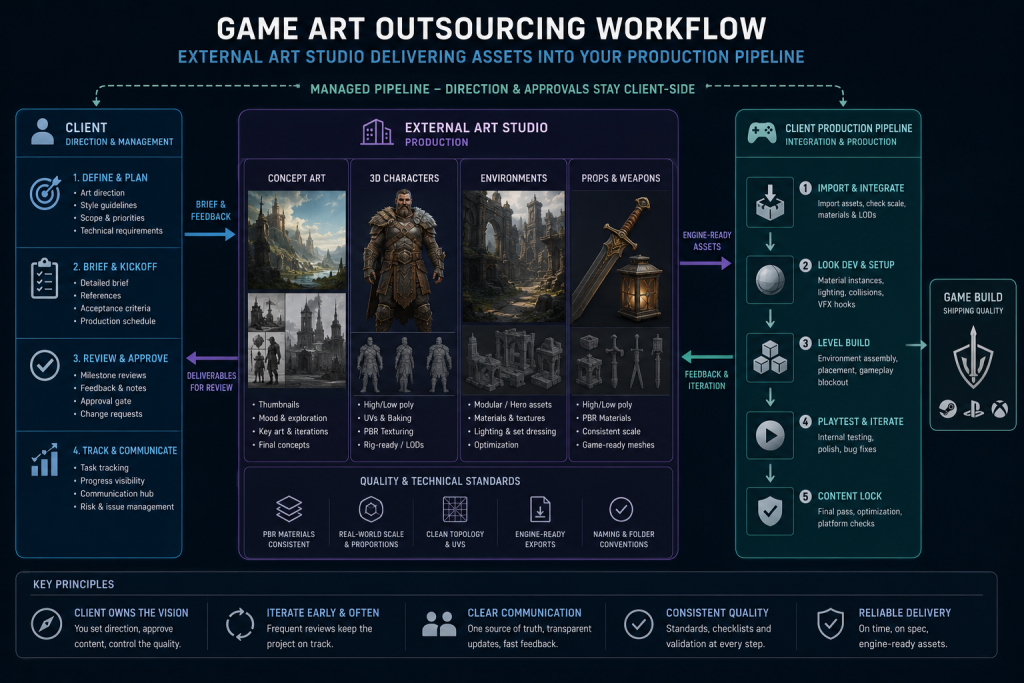
“Editorial illustration created for visual reference purposes. It does not represent a real project, client work, or official software screenshot unless stated otherwise.”
Definition. Game art outsourcing is the practice of partnering with an external team to produce engine-ready visual assets while you keep direction, approvals and production outcomes in-house. In its modern form it means integrated pipelines, milestone review and engine-first validation — not a one-way vendor handoff.
Why “find a cheaper studio” is the wrong first question
The instinct to open with price is understandable, and it’s usually a trap. Content costs keep climbing for the largest studios: Deloitte’s recent media and entertainment outlook notes that the very biggest games can now cost upwards of a billion dollars to develop and bring to market, with studios under real pressure to rein in costs while sustaining a narrow band of premium franchises. With the global games market crossing $200 billion for the first time in 2025 (on Newzoo’s data) and content demand still climbing, outsourcing is less about shaving a day rate and more about buying scalable capacity without destabilizing your core team.
Here’s the failure mode that price-first thinking hides. You pick the lowest quote, the first milestone comes back looking fine in isolation, and by the third batch the assets don’t sit together, integration surfaces problems nobody caught, and a second production spins up inside your studio just to reconcile it. For an outsource decision-maker, that isn’t a “quality issue” in the abstract — it’s a vendor scorecard sliding as first-pass approval drops, review cycles stretch, and the next milestone moves into vendor-risk territory — the point where the MSA needs a hard conversation. The same event reads differently one chair over: for a producer it’s opex and milestone risk, re-work days that were never in the capacity plan, and the quiet possibility of a mid-pipeline vendor switch that can cost a large share of the original budget to unwind. Cheap, chosen wrong, is the most expensive option on the table.
The cooperation models — and which one fits your production
Outsourcing game art production is not one relationship; it’s a set of them, and picking the wrong shape is where predictable engagements quietly go sideways. Most studios work in one of a few models, and each trades control for flexibility differently.
| Model | How it works | Best for | Cost basis | You control |
| Project-based (fixed scope) | Defined deliverables, fixed price | Well-specified, stable-scope batches | Per asset / per package | Outcomes, less the process |
| Time & Material (T&M) | Pay for hours/days actually used | Evolving scope, ongoing content | Day rate | Direction round to round |
| Retainer | Reserved monthly capacity | Steady, predictable pipelines | Monthly | Guaranteed throughput |
| Dedicated / managed team | A ring-fenced team run by the vendor | Long production, deep integration | Monthly per seat | Priorities, not admin |
| Staff augmentation | External artists inside your pipeline | Filling specific role gaps | Per seat | Day-to-day tasking |
| Co-development | Shared ownership of production | Blurred internal/external lines | Blended | Jointly |
The honest way to choose is to match the model to how settled your scope is. Fixed-scope, well-briefed work rewards project-based pricing; live-ops and evolving content usually want a retainer or dedicated team so capacity is there when the roadmap moves. When the line between “your team” and “their team” genuinely blurs, that’s co-development versus outsourcing, and it’s a different contract and a different mindset — closer to shared production than to a clean handoff.
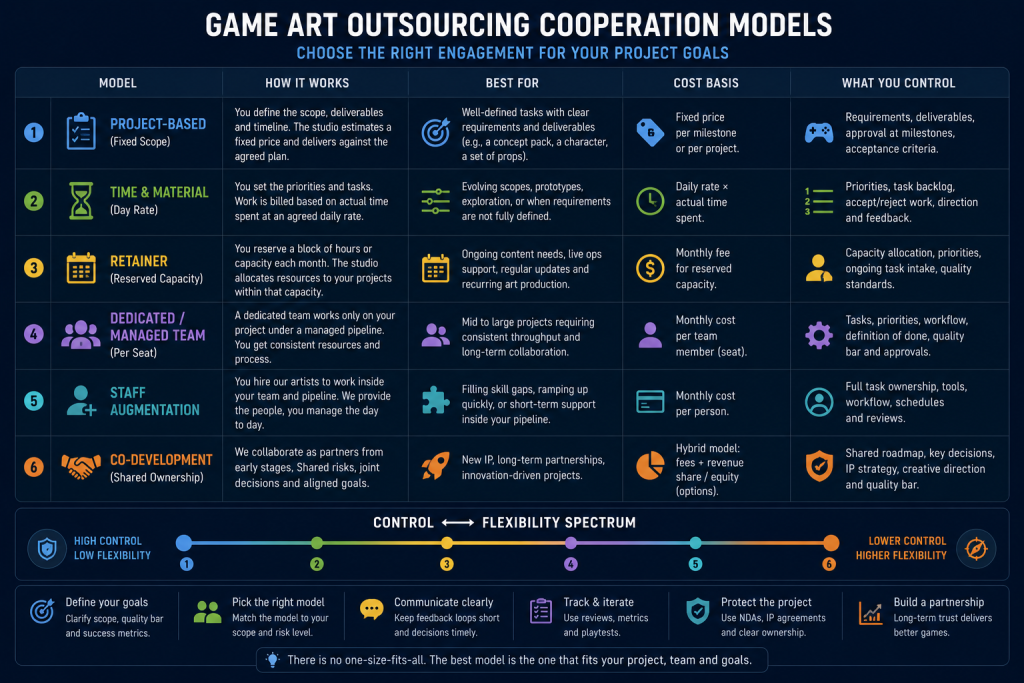
“Editorial illustration created for visual reference purposes. It does not represent a real project, client work, or official software screenshot unless stated otherwise.”
In-house vs outsource: an honest cost breakdown
Before the models matter, most teams face an earlier fork: scale the art team internally, or send the work out. It’s a real in-house versus outsource decision with a real answer that depends on your numbers — so it’s worth walking the in-house path honestly rather than waving it away.
What running art fully in-house actually takes
Building the capacity internally is entirely doable, and for some studios it’s right. It means hiring genuine seniors, not generalists — a producer or art lead who owns the visual target, modelers and texture artists with shipped experience, a technical artist working with art leads to enforce engine-readiness (retopology budgets, texel density, in-engine validation), and the pipeline tooling and templates to keep everyone consistent. The costs that ambush teams here aren’t the salaries; they’re the ramp. As Game Developer’s analysis of external production points out, the sourcing, interviewing, onboarding and training load balloons when you need dozens of extra artists at once — think 25 to 100 for a real scale-up — and even strong hires typically take their first one to three months to reach full output.
Three failure points recur. First, teams under-hire on technical art and discover at integration that assets miss platform budgets — caught late, after sign-off. Second, they staff up for one project and then carry idle seniors between productions, because, unlike an external team you can release, full-time staff are paid whether or not there’s content in production. Third, they underestimate the management and support drag — HR, IT, licenses, hardware — that doubling a team quietly imposes.
The self-deception in build-vs-buy is counting only the direct line — “an artist costs $X, so doing it ourselves saves $X.” The costs that decide the outcome are the ones that don’t show up on that line.
| Hidden cost | What it is | Rough estimate |
| Ramp to productivity | First 1–3 months of a new hire at reduced output | ~10–25% of a senior’s annual cost, per hire |
| Recruiting & onboarding | Sourcing, interviewing, training — worse at 25–100 artists | Weeks to months of lead time before output |
| Hardware & licenses | Workstation, tablet, GPU, software per added artist | ~$5,000–$10,000 per additional artist |
| Idle capacity | Seniors paid between projects with no content to make | Full salary during troughs |
| Rework / tech-debt | Under-resourced tech art → assets missing platform budgets | Re-do multiplier + milestone slip |
| Management & support | Added HR, IT, office, insurance load as team scales | Grows non-linearly with headcount |
Read as a market picture rather than a promise, an in-house AAA-tier art pod (senior 3D plus technical artist plus rigger) commonly runs in the tens of thousands per month fully loaded, before recruiting time and before the idle-capacity risk between projects. Comparable outsourced capacity under an MSA is elastic — you release it when the roadmap dips instead of carrying it — and, depending on region, seniority mix and management layer, it can work out materially cheaper than holding the same capacity in-house year-round.
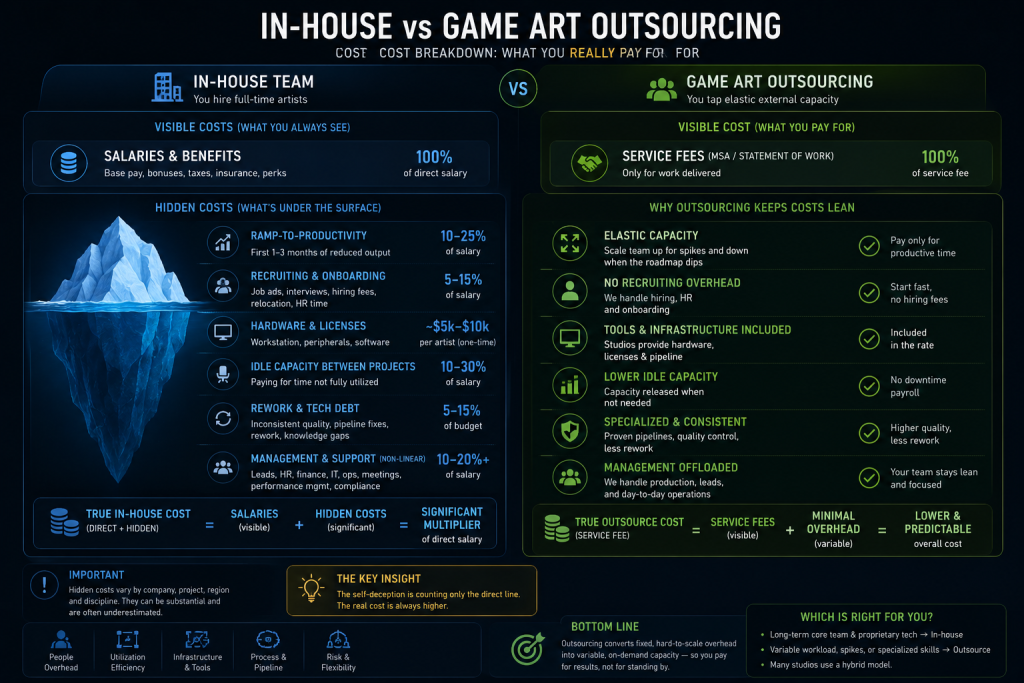
“Editorial illustration created for visual reference purposes. It does not represent a real project, client work, or official software screenshot unless stated otherwise.”
The break-even: when outsourcing wins
None of this makes in-house wrong. It makes the decision conditional, and the thresholds are worth stating as a calculation you can run on your own numbers:
- By volume. If a batch is small, well-scoped and one-off, in-house or a fixed-scope vendor both work. Past a steady, ongoing content demand your existing team can’t absorb without new hires, external capacity usually wins — you’re comparing weeks of recruiting against a team that starts this week.
- By team state. If you don’t already have a technical artist who owns engine-readiness, your first several outsourced or in-house assets will need rework regardless — but a mature studio brings that discipline with them, whereas hiring it takes months.
- By senior time. If a senior’s hour is worth more on hero assets and core problems than on batch production, every hour they spend on volume work is the expensive option. That’s the classic case for offloading the batch and keeping internal talent on what only they can do.
A note on how this usually plays out. In our experience the typical build-vs-buy story isn’t a spreadsheet decision made calmly up front — it’s a studio that staffed two in-house seniors to cover a large environment batch for a UE5 project, hit a capacity wall around the third milestone when engine-readiness and consistency started slipping, and came to us for emergency capacity to save a gate review. That rescue almost always costs more than planning the model correctly from the start would have — usually because emergency procurement carries a premium and because some already-approved assets have to be reopened. The lesson isn’t “always outsource.” It’s “decide the model before the wall, not at it.”
What actually drives the cost
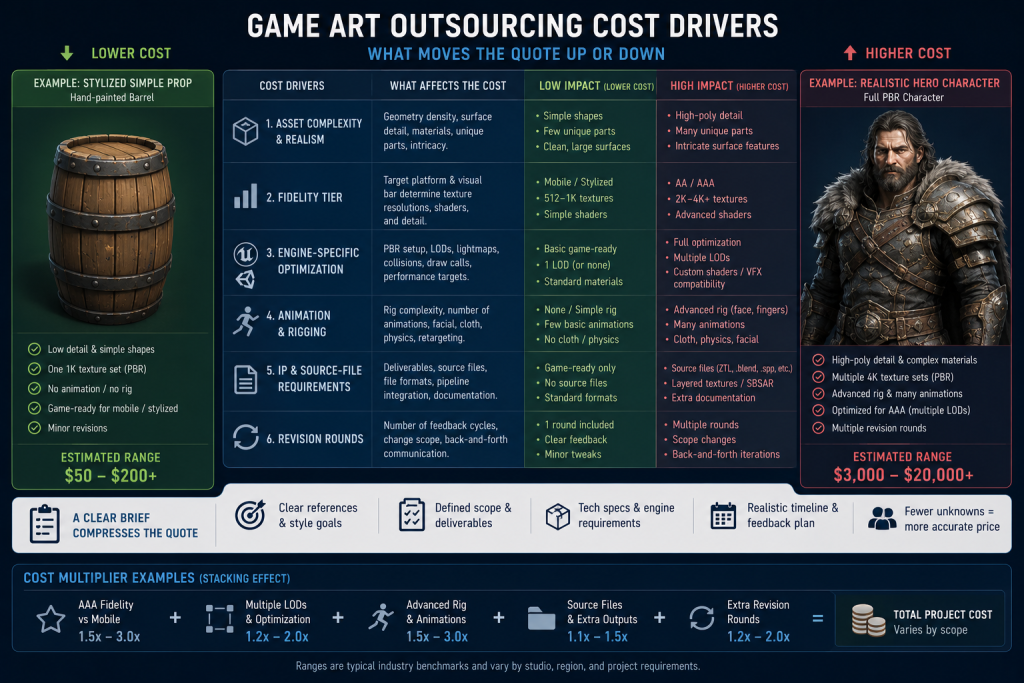
Once you’re outsourcing, the price of 3D game art outsourcing isn’t a single number — it’s a function of a few drivers, and understanding them is what lets you brief for a tight quote instead of a wide one. Asset complexity and realism sit at the top: a stylized prop with simple surfacing is a fraction of a realistic hero model with a full material set. Fidelity tier (mobile vs AA vs AAA), engine-specific optimization, animation and rigging, IP and source-file requirements, and the number of revision rounds all move the figure. There’s no honest universal price for a character: stylized and mid-fidelity models sit in one tier, while realistic hero characters with full material sets, rigging, hair, facial setup and engine integration climb well beyond it. The useful figure isn’t an average — it’s the set of drivers, which is what lets you brief for a tight quote instead of a padded one.
“Editorial illustration created for visual reference purposes. It does not represent a real project, client work, or official software screenshot unless stated otherwise.”

The single biggest lever on your side is the brief. Vague scope produces padded quotes because the vendor prices the uncertainty; a clear art bible, asset list and target-engine spec compress both the estimate and the risk. It’s the same logic at the project level — cost clarity follows scope clarity. For a concrete example of how driver-based pricing works asset by asset, our 3D prop outsourcing for game-ready assets is scoped by complexity, material count and engine target rather than a flat rate.
The practices that separate a controlled pipeline from a dependency risk
The difference between outsourcing that extends your pipeline and outsourcing that becomes a liability is almost entirely practice, not talent. A few disciplines do the heavy lifting, and they’re the ones a serious game art outsourcing services partner will bring up before you have to ask.
Contracts and IP: SOW, NDA, ownership
Get the paperwork right before any asset moves — and in the right order. The NDA comes first: it’s signed before any RFP, references or builds change hands, so scope can even be discussed. From there, the scope of work names deliverables, formats, milestones and revision counts explicitly, and an IP-assignment clause transfers IP ownership of the delivered work on acceptance. One trap worth flagging: IP assignment and editable source-file delivery aren’t the same thing — you can own the delivered work and still lack the layered project files needed to edit it later, unless the SOW names them. How you structure the SOW and IP terms that protect you is often the difference between a clean engagement and a dispute — and layered source files (project files, bakes) are frequently a negotiated line item rather than an automatic inclusion.
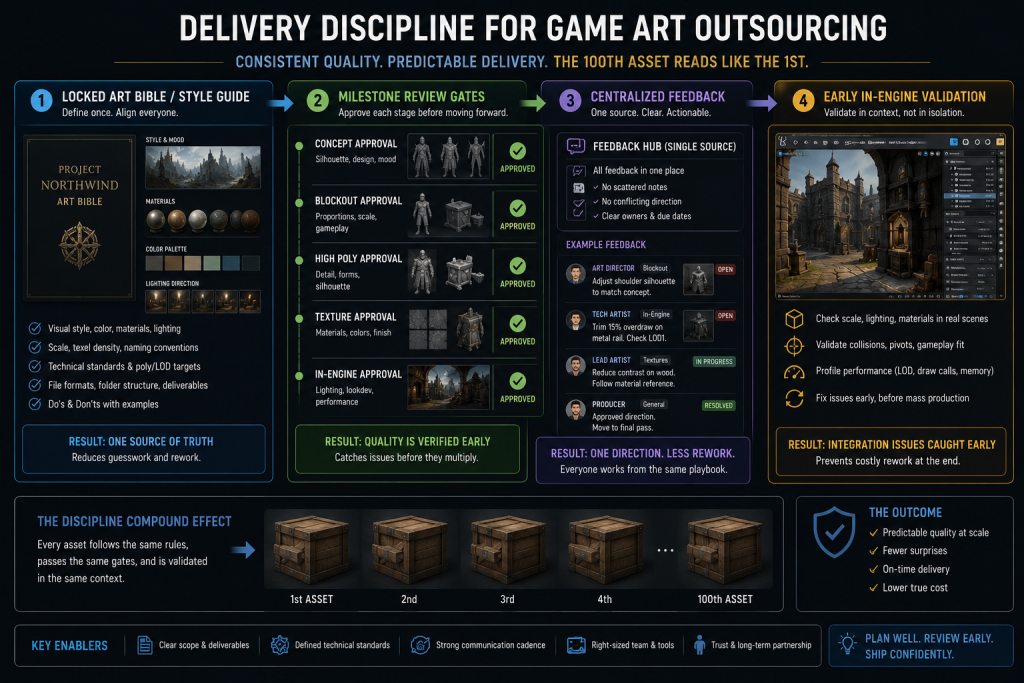
Style consistency at scale: art bible and review gates
Consistency across dozens or hundreds of assets is a process, not a hope. A locked art bible and style guide give every artist the same target; milestone approvals gate each stage before the next begins; centralized feedback prevents conflicting stakeholder notes; and early in-engine validation catches integration problems before mass production, not after. On environment-heavy work especially — the kind our 3D environment outsourcing pipeline is built around — those review gates are what keep the hundredth asset reading like the first. When these practices are in place, outsourcing becomes a controlled extension of your pipeline instead of a dependency you can’t steer.
“Editorial illustration created for visual reference purposes. It does not represent a real project, client work, or official software screenshot unless stated otherwise.”
How to choose a game art outsourcing studio
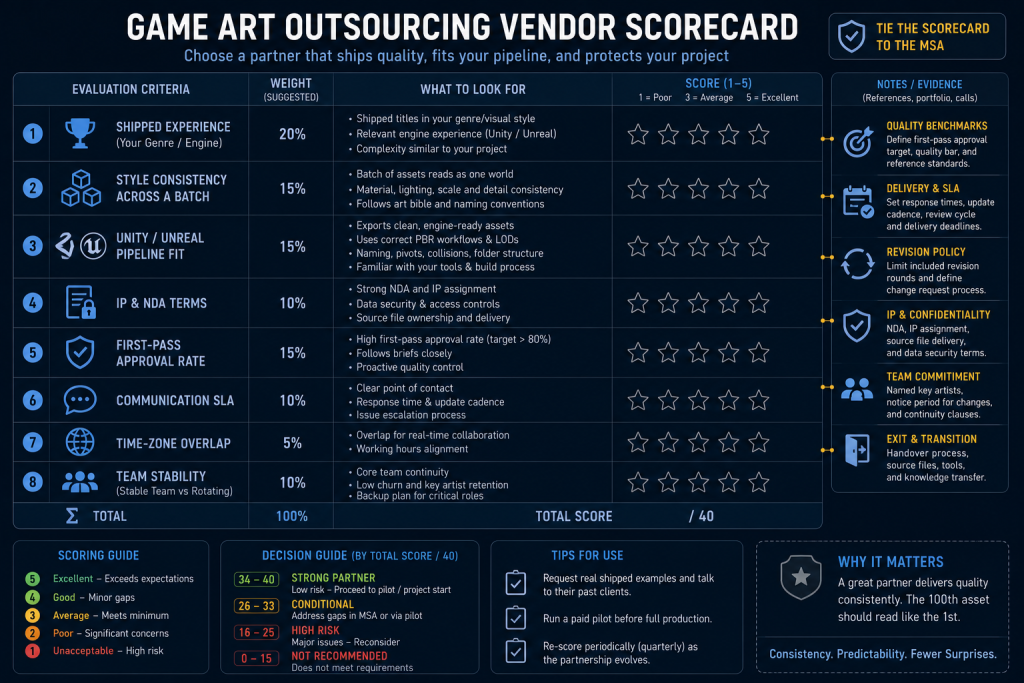
Choosing a studio on portfolio gloss alone is how you end up with beautiful assets that don’t fit your pipeline. Production fit is the real filter. Weight shipped experience in your genre and engine over showreel polish; check whether they can hold a style guide across a batch, not just nail a single beauty shot; confirm Unity or Unreal pipeline compatibility, IP and NDA terms, and — critically — whether they can keep a stable team across the length of your production rather than rotating strangers through it.
The most capable video game art outsourcing teams cover many asset types, but breadth isn’t the filter that matters most — production fit is. Studios also differ sharply by tier: the right partner for a lean indie batch is often not the right partner for a AAA content pipeline, which is worth understanding across indie, AA and AAA production realities before you shortlist.
“Editorial illustration created for visual reference purposes. It does not represent a real project, client work, or official software screenshot unless stated otherwise.”
For an outsource decision-maker, the operational signals matter as much as the art. Build a simple vendor scorecard and hold candidates to it: a realistic first-pass approval rate on the first batch, a defined communication SLA, workable time-zone overlap, and — most underrated — the scalability to hold a stable team across a multi-milestone run rather than rotating strangers through it. Tie the scorecard to the contract: the engagement model, the milestone and revision structure, IP ownership and source-file delivery, and an exit clause should all be settled in the MSA before the first asset, so a slipping approval rate triggers a defined conversation instead of a scramble. A partner who welcomes being measured this way is usually the one worth signing.
A quick self-test: outsource or scale in-house?
Run this honestly. Count a check for each “yes.”
- We have a senior art lead who owns the visual target and has the bandwidth to direct external work.
- We already employ a technical artist who owns engine-readiness (budgets, texel density, in-engine validation).
- Our internal seniors’ time is better spent on hero assets and core problems than on batch production.
- We have a locked (or near-locked) art bible / style guide to hand a vendor.
- Our target engine, platform and asset list are defined, not still moving.
- We have a clear budget range and accept that 2–3 review rounds are normal.
- Our content demand is ongoing or spikes beyond what our current team can absorb.
- We have 6+ weeks of lead time — or need capacity faster than we could ever hire it.
- We’re prepared to put an SOW, IP clause and NDA in place before work starts.
- We’d rather manage priorities than manage hiring, HR and idle capacity.
8+ checks: you’re ready to outsource well — the model and partner are the only open questions. 5–7: outsourcing can work, but tighten the brief and the internal ownership first. Under 5: the “savings” from either path are likely illusory until you fix the fundamentals — usually the brief and a technical-art owner.
How we approach game art outsourcing at Nasty Rodent
At Nasty Rodent, game art outsourcing is managed as a production pipeline, not a loose vendor handoff. Our team supports studios across concept art, 3D props, characters, environments, weapons, vehicles and game UI, with internal art direction, project management and technical review built into the process. That structure helps clients scale external art production without losing style consistency, delivery discipline or engine readiness. If your team needs a reliable game art outsourcing studio, we can review your brief, identify production risks and suggest the right cooperation model before full-scale asset work begins.
Cooperation models at a glance
| If your scope is… | The usual fit | Why |
| Fixed and well-briefed | Project-based | Priced to defined deliverables |
| Evolving / live-ops | Retainer or dedicated team | Capacity is there when the roadmap moves |
| A specific role gap | Staff augmentation | External artists inside your pipeline |
| Deeply shared production | Co-development | Blurred internal/external lines |
Takeaway: the model should follow how settled your scope is — most overruns trace back to a fixed-price contract wrapped around scope that was never fixed.
Turn the decision into a next step
The decision that protects your production isn’t which studio is cheapest — it’s choosing the right cooperation model, briefing it tightly, and holding it to real delivery discipline. Get those right and outsourcing becomes capacity you can steer; get them wrong and it becomes a second production you didn’t plan for.
If you want a concrete read on a specific partner, we’ll run a free vendor capability assessment: within 48 hours we’ll hand you a vendor scorecard against your RFP — projected first-pass approval, time-zone overlap, communication SLA, and the production risks we’d flag before you commit. Not ready to evaluate a partner yet? Send the brief anyway, and we’ll tell you where the biggest production risks sit and which cooperation model actually fits your scope.
Send your brief or RFP to business@nastyrodent.com to start.