Stylized 3D Characters: Art Direction Principles for AAA-Tier Production
-

Written byDenys Zadoienyi
-

Updated on21.05.2026
-

Time to read19 min

- Introduction
- What “stylized 3D characters” actually means in 2026
- Principle 1 — Shape Language: the foundation everything else stands on
- Principle 2 — Silhouette Readability: the production test that runs forever
- Principle 3 — Color Script and Value Compression
- Principle 4 — Hero Asset Anchoring and World Coherence
- Principle 5 — Rendering Stack: NPR, PBR, and the Hybrid Reality of 2026
- Principle 6 — Concept-to-3D Fidelity: closing the most expensive gap
- The production reality: where AAA-tier stylized character work breaks
- When to bring stylized character work in-house, and when to outsource
- The art direction discipline that protects style consistency
- Bottom line: stylization rewards discipline, not just vision
- About Nasty Rodent
Introduction
Stylized 3D characters are the only category of game art that ages well. Photorealism gets dated the moment GPU generations shift — what looked cutting-edge in 2018 looks visibly older today. A well-directed stylized character holds up indefinitely. Breath of the Wild from 2017 still looks current in 2026. Overwatch’s launch roster still anchors a billion-dollar IP nine years after release. Fortnite’s silhouette language built a global crossover platform that absorbs Marvel heroes and NFL athletes without visual dissonance.
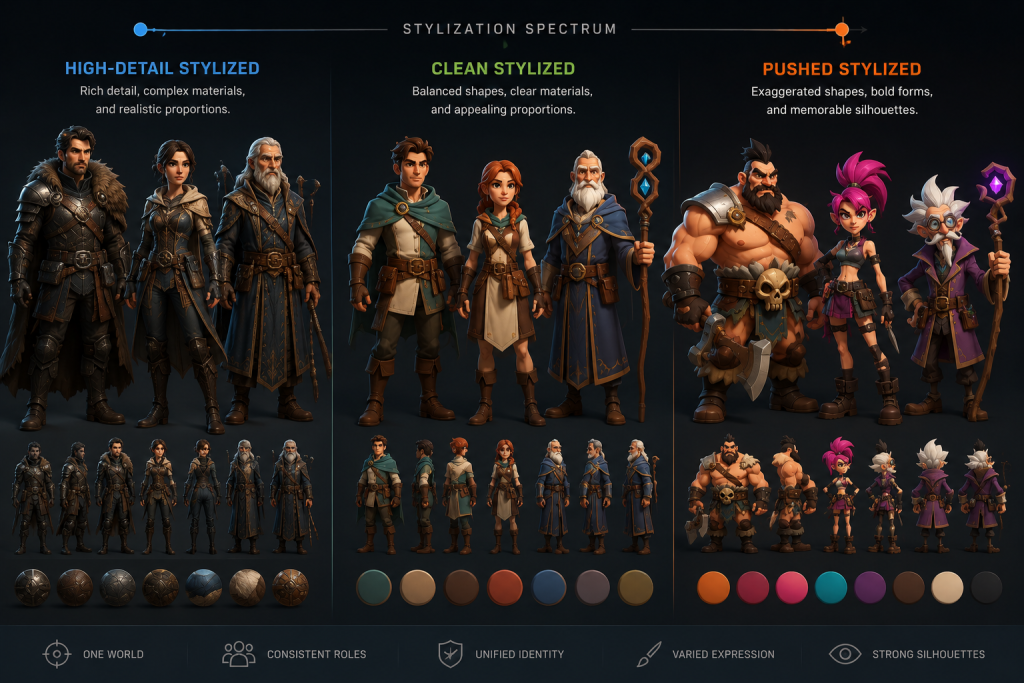
“Editorial illustration created for visual reference purposes. It does not represent a real project, client work, or official software screenshot unless stated otherwise.”
The reason isn’t that stylization is “easier” — it’s that stylization is a more disciplined art direction problem. A photorealistic character either looks correct or it doesn’t; the reference is reality itself. A stylized character has to invent and then defend its own visual logic — every proportion choice, every silhouette decision, every shader behavior has to serve a coherent style that the rest of the project’s art must respect.
That’s also where most stylized projects fail. Style drift at milestone three. The hero character looks iconic in the announcement trailer; the rest of the cast looks like they came from a different game. The art bible was 60 pages, but no one’s enforcing it. By the time the issue surfaces in vertical slice, the timeline to fix it is the timeline to remake half the cast.
This piece walks through the six art direction principles that AAA-tier teams apply to keep stylized 3D character production on-style from concept to shipped asset. The framing is technical and director-grade — what to enforce, what to defer, and where production reality and visual ambition collide.
What “stylized 3D characters” actually means in 2026
Stylized 3D characters are characters that deliberately diverge from anatomical or photographic realism in favor of a coherent invented visual language — exaggerated proportions, simplified or amplified shape language, deliberate color and value choices, and rendering approaches that range from PBR-with-art-direction through cel-shaded non-photorealistic rendering. The category covers a wide stylization spectrum: high-detail stylized in the Overwatch tradition; clean stylized in the Disney Infinity tradition; further-pushed stylization like Ratchet & Clank; and at the abstract end, shape-primitive characters in titles like Monument Valley.
What separates AAA-tier stylized character production from generic 3D character modeling for games is the rigor of the art direction layer. The 3D execution is downstream of disciplined upstream decisions: shape language defined before any blockout, silhouette tests enforced at every iteration, value compression rules, palette constraints, and rendering choices locked before lookdev. Without that upstream discipline, you get individually competent assets that don’t cohere as a cast.
This is why our 3D character art work sits inside our concept art and visual development practice rather than being run as a separate modeling shop — the art direction layer feeds the 3D execution, not the other way around.
Principle 1 — Shape Language: the foundation everything else stands on
Shape language is the most-overlooked, most-decisive layer of stylized character design. It’s the alphabet of your visual vocabulary. Get it right and every character in the cast immediately reads as belonging to the same world; get it wrong and no amount of texture work fixes the issue.
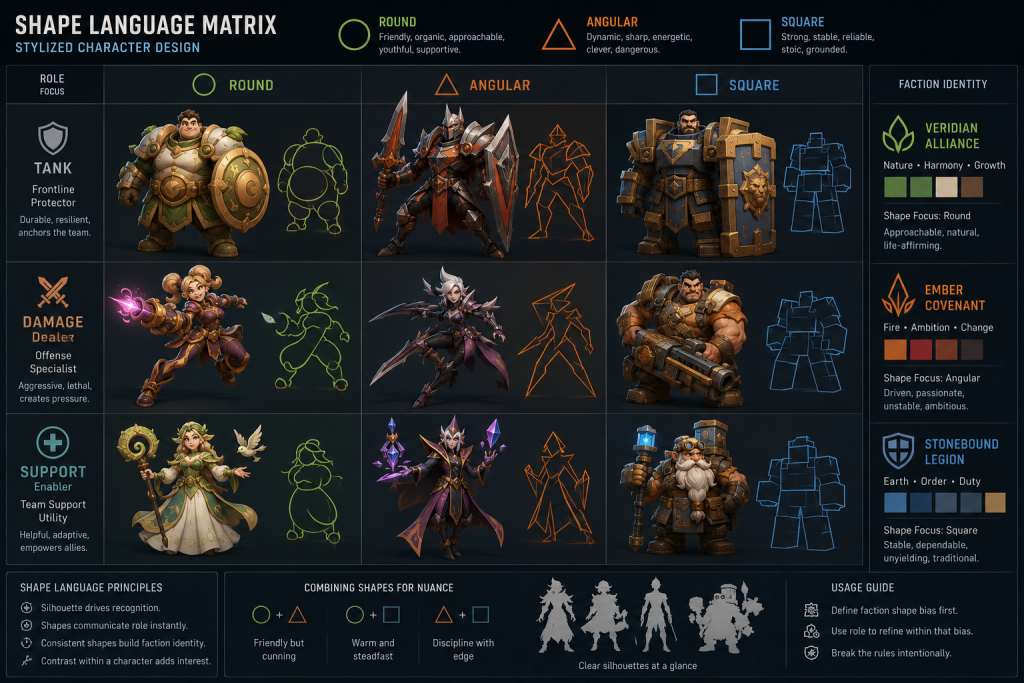
“Editorial illustration created for visual reference purposes. It does not represent a real project, client work, or official software screenshot unless stated otherwise.”
The underlying logic is established in animation theory and applies cleanly to stylized 3D: round shapes read as friendly, approachable, or harmless; angular shapes read as aggressive, dangerous, or efficient; square shapes read as stable, dependable, or stoic. A stylized cast typically encodes faction or role through shape language alone — heroic characters lean toward rounded volumes with selective angular accents; antagonists trend angular and asymmetric; support characters often sit in square stability.
What an AAA art director enforces. A defined shape-language matrix for the cast before any 3D blockout begins. Each major character or character class gets a primary shape (sphere/cube/cylinder/cone/pyramid), a secondary shape used for accents, and a forbidden shape (the silhouette move that breaks the character’s read). A silhouette study at 100% black against white background is the first acceptance test — if the character isn’t recognizable as a black silhouette, the shape language has failed and no amount of texture polish will recover it.
The connection upstream. Shape language is decided in concept art, not in 3D. A strong concept artist works in flat shape-pass first, in pure black/white, before adding line. By the time a concept reaches 3D, the shape choices should be locked. Style drift between concept and 3D usually starts here — the 3D artist subtly “improves” proportions toward anatomical correctness, breaking the deliberate exaggeration the concept established. The concept-to-3D handoff in our work treats shape language as non-negotiable; the 3D execution interprets it, doesn’t revise it.
Principle 2 — Silhouette Readability: the production test that runs forever
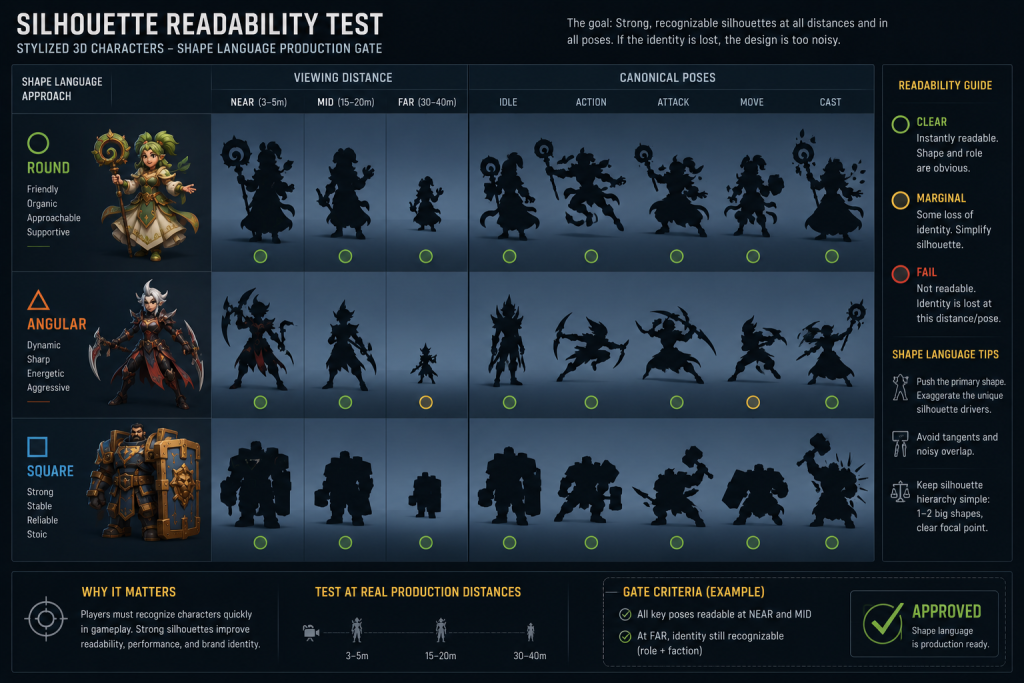
A stylized character has to read in motion, at distance, in low light, against a chaotic background. If a player can’t recognize a character class — friendly, enemy, important NPC — in a single frame from across a battlefield, the character has failed at its production job regardless of how beautiful it looks in a portfolio render.
“Editorial illustration created for visual reference purposes. It does not represent a real project, client work, or official software screenshot unless stated otherwise.”
The recognition-threshold rule. Render the character at three test distances: hero-shot close (5 meters), gameplay-typical (15 meters), and recognition-threshold (50–100 meters depending on game scale). At the recognition threshold, the character must still be identifiable by silhouette alone. This is why hero characters in Overwatch carry such exaggerated silhouettes — Reinhardt’s hammer, Lúcio’s headphones, D.Va’s mech profile are silhouette anchors that read at every distance and pose.
Pose silhouette testing. Static silhouettes aren’t enough. Test the character in five canonical poses — neutral idle, attack pose, traversal pose, hit reaction, and victory pose — at the recognition threshold. The silhouette has to hold across all five. A character whose silhouette reads as “humanoid with arms” in the attack pose isn’t doing the silhouette work.
Production implication. Silhouette readability is the cheapest test in stylized production and the most expensive to retrofit. If silhouette fails at the first vertical slice, fixing it means rebuilding the character at the high-poly level — and any deformation rigging done on the old proportions is wasted. Build the silhouette gate into the milestone process at blockout, retopo, and final-bake stages. Don’t defer it to lookdev review.
Principle 3 — Color Script and Value Compression
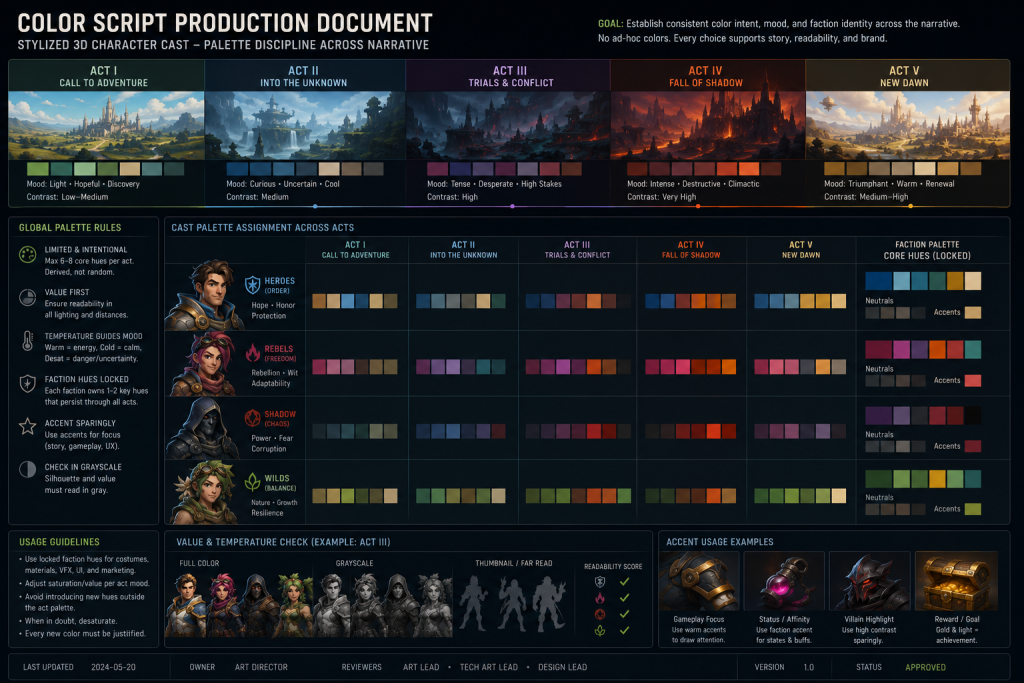
Stylized characters live or die on color discipline. Photorealistic characters can lean on real-world reference for color choices; stylized characters have to invent and defend their palette. A cast without a color script ends up looking like every artist on the project picked their own favorites — visually busy, narratively flat, and unable to support cinematic moments.
Color script as production document. Senior teams build a color script that maps the cast across acts or biomes — which characters anchor which moments, which palettes belong to which factions, and how warm/cool relationships build through the project. The color script is a chronological strip, not a mood board. It’s read left-to-right like a film storyboard. Character palettes get locked against the color script before texture work begins.
“Editorial illustration created for visual reference purposes. It does not represent a real project, client work, or official software screenshot unless stated otherwise.”
Value compression. Stylized characters compress real-world value range. Photorealism uses near-full dynamic range; stylization typically uses a compressed range with deliberate value steps — for example, three-value shadow / midtone / highlight rather than a continuous gradient. This compression is what gives stylized work its readable “shape” in lighting. Value compression rules belong in the stylized 3D art style guide and have to be enforced in texture review, not discovered at lookdev.
Practical art-director check. Render the entire cast against three lighting conditions (key from front, key from side, rim only) at 25% saturation. If the value relationships break down — characters merge into each other, hero accents disappear, faction colors stop reading — the value compression isn’t tight enough. This test is fast and surfaces issues that full-color review hides.
Principle 4 — Hero Asset Anchoring and World Coherence
Stylized character casts are anchored by hero assets — typically the protagonist plus two or three flagship designs that define the visual vocabulary the rest of the cast must respect. Get hero asset standards right and the rest of the cast snaps into place. Get hero asset standards loose and every subsequent character costs you art-direction overhead.
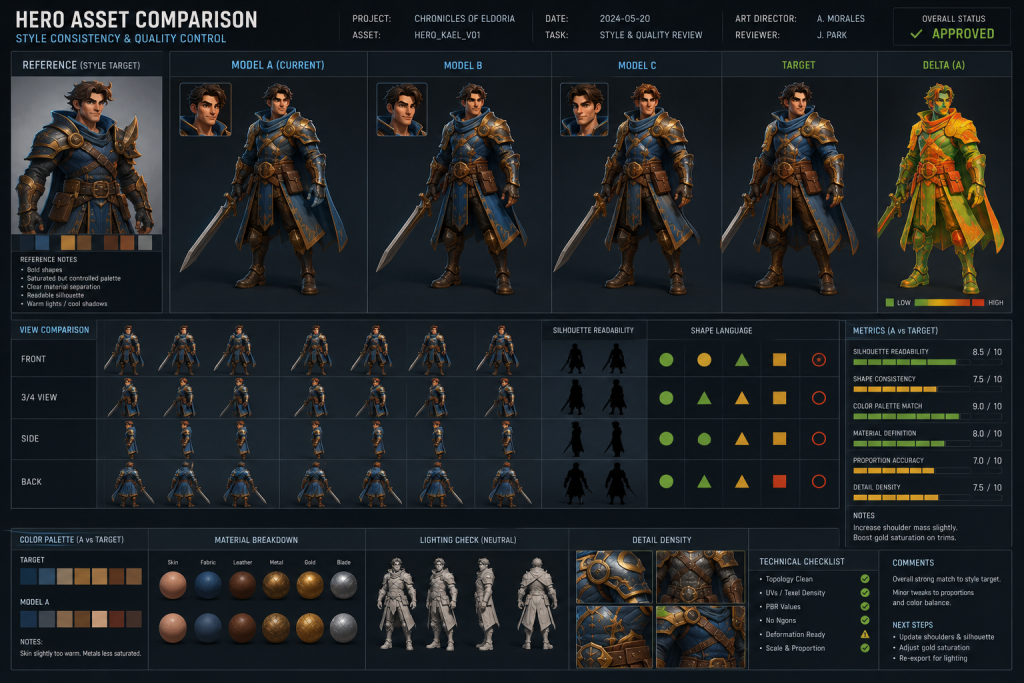
What a hero asset has to lock. Proportion ratios (head-to-body, limb-to-torso, shoulder breadth), polycount budget for the silhouette tier, texel density target, NPR or PBR-hybrid stack, outline thickness rules (if NPR), shader feature list, and the named “look” reference renders that subsequent characters get measured against. Hero asset standards become the art bible’s enforcement spine.
World coherence. Hero characters don’t live in isolation. The character work has to read inside the environment the player sees them in. A character whose stylization is pushed further than the environment art creates a visual jarring effect — and the inverse is equally damaging. Stylized character pipelines coordinate tightly with stylized environment production and prop work to keep the world’s stylization consistent across categories. If the environment is hand-painted with simplified forms but the character carries PBR detail, the project ships looking inconsistent.
Hero asset as production reference. Every subsequent character in the cast gets reviewed against the hero asset in a comparison render — same lighting, same camera, side-by-side. Style drift surfaces in this comparison faster than in solo character reviews where the eye adjusts. AAA-tier studios run this comparison as standing milestone procedure.
“Editorial illustration created for visual reference purposes. It does not represent a real project, client work, or official software screenshot unless stated otherwise.”
Principle 5 — Rendering Stack: NPR, PBR, and the Hybrid Reality of 2026
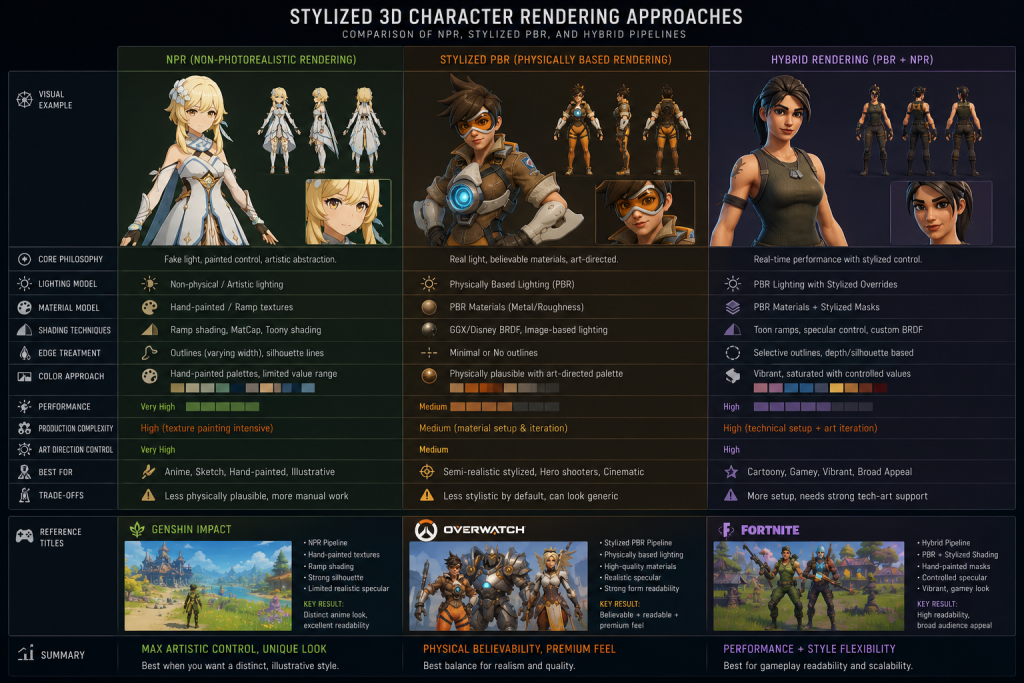
Stylized characters in 2026 generally fall into one of three rendering camps, and the choice is a production-defining decision made early and rarely reversed.
Pure non-photorealistic rendering (NPR). Cel-shaded, outline-driven, painterly. The most technically sophisticated AAA NPR pipeline at scale is the Hoyoverse stack — Genshin Impact, Honkai Star Rail, Honkai Impact, Zenless Zone Zero, and Wuthering Waves all rely on custom NPR character shaders. The technical depth is real: anisotropic hair shading, custom face shadow controls, outline rendering that adapts to camera distance, painted ambient occlusion baked into texture rather than computed real-time, and per-character shadow control that overrides physical correctness for aesthetic intent. The 80 Level breakdown of the Genshin Impact-style shader in Unreal Engine 5 is one of the more accessible production-grade documentations of what this stack involves. NPR demands a senior tech artist on staff or in your vendor team — the shader work isn’t an asset-level decision, it’s a project-level architecture.
Stylized PBR. PBR materials with deliberate art-direction limits on saturation, value range, and surface complexity. Overwatch, Fortnite, Valorant. The advantage is engine-friendliness — PBR materials respond to lighting naturally, integrate cleanly with environments, and don’t require custom shader engineering at every interaction. The discipline lives in art direction constraints applied to PBR: narrowed value ranges, palette discipline, geometry simplification, exaggerated proportions. This is the most production-scalable approach for AAA stylized work in 2026.

Hybrid PBR + NPR. Increasingly the production reality on titles where both immersion and stylized identity matter. PBR materials handle base shading; NPR post-process or material overrides handle outlines, painterly highlights, or selective stylization. Stylized characters with realistic-leaning materials sit on PBR with NPR accents; realistic environments with stylized VFX run inverse. Hybrid demands the strongest art direction — the more axes you mix, the more documentation you need to keep the team aligned. Production breakdowns like Gabriel Lopes’s stylized character lookdev process in Marmoset Toolbag walk through the practical side of this hybrid craft — exaggerated specular response, layered hair shading, and stylized lighting setups that hold PBR consistency without flattening the stylized intent.
“Editorial illustration created for visual reference purposes. It does not represent a real project, client work, or official software screenshot unless stated otherwise.”
Documented reference. Epic Games maintains authored learning paths for stylized rendering in Unreal Engine — including Kris Kaufman’s “Introduction to Stylized Rendering” tutorial covering flat shading, outline systems, and painterly post-process materials, plus newer talks like “Stylized Rendering Insights from Japan” surveying NPR techniques across recent shipped projects. For studios making the rendering stack decision now, those resources are worth pulling into the technical pre-production phase rather than relearning the same lessons mid-project.
What the rendering choice locks. Once you choose, you’ve locked tooling, hiring profile, vendor selection, and the structural shape of your lookdev process. Switching from PBR-hybrid to pure NPR at milestone 4 means rebuilding character shaders, retraining the team on outline control, and re-baking texture maps with a different shading philosophy. The cost is structural.
Principle 6 — Concept-to-3D Fidelity: closing the most expensive gap
The widest cost gap in stylized character production sits between concept approval and first-pass 3D delivery. A concept artist delivers a strong stylized character. The 3D artist interprets it. Three weeks later, the result isn’t quite the same character — proportions shifted, silhouette softened, signature shape elements muted. The concept is now “based on” rather than “matching.” This is style drift in its most expensive form, and it happens on virtually every project without active discipline against it.
Why this happens. Most 3D artists have stronger anatomy training than stylization training. Faced with an exaggerated stylized concept, the 3D artist’s instinct is to correct toward anatomical plausibility — slightly normalize proportions, soften the deliberate angularity, add muscle definition the concept omitted. Each individual correction looks reasonable in isolation. The aggregate effect over the cast is a complete shift in style register.
What AAA art directors enforce. A concept-to-3D fidelity protocol with specific gates: blockout review with the concept overlaid at the same camera; high-poly review with silhouette comparison against the concept’s flat silhouette study; final-bake review with side-by-side hero shots at matched lighting. Each gate has explicit reject criteria — if proportion deviation exceeds defined thresholds, the work goes back to blockout, not forward to texture.
The concept artist’s role through 3D. AAA pipelines increasingly keep the concept artist engaged through 3D delivery, not just at handoff. The concept artist participates in blockout review, provides silhouette feedback, and signs off on each milestone. This is more expensive than throw-it-over-the-fence handoffs and significantly cheaper than rebuilding characters at milestone 4.
Practical pipeline marker. First-pass approval rate on stylized characters is a measurable production metric. AAA-tier vendors who own concept-through-3D internally typically hit higher first-pass rates than vendors who handle 3D-only with externally supplied concepts — this is an industry pattern observable in vendor scorecards rather than a single-source claim. The implication for art direction: keeping concept and 3D under one art direction roof — internally or through a vendor that runs both — meaningfully reduces this style drift cost.
The production reality: where AAA-tier stylized character work breaks
The six principles above don’t apply themselves. Even with a strong art bible, a great concept team, and competent 3D artists, AAA-tier stylized character production fails in predictable places. These failure modes are worth naming because they’re the practical entry points where art direction discipline either holds or breaks.
Vertical slice style drift. The hero character looks great in the announcement trailer. By vertical slice, the second-tier cast doesn’t match. The fix at this stage is a partial rework that costs more than the original production. Mitigation: enforce hero-asset comparison render at every cast member’s milestone-3 gate, not just at vertical slice review.
Cross-discipline incoherence. Character art and environment art each look strong, but the world doesn’t read as one place. Mitigation: shared style-guide review involving both directorial leads at lookdev gate; hero environment shots with hero characters in them as the standing reference render.
Vendor handoff style register shift. The studio’s in-house characters look one way; the vendor’s characters look subtly different. Often the vendor is technically skilled but matching to a slightly different stylization spectrum point. Mitigation: paid art test on a real cast member (not a generic test character) with concept artist available for direct feedback during the test.
Late-stage rendering stack changes. A producer or technical director pushes for a rendering pipeline shift at milestone 4 (“let’s add cel-shading on top”) that requires character work to re-bake or rework. Mitigation: lock rendering stack as a director-level decision at pre-production gate, not as an iterative experiment.
The recent shipped work in our portfolio covers stylized character production at AAA-tier scale across multiple games — the work that’s representative is the work that survived all four failure modes above with consistency intact. That consistency is what art direction discipline buys.
When to bring stylized character work in-house, and when to outsource
Note: the breakdown below describes patterns observed across mid-core and AAA studio conversations; specific cost and time figures should be treated as industry observations rather than studio-guaranteed numbers.
In-house stylized character production works when you have a senior art director with shipped stylized AAA experience, at least one senior character artist who’s worked in your target stylization register, a tech artist for NPR shader work (if NPR is in your stack), and stable scope across a 12-month-plus window. Live-service titles particularly benefit from in-house ownership — the institutional memory around style decisions matters more than incremental cost savings from outsourcing.
Outsourcing stylized character work makes sense when you need specialized depth your team doesn’t carry — particularly NPR pipeline expertise, which is genuinely scarce; you need additional capacity during a milestone-heavy push; you’re scaling a stylized cast beyond what your in-house team’s bandwidth supports; or you’re building a stylization register your team hasn’t shipped before and need senior outside calibration during pre-production.
A common DIY-to-us pattern. A mid-core studio with strong realistic-stylized character experience tries to extend into NPR for a new project. The team builds first prototypes that look acceptable in isolation but suffer in lookdev — face shadows fight the engine’s lighting, outlines pop and disappear inconsistently, hair shading doesn’t hold across angles. By milestone three, the studio realizes they need either a senior NPR tech artist hire (typically a 4–6 month recruitment cycle with significant compensation premium given scarcity) or a vendor that owns the NPR stack. The vendor route can deliver production-ready character batches in 5–8 weeks for typical hero asset scope; the recruitment route, factoring ramp-up, is significantly longer to first deliverable.
Self-test for the outsourcing decision. Run through with your art director, lead 3D, and producer:
- Does your team have shipped experience in the exact stylization register the project requires?
- Is your rendering stack (NPR / PBR / hybrid) a domain your senior team owns confidently?
- Do you have a tech artist who can own custom shader work for stylized characters?
- Is your scope stable across the next 12 months, or shifting milestone-to-milestone?
- Is your project visual quality target AAA-tier hero work, or polished functional work?
- Do you have capacity for the recruitment cycle to fill senior gaps (typically 4–6 months for NPR specialists)?
- Is your cast size manageable in-house, or does it require scaling beyond current bandwidth?
- Is your concept art and 3D character work currently under one art direction roof?
If you answer “yes” to 1, 2, 3, 6, 7, and 8, in-house ownership is likely your better path. If you answer “no” or “uncertain” on 1, 2, or 3, and “yes” to 5 or “uncertain” to 7, outsourcing or hybrid is the more realistic route — particularly when the gap is in the NPR pipeline or in the specific stylization register.
The art direction discipline that protects style consistency
The six principles aren’t a checklist to satisfy; they’re a discipline to enforce continuously. Style consistency in a stylized 3D character cast comes from running the same review protocols at every gate, comparing every new character to the hero asset, and treating concept-to-3D fidelity as a system rather than a moment. AAA-tier teams that ship coherent stylized casts run this discipline rigorously. Teams that don’t ship inconsistent casts and discover the cost at vertical slice.
Three high-leverage habits to bake into the production process:
Hero comparison render at every gate. Every cast member, at every milestone, gets rendered side-by-side with the hero asset under matched lighting. Style drift surfaces in this comparison faster than in solo reviews.
Silhouette acceptance test as a hard gate. Don’t move from blockout to high-poly without passing the silhouette test at the recognition threshold. Don’t move from high-poly to retopo until silhouette holds in canonical poses.
Concept artist signoff through 3D milestones, not just at handoff. The concept artist who designed the cast has the strongest sense of style intent. Keep them in the room at blockout, high-poly, and final-bake reviews. This is the single most effective discipline against style drift.
Bottom line: stylization rewards discipline, not just vision
Memorable stylized 3D characters look like inspired creative work in the final game. That’s by design — the discipline that made them possible isn’t visible in the screenshots. What’s behind it is a stack of art direction decisions enforced at every milestone: shape language locked in concept; silhouette tested at recognition threshold; color script defended against ad-hoc choices; hero asset standards held as production reference; rendering stack locked at pre-production; concept-to-3D fidelity gated, not assumed.
Studios that ship iconic stylized casts run this discipline. Studios that ship inconsistent casts discover the cost late and pay for it twice — once in the rework, once in the brand strength they didn’t build.
About Nasty Rodent
Nasty Rodent is a full-cycle game art studio where stylized 3D character art is treated as a core pillar of world-building, not just a collection of models. With over a decade of production experience for industry leaders like Saber Interactive and Remedy Entertainment, we deliver characters that balance unique visual identity with flawless technical performance. From high-level art direction and high-poly sculpting through optimal retopology to final engine integration, our team of 40+ experts keeps the pipeline seamless and the assets production-ready from day one. Our 3D Character Art service sits alongside concept art, environment, props, vehicles, weapons, and UX/UI — so stylized character work lives inside the same art direction as the world it has to inhabit, not as a separate modeling deliverable. If you’re at the art direction stage for your next project’s stylized cast, the conversation usually starts with the six principles above — and our team is happy to walk through specifics rather than hand over a generic deck.