Co-Development vs Pure Outsourcing: Decision Framework
-

Written byDenys Zadoienyi
-

Updated on14.07.2026
-

Time to read11 min

- What Pure Outsourcing Means in Production
- What Co-Development Means in Production
- The Core Difference: Deliverables vs Shared Production Ownership
- When Pure Outsourcing Is the Right Model
- When Co-Development Is the Better Fit
- Cost Structure: Why Co-Development Isn’t Just “More Expensive Outsourcing”
- Procurement Risks: What Each Model Can Break
- The Hybrid Model: A Practical Middle Ground
- Game Co-Development vs Outsourcing: Which Model Should You Choose?
- About Nasty Rodent
Co-development vs outsourcing isn’t really a question about whether to work with an external team – that decision is usually already made by the time this comparison matters. It’s a question about which production model that relationship should run on, and studios that skip it tend to find out the hard way: three months into a contract built for asset delivery, discovering the project actually needed a partner who sits in on design reviews.
“Editorial illustration created for visual reference purposes. It does not represent a real project, client work, or official software screenshot unless stated otherwise.”
The two models solve different production problems, not different quality tiers. Pure outsourcing buys capacity against a defined brief. Co-development buys shared production judgment. Picking the wrong game development outsourcing model doesn’t just cost money – it costs the thing procurement was trying to protect in the first place: predictable delivery. This is also where game co-development vs outsourcing stops being an abstract industry debate and becomes a specific, per-engagement decision: not “which model is better,” but “which one matches the scope in front of you right now.”
What Pure Outsourcing Means in Production
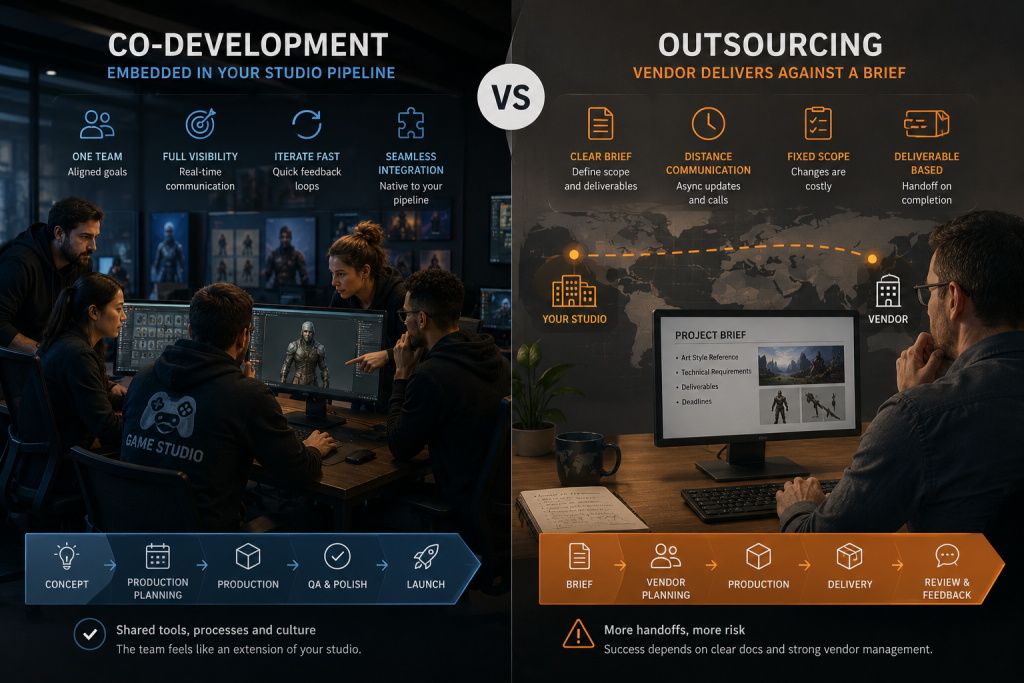
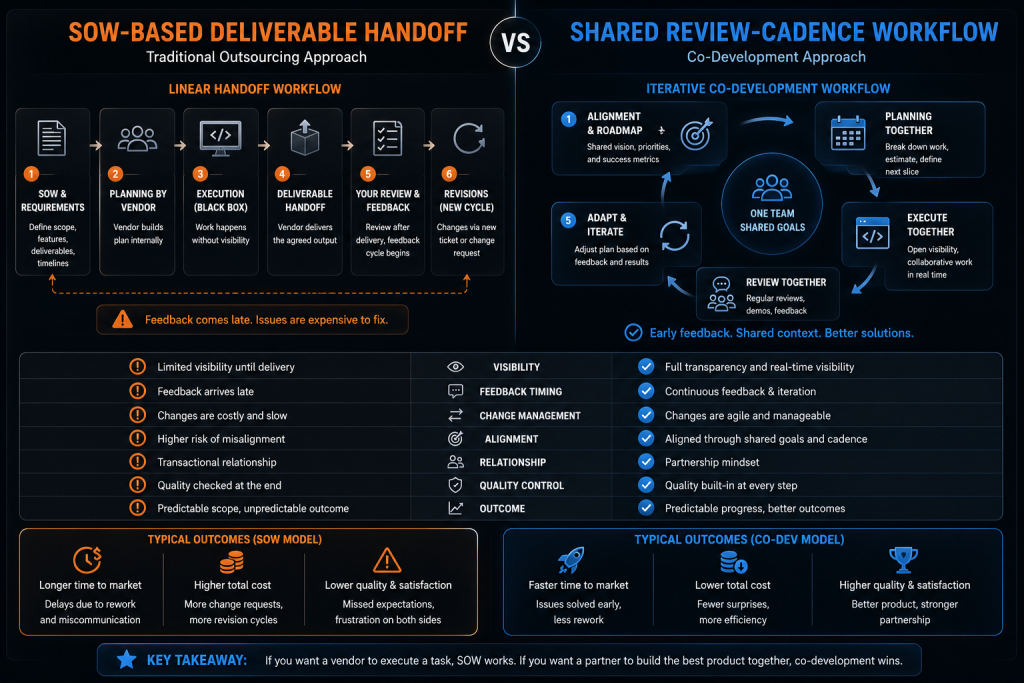
Pure outsourcing is the model most people default to when they hear “external game development partner” – the most familiar structure in the industry, and the easiest to organize around a defined set of deliverables, which is also why it gets applied to work it was never designed for. For a co-development vs outsourcing game studio comparison to be useful, it has to start from what the client actually owns and controls, not from vendor marketing language. The client owns direction, specs, and approvals. The vendor executes against a brief, a style guide, and a Statement of Work, then delivers for review. Communication runs on a milestone schedule rather than continuous back-and-forth – the vendor doesn’t need to sit inside the studio’s daily production rhythm to do the job well.
This works cleanly when the scope is genuinely modular: prop batches, weapon variants, secondary environment dressing, texture passes, LOD generation, or asset production once the art direction is already locked. The brief defines the system, the vendor handles the batch, and the milestone gate closes on schedule because the decision surface is narrow.
What Co-Development Means in Production
Co-development moves the external team inside the production process itself, rather than alongside it. Ownership becomes genuinely shared: the partner doesn’t wait for a finalized brief to start contributing – they participate in shaping it. Communication runs through the same channels as internal work: shared boards, joint planning, and continuous review layered on top of agreed milestones, rather than relying on milestone handoff alone. This is one of six external collaboration models we break down in more depth in our overview of game art outsourcing approaches, where co-development sits alongside project-based, dedicated-team, and retainer arrangements – each suited to a different kind of production problem.
“Editorial illustration created for visual reference purposes. It does not represent a real project, client work, or official software screenshot unless stated otherwise.”
What makes co-development a distinct model rather than “outsourcing with extra meetings” is where decisions get made. In pure outsourcing, the external team optimizes for delivery against a spec someone else wrote. In co-development, they optimize for the production outcome – which sometimes means flagging that a system isn’t working before it’s been fully built, or pushing back on a direction because the downstream cost isn’t visible in the brief yet. The billing structure tends to follow the same logic: pure outsourcing’s fixed-price and milestone payments work because the scope is locked before the contract is signed, while co-development more often runs on time-and-materials or dedicated-capacity billing, because a genuinely evolving scope is hard to price against fixed deliverables in advance. One art director’s account of moving a studio from asset-batch outsourcing toward co-development shows why these categories resist a single rule: at that studio, co-development ran on milestones with weekly feedback cycles, while the batch asset work needed daily check-ins to stay aligned with art direction – a reminder that review cadence follows what the work actually needs, not a fixed label attached to the model.
| Factor | Pure Outsourcing | Co-Development |
| What you’re buying | Output capacity against a brief | Shared production judgment |
| Scope | Fixed before work starts | Expected to evolve with production |
| Client’s role | Defines, reviews, approves | Collaborates and decides jointly |
| Vendor’s role | Executes against the spec | Helps shape the spec |
| Best fit | Modular, well-specified work | Complex or evolving systems |
| Contract shape | SOW-heavy, deliverable-based | Governance plus time-and-materials or dedicated-capacity billing |
| Main risk | Scope drift, revision creep | Ownership ambiguity, decision-rights confusion, or burn rate that outpaces fixed targets |
Neither column is the “better” one. A studio that forces co-development-level integration onto a stable, well-specified asset batch is paying for judgment it doesn’t need. A studio that hands an evolving, high-ambiguity system to a pure-outsourcing vendor is buying execution speed for a brief that doesn’t exist yet – and will spend the difference on revision cycles instead.
When Pure Outsourcing Is the Right Model
Pure outsourcing earns its lower communication overhead when the answer to one test is yes: can you write a complete brief before the work starts, and evaluate the result against it? If the style guide is finished, the deliverable list is countable, and quality can be judged against a reference sheet, outsourcing is the more efficient model – not because it’s cheaper by default, but because it doesn’t spend budget on integration the work doesn’t require.
Typical fits: prop and weapon variant batches, secondary environment dressing once biome rules are locked, texture and material passes, LOD and optimization work, and production-volume asset work on a feature branch that isn’t changing direction mid-cycle. The common thread isn’t asset type – it’s that the decision surface is narrow enough for a vendor to execute without needing product context beyond the brief.
When Co-Development Is the Better Fit
Knowing when to choose co-development starts with the same test in reverse: can the work not be fully specified before it starts, because it depends on decisions that are still being made elsewhere in production? Interface systems that need to respond to gameplay changes that aren’t locked yet are a clear example – a pattern we cover in detail in our dedicated framework for UI/UX co-development versus outsourcing, where the same underlying decision plays out for one specific discipline.
The same logic extends past interface work. Hero character pipelines that need continuous art-direction alignment, modular environment kits where the rules themselves are still being refined, and any system with tight interdependencies – where a change in one area quietly breaks another – tend to punish a pure-outsourcing structure. Not because the vendor lacks skill, but because a milestone-gated brief can’t keep up with a moving target, and the gap between what the brief said and what the game actually needs gets expensive to close late.
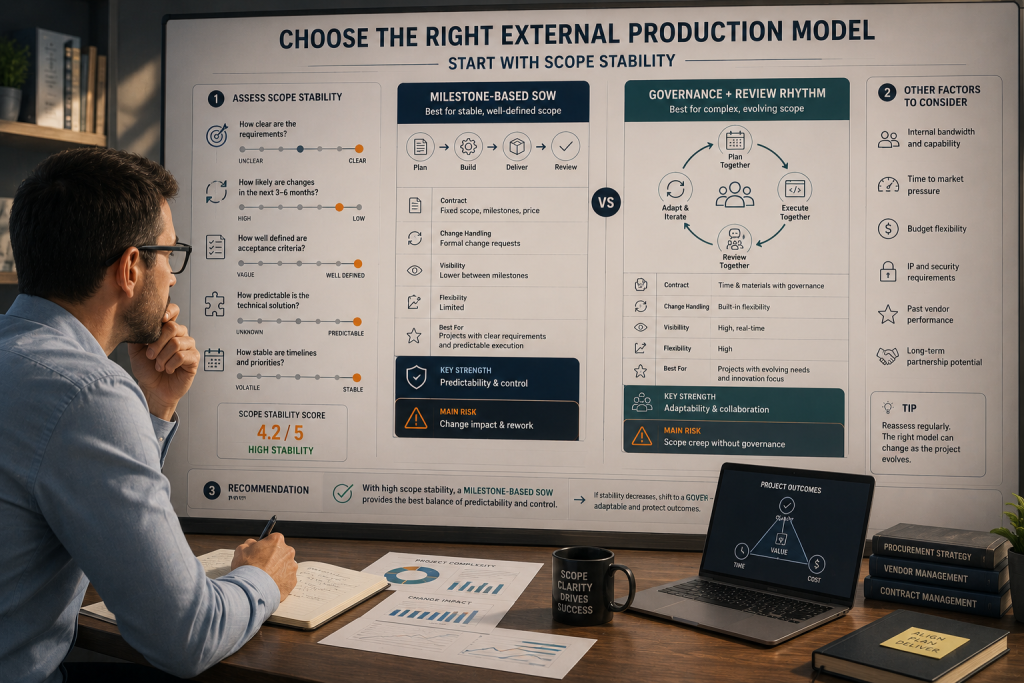
For a game studio weighing co-development vs outsourcing on a specific project rather than as a general policy, the practical test is scope volatility over the life of the engagement – not the discipline, not the team size, and not the vendor’s marketing language. A prop pipeline can need co-development if the kit rules are still being written. A UI system can run on pure outsourcing once the interaction patterns are fully locked. The model follows the work, not the other way around.
Cost Structure: Why Co-Development Isn’t Just “More Expensive Outsourcing”
Pure outsourcing’s cost structure is visible and easy to defend in a budget review: price per asset, a defined number of revision rounds, QA, and integration fixes. That visibility is part of its appeal for procurement – it produces a clean cost line finance can plan against.

Co-development’s cost structure looks different rather than simply larger: onboarding time, shared documentation, planning participation, and more senior-level communication on both sides. One outsourcing studio’s own account of shifting toward a more integrated production role described the change less as a service upgrade and more as becoming a genuine extension of the client’s own development team – with the cost of that shift showing up as relationship-building time rather than a line-item markup.
That distinction matters for the person who eventually reads the invoice, not just the person who signs the contract. Pure outsourcing looks cheaper when the scope is genuinely clear, because the client isn’t paying for judgment it doesn’t need. Co-development looks cheaper in hindsight when ambiguity, iteration, and context transfer would otherwise have produced the same cost anyway – just spread across repeated revision cycles instead of concentrated in relationship setup. Producers evaluating either model should price the full cycle, not just the rate card: a lower day rate with three rework passes is not automatically the cheaper outcome.
Procurement Risks: What Each Model Can Break
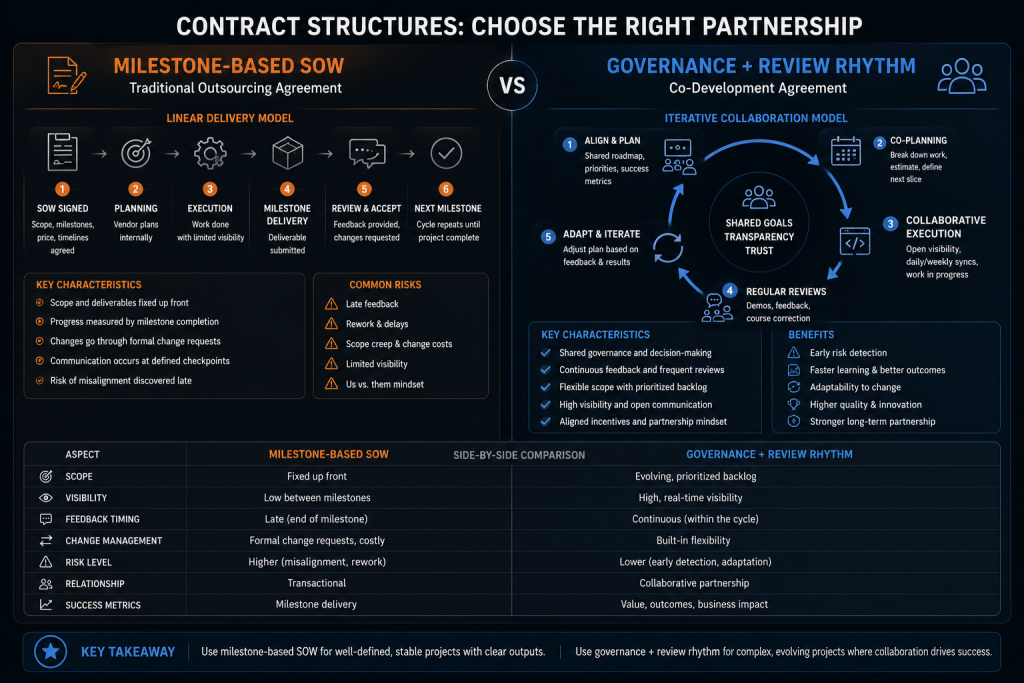
Pure outsourcing risks cluster around the brief itself. An under-specified brief produces a low first-pass approval rate, which produces revision creep, which quietly erodes whatever cost advantage the model was chosen for. The vendor isn’t at fault for executing a spec that didn’t anticipate the actual production need – that’s a scoping failure, not a delivery failure.
Co-development risks cluster around governance instead. Unclear decision rights, too many people in review, and blurred accountability are the model’s characteristic failure modes – a partner pulled into strategic conversations without the authority to act on them creates friction that a tighter outsourcing brief would never have produced in the first place.
Both risk clusters are addressable at the contract stage, not after signing. Scope stability, revision limits, IP assignment, escalation paths, and – for co-development specifically – decision-rights language belong in the same document. We cover that structure directly in our breakdown of RFP and SOW practices for game art outsourcing, including where a standard SOW template needs governance clauses added for a co-development engagement to actually hold up in production.
“Editorial illustration created for visual reference purposes. It does not represent a real project, client work, or official software screenshot unless stated otherwise.”
The Hybrid Model: A Practical Middle Ground
Most studios don’t run one model for an entire project. The more common pattern is co-development for the systems that carry the most production risk – a hero pipeline, an interface system, a live-content stream – paired with pure outsourcing for the modular work around it: prop batches, variant sets, dressing assets, LOD passes. The same external partner can often operate in both modes on the same engagement, as long as the contract is structured to say so explicitly rather than assuming the relationship will sort itself out.
This is a different decision from the in-house-versus-external question that determines whether a studio brings capacity in-house at all. If that earlier fork hasn’t been resolved yet, our in-house vs outsource decision framework covers it directly – co-development and pure outsourcing are both downstream of having already decided to work with an external partner; the hybrid question here is which parts of that partnership run on which model.
Game Co-Development vs Outsourcing: Which Model Should You Choose?
“Editorial illustration created for visual reference purposes. It does not represent a real project, client work, or official software screenshot unless stated otherwise.”
Boiled down, game co-development vs outsourcing is a scope-volatility question dressed up as a vendor question. The table below is the same test from earlier sections, laid out as a single reference:
| Choose pure outsourcing when… | Choose co-development when… |
| Scope and style guide are already locked | Scope is still being defined |
| Deliverables are easy to price individually | Outcomes matter more than unit counts |
| Work is modular and repeatable | Work touches multiple interdependent systems |
| You need capacity, not judgment | You need a partner who can push back on a brief |
| Milestone review in batches works fine | Review needs to happen continuously |
Run through this checklist before the RFP goes out, not after a vendor is already selected:
- Is the scope stable, or will it evolve as production continues?
- How much product context does the partner actually need to do the work well?
- Who holds final decision rights, and is that written into the contract?
- How often will review realistically need to happen – batches, or continuous?
- Is this a one-off asset batch, or the start of a longer production relationship?
None of these questions have a universally correct answer. That’s the point of running them deliberately, once, per engagement – instead of defaulting to whichever model the last vendor happened to offer.
About Nasty Rodent
Nasty Rodent works across both models rather than defaulting to one. Some engagements need a tightly integrated art partner inside planning and review gates; others need a reliable team executing a clearly scoped batch. As a game art outsourcing studio covering characters, environments, props, and UX/UI across both structures, our starting point for evaluating fit isn’t a single service page – the right model depends on the asset scope and production risk, not on which discipline is involved.
If you’re not sure which model your next engagement needs, send us the scope and current pipeline maturity – we’ll tell you honestly whether it’s a co-development fit, a pure-outsourcing fit, or a split between the two.