Vendor Onboarding for Game Art Outsourcing: 8-Week Protocol That Prevents Milestone Slippage
-

Written byDenys Zadoienyi
-

Updated on25.05.2026
-

Time to read19 min

- Why Slipping Approval Rates Are a System Problem, Not a Vendor Problem
- Before Week One: The Onboarding Package Your Team Needs to Prepare
- Weeks One and Two: Legal Foundation and Documentation Transfer
- Weeks Three and Four: Brief Package and Style Transfer
- Weeks Five and Six: Governance Layer and Production Preparation
- Weeks Seven and Eight: First Production Milestone and Ongoing KPI Framework
- The KPI Framework: What to Track After Week Eight
- When the Protocol Surfaces a Genuine Vendor Problem
The signed contract is not the end of the procurement job. It is the beginning of the part that actually determines whether the engagement succeeds.
Most game art outsourcing failures do not originate in the vendor’s skill level. They originate in a two-to-three week window after the MSA is signed — when both sides assume the other has the information they need to begin, and neither has validated that assumption. The vendor starts working from an incomplete brief. The internal team assumes the vendor understood the style from the portfolio review. The first delivery arrives, and something is subtly wrong — silhouettes that don’t read at gameplay distance, a color palette that has drifted from the style guide, file naming conventions that break the import pipeline. What follows is a revision loop that absorbs two weeks of schedule and compounds across every milestone after it.
Rework consistently accounts for 20 to 40 percent of total art production labor when outsourcing governance is informal — and that figure rarely appears as a line item in any risk register. The costs are real. They are just absorbed by producers and quietly written off as the cost of working with external teams.
“Editorial illustration created for visual reference purposes. It does not represent a real project, client work, or official software screenshot unless stated otherwise.”
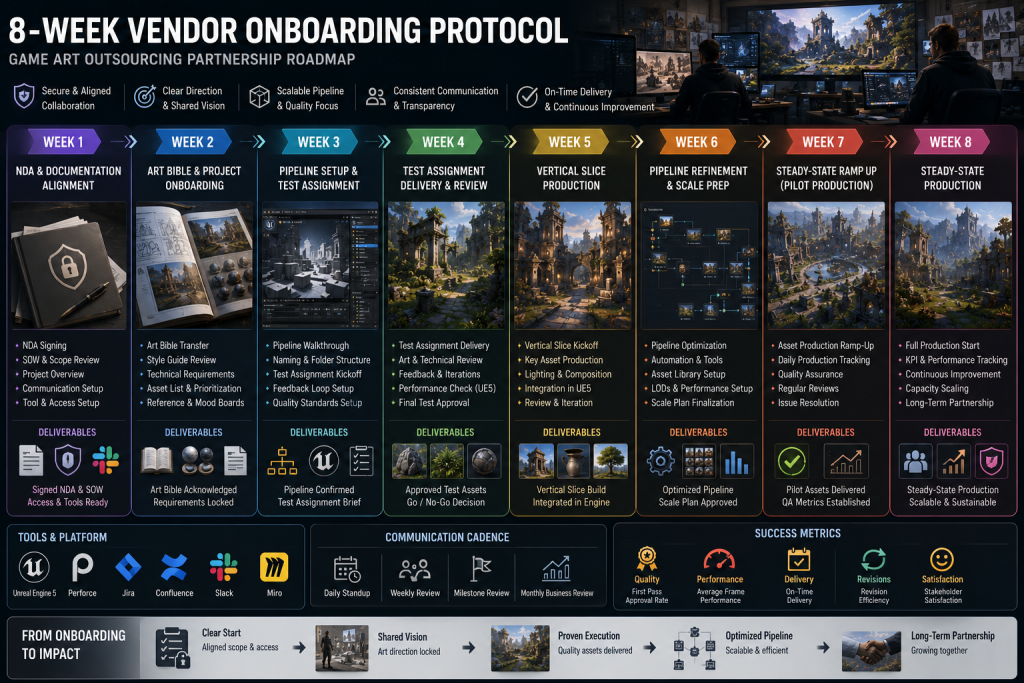
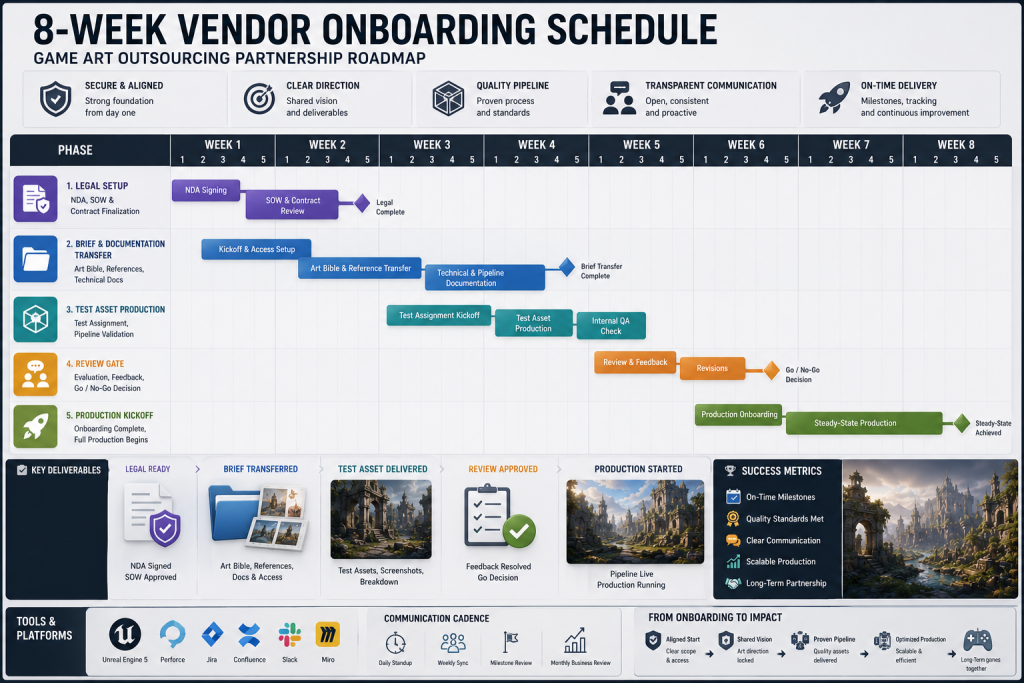
This protocol treats that assumption as false. Structured onboarding is not administrative overhead — it is the mechanism by which you convert a new vendor relationship into a predictable production system. The eight weeks below are designed to front-load the governance cost, surface integration problems on a single test asset, and give you a measurable baseline — first-pass approval rate, revision count per asset, feedback response time — before full-scale production begins.
Why Slipping Approval Rates Are a System Problem, Not a Vendor Problem
First-pass approval rate is the single most diagnostic metric in a game art outsourcing engagement. When assets consistently fail first review — requiring a second or third pass before they meet acceptance criteria — the instinct is to attribute it to vendor quality. That attribution is usually wrong, or at least incomplete.
A slipping first-pass approval rate is almost always a system failure upstream of the vendor. The three most common causes are brief ambiguity, absent acceptance criteria, and feedback latency — and all three are established before the first asset is submitted, not after.
Brief ambiguity happens when the brief describes tone and mood without anchoring them to concrete visual references. When a brief says “weathered industrial aesthetic” without annotated keyframes, approved color swatches, and a specific example of what passes versus what fails, the vendor’s artists fill the gap with their own interpretation. The probability of first-pass alignment drops with each degree of ambiguity. A brief that takes three additional hours to annotate properly prevents two rounds of revision on a character or environment asset — the math is uncomplicated, and the discipline to do it is where most pipelines break down.
Absent acceptance criteria are structurally identical to brief ambiguity, but they operate at the delivery end rather than the brief end. When there is no written definition of what constitutes a complete, approvable asset — which textures at what resolution, which LODs, which naming conventions, whether collision geometry is included, whether the material is set up in engine or delivered as a raw file — the vendor delivers what it thinks is correct, and the review becomes a negotiation rather than a quality gate.
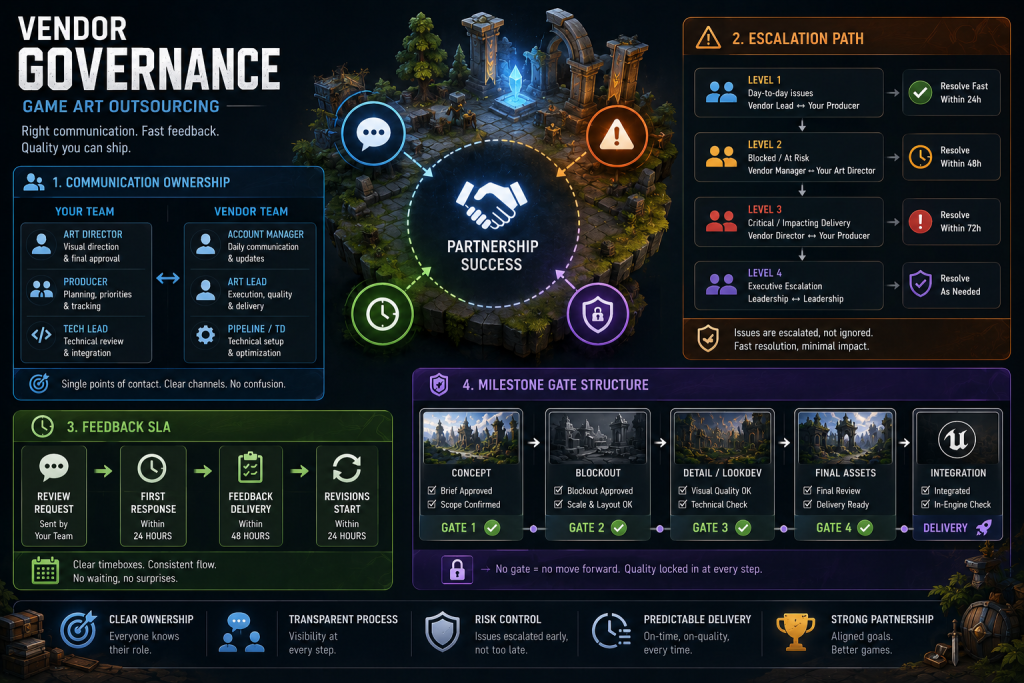
Feedback latency is the third and most insidious cause. When an internal reviewer takes five or six days to respond to a vendor delivery, the vendor’s artists have already moved to the next asset based on the same assumptions that generated the first problem. By the time feedback arrives, the same error has been replicated across an entire batch. A committed feedback SLA — a maximum response time for reviews, documented in the SOW — is not a nice-to-have. It is the mechanism that keeps revision costs from compounding.
The eight-week onboarding protocol below addresses all three failure modes before they reach production scale.
“Editorial illustration created for visual reference purposes. It does not represent a real project, client work, or official software screenshot unless stated otherwise.”
Before Week One: The Onboarding Package Your Team Needs to Prepare
The most common onboarding mistake is treating the vendor as responsible for structuring the engagement. The vendor is responsible for executing — your team is responsible for structuring. If you hand a new vendor a brief and a deadline without a complete onboarding package, you have outsourced your production risk along with the art.
“Editorial illustration created for visual reference purposes. It does not represent a real project, client work, or official software screenshot unless stated otherwise.”
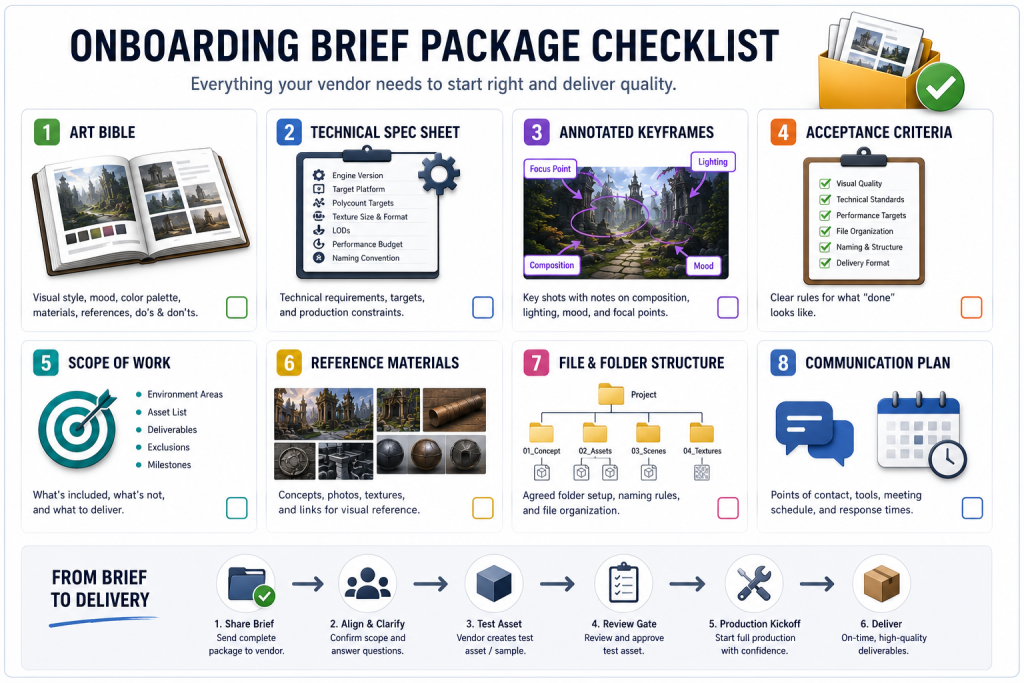
The onboarding package has four components. Each one is your team’s responsibility to produce before the vendor starts.
The art bible. This is the non-negotiable foundation. The art bible defines color palette with specific values, lighting approach and mood targets, material properties for the dominant surface types, silhouette principles for characters and environments, and the visual reference that represents the approved quality bar. A studio working without an art bible will drift in style across the project. Every revision cycle that results from style drift is avoidable — the art bible is the mechanism that prevents it. If you do not have a complete art bible before onboarding begins, producing one is the prerequisite, not the first week of the protocol.
The technical specification sheet. This document defines: target polygon budget per asset category, texture resolution and channel packing convention (ORM vs ORMh, etc.), UV layout standards and texel density targets, LOD requirements and generation method, naming conventions and folder structure, file delivery format, engine import configuration, and collision geometry standard. This is the document that defines what “done” means at the asset level. Without it, your acceptance criteria cannot be objective.
The annotated keyframe set. Take two or three assets that represent the approved quality bar — one that passes on all criteria, one that passes on artistic quality but fails on a technical standard, and if possible one that illustrates a common misread of your style guide. Annotate each with written notes explaining why it passes or fails. This is the most efficient brief-clarification tool available, and it costs your internal art lead two hours to produce. It prevents far more than two hours of revision time. Guerrilla Games’ approach to large-scale art outsourcing — documented in their Art Direction Bootcamp talk at GDC — centers on exactly this principle: the investment in highly detailed briefs is the primary mechanism by which they maintain quality across a vendor network while keeping their internal asset art team deliberately small.
The communication and governance document. This is the short document that establishes: the named point of contact on both sides with decision-making authority, the feedback response SLA (maximum hours from vendor delivery to internal review), the escalation path when a question cannot be resolved at the lead level, the review cadence (synchronous call frequency), and the milestone acceptance process (who approves, in writing, and within what timeframe).
Vendors who receive a complete onboarding package respond with questions about risk, edge cases, and clarifications that reveal their internal QA maturity. Vendors who receive an incomplete onboarding package respond with enthusiasm and start producing. The difference becomes visible at the first milestone review.
Weeks One and Two: Legal Foundation and Documentation Transfer
Week 1 — Contracts and access
The NDA is signed before any project-specific material changes hands. This is not a formality — it is the legal prerequisite for sharing your art bible, visual targets, GDD excerpts, or unreleased builds. Vendors with mature procurement processes expect the NDA as the first step, not a negotiation.
The MSA establishes the governing framework for the relationship: IP ownership (all deliverables, source files, and derivative works transfer to you upon payment), liability limits, data protection terms, and dispute resolution. The MSA is negotiated once; subsequent project scopes are appended as SOWs, which gives you a reusable framework that dramatically reduces onboarding cost for the second and third projects with the same vendor.
The SOW for the test asset phase is drafted and signed in parallel. It defines the specific scope — one or two representative assets, not a full batch — the acceptance criteria mapped to your technical specification sheet, the milestone dates including review deadlines on your side, the revision terms (how many rounds are included, what triggers additional scope), and the named points of contact on both sides.
Tooling access is provisioned: version control repository invitations (Perforce, Git LFS, or your internal solution), project management tool access (Shotgrid, Jira, Ftrack, or equivalent), and if applicable, access to your engine build for in-engine validation.
Week 2 — Onboarding package transfer and vendor acknowledgment
The complete onboarding package — art bible, technical specification sheet, annotated keyframes, communication document — is delivered to the vendor’s lead in a single handoff, not in piecemeal messages over several days.
The vendor reviews the package and returns a written acknowledgment within 48 hours. The acknowledgment should identify: which requirements are fully understood and confirmed, which require clarification before work begins, and which elements of the art bible represent potential production risk from the vendor’s perspective.
This acknowledgment is the first real signal about the vendor’s internal QA maturity. A studio that returns the acknowledgment with no questions or risk flags is not signaling confidence — it is signaling that their pre-production review process does not include style auditing. Ask explicitly: what in this brief concerns you? What would you want us to clarify before the first asset begins? A vendor who can answer those questions specifically and technically has internalized the brief. A vendor who cannot has not.
If clarifications are needed, they are resolved in a synchronous call before any asset enters production. Changes to the brief based on this call are documented in writing by your team and sent to the vendor as a brief revision note. Not a message in Slack — a dated document.
Weeks Three and Four: Brief Package and Style Transfer
Week 3 — Test asset selection and blockout
The test asset is selected deliberately. It should be representative of the production challenge — not the easiest asset in the batch, and not the most complex. For environment art, a single modular kit piece with a mid-complexity surface treatment is appropriate. For character art, a secondary character that uses the dominant rig structure and material approach. For concept art, a scene that requires the primary style vocabulary rather than a generic composition.
The vendor produces the blockout: geometry or composition without final textures, materials, or details. Your art director reviews the blockout in the production context — in engine, not in a rendered preview, and at gameplay-relevant camera distances, not in a beauty shot framing. This is the checkpoint where proportion errors, silhouette misreads, and fundamental style misalignments surface at minimum cost.
The blockout review is a formal gate. Work does not proceed to the next phase until the blockout is approved in writing, with the date logged. If the vendor’s standard process does not include this gate, establish it in the SOW.
Feedback on the blockout is delivered within 24 hours. This is not a target — it is the commitment that keeps the vendor’s momentum from stalling and prevents the feedback latency failure mode from appearing in week three of an eight-week protocol.
For studios handling concept art as the entry point into their production pipeline, this phase is where the style vocabulary is locked before any downstream production begins. Getting the concept pass right in week three prevents the style drift that surfaces two months later in 3D production.

Week 4 — First full pass and technical validation
The vendor delivers the first complete pass of the test asset: final mesh, textures, materials set up in your engine project, LODs where required, collision geometry, and naming conventions matching your project structure.
Your technical art lead validates the asset in the engine. The validation checklist maps directly to the acceptance criteria in the SOW — this is not a subjective review, it is a structured pass/fail assessment against written standards. The validation note is delivered to the vendor within 48 hours and contains: the pass/fail status for each acceptance criterion, specific revision items with clear actionability (not “the roughness feels off” — “roughness value is reading 0.9 in engine under standard lighting; spec calls for 0.6–0.7 for this surface type”), and the deadline for revision delivery.
If all acceptance criteria pass: the vendor moves to the revision confirmation phase in week five. If revision is required: revision scope is triaged — minor technical corrections versus fundamental approach changes. Minor corrections proceed to revision within the SOW’s included revision count. Fundamental changes trigger a brief conversation with both leads before proceeding, to confirm the root cause and prevent recurrence in production.
The cost of discovering a fundamental misalignment at week four is a conversation and one revised asset. The cost of discovering it at week twelve, when 40 assets have been produced on the same incorrect foundation, is substantially higher.
Weeks Five and Six: Governance Layer and Production Preparation
Building the governance layer
The test asset phase has produced data. Now you build the operational system that will carry the engagement through production.
“Editorial illustration created for visual reference purposes. It does not represent a real project, client work, or official software screenshot unless stated otherwise.”
First-pass approval rate baseline: Did the test asset pass on first review, or require revision? If it required revision, what was the root cause — brief ambiguity, technical specification gap, or vendor interpretation error? Document the root cause explicitly. This is not to assign blame; it is to determine which governance element needs strengthening before production begins.
Revision count per phase: How many rounds of revision did the blockout require? The first full pass? Log these numbers. They are your baseline. A mature outsourcing engagement improves these numbers over the first three to four milestones as the vendor internalizes the style and technical standards. If revision count is not declining after four milestones, the governance system has a structural gap that needs to be identified and addressed, not absorbed.
Feedback response time: How long did your internal team take to respond to vendor deliveries during weeks three and four? If the actual response time exceeded the committed SLA, that is internal data that your producer needs — not a vendor performance issue.
Escalation log: Did any questions require escalation beyond the named leads? If so, document the resolution process and consider whether the SOW’s escalation path needs to be clarified.
This data is reviewed in a production readiness call at the end of week five. Both sides participate. The call is not a status update — it is a governance audit. What worked, what created friction, and what needs to be adjusted before production begins.
Week 6 — Production kickoff preparation
The production SOW for the first batch is drafted based on the test asset learnings. The acceptance criteria are updated to reflect any clarifications that emerged from the test phase. The communication document is revised if the review cadence or feedback SLA needs adjustment.
The production milestone schedule is established: batch delivery dates, review deadlines on both sides, revision turnaround commitments, and the milestone payment schedule. Milestone-based payments tied to milestone acceptance — not to delivery dates — create a financial incentive for both sides to resolve acceptance questions promptly rather than letting them drift.
If the production scope involves 3D environment modeling for games — modular kits, landscape assets, or scene-level compositions — this is the point to confirm that the vendor’s internal pipeline for large-scale environment production is documented and understood by both sides. Environment art at production volume introduces constraints — tile-ability, streaming-safe asset dimensions, LOD chains across multiple levels of detail — that a single test asset may not fully surface. A brief environment pipeline review call with the vendor’s technical art lead is worth thirty minutes of both sides’ time.
Weeks Seven and Eight: First Production Milestone and Ongoing KPI Framework
Week 7 — First batch production
The vendor is in steady-state production on the first batch. Your internal team’s role is not to manage the vendor’s internal process — it is to manage the gates.
The mid-batch check-in, scheduled at the midpoint of the delivery window, is a brief synchronous review of works-in-progress. Not a formal review — a directional check. Are the assets tracking toward the approved standard? Is there any drift from the art bible that needs course correction before the full batch is delivered? A fifteen-minute call at the midpoint costs fifteen minutes. The same correction surfaced at final delivery costs three days of revision across the full batch.
Silent weeks are operationally dangerous. A vendor that goes dark for a week and then delivers is not managing your engagement — they are managing their workload. A committed weekly status update, even a brief written note with WIP images attached, keeps your producer informed and gives your art director early warning if directional drift is developing.
Week 8 — First batch review and KPI assessment
The first batch is delivered and reviewed against the production acceptance checklist. Your technical art lead validates each asset systematically, not impressionistically. The validation log — pass/fail per acceptance criterion, per asset — is the record that allows you to track first-pass approval rate across milestones.
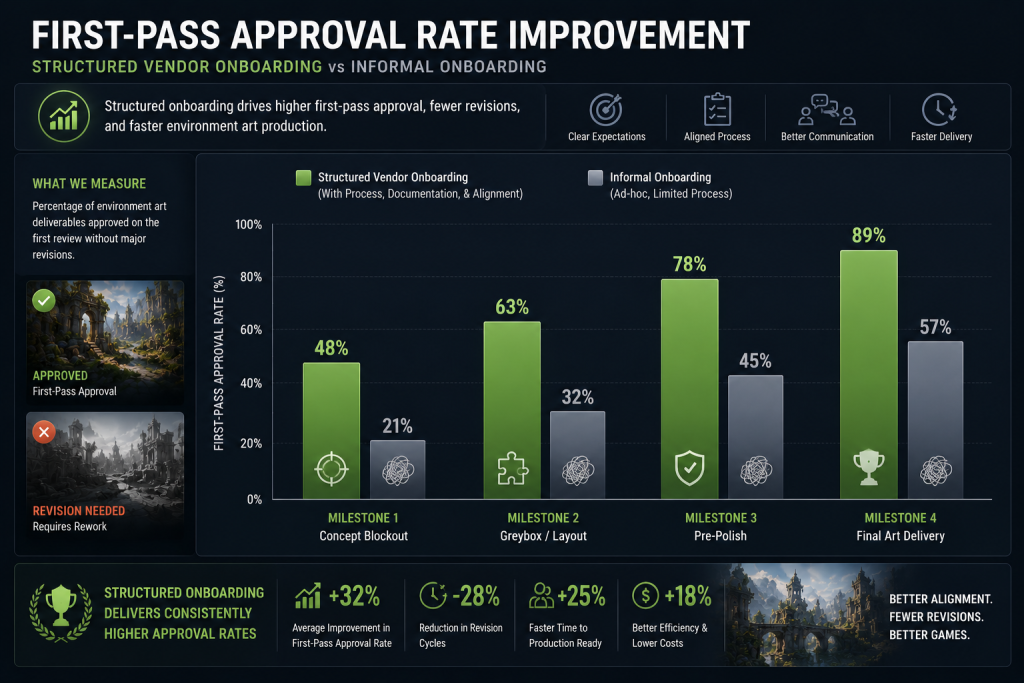
First-pass approval rate on the first production batch is your most important early indicator. A first-pass approval rate above 75 percent on the first batch indicates that the brief package was absorbed correctly and the test asset phase was representative. A rate below 60 percent indicates either a brief gap that was not surfaced during the test phase, a technical standard that was not clearly enough specified, or a vendor team that did not apply the learnings from the test asset review to the batch.
“Editorial illustration created for visual reference purposes. It does not represent a real project, client work, or official software screenshot unless stated otherwise.”
Do not treat a below-target first-pass rate as a vendor failure until you have diagnosed the root cause. Review the revision items: are they clustered around a specific asset type, a specific technical criterion, or a specific section of the art bible? Clusters indicate a system gap. Random distribution indicates a vendor consistency problem. The response is different in each case.
The governance layer built in weeks five and six gives you the framework to make that diagnosis without argument. When the acceptance criteria are written, the revision data is specific, and the feedback loop is documented, both sides can have an objective conversation about what happened and how to prevent recurrence. When none of those elements are in place, the same conversation becomes a dispute about subjective quality.
The KPI Framework: What to Track After Week Eight
The eight-week protocol establishes the governance system. The KPI framework is what keeps it operating correctly after the initial engagement is running.
First-pass approval rate should be tracked per milestone, per asset category, and over time. Target: above 75 percent from the second production milestone onward. A studio with a mature internal QA process will typically reach 85–90 percent by the fourth milestone as the team internalizes the style and technical standards. Decline over time — not just a single bad milestone — indicates a systemic issue: artist rotation on the vendor side, scope change that has not been reflected in a brief revision, or accumulating drift in the style guide. The production management model for AAA art outsourcing described in The Business of AAA Art Production at GDC underlines the same point: the metrics that matter in an outsourcing engagement are not subjective quality impressions but measurable production KPIs that allow both sides to have objective conversations about what happened and why.
Revision count per asset is the more granular metric. Track the average number of revision rounds required per asset type. If environment assets consistently require more revisions than character assets, the root cause is likely in the environment technical specification — either the spec is incomplete for that asset type, or the vendor’s pipeline for environment production differs from what the spec assumes.
Feedback response time is your team’s metric, not the vendor’s. If you are consistently exceeding the committed SLA for internal reviews, your producer needs to address that before it manifests as milestone slippage at the vendor level.
Milestone delivery accuracy — what percentage of committed assets are delivered on the committed date — is the vendor’s operational reliability metric. Distinguish between late delivery caused by scope change or ambiguity in the SOW, and late delivery caused by the vendor’s internal capacity or planning. The appropriate response differs.
The Game Art Studio behind this protocol — Nasty Rodent — operates a documented vendor onboarding process for mid-core and AAA game art production, covering 3D environment, character, concept art, and props pipelines. If your studio is beginning a vendor search or preparing for a new outsourcing engagement, a brief is the starting point.
When the Protocol Surfaces a Genuine Vendor Problem
The eight-week protocol is designed to surface vendor problems early, when the cost of addressing them is lowest. In some cases, what it surfaces is not a correctable gap but a fundamental misalignment that makes the engagement unworkable.
Signals that indicate a vendor problem rather than a system problem: revision feedback that is addressed superficially rather than structurally — the specific annotated issue is corrected, but the underlying cause (misread of the style guide, incorrect interpretation of a technical standard) is not resolved, and the same category of error recurs in subsequent deliveries. Communication that is responsive to direct questions but does not proactively surface problems — a vendor who does not tell you that the second asset is tracking toward the same issue that caused revision on the first asset is not managing your engagement. Acknowledgment of feedback without integration — a vendor who accepts revision notes, asks no clarifying questions, and then delivers the same error at a lower volume.
A single underperforming milestone is data. Two consecutive underperforming milestones are a trend. Three is a system failure. The protocol’s value in this case is that it surfaces the failure at week four or week eight, not at week twenty. Replacing a vendor at week eight, while painful, is manageable. Replacing one at week twenty, with a locked production schedule, is not.
The exit clause in your MSA — the notice period, the IP transfer terms for work-in-progress, the final payment structure — matters here. Review it before you need it. If your MSA requires ninety days notice for termination, you need to make the call at week eight, not week ten.