What Is Lookdev in Game Art Production: From Concept to Beauty Shot
-

Written byDenys Zadoienyi
-

Updated on15.05.2026
-

Time to read12 min

- What Is Lookdev, Exactly?
- What Lookdev Is Not: Common Misreadings
- The Lookdev Workflow: Stage by Stage
- The Art Bible, Style Guide, and Visual Target: How They Connect
- Lookdev in Realtime Engines: What Changes
- Why Lookdev Fails: The Three Most Common Breakdown Points
- Lookdev as a Production Gate, Not a Finishing Step
Look development — or lookdev — is the production stage where a 3D asset gets its final visual identity. It bridges concept art and 3D production: this is where lighting, materials, and rendering decisions are validated against the visual target before the asset moves into the full production pipeline. In AAA game art, lookdev determines whether a hero asset will hold up under a close-camera beauty shot — or fall apart at the first review cycle.
What Is Lookdev, Exactly?
At its core, lookdev is about one question: does this asset look the way it’s supposed to look?
That question sounds simple. In practice, it involves aligning physically-based materials, environment lighting, rendering context, and the visual target established in the art bible — all before a single production-scale pass begins.
The term itself comes from VFX and film, where look development historically referred to offline rendering workflows — final frame rendering, high-fidelity material setups, cinematic lighting. In game art production, lookdev has a different constraint set: assets need to hold up in realtime, at target platform performance budgets, across multiple lighting environments. A hero character that looks stunning in an offline Marmoset render but loses silhouette readability at 4K in-engine isn’t production-ready. That gap is exactly what lookdev is designed to catch.
The distinction matters for anyone working on the concept-to-3D pipeline: lookdev in game art is not a rendering exercise. It’s a fidelity validation step with production consequences.
What Lookdev Is Not: Common Misreadings
Before walking through the workflow, it’s worth separating lookdev from two adjacent disciplines that often get conflated with it.
Lookdev is not shading. Shading is the technical execution of materials — writing shaders, authoring PBR textures, setting material parameters. Lookdev uses the output of shading as input, but its goal is visual validation, not technical authoring. A shading artist can produce technically correct PBR materials that still fail lookdev because the visual result doesn’t match the mood reference or visual target.
Lookdev is not lighting design. Lighting design establishes the emotional and narrative tone of a scene. Lookdev uses a controlled lighting reference setup — typically a neutral IBL environment or a standardized three-point rig — to evaluate how materials respond to light, not to compose a final scene.
Conflating these three disciplines is one of the most common sources of style drift on mid-core and AAA projects. When a concept artist doesn’t account for how a material will behave under lookdev lighting conditions, the 3D team ends up with a third-pass correction cycle that could have been avoided at the mood reference stage.
The Lookdev Workflow: Stage by Stage
Lookdev doesn’t happen in a single session. On a structured AAA pipeline, it unfolds across several sequential validation steps — each one narrowing the gap between the initial concept and the production-ready render.
Stage 1: Visual Target Definition
Before any 3D work begins, the art director establishes the visual target. This is documented in the art bible and supported by a mood reference package: lighting references, texture references, colour scripts, and value studies. The visual target is the benchmark everything else will be measured against during lookdev review cycles.
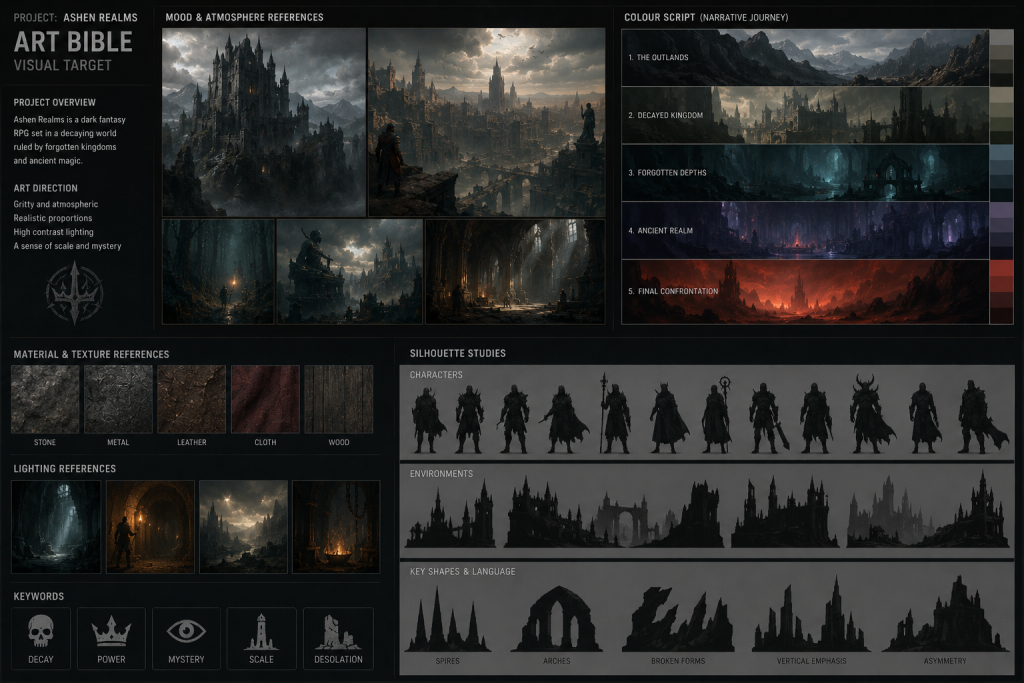
“Editorial illustration created for visual reference purposes. It does not represent a real project, client work, or official software screenshot unless stated otherwise.”
Without a documented visual target, lookdev devolves into subjective feedback — “it doesn’t feel right” — which has no actionable resolution path.
Stage 2: Concept-to-3D Translation Check
The first lookdev checkpoint happens before material authoring begins. A senior concept artist or art director reviews the 3D model against the original concept: silhouette study, proportional accuracy, major shape language. This is not a final lookdev pass — it’s a structural gate.
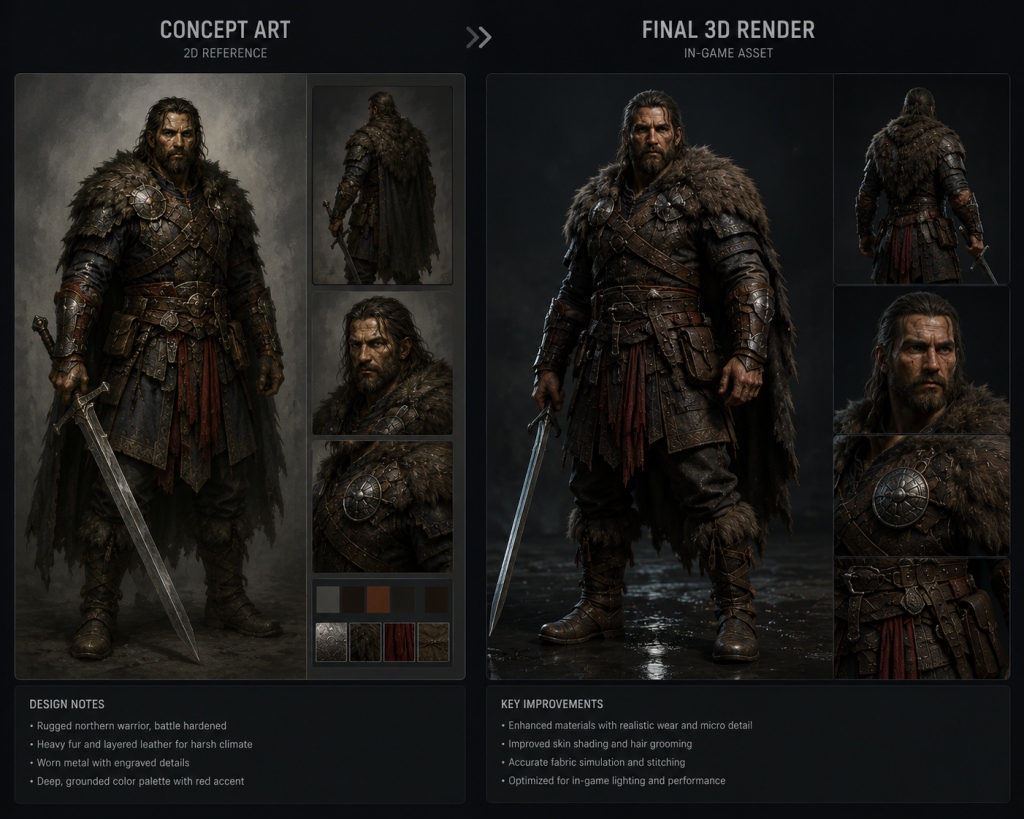
“Editorial illustration created for visual reference purposes. It does not represent a real project, client work, or official software screenshot unless stated otherwise.”
Catching a silhouette that doesn’t match the model sheet at this stage costs one revision cycle. Catching it after two rounds of material authoring costs five.
Stage 3: Material Authoring and PBR Validation
Once the geometry passes the concept-to-3D check, material authoring begins. The key output here is PBR-consistent textures — albedo, roughness, metalness, normal maps — authored to the project’s texel density spec and UV layout standards.
At this stage, lookdev is evaluated in a controlled render environment: typically Marmoset Toolbag with a standardized IBL setup, or the target engine’s material preview with a neutral lighting reference. The goal is to validate that materials read correctly before committing them to a full production render context. Marmoset’s own guide to PBR art creation remains the industry reference for understanding how albedo, roughness, and metalness interact under physically-based lighting — the same principles that define what “correct” looks like at this lookdev stage.
Stage 4: Lookdev Sheet and Beauty Shot
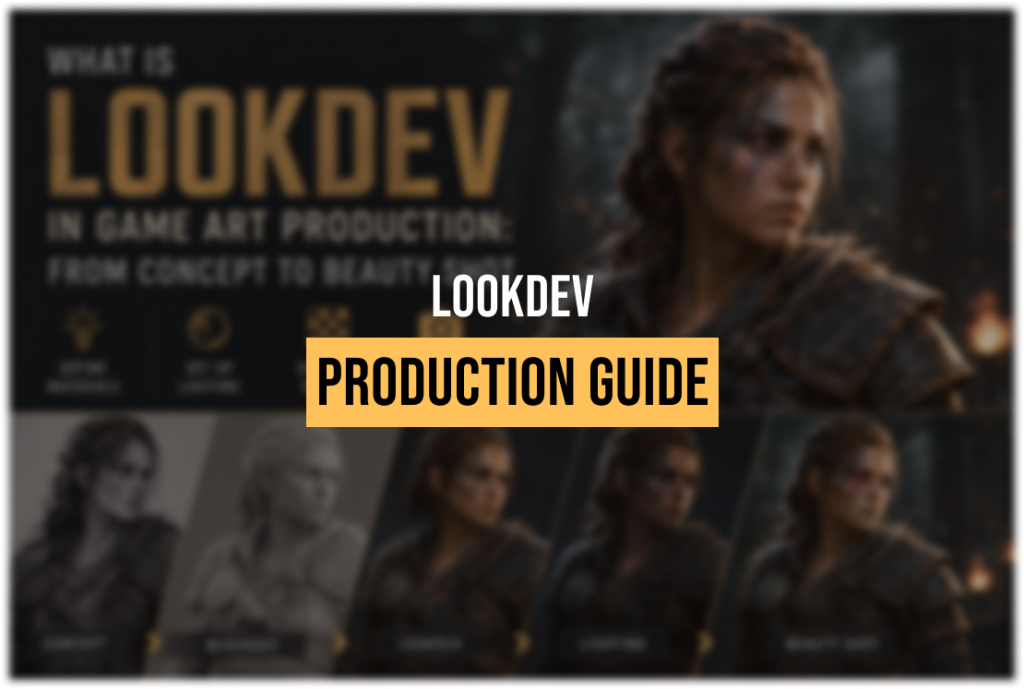
The lookdev sheet is the formal deliverable of this stage: a standardized render showing the asset from multiple angles, under multiple lighting conditions (neutral IBL, key light, rim light, and sometimes a stylized or in-engine context pass). It documents the asset’s visual behaviour and serves as the reference for all subsequent production work.

“Editorial illustration created for visual reference purposes. It does not represent a real project, client work, or official software screenshot unless stated otherwise.”
The beauty shot — a polished hero render of the asset under optimal lighting — is the final lookdev deliverable. It’s not a marketing asset at this point; it’s a production reference that establishes what the asset is supposed to look like when art direction is fully executed.
When a beauty shot doesn’t survive a close-camera review — when silhouette readability breaks down, when PBR consistency between surface regions doesn’t hold, when the hero asset stops looking like it belongs in the same visual world as the surrounding environment — the lookdev cycle restarts.
Stage 5: Art Direction Sign-Off and Production Handoff

Sign-off means the art director has confirmed the beauty shot matches the visual target from the art bible. At this point, the lookdev sheet becomes the binding reference for production: every subsequent asset in the same category should match its material response, lighting behaviour, and silhouette quality.
This is why the hero asset must set the tone. Everything else in the production batch will be measured against it. An approved beauty shot that doesn’t fully commit to the visual target creates a moving benchmark — and a moving benchmark produces style drift.
The Art Bible, Style Guide, and Visual Target: How They Connect
Lookdev doesn’t exist in isolation. It’s downstream of three foundational documents that define the visual language of the project.
The art bible is the master reference document. It establishes the overall visual direction: genre, tone, colour language, lighting philosophy, and the relationship between concept art and production output. On a well-run AAA project, the art bible is version-controlled and actively maintained by the art director throughout production — not written once at pre-production and left to drift.
The style guide operationalizes the art bible at the asset level. It defines material tiers, texel density standards, polycount budgets by asset category, naming conventions, and UV layout rules. A well-constructed style guide answers the questions a 3D artist will ask when translating a concept into production geometry.
The visual target is the specific benchmark for a given asset or asset category. It’s typically a curated set of reference images, colour scripts, and value studies that define what “correct” looks like — not abstractly, but for this character, this environment, this prop, in this project. The visual target is what the lookdev sheet gets compared against during review cycles.
Art bible compliance rate and concept-to-3D fidelity match are the two measurable outputs of this system. When they’re high, lookdev review cycles are short. When they’re low, the gap between what the concept artist imagined and what the 3D team produced widens with every pass — and the art bible ends up being revised to accommodate what got built, rather than guiding what gets built. That’s the failure mode.
Lookdev in Realtime Engines: What Changes
The shift from offline to realtime rendering introduces constraints that directly affect lookdev decisions.
In a film VFX pipeline, lookdev can assume near-unlimited rendering time per frame. In game art production, the same asset needs to hold up at target platform frame budgets — 60fps on console, 90fps on PC — under dynamic lighting conditions, with LOD transitions, across varying camera distances.
This means several lookdev decisions that would be invisible in an offline context become critical in realtime:
Material complexity vs. draw call budget. A material that requires multiple texture samples and complex shader instructions may look correct in Marmoset but contribute disproportionately to GPU overhead in UE5 or Unity HDRP. Lookdev for game art must account for how material authoring choices translate to shader complexity at runtime.
Normal map baking quality. In realtime, normal maps carry most of the surface detail work. Baking errors — seam artifacts, incorrect cage settings, tangent space mismatches — that are barely visible in an offline render become obvious under the harsh lighting conditions of in-engine review. Lookdev in game art catches these before they propagate through a production batch.
IBL vs. in-engine lighting response. An asset validated against a neutral IBL in Marmoset may respond differently to the dynamic directional lighting and environment reflections in UE5’s Lumen system. Part of the lookdev process for engine-targeted assets includes a validation pass in the actual target environment — not just the controlled render setup. Weapon designer Lennard Claussen’s UE5 lookdev workflow breakdown on 80.lv shows how practitioners handle this gap in practice: a dedicated in-engine scene template with calibrated post-processing and camera settings, used specifically for lookdev validation before production handoff.
LOD behaviour. High-fidelity surface detail that reads clearly on the hero LOD may collapse into visual noise on LOD-1 or LOD-2. Lookdev for game art production should include at least a basic review of how the asset reads at distance — particularly for hero characters where silhouette readability is critical.
These are not edge cases. They’re the standard constraints of realtime production, and ignoring them during lookdev means catching the problems during QA — at considerably higher cost in rounds of revisions.
Why Lookdev Fails: The Three Most Common Breakdown Points
Across mid-core and AAA projects, lookdev tends to break down at predictable points in the pipeline.
Breakdown 1: No visual target documented before lookdev begins. When the art bible exists but the visual target for a specific asset category hasn’t been defined — or when mood references are vague or inconsistent — lookdev becomes subjective. “It doesn’t feel right” is not a revision note. An art director without a documented reference can spend three lookdev review cycles without moving closer to sign-off.
Breakdown 2: Concept-to-3D translation check is skipped. When 3D artists move directly from concept to material authoring without a structural geometry check, silhouette and proportion errors get locked in under layers of texture work. Correcting a silhouette after materials are authored costs significantly more than correcting it at the model sheet stage.
Breakdown 3: Lookdev is treated as a single pass, not a stage. On compressed timelines, teams sometimes treat lookdev as a checkbox — one beauty shot, one review, done. In practice, lookdev is a validation loop: beauty shot → review against visual target → revision → repeat until art direction sign-off. Compressing this loop produces assets that pass a rushed review but fail at the first detailed camera angle in engine.
The common thread across all three is the same: lookdev doesn’t fail because 3D artists lack skill. It fails because the foundational reference documents — art bible, visual target, model sheets, callout sheets — aren’t complete before production begins.
Lookdev as a Production Gate, Not a Finishing Step
The most expensive misunderstanding about lookdev is treating it as something that happens at the end of 3D production — a final polish pass before delivery. On a structurally sound pipeline, lookdev is a gate, not a finish line.
It’s the point where the concept artist’s visual intent gets formally validated in a production context. When that gate is clear — when the art bible is complete, the visual target is documented, the model sheets and callout sheets exist — lookdev review cycles are short, revision counts are predictable, and beauty shots hold up. Art bible compliance rate stays high because the benchmark is stable.
When the gate is unclear — when the visual target is defined by feel rather than documentation — lookdev becomes the place where production debt accumulates. Every undocumented assumption about how a material should look, every silhouette that “feels right” without a reference, every colour script that exists in someone’s head rather than the art bible: all of it surfaces during lookdev review cycles, at the worst possible time in the pipeline.
The concept-to-3D fidelity match that makes a hero asset worth a beauty shot doesn’t happen by accident. It’s the product of documentation that starts at the art direction stage and gets validated — not assumed — at every lookdev checkpoint along the way.
At Nasty Rodent, we bring over a decade of production experience to every project — from concept art through final delivery. As a full-cycle game art outsourcing studio based in Tallinn, Estonia, our team of 40+ covers 3D Characters, 3D Environment, 3D Props, Concept Art, and UX/UI across mid-core and AAA pipelines. We’ve contributed production-ready visuals to titles including Squad, Ready Or Not, Mutant Year Zero, Starship Troopers: Extermination, and Miasma Chronicles. From initial concept to final UI and animation, we provide the high-fidelity fuel your gameplay needs to drive storytelling and deep player immersion.
Explore our Concept Art work →