Time Zones in Game Art Outsourcing: A Working SLA Framework
-

Written byDenys Zadoienyi
-

Updated on13.08.2026
-

Time to read12 min

- Definition: what “managing time zone differences” actually covers
- Why “just add a Slack channel” doesn’t fix distant collaboration
- What to put in place before production starts
- A practical SLA and escalation framework
- Where the trap is hidden: the milestone that slips a little every time
- Why cutting corners on this infrastructure can cost more than it saves
- Overlap-Heavy vs Async-First vs Hybrid: which communication model fits
- Comparable engagements
- How we approach this at Nasty Rodent
Managing time zone differences in game art outsourcing is not a scheduling inconvenience you tolerate until the project ships – it’s an infrastructure problem, and like every infrastructure problem, it either gets designed deliberately or it emerges later through avoidable review and milestone delays. The vendor is skilled, the contract is signed, the kickoff call went well. Then, a few review cycles in, the pattern becomes visible: a blocked artist waited far too long for an answer that should have taken twenty minutes, a revision note got interpreted three different ways across two time zones, and nobody can say who was supposed to catch it.
“Editorial illustration created for visual reference purposes. It does not represent a real project, client work, or official software screenshot unless stated otherwise.”
None of that is a time zone problem in the way people usually mean it. It’s a missing-infrastructure problem that a time zone gap makes visible faster than it would in-house.
Definition: what “managing time zone differences” actually covers
Managing time zone differences in a game art outsourcing relationship means designing four things deliberately: an overlap window that’s actually protected where one is needed, a response-time structure tiered by urgency, an escalation path with a named owner, and a review cadence that doesn’t depend on both sides being awake at once. Get those four right and an eight-hour gap is a scheduling fact, not a production risk. Leave them undefined and even a smaller gap can eventually affect a milestone.
Why “just add a Slack channel” doesn’t fix distant collaboration
The default response to a time zone gap is almost always tooling: spin up a shared Slack, add a Discord voice channel, drop a Trello board in front of both teams, and assume the gap solves itself once everyone can technically reach everyone else. It doesn’t, and the reason is structural, not technical. A tool answers how people talk. It says nothing about when a reply is expected, who is accountable if it doesn’t arrive, or what happens when a routine question turns into a blocker at the end of one team’s day and the middle of the other’s night.
We’ve written elsewhere about why studio location itself is a production decision – that piece covers the evaluation stage, before a contract exists. This one assumes you’ve already made that call. The question here isn’t whether to work with a distant studio. It’s what the operating model looks like once production actually starts.
Across both realistic-military and stylized production, a recurring cause is not the time gap itself but unclear ownership during the period when one side is offline – and that gap in ownership doesn’t announce itself until it’s already expensive.
What to put in place before production starts
Five things, roughly in order of how often we see them skipped. Some of this belongs in the SOW before signing; the rest gets confirmed at kickoff, before the first asset moves into production – the important part is that none of it is left to be figured out later.
1. A protected overlap window, calculated from real schedules – where one is actually needed
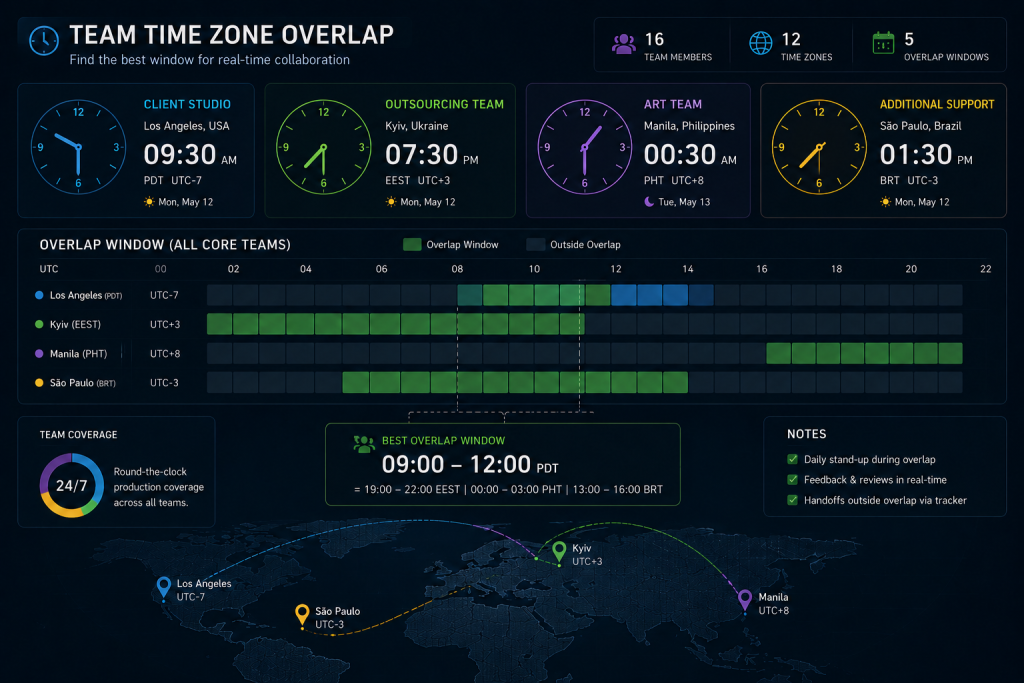
Every distant vendor relationship has some number of hours where both time zones are technically awake – but that number depends entirely on each team’s actual working hours, not on the raw UTC distance between two cities. A large gap on paper can still produce a workable window if one side runs an early shift; a moderate gap can produce close to nothing if both sides keep strict 9-to-6 hours. The only reliable way to know is to lay both teams’ real schedules side by side, not estimate from time zone names.
Whether that window needs to exist at all depends on the work. Where the engagement involves same-day decisions or live milestone review, it’s worth creating a deliberate shared window by shifting a defined block of hours on one or both sides. Where it doesn’t – well-specified batch production with mature documentation on both ends – an async-first model with scheduled exception calls can be more efficient than forcing daily overlap that neither side actually uses.
2. A response-time structure, tiered by urgency, with a clear clock
Not every message deserves the same clock, and the clock itself needs a definition – otherwise a “4-hour SLA” is unenforceable the moment the gap is larger than the overlap window. A workable structure ties the response window to whichever team is receiving the message, not to a fixed number that assumes constant mutual availability:
- Blocking issues – acknowledged within the shared overlap window if one exists, or at the very start of the receiving team’s next working period; a resolution plan follows within that team’s first few working hours.
- Standard clarifications – acknowledged or answered by the end of the receiving team’s next business day; more complex questions may need longer, by agreement.
- Non-critical items – queued for the next scheduled review, or answered within an agreed low-priority window, whichever comes first.
The exact numbers should be set per engagement, based on both teams’ real hours – not copied from a generic table.

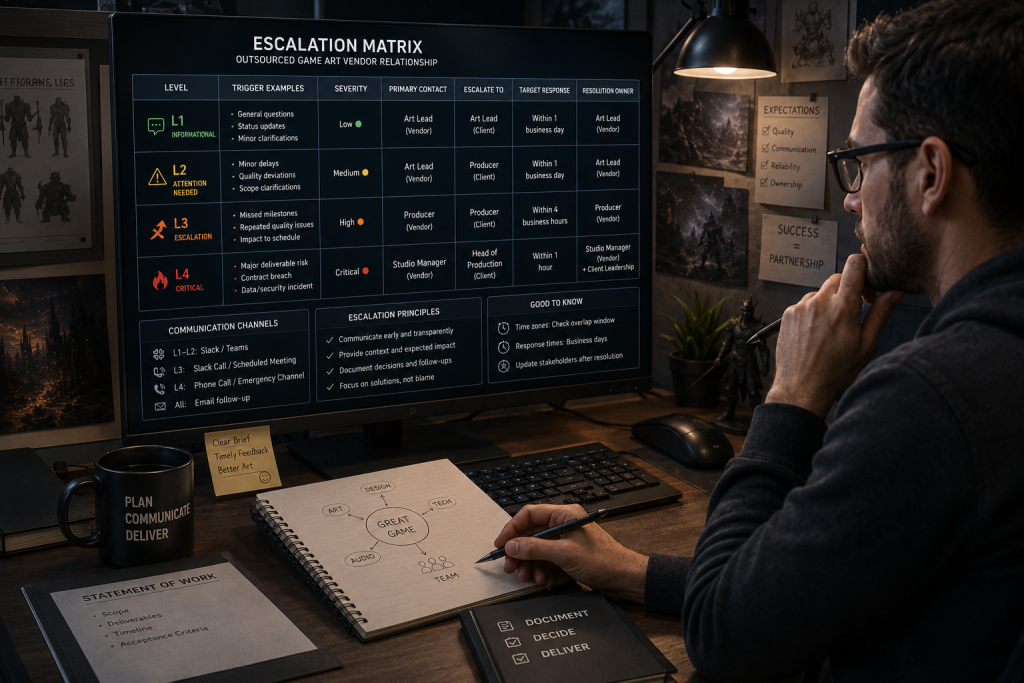
3. A named escalation path, triggered by severity, not by a counter
Every studio says “just reach out if something’s blocked.” Far fewer name who, specifically, gets contacted when the primary point of contact is asleep, on leave, or hasn’t answered in time – and fewer still define escalation in a way that actually matches how serious the problem is. A trigger based purely on “two missed replies” is either too slow for a genuine production blocker or overkill for two minor questions that happened to land back to back.
A better structure ties escalation to impact: immediate escalation for anything threatening the active milestone, regardless of message count; escalation after one missed response on a genuinely blocking issue; and escalation only after a pattern of missed standard-tier responses that signals a systemic problem, not a one-off. Escalation itself should end in acknowledgment, not just a handoff – someone with authority confirms they own it and gives a time-bound recovery plan, not just a name in a Slack channel.
“Editorial illustration created for visual reference purposes. It does not represent a real project, client work, or official software screenshot unless stated otherwise.”
4. A review cadence that doesn’t assume synchronous availability
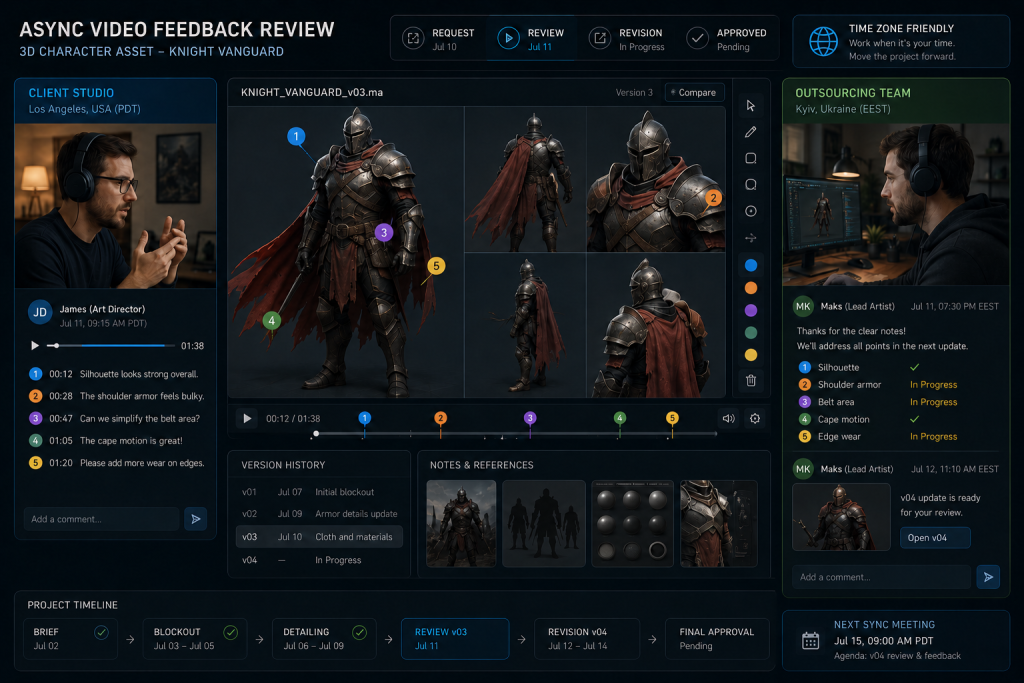
Milestone reviews built around “let’s hop on a call” quietly assume both sides can find a shared hour whenever review is ready – which, across a real gap, is often not true on the day it matters. The fix isn’t abandoning calls; it’s designing review as async-first with sync as the deliberate exception: recorded walkthroughs with timestamped notes, structured feedback templates instead of freeform comments, and a fixed calendar slot reserved for the cases that genuinely need a live conversation.
“Editorial illustration created for visual reference purposes. It does not represent a real project, client work, or official software screenshot unless stated otherwise.”
Async sign-off itself isn’t a risk – plenty of well-run engagements approve milestones this way by default. What turns it into a risk is the absence of a named approver, an agreed deadline for feedback, and a clear route to request a live walkthrough if something in the async feedback is ambiguous.
5. Documentation-first handoff, not tribal memory
The single biggest tell that a distant vendor relationship is under-engineered: decisions live in someone’s memory of a call instead of a written record either side can point to later. Documentation-first doesn’t mean bureaucracy – it means every decision that changes scope, style, or spec gets written down at the moment it’s made, in a place both teams check, so a large time gap doesn’t turn into a multi-day game of telephone.
A practical SLA and escalation framework
The table below is a practical starting structure that can be adapted per engagement – to the actual time-zone gap, engagement length, production phase, and staffing on both sides. It’s not a fixed industry standard; treat the numbers as a starting point to negotiate into your SOW, not a formula to copy as-is.
| Tier | When It Applies | Target Response | Red Flag |
| Blocking | Pipeline halted, spec conflict, broken reference file | Acknowledged in the shared window, or at the start of the receiving team’s next working period; resolution plan within their first few working hours | No named backup contact when the primary is offline |
| Standard | Revision notes, clarification requests, asset feedback | Acknowledged or answered by end of the receiving team’s next business day | Replies arrive on time but don’t answer the actual question |
| Non-critical | Style discussion, long-range planning, optional suggestions | Folded into the next scheduled review, or answered in an agreed low-priority window | Non-critical items get silently reprioritized as urgent, burning goodwill on both sides |
| Escalation | Impact-based trigger (see above), not a fixed miss-count | Immediate handoff to, and acknowledgment by, a named senior contact, followed by a time-bound recovery plan | The escalation path exists only informally, discovered for the first time under pressure |
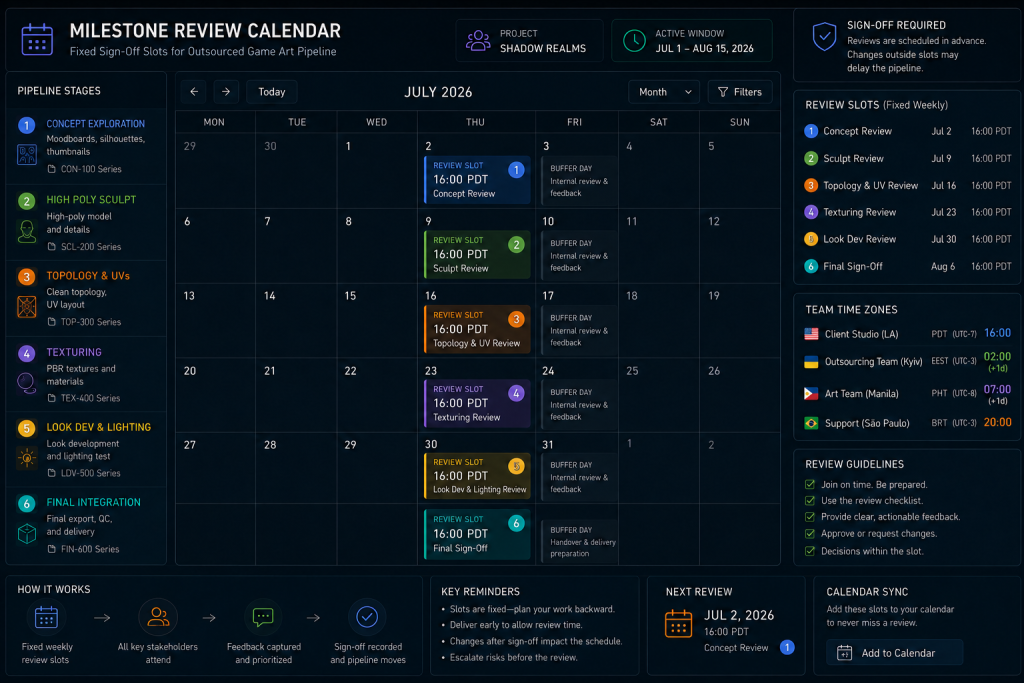
Milestone sign-off is a separate governance question, not another row on this table – it needs its own named approver, a fixed review slot on the calendar, and an explicit route to request a synchronous walkthrough, regardless of which tier the underlying feedback falls into.
“Editorial illustration created for visual reference purposes. It does not represent a real project, client work, or official software screenshot unless stated otherwise.”
This “Red Flag” column is often missing from SLA templates entirely. A target response time is more useful once the document also defines what failure looks like and what happens next.
Here’s a pattern worth watching for. A milestone is due Friday. It lands the following Monday – not because the work wasn’t done, but because a late-week question sat unanswered until it was already the start of the following week on the other side. Nobody missed a deadline dramatically. In a tightly coupled schedule, a review delay of even a couple of days can compress the next milestone’s window even when the final ship date hasn’t moved – and repeated across a multi-milestone engagement, that compounding effect is often what actually erodes a schedule, more than any single dramatic failure does.
This is the trap that a protected overlap window and a tiered response structure are specifically built to close.
Why cutting corners on this infrastructure can cost more than it saves
Skipping the SLA-and-escalation setup looks like it saves time – a kickoff conversation, a shared doc, an hour nobody wants to spend before the “real work” starts. The cost, when it shows up, tends to be larger and less visible on a Gantt chart: escalation paths that don’t exist on paper get built under pressure, mid-crisis, by whoever happens to be online – which is a worse way to make that decision than a short conversation at kickoff would have been.
Deloitte’s 2024 Global Outsourcing Survey reports growing adoption of outcome-based delivery models and a broader shift toward value-based outsourcing relationships as organizations mature their sourcing strategies. Deloitte doesn’t frame that shift specifically in terms of response-time commitments – that’s our own read on it – but the underlying logic transfers cleanly to production: a tiered SLA is the game-art-pipeline version of the same idea, turning a general promise of responsiveness into a defined, negotiable commitment rather than a hope both sides carry into the engagement.
Overlap-Heavy vs Async-First vs Hybrid: which communication model fits
The ranges below are operating heuristics we’ve found useful for framing the conversation, not fixed industry bands – actual overlap depends on real working schedules, flexible hours, and how mature each team’s async documentation habits already are.
| Model | Best Fit | Typical Overlap | Failure Mode If Unmanaged |
| Sync-heavy | Small gap, fast-iteration phases like concept revisions | Several hours daily | Meetings consume the entire overlap window, leaving no time for actual production work |
| Async-first | Large gap, documentation-mature teams on both sides | Little to no daily overlap, particularly for well-specified batch production with no same-day approval dependency | Decisions drift without a written record; feedback contradicts itself across successive days |
| Hybrid overlap window | Most mid-core/AAA vendor relationships with a moderate gap | A short daily window, deliberately protected | The overlap window exists on the calendar but isn’t defended from unrelated meetings |
For most game art outsourcing engagements, some version of the hybrid model tends to work best: a fixed, protected window for milestone reviews and blocking questions, with the rest of the day running async on documentation.
Comparable engagements
Our work with Offworld Industries on Squad involved production content – from concept art to final vehicle and weapon assets – delivered by the Tallinn team for a North American partner. It’s a useful example of the kind of cross-time-zone engagement this framework is designed to support.
Before committing to a distant vendor relationship, it’s worth having the commercial documentation in order too – our breakdown of RFP and SOW practices for game art outsourcing covers where SLA and escalation language belongs in the contract itself, not just the working process. And if you’re still weighing the underlying hire vs. outsource decision, that trade-off is worth resolving first.
How we approach this at Nasty Rodent
Nasty Rodent matches communication cadence, ownership, and review structure to the client’s time zone and production needs, with a dedicated point of contact and milestone-based delivery on every engagement. If time zone risk is one of the things holding your outsource decision back, we run a free vendor capability assessment against your brief or RFP: within 48 hours, a read on realistic time-zone overlap, a suggested communication structure, and the production risks worth flagging before you commit – no obligation attached.
Send your brief to nastyrodent.com/services → Send Request, or book a call directly with our production team to talk through the specific overlap and communication setup for your engagement.