Hand-Painted vs Procedural: Building a Scalable Stylized 3D Pipeline
-

Written byDenys Zadoienyi
-

Updated on20.07.2026
-

Time to read17 min

- Hand-Painted vs Procedural Texturing: The Core Pipeline Decision
- Stylized vs Realistic 3D Production Cost: What Actually Changes
- Style Drift and Uneven Detail Density: The Pitfall That Costs the Most Late
- Highly Illustrative Real-Time 3D: Choosing the Right References
- The Texturing Rules a Stylized Art Bible Must Lock
- Comparison: Hand-Painted vs Procedural Texturing for Stylized Mid-Core Production
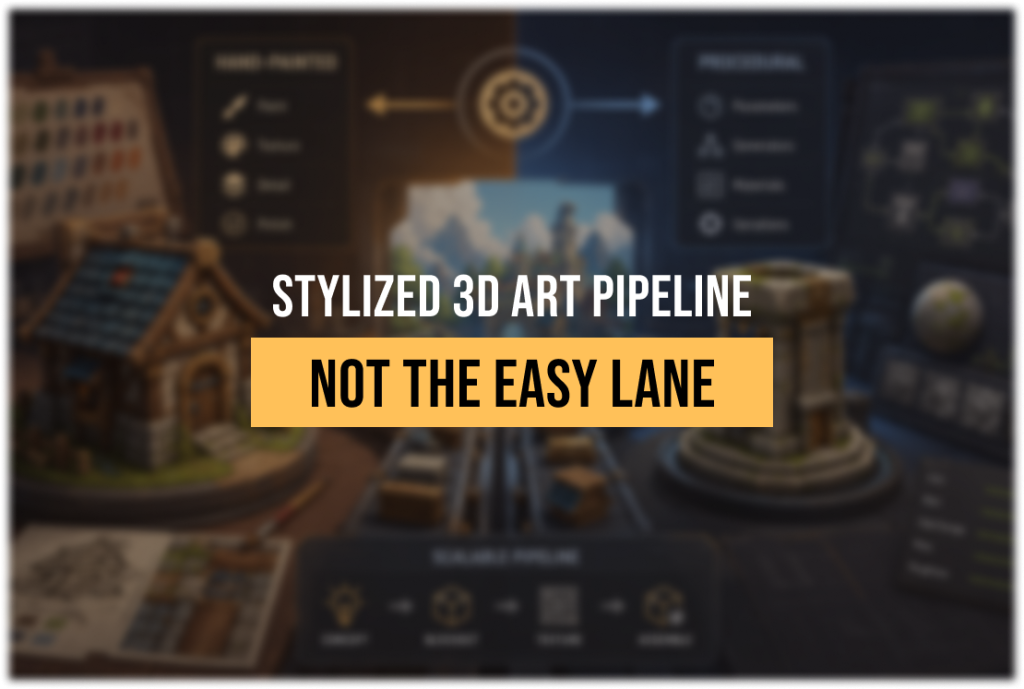
A stylized 3D art pipeline for mid-core games is not a cheaper, simplified version of a realistic pipeline — it is a different production system with its own cost structure, its own failure modes, and its own decision points that have to be locked before the first asset enters production. Producers who treat stylized production as “the easy lane” tend to discover the real cost structure only once production has scaled past the first few hero assets, when detail density has drifted across the asset library and nobody can say why the environment reads as inconsistent.
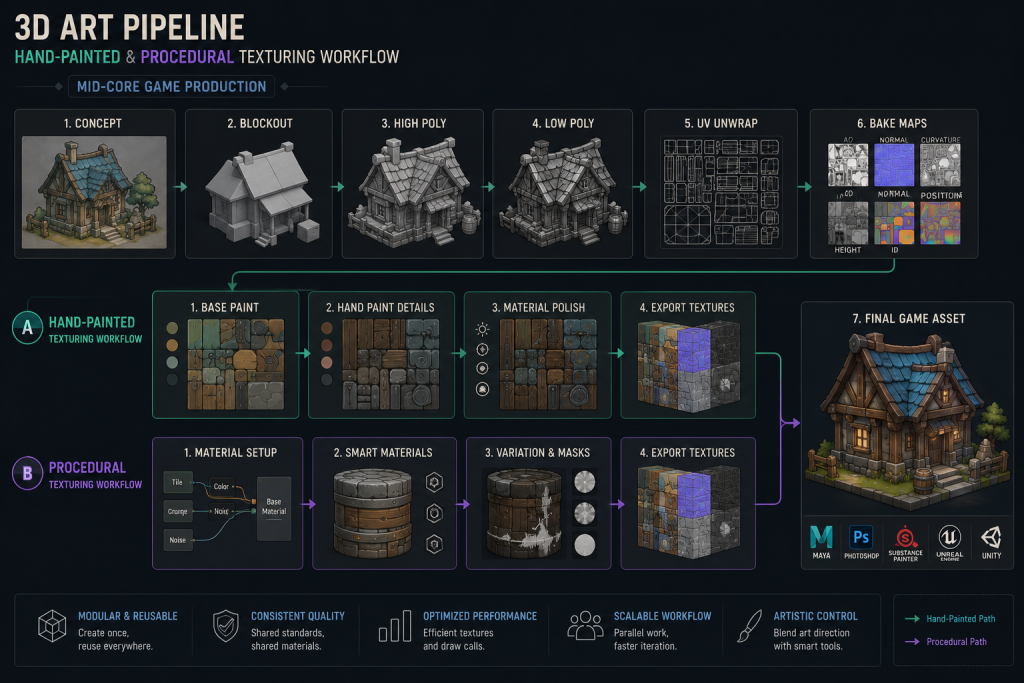
“Editorial illustration created for visual reference purposes. It does not represent a real project, client work, or official software screenshot unless stated otherwise.”
This guide is scoped narrowly and on purpose. Shape language, silhouette testing, hero asset anchoring, and rendering stack decisions (NPR vs stylized PBR vs hybrid) are character-specific art direction principles already covered in depth on our blog — they aren’t repeated here. Realistic-vs-stylized-vs-semi-realistic visual language for environments specifically is also already mapped in our 3D environment design guide. What follows is the production-pipeline layer underneath any of those visual choices — the part that determines whether a mid-core studio’s budget assumptions about “going stylized” survive contact with an actual production schedule: how hand-painted and procedural texturing actually compare as production methods, what stylized production costs against a realistic AAA baseline, and where detail density breaks down across a growing asset library.
As a producer planning a stylized project for Q3 delivery, the pipeline decision you make now determines your FTE cost structure for the next two to three quarters — not just the visual outcome. That’s the framing this guide takes.
Hand-Painted vs Procedural Texturing: The Core Pipeline Decision
Each stylized asset category should have a defined texturing strategy before production begins — how much of the final surface language will be hand-authored versus procedurally generated, and where trim sheets, tileables, decals, or vertex-color blending fit into that mix. Hand-painted versus procedural is the central axis of that decision, and it’s the one this guide focuses on, but it isn’t the only production choice on the table. The two core approaches produce visually similar results at a glance but come from fundamentally different production disciplines, and the choice compounds across every asset that follows.
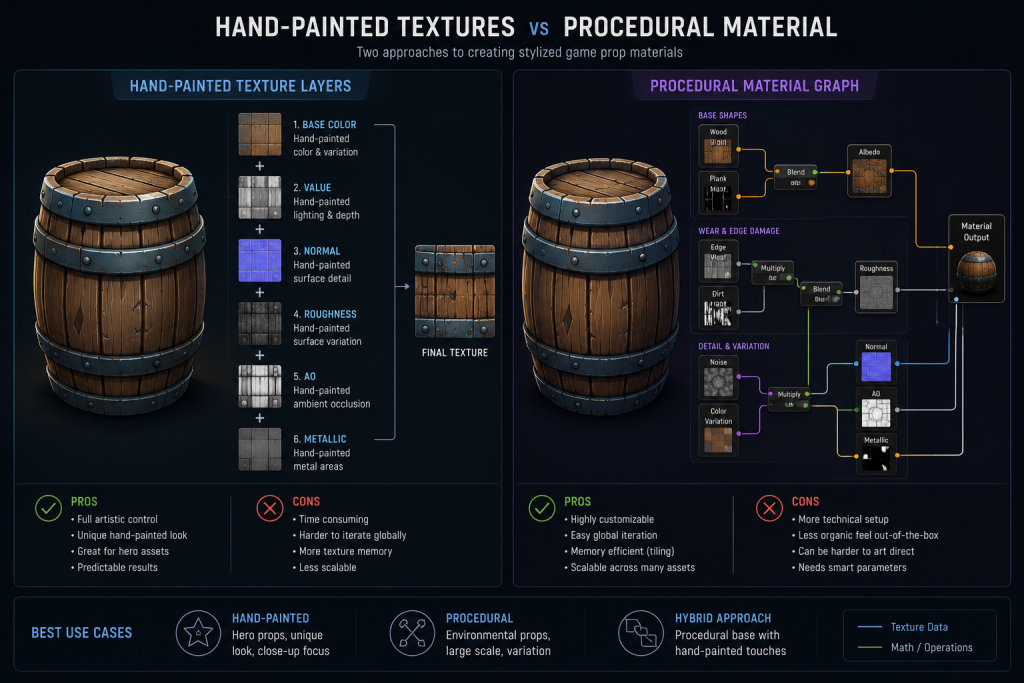
“Editorial illustration created for visual reference purposes. It does not represent a real project, client work, or official software screenshot unless stated otherwise.”
Hand-Painted Texturing: Direct Control, Higher Per-Asset Cost
Hand-painted texturing means an artist authors the surface appearance manually, usually by painting a base-color or diffuse texture in 3DCoat or Substance 3D Painter using the asset’s UV layout, with a 2D editor like Photoshop typically used for UV-space refinement rather than direct on-model painting. It’s worth being precise about scope here: hand-painted and PBR aren’t mutually exclusive categories. A traditional baked-light workflow paints ambient occlusion, gradients, and highlights into a diffuse texture, sometimes under an unlit or simplified shader — this can imitate the look of gloss or matte surfaces, but it isn’t recording actual roughness response, which is a physical material property, not something a brush stroke can encode. A hand-authored stylized PBR workflow paints the same surfaces by hand but keeps roughness, metallic, and normal data separate, so the asset still responds to dynamic engine lighting. Production breakdowns of the traditional workflow describe the same core sequence: flat base colors first to lock the palette, then occlusion and shadow painting, then gradient and detail passes.
The strength of hand-painted work is expressive control — an artist can push a color relationship or a shadow shape exactly where the composition needs it, independent of what a physically based material response would produce. Practitioners frequently note that dedicated painting tools like 3DCoat offer more direct, brush-first control for this specific niche than Substance Painter’s more procedural-oriented layer stack — worth evaluating per artist preference rather than defaulting to a single tool studio-wide. The cost is that this control doesn’t scale linearly: doubling the number of texture artists on a project doesn’t double throughput if art-direction and review bandwidth stay fixed — the bottleneck isn’t hands, it’s consistent eyes reviewing consistent brushwork across a growing library.
Procedural texturing builds reusable surface logic through node graphs, generators, masks, and exposed parameters — commonly in Substance 3D Designer, but also through engine-side material systems (Unreal material graphs, Unity Shader Graph), Houdini, or studio-specific tools. The output can target either a realistic PBR look or, increasingly, a deliberately stylized one. An Adobe Substance 3D case study on a semi-stylized environment demonstrates a hybrid approach: stylized color decisions combined with procedurally authored wall and ground materials — built from grunge maps, directional warps, and noise layers — that still respond consistently across different lighting conditions rather than being flat-lit.
The production advantage of procedural work is that the graph is a record of the decision, not just the output. When parameters and outputs stay connected to the same controlled graph and export pipeline, a graph-level change can be propagated across dependent material variants — a weathered and a clean version of the same wall material becomes a parameter swap rather than a repaint. That propagation depends on the setup: instances with local overrides, disconnected graph versions, or textures already baked out to static bitmaps still need a manual re-export and reimport pass. This is why procedural and reusable material systems are widely used in large-scale realistic environment production — and why the same logic increasingly appears in stylized pipelines: variant generation and late-stage art direction changes get cheaper once the pipeline is set up to support it.
The tradeoff is upfront investment. Building a procedural stylized material graph that reads as intentionally hand-crafted — not as “recognizably procedural, wearing a stylized skin” — takes a technical artist with genuine stylized sensibility, and that combination can be harder to source than a strong hand-painting artist alone. Get the graph wrong and every asset built from it inherits the same tell: repetitive noise patterns, mechanical-looking edge wear, a “proceduralism” the player’s eye catches even without naming it.
What Makes a Procedural Graph Read as Stylized, Not Just “Procedural With a Stylized Skin”
This failure mode is worth naming precisely, because it’s what separates a graph a technical artist can hand off confidently from one that quietly undermines the whole pipeline. A procedural material graph built with realistic-production habits — physically plausible or reference-derived noise scales, uniform wear distribution, roughness values pulled from real material references — produces a technically stylized-looking output that still reads as procedural to a trained eye, because the underlying logic is still “simulate a real surface,” just with the color and value range compressed afterward.
A graph that actually holds a stylized register does the opposite: wear, edge accents, and surface variation follow compositional hierarchy rather than purely physical simulation, noise scale is exaggerated and simplified rather than photorealistically fine-grained, and edge highlighting is often baked in as a deliberate stylistic pass rather than derived from a physically based Fresnel response. This is the specific skill gap that makes a stylized-capable technical artist harder to source than a generalist one: building a technically functional graph is a distinct material-authoring skill on its own, while building one whose decisions read as art-directed rather than simulated adds a further stylization discipline on top of it.
Which One a Mid-Core Pipeline Actually Needs
In production practice, the choice isn’t binary for most mid-core projects — it’s a ratio decision made per asset category:
- Hero props and focal assets — often receive more hand-authored treatment over a procedural or reusable base, because they carry the visual signature players remember and justify the additional artist time. Character pipelines specifically are covered separately, but it’s worth noting modern character work is frequently hybrid rather than purely hand-painted.
- Background and modular environment pieces — typically procedural-first, because the volume math favors a system that generates consistent variants over an artist repainting near-identical tiles fifty times.
- Mixed hybrid pipelines — a common production model for teams managing varied asset tiers at scale: procedural base layers for tileable surfaces and bulk props, hand-painted overlay passes for hero-tier assets and anything the camera lingers on.
This decision gate belongs in the pre-production art bible — not discovered mid-milestone when the environment team realizes half the modular kit was hand-painted at hero quality and the schedule can’t absorb that cost across the rest of the modular asset set. Prop production is where this hero/background split shows up most concretely: hero props absorb the hand-painted budget, background props absorb the procedural one.

Stylized vs Realistic 3D Production Cost: What Actually Changes
The most persistent myth in mid-core production planning is that stylized art is the cheaper option. It sometimes is — but not for the reason most producers assume, and not consistently across every asset category.
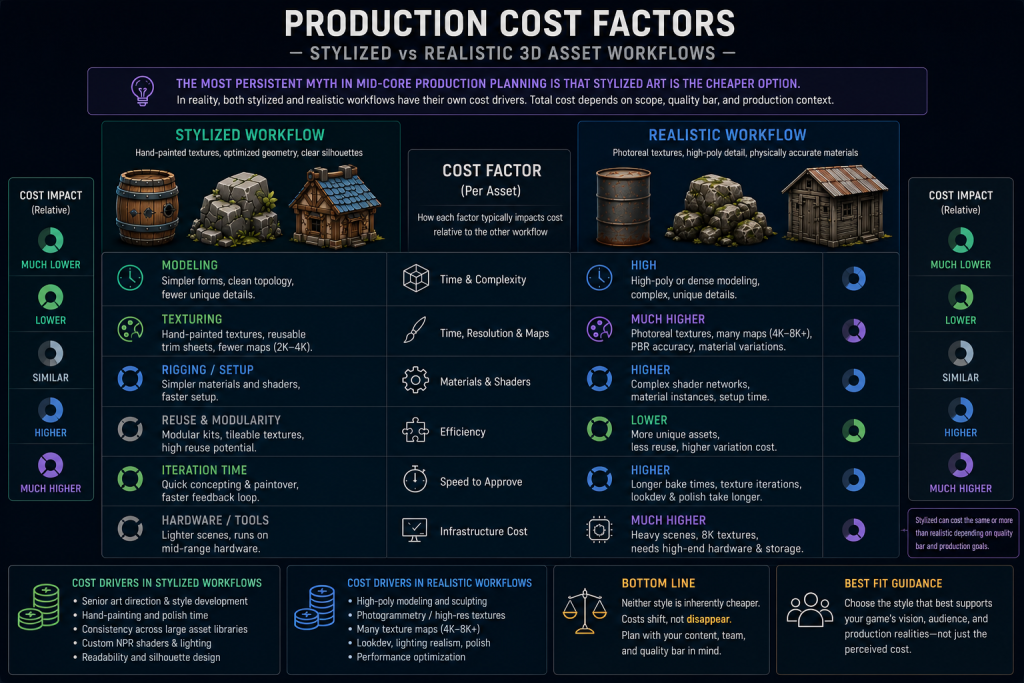
“Editorial illustration created for visual reference purposes. It does not represent a real project, client work, or official software screenshot unless stated otherwise.”
Where stylized production genuinely saves budget:
- Texture-set complexity. Some stylized pipelines reduce authoring overhead by relying more heavily on a hand-authored base color map, simplified material response, or packed masks instead of a conventional PBR texture set (base color, normal data, and packed or separate roughness, metallic, and ambient-occlusion information). This can reduce texture memory, export complexity, and authoring overhead — though it doesn’t necessarily reduce the number of intermediate maps baked during production, and it isn’t inherent to stylized production. A stylized PBR asset built the way the Adobe case study above describes can carry the same map count as a realistic one; the reduction is a pipeline choice, not an automatic consequence of going stylized.
- Reference requirements. Stylized production may need less strict one-to-one matching with physical reference, but it doesn’t eliminate reference research. The emphasis shifts toward curated shape, color, material, and mood references synthesized into a project-specific art bible — which can reduce repetitive asset-level lookup, but can also increase upfront visual-development work if the target style is original rather than adapted from an existing genre convention.
- Selective simplification. Stylized art direction can deliberately reduce geometric and surface complexity where the brief calls for it, which does reduce authoring time on those specific forms. That tolerance isn’t universal, though — in silhouette-driven stylized work, small proportion or curvature changes are often more visible than they would be in a detail-rich realistic model, precisely because there’s less surface noise to hide them.
Where stylized production costs the same or more:
- Senior art direction bandwidth. Because stylized assets are validated against project-specific visual rules rather than physical resemblance alone, senior art-direction review can represent a larger share of the budget than producers initially expect. Whether it exceeds the review cost of realistic production — which carries its own senior-review demands around likeness, hard-surface engineering, and scan cleanup — depends on the project’s fidelity target, asset type, and approval structure.
- Consistency enforcement at scale. Style drift isn’t unique to stylized production — realistic pipelines have their own version of it, from inconsistent roughness response to mismatched wear levels or uneven texel density across a photogrammetry-heavy asset set. What’s different is the arbiter: realistic work can often use physical reference as an additional validation layer, while stylized work depends more heavily on project-specific visual rules — which can make drift harder to diagnose and resolve when those rules are incomplete or inconsistently enforced. Controlling it consumes ongoing effort that doesn’t show up in a per-asset cost estimate, as covered below.
- NPR or stylized-shader technical art. If the stylization target requires custom shader work — outline rendering, cel-shading bands, stylized specular response — that adds senior technical art headcount a conventional PBR pipeline may not need. That doesn’t mean realistic production comes without its own technical-art costs: layered material work, hair and skin shading, virtual texturing, and lighting/deformation tooling all carry senior technical art overhead too. The specialization differs; the need for it doesn’t disappear on either side.
The honest framing for a producer building a milestone budget: stylized 3D production may reduce some forms of per-asset surface-authoring or fidelity-matching work, but it often shifts more effort into visual development, senior art-direction review, and ongoing consistency enforcement. Whether that trade nets cheaper depends heavily on your art director’s bandwidth and whether your review process is built to catch drift early or late.
Style Drift and Uneven Detail Density: The Pitfall That Costs the Most Late
Detail density — the amount and spatial frequency of geometric, textural, and material information an asset carries relative to its gameplay role, camera distance, and narrative importance — is one of the most common failure points in scaling a stylized 3D art pipeline for mid-core games past the first handful of hero assets.
How it happens. A hero prop gets art-directed attention: multiple revision rounds, a senior artist’s full focus, careful detail placement that reads at gameplay distance. A background prop, produced under schedule pressure three weeks later by a different artist or a faster procedural pass, ends up either under-detailed (flat, lifeless, visibly “cheaper” next to the hero) or over-detailed (a junior artist compensating for uncertainty by adding more brushwork than the asset’s narrative weight justifies, creating visual noise that competes with actual hero assets for the player’s attention).
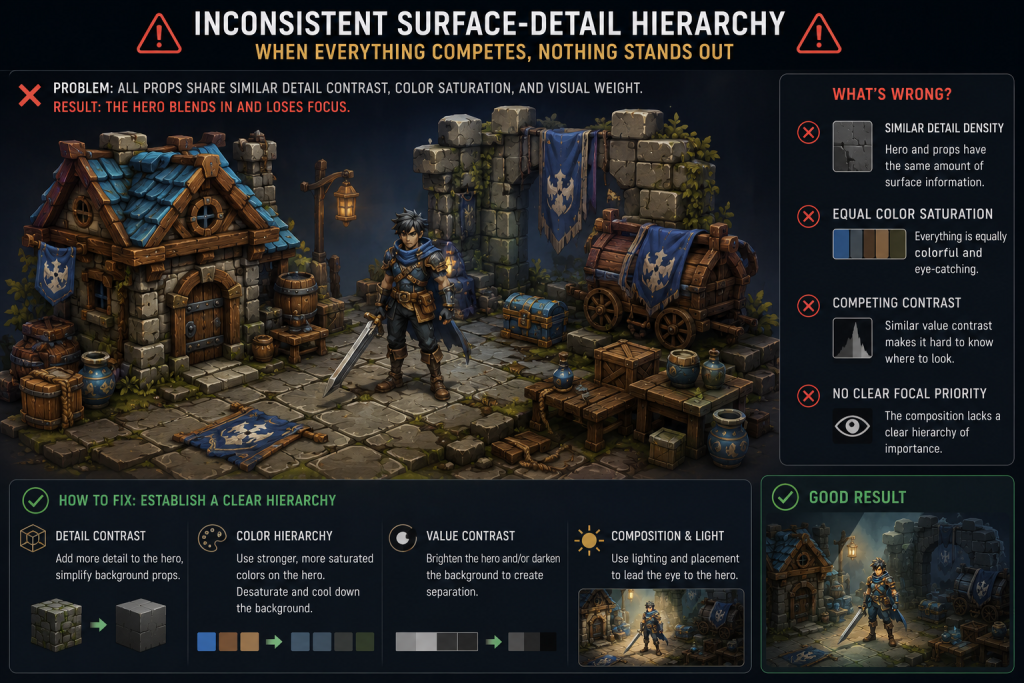
“Editorial illustration created for visual reference purposes. It does not represent a real project, client work, or official software screenshot unless stated otherwise.”
Neither direction is really about individual artist skill. It’s a missing detail density budget — a defined, tiered specification for how much surface complexity each asset tier is allowed to carry, set at the art bible stage and enforced at review, not discovered by eye per asset. A documented game art style guide exists precisely to prevent this: it locks proportions, color logic, and — critically for stylized work — detail density tiers before production scales past the point where verbal direction can hold consistency together.
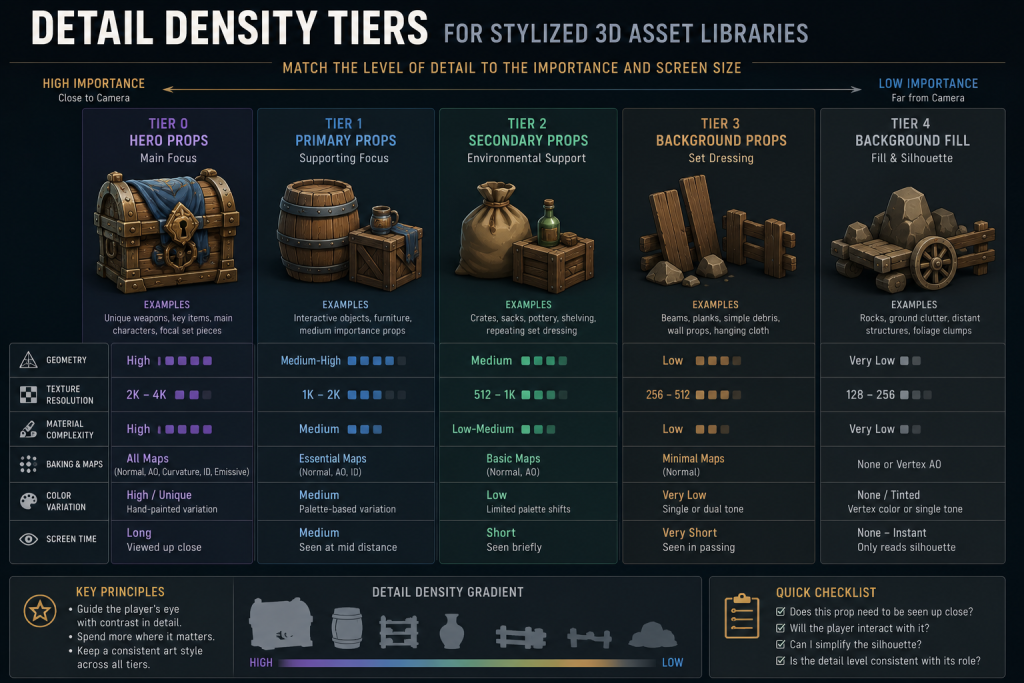
“Editorial illustration created for visual reference purposes. It does not represent a real project, client work, or official software screenshot unless stated otherwise.”
Illustrative density tiers for mid-core planning (an internal planning model to adapt to your own project, not an industry-standard measurement — “detail density” isn’t a unit anyone measures objectively without a project-specific scoring approach):
| Asset tier | Surface-detail direction | Review point |
| Hero / narrative-critical | Highest authored complexity, senior artist sign-off at each production gate | Blockout, texture/lookdev, and final validation |
| Mid-tier / recurring gameplay props | Controlled secondary detail that doesn’t compete with hero assets | Batch review at each sprint or agreed delivery gate |
| Background / set-dressing fill | Simplified forms, broad value grouping, reusable materials, procedural-first where possible | Milestone gate |
The comparison test that catches drift early. Render new assets side-by-side against an already-approved reference asset from the same tier, under matched lighting, before final approval — the same principle stylized character pipelines use for hero-asset comparison, applied here at the tier level rather than the individual-hero level, since stylized environment and prop libraries scale far past what individual comparison review can cover.
Uneven detail density is expensive to catch late for the same reason style drift always is: fixing it at vertical slice means reworking dozens of already-approved assets, not adjusting a spec document. Shared procedural systems can make some classes of surface-complexity correction cheaper to propagate — a corrected parameter in a properly exposed graph can update dependent instances — though geometry, UV scale, baked detail, and engine-side integration may still need per-asset revision even in a procedural pipeline. A predominantly hand-painted library has fewer of these system-level levers: shared shaders, gradient maps, or color-correction passes can still propagate globally, but unique painted detail generally requires per-asset revision. This is one of the concrete arguments for the hybrid texturing approach described above: procedural bulk production at least gives you a density lever to pull retroactively for part of the library.
Highly Illustrative Real-Time 3D: Choosing the Right References
Our environment design guide already maps the realistic → semi-realistic → stylized spectrum for mid-core visual language, and rendering-stack decisions (NPR vs stylized PBR vs hybrid) are covered in our characters piece — neither is repeated here. One thing worth flagging for anyone briefing toward the cartoon-illustrative extreme: it’s easy to reach for the wrong reference. Cuphead, for instance, is entirely hand-drawn traditional cel animation with no 3D asset pipeline behind it at all — a poor production reference for a real-time 3D brief, however visually relevant the style might seem.
A cleaner real-time 3D reference for that extreme is Arc System Works’ Guilty Gear Xrd, whose art team documented in a GDC talk how they pushed real-time 3D character models to read as hand-illustrated — including manually editing vertex normals independent of the underlying mesh geometry, so shading reads as a clean, deliberate gradient rather than the mottled banding raw topology produces under a hard cel shader. It’s a mesh-preparation step upstream of texturing, and it’s a large part of why that specific visual lineage (later continued in Guilty Gear Strive) reads as intentional illustration rather than “3D pretending to be 2D.” The further a project’s target register sits toward that extreme, the more production emphasis shifts toward this kind of authored mesh and shading control alongside hand-painted texturing, and the less useful physically realistic material fidelity becomes.
The Texturing Rules a Stylized Art Bible Must Lock
Every production style guide needs measurable visual and technical constraints, stylized or not. In stylized production specifically, rules that physical reference might otherwise help resolve have to be documented especially explicitly — realistic work can often lean on physical reference as an additional validation layer; stylized work depends more heavily on the project-specific rules written into the art bible. At minimum, the texturing-specific portion of a stylized art bible for a mid-core production should lock:
- The texturing-method assignment per asset tier — which categories are hand-painted, which are procedural, which are hybrid, decided before production scales rather than negotiated per asset.
- Approved material families, channel-packing convention, and texel-density ranges — so texture sets stay comparable across artists and tools.
- Detail density targets per tier, defined against a shared reference point rather than a vague “keep it consistent” instruction.
- Rules for baked lighting cues in any traditional baked-light work — how much occlusion, gradient, and highlight painting is acceptable before it reads as inconsistent with the engine’s actual lighting.
- Procedural graph review criteria for any technical artist building shared material graphs, covering the compositional-vs-physical wear logic described above, plus allowed noise frequencies and edge-wear conventions.
- A comparison-render protocol and validation lighting setup — how often, under what lighting, and against what reference, new assets get checked against approved ones from the same tier.
None of this replaces artistic judgment. It replaces the assumption that artistic judgment alone holds consistent across a dozen artists and several hundred assets without a written specification to check against.
Comparison: Hand-Painted vs Procedural Texturing for Stylized Mid-Core Production
| Factor | Hand-Authored Emphasis | Procedural Emphasis |
| Common asset fit | Assets needing unique focal treatment, bespoke color placement, or illustration-like surface work | Repeated material families, modular kits, tileables, and assets needing shared surface logic |
| Upfront cost | Lower reusable-system setup cost, higher unique authoring effort per asset | Higher graph-building investment, lower per-instance cost once built |
| Variant generation | Usually more manual adjustment per variant, though layered source files and shader-level controls can reduce the workload | Faster when the variation is already supported by exposed parameters |
| Consistency at scale | Depends on senior review bandwidth | Improved baseline consistency, provided parameter ranges and usage rules are controlled |
| Talent sourcing | Strong hand-painting artists are relatively common | Artists combining procedural-material skills with strong stylized direction can be harder to source |
| Late-stage art direction changes | Usually more expensive — unique painted detail often requires per-asset revision | Cheaper when the pipeline is set up to propagate graph-level changes |
For many mid-core asset libraries, a hybrid model is a practical default: procedural-heavy for volume, hand-authored emphasis for hero tier — locked in the art bible before the first asset ships, not negotiated asset-by-asset under schedule pressure. In practice this is rarely a strict character-vs-prop split; modern character pipelines lean on procedural bases and smart materials too, and the hand-painted/procedural balance is better decided per asset role than per asset category.
At Nasty Rodent, we define the balance between hand-authored and procedural work in our stylized game art outsourcing production during pre-production, based on asset role, visual target, reuse potential, camera distance, and the client’s existing pipeline — the kind of tier-level planning that keeps a growing background-prop batch from quietly drifting away from the hero-tier standard as production scales.

Let's work
together


in mind?
From 3D characters and environments to weapons, props, concept art and game UI/UX: ten years deep, 40+ artists strong, zero fluff. Tell us what you are making and get a free, no-pressure estimate.
estimate