Unity Subscription vs Unreal Royalties: What Each Engine Actually Costs a Studio
-

Written byDenys Zadoienyi
-

Updated on18.08.2026
-

Time to read14 min

- Two Pricing Philosophies, Not Two Versions of the Same Fee
- What Unreal Engine Actually Costs
- What Unity Actually Costs
- Unity vs Unreal Engine: Licensing at a Glance
- A One-Year Crossover Example for a Five-Seat Team
- The Variable Most Budget Comparisons Skip: Headcount vs Revenue
- What This Means for a Mid-Core/AAA Production Budget
- Where This Fits in the Broader Engine Decision
- How Nasty Rodent Works Across Both Engines
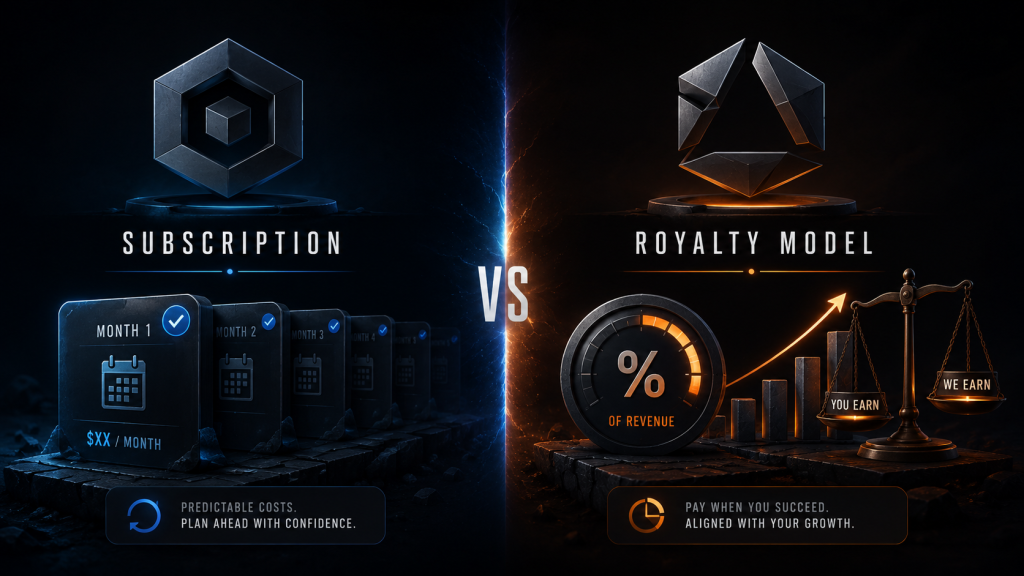
“Editorial illustration created for visual reference purposes. It does not represent a real project, client work, or official software screenshot unless stated otherwise.”
Unity and Unreal Engine price access to their engines in fundamentally different ways, and calling both a “royalty” is inaccurate. Unreal Engine charges a 5% royalty, and only after a title crosses $1 million in lifetime gross revenue. Unity charges a flat annual subscription — $2,310 per seat per year for Unity Pro, if prepaid annually — once a studio passes $200,000 in annual revenue or funding, regardless of how much the game eventually earns. These are two different pricing philosophies scaling on two different variables, and that difference is what actually decides which engine is cheaper for a given project — not a simple side-by-side percentage comparison, and not a single “crossover number” that holds for every team.
This piece goes deep on one thing only: what each engine’s pricing model actually costs, and how to model it against your own team and revenue. For the broader production decision — rendering, hiring, pipeline, and licensing together — see the related guide linked further down.
Two Pricing Philosophies, Not Two Versions of the Same Fee
The phrase “Unity royalties” still gets searched constantly, and the confusion has a real history behind it. In September 2023, Unity announced a Runtime Fee — a per-install charge that would apply once a game crossed certain install and revenue thresholds. Developer backlash was immediate, and within about ten days Unity walked back the harshest terms — exempting Personal and Plus users entirely and gating the fee to new engine versions going forward. But the fee itself wasn’t dropped at that point; it stayed on the books in revised form for almost another year. Unity fully cancelled the Runtime Fee for games on September 12, 2024, under new CEO Matt Bromberg, and reverted entirely to the existing seat-based subscription model. In practice, the fee was never actually charged to any shipped game before it was cancelled.
That history matters for a budgeting decision made in 2026, because it explains why the two engines now operate on structurally different cost logic. Unreal’s fee is a percentage of revenue — it costs nothing until a game earns money, and even then it costs nothing until that money crosses a specific threshold. Unity’s fee is a flat subscription per developer seat — it costs the same whether the game sells ten copies or ten million, and the trigger for paying it is the studio’s revenue or funding, not the game’s.
What Unreal Engine Actually Costs
Unreal Engine’s licensing terms, as published on Epic’s own Unreal Engine licensing page, break down into three tiers:
Free to develop, no revenue limit, regardless of studio size. Anyone can download Unreal Engine, access the full source code, and build a game without paying anything — including studios already generating well over $1 million a year — because the royalty is triggered by what a specific shipped product earns, not by the developer’s overall size or headcount. Educators and schools get the same unlimited access with no revenue ceiling at all. Separately, for commercial uses that don’t qualify as a Royalty Product (covered below), Epic exempts individuals and small businesses with less than $1 million in trailing 12-month gross revenue from needing a paid seat.
5% of royalty-eligible revenue above $1 million lifetime gross, per product. Once a shipped game crosses $1 million in lifetime gross revenue — not annual revenue, lifetime — Epic charges 5% of the qualifying revenue above that threshold, calculated against a defined “Royalty Revenue” figure rather than literally every dollar of gross earnings. The first $1 million is never subject to royalty, no matter how large the game eventually becomes, and the threshold applies per product, so a studio running three titles that each earn $900,000 pays nothing on any of them, even though the studio’s combined revenue from Unreal-built games is $2.7 million. The EULA’s Royalty Addendum also excludes a calendar quarter’s revenue entirely if that quarter’s gross for the title stays under $10,000 — mainly relevant for older titles with a long, thin revenue tail rather than for the initial threshold decision. It also defines other exclusions and credits, including specific treatment of recoupable publisher advances: royalties already paid on an advance can be credited against future royalty obligations for the same product, so Epic isn’t paid twice on the same money, though the advance itself isn’t automatically excluded from Royalty Revenue.
A reduced rate exists, tied to ongoing conditions — not just a launch date. Revenue collected through the Epic Games Store is excluded from the royalty calculation itself (separate from whatever cut Epic takes as a storefront, which is a different fee entirely). And under the “Launch Everywhere with Epic” program, titles that ship on the Epic Games Store on or before their release on other storefronts can qualify for a reduced 3.5% royalty rate — but qualification isn’t a one-time checkbox. It requires the Epic Games Store version to maintain content, feature, and marketing parity with other platforms for as long as the product is live. If a title stops meeting those conditions, the rate reverts to the standard 5% from that point forward.
Non-game commercial use follows a separate classification, not a simple “games vs. everything else” split. Epic’s EULA distinguishes a “Royalty Product” — broadly, anything that incorporates Unreal Engine code at runtime and is distributed to third-party end users — from other commercial uses that require a seat subscription instead. Most shipped games fall into the Royalty Product category, but so can some non-game software distributed the same way, such as an off-the-shelf training or visualization tool sold to clients. Studios using Unreal Engine for internal tools, client-delivered custom work that isn’t distributed further, or similar non-runtime-distributed use typically fall under the seat model instead: $1,850 per seat per year, required once the company has generated more than $1 million in the past 12 months. The practical takeaway for a producer: the classification depends on how the product is built and distributed, not on whether it’s labeled a “game,” so non-game teams should confirm their specific case against the current EULA rather than assume.
For teams deciding on UE5 primarily on technical grounds rather than cost — what Nanite and Lumen actually change in an art production pipeline — that ground is covered separately in our guide to what Unreal Engine 5 is, including the same $1 million lifetime threshold in context of the engine’s broader feature set.
What Unity Actually Costs
Unity’s current tier structure, confirmed directly on Unity’s plans and pricing page, works on eligibility thresholds rather than revenue-share:
Unity Personal — free. Individuals, hobbyists, and small teams stay eligible as long as their trailing 12-month revenue and funding, combined, stay under $200,000. This applies whether that $200,000 comes from the game itself or from investment the studio has raised. There’s a nuance worth flagging for outsourcing-facing teams specifically: if a business is providing Unity development services to a third-party client rather than shipping its own title, eligibility can be assessed against the client’s finances rather than the service provider’s own revenue — relevant for any studio doing contract Unity work where the client, not the contractor, is the one approaching a tier threshold.
Unity Pro — $2,310 per seat per year if prepaid annually, or $210 per seat per month on the monthly plan. These aren’t the same number: paying monthly for a full year comes to $2,520, roughly $210 more than committing to the annual plan upfront. Pro is required once a studio crosses the $200,000 threshold, and it’s billed per developer seat regardless of how the game performs commercially. A five-person team on annual Pro plans pays $11,550 a year in licensing whether the game grosses $250,000 or $25 million. The per-seat annual price rose 5% on January 12, 2026 — up from $2,200 to $2,310 — as part of Unity’s stated policy of predictable annual price adjustments, with the same 5% increase applied to Enterprise pricing.
Unity Enterprise — custom pricing, required once total finances equal or exceed $25 million. Per Unity’s Editor Software Terms, a studio must move to Enterprise once its trailing 12-month revenue and funding combined reach that mark, not only once they exceed it. Enterprise adds on-premises build automation, read-only source code access, extended LTS support, and dedicated support, priced through direct negotiation with Unity’s sales team rather than a published rate.
Unity Industry — required for non-game commercial applications above $1 million in company finances. Studios building simulation, training, or visualization products outside games and entertainment are required to use Industry rather than Pro or Enterprise once their finances cross that mark — the non-game equivalent of Unreal’s seat-based license, though priced and structured separately.
None of these tiers scale with the game’s revenue once a studio is inside them. A Unity Pro team pays the same per-seat rate whether the title underperforms or becomes the year’s breakout hit. The subscription is a fixed cost of doing business at a given team size, not a share of the outcome.

Unity vs Unreal Engine: Licensing at a Glance
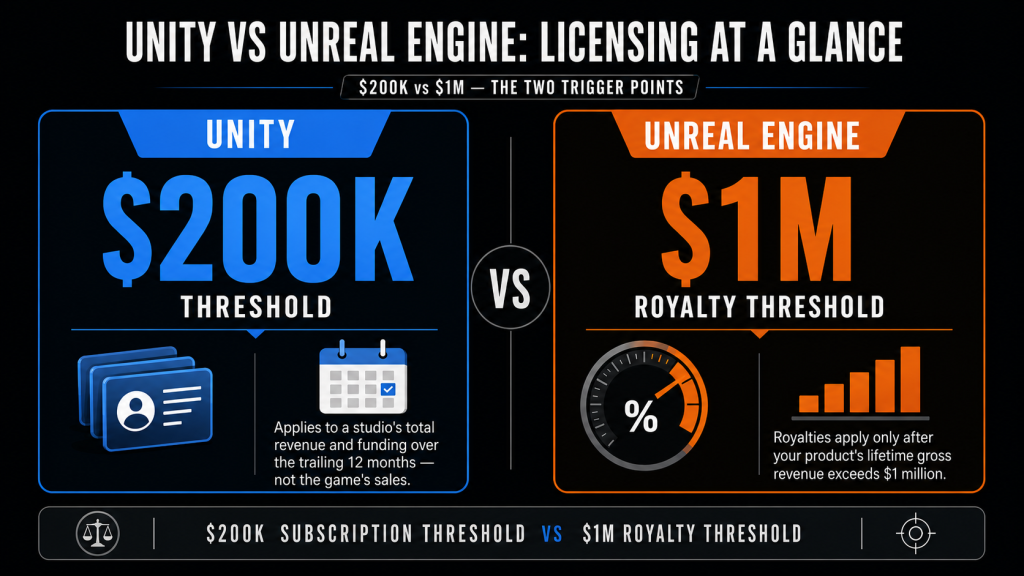
| Criterion | Unity | Unreal Engine |
| Free tier ceiling | <$200K annual revenue + funding combined | No ceiling for development; games pay nothing until $1M lifetime revenue |
| What triggers a fee | Studio’s revenue/funding crosses a threshold | The specific product’s lifetime revenue crosses $1M |
| Fee structure | Flat subscription per developer seat | Percentage royalty on revenue above the threshold, reported quarterly |
| Standard paid rate | $2,310/seat/year prepaid annually ($2,520/year on the monthly plan) | 5% of royalty-eligible revenue after the $1M lifetime exclusion |
| Reduced rate available | No | 3.5% via Launch Everywhere with Epic — requires ongoing store parity, not just a launch date |
| Store-specific exemption | None | Epic Games Store revenue excluded from royalty calculation (separate from EGS’s own storefront cut) |
| Non-game commercial use | Unity Industry, custom pricing above $1M finances | Depends on Royalty Product classification; seat license $1,850/seat/year applies to non-runtime-distributed use above $1M revenue |
| 2026 pricing change | Pro and Enterprise +5%, effective Jan 12, 2026 | No change to the royalty structure |
| Cost scales with | Team size (number of seats) | Product revenue |
A One-Year Crossover Example for a Five-Seat Team
Because the two models scale on different variables, “which engine is cheaper” only has an answer once specific assumptions are fixed — team size, subscription plan, how many years the team has been paying, and how the game’s revenue is distributed across stores. What follows is a one-year snapshot for one specific scenario, not a permanent break-even point.
Take a five-person team on annually prepaid Unity Pro. Fixed licensing cost for that year: 5 × $2,310 = $11,550. For Unreal’s royalty on a comparable game to reach that same $11,550 in a single year, revenue above the $1 million threshold would need to hit $11,550 ÷ 0.05 = $231,000 — meaning the game would need roughly $1.23 million in lifetime revenue for that year’s royalty to match what the five-seat Unity team already owes annually, win or lose.
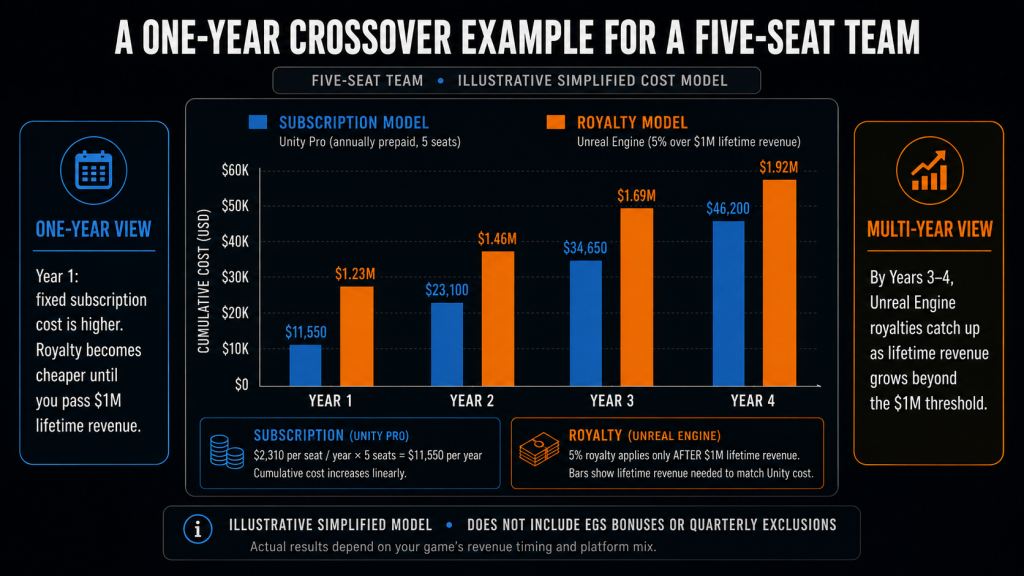
“Editorial illustration created for visual reference purposes. It does not represent a real project, client work, or official software screenshot unless stated otherwise.”
That $1.23 million figure isn’t fixed, though — it moves as Unity subscription costs accumulate over additional years, while Unreal retains the same one-time $1 million lifetime exclusion:
| Years on Unity Pro (5 seats, prepaid) | Cumulative Unity cost | Unreal revenue needed to match that cost in cumulative royalty |
| 1 year | $11,550 | ~$1.23M lifetime |
| 2 years | $23,100 | ~$1.46M lifetime |
| 3 years | $34,650 | ~$1.69M lifetime |
| 4 years | $46,200 | ~$1.92M lifetime |
This is a simplified model that assumes no quarterly exclusions, no Epic Games Store revenue mix, no Launch Everywhere rate reduction, and no custom licensing terms on either side — all of which shift the real numbers for an actual production. Treat it as a way to see how the comparison behaves, not as a substitute for running your own team’s actual seat count, plan, and revenue forecast through the math.
The Variable Most Budget Comparisons Skip: Headcount vs Revenue
This is the detail that most engine cost comparisons flatten into a single “5% vs subscription” line, and it’s the one that actually determines which engine fits a given studio.
Unity’s cost is a function of how many people are building the game, not how well it sells. A twelve-person art and engineering team on annually prepaid Unity Pro pays $27,720 a year in licensing before a single unit ships — and keeps paying it through every year of a multi-year production, regardless of whether the title ever crosses $200,000 in revenue. For a studio with a large team and a long, uncertain path to release — common in mid-core and AAA production — that fixed cost compounds across the entire development cycle.
Unreal’s cost is a function of how much the finished product earns, not how many people built it. A two-hundred-person AAA team ships a game on Unreal Engine and pays nothing until that specific title crosses $1 million lifetime — team size never enters the calculation. The risk profile inverts: a studio can never owe Unreal more than 5% of the revenue above threshold, so the fee is always proportional to commercial success, but a breakout hit generates a royalty bill that scales without a ceiling, and that bill compounds every quarter the game keeps earning.
Neither structure is categorically cheaper, and the crossover table above shows why: the answer depends on team size, how many years the team stays on a paid Unity tier, distribution mix across stores, and whether either side qualifies for a reduced rate or custom terms. A well-funded team with a long production runway and uncertain commercial outcomes often does better under Unreal’s revenue-gated model for the early years of development. A lean team building toward a title expected to earn well past the multi-million mark, for many years post-launch, may find Unity’s flat per-seat cost becomes the smaller cumulative number over time. This is precisely the kind of calculation a producer building a project budget needs to run against the studio’s actual headcount, timeline, and revenue projection — not a generic industry rule of thumb.
What This Means for a Mid-Core/AAA Production Budget
Engine licensing sits as its own line item, separate from art production spend, and the two scale independently of each other. A studio’s art budget is typically driven by asset count, fidelity target, and outsourcing model rather than which engine the assets ship into; our breakdown of how budget and team size shift across indie, AA, and AAA production covers how that art spend scales by tier — commonly estimated at a substantial share of total development cost, though the exact proportion varies by genre, live-service model, and how much production is outsourced. Engine licensing sits alongside that spend as a fixed or revenue-linked cost depending on which engine the production has chosen.
What changes at each tier is how much the engine fee actually matters relative to everything else being spent. An indie team on Unity Pro paying $2,310 a year for a single seat is a meaningful line item against a $200,000 total budget. At the other end of the scale, a large AAA production with a commercially successful, high-grossing title can still see its Unreal royalty become a material line item in absolute dollars, even if it’s small relative to total development spend — the royalty scales with success, so the better the game performs, the larger that specific number gets, which is worth modeling against expected gross revenue rather than assuming it disappears at scale. Licensing trade-offs are often especially visible in mid-core and AA budgeting, where seat count is large enough to matter but commercial outcomes remain genuinely uncertain — though the same calculation is worth running at indie and AAA scale too, for different reasons in each case.
Where This Fits in the Broader Engine Decision
Nothing above is an argument for choosing an engine on cost alone, and licensing is only one input into that decision. For the full picture — how Nanite and Lumen change the art pipeline, how hiring pools differ between Unity’s C# base and Unreal’s C++ core, and how the two engines compare on a production-matrix level — our AAA production guide to Unity vs Unreal Engine 5 covers the decision end to end, with licensing as one section among several. This piece exists to go deeper on that one section: the actual cost math, the EULA mechanics behind it, and how the comparison moves depending on team size and time horizon. The two are meant to be read together, not as competing answers.
How Nasty Rodent Works Across Both Engines
Licensing structure doesn’t change how art gets produced or delivered — a Nanite-ready environment kit or a rigged, engine-integrated character needs to be technically correct regardless of whether the studio pays Epic a royalty or Unity a subscription. Our game art outsourcing services deliver production-ready 3D characters, environments, props, and concept art built to spec for both Unreal Engine and Unity pipelines, scoped around the production’s actual technical requirements rather than a fixed process that assumes one engine. If you’re comparing outsourcing partners alongside your engine decision, our roundup of game art outsourcing companies covers how to evaluate vendors on criteria beyond a portfolio review.