3D Character Cost Breakdown: What Indie, AA, and AAA Budgets Actually Buy
-

Written by Denys Zadoienyi
-

Updated on31.07.2026
-

Time to read12 min

Search “how much does a 3D character cost” and the honest answer looks unhelpful at first: anywhere from $150 to $40,000. Part of that spread is two different markets getting counted as one. At the very low end, template-based and marketplace-derived assets – pre-made models adapted rather than built for your project – can run $150–300. That’s a real, legitimate option for some projects, but it’s not what this breakdown covers, and we won’t mix it into the numbers below. At $40,000+, you’re generally looking at a bespoke AAA hero asset with a high-fidelity modeling and texturing scope – facial rig systems, complex grooming, additional costumes, and deeper engine integration can push the total further depending on the brief. Both get called “a 3D character.” This breakdown is about the second kind: custom, production-ready work built for your project.
“Editorial illustration created for visual reference purposes. It does not represent a real project, client work, or official software screenshot unless stated otherwise.”
This breakdown exists to answer the question that actually matters: for a custom, production-ready character – not a marketplace asset – what does tier, narrative role, and complexity do to the price. Not “hire vs. outsource” – that’s a separate production-risk decision covered in our guide to hiring a 3D artist vs. outsourcing to a studio. This is about the number itself, and – just as important – what scope that number is attached to. The ranges below are broad planning bands, not market averages or a Nasty Rodent rate card – publicly quoted character prices vary substantially because studios package concept work, rigging, grooming, revisions, and engine integration differently, so treat these as a starting point for your own budget conversation, not a quote.
What Actually Sets the Price
Most quotes are shaped by five broad categories, and they interact rather than stack cleanly. None of them is a specification by itself – two AAA projects can assign very different budgets to the same narrative role depending on how these combine.
- Production tier. Indie, AA, and AAA are useful shorthand for expected fidelity, approval depth, and technical integration – not a fixed price bracket. A well-produced AA hero can cost more than a lean AAA background asset; tier sets a production standard, not a guaranteed number.
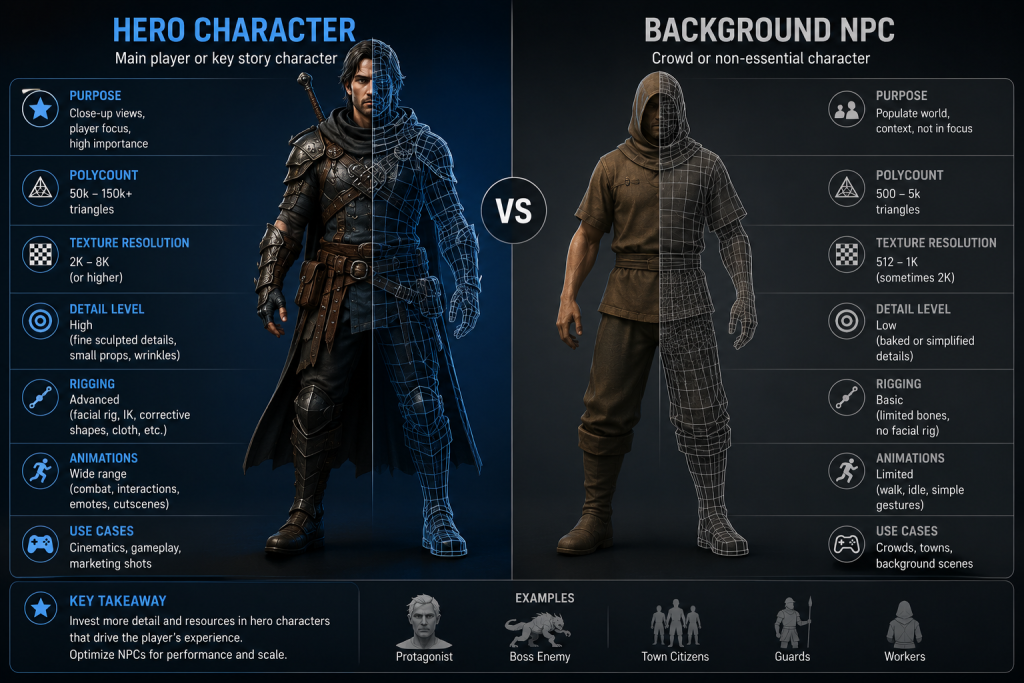
- Narrative role. A hero character carries close-up camera time, marketing renders, and cinematic scrutiny. A background NPC exists to populate a scene at a distance. The production budget follows that visibility, not the character’s technical difficulty in isolation.
- Complexity factors. Stylized vs. realistic rendering, hair and fur treatment, the number of costume or skin variants, and target texture resolution each add production hours, though – as the breakdown below shows – not always in the direction people assume.
- Delivery and pipeline requirements. Target engine, whether the character uses an existing project skeleton or needs a new one, facial animation needs, modularity, LOD count, source-file ownership, and the number of review rounds. This is often what actually separates a “finished-looking model” from a production-ready character – and it’s frequently the least visible line item in a quote.
- Where the work is done. Studio location and team structure shift hourly rates – publicly quoted rates often trend higher in North America and Western Europe than in Eastern Europe or parts of Asia, though overlap is substantial. This is a real line item, not a red flag by itself; it becomes a red flag only when a quote doesn’t disclose it.
“Editorial illustration created for visual reference purposes. It does not represent a real project, client work, or official software screenshot unless stated otherwise.”
Cost Breakdown by Project Tier
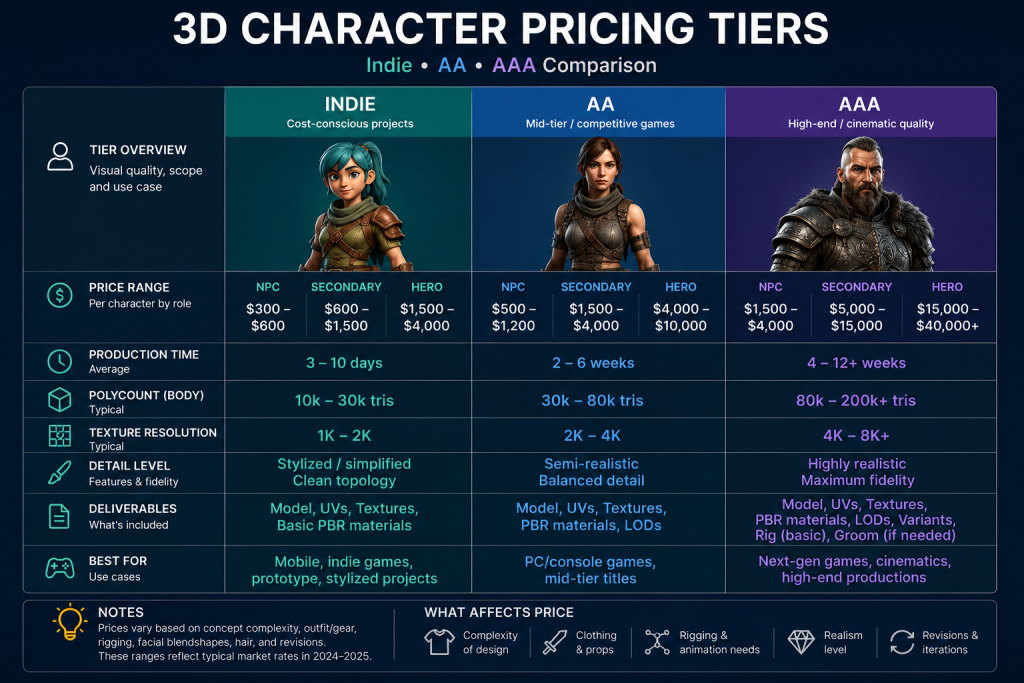
The clearest way to see how these variables compound is to hold role constant and move tier. This table covers bespoke, custom-production characters only – not the marketplace/template segment mentioned above. For comparability, the ranges assume a game-ready character covering modeling, retopology, UVs, baking, and texturing. Facial rigs, strand-based grooms, animation, additional costumes, and full engine integration are frequently priced separately – whether they’re bundled depends on the vendor, so confirm scope per quote rather than assuming it matches the table:
| Project Tier | Background NPC | Secondary Character | Hero Character |
| Indie | $300 – $600 | $600 – $1,500 | $1,500 – $4,000 |
| AA | $500 – $1,200 | $1,500 – $4,000 | $4,000 – $10,000 |
| AAA | $1,500 – $4,000 | $5,000 – $15,000 | $15,000 – $40,000+ |
A few things worth reading carefully in this table. First, the ranges overlap across tiers – a well-produced AA hero can cost more than a lean AAA background asset. Tier sets a production standard, not a fixed number. Second, the lower end of each range reflects a deliberately constrained scope. At the $300–600 end of Indie Background NPC, for example, “bespoke” means a locked concept, simple topology and materials, minimal revision rounds, no rig, no grooming, and no engine integration – a narrow scope that shouldn’t be read as what a typical full-cycle studio NPC costs. The upper end of each range reflects the fuller custom scope described above.
Third, and worth being precise about: the ratio between roles isn’t constant across the table. Secondary-to-hero within a given tier runs roughly 2–3x (AAA secondary $5,000–15,000 to AAA hero $15,000–40,000+), though that consistency shouldn’t be read as a reliable predictive multiplier – the ranges themselves overlap across tiers, and individual quotes vary with facial work, grooming, and review depth. Background-to-hero is a much wider gap that grows with tier – roughly 5–8x at indie and AA, approaching an order of magnitude at the high end of AAA – because a hero character isn’t just “a more detailed NPC,” it’s a different scope entirely: cinematic scrutiny, marketing renders, and a level of approval scrutiny a background asset never sees. There’s no single reliable multiplier here; camera time and approval depth matter more than any fixed ratio.
For teams scoping a full character roster rather than a single asset, this is also where budget planning gets more tractable: once you know your tier and your role mix (how many heroes, how many secondary characters, how many NPCs), the roster becomes modelable as a weighted asset mix – a first-pass budget that then gets adjusted for reuse, shared rigs, variant counts, and review overhead, rather than an unstructured guess.

Cost Breakdown by Complexity Factor
Tier and role explain most of the variance. The remainder comes from complexity factors that layer on top of a base quote – and several of them don’t move price in the direction people assume.
- Stylization vs. realism. The common assumption is that stylized costs less than realistic. That’s not reliable. Realism does add lookdev cost – subsurface scattering setup, pore-level texture detail, and the extra passes needed before skin reads correctly under real-time lighting rather than a single beauty render. But stylization isn’t a shortcut: it trades that cost for a different one. A disciplined stylized character requires its own invented shape language, silhouette testing at multiple distances, a defended color script, and – if the pipeline uses non-photorealistic rendering – specialized shader work that’s genuinely scarce to hire for. A highly authored stylized hero can cost as much as a realistic one, or more. Our breakdown of stylized character art direction covers what actually drives that cost. Style alone isn’t a reliable pricing shortcut in either direction.
- Rigging depth. Rigging is sometimes bundled into a full-cycle character quote and sometimes priced as a separate line – this varies by vendor, and it’s worth confirming rather than assuming either way. At minimum, clarify whether a quote covers a skinned mesh on an existing skeleton, a new deformation skeleton, animator controls, facial blendshapes, or engine-side retargeting – these are meaningfully different scopes of rigging work, not one line item.
- Hair and fur treatment. Card-based hair (textured planes arranged to suggest volume) is generally more predictable and performance-friendly than strand-based grooming, but production-quality card placement, texture work, LODs, and engine validation still represent a real part of a character’s budget – not a rounding error. Strand-based grooming, used on hero characters where hair needs to read as individual strands under close camera, is a more specialized skill with its own render-cost implications, and studios that offer it typically price it as a distinct line.
- Costume and skin variants. These are not one line item – they’re two different scopes that get conflated. A recolor or material-only variant (same geometry, new textures) is a comparatively light addition. A new costume with different geometry is a different job: modeling, retopology, UVs, baking, skinning to the existing skeleton, clipping checks, and sometimes new cloth or secondary-motion setup. Teams planning multiple skins for a character – common on live-service titles – should ask which type of variant they’re scoping before assuming a flat per-variant rate.
- Texture resolution. Resolution alone is a weaker cost predictor than it looks. Exporting an existing texture set at 4K instead of 2K adds little work by itself. What actually drives cost is the number of unique texture sets or UDIMs, the surface fidelity required, material complexity, and whether the asset needs to hold up under extreme close-ups or cinematics. A hero character doesn’t cost more because it’s “4K” – it costs more because it typically needs more unique, high-fidelity surfaces, which resolution happens to accompany.
What a Per-Asset Quote Should Actually Include
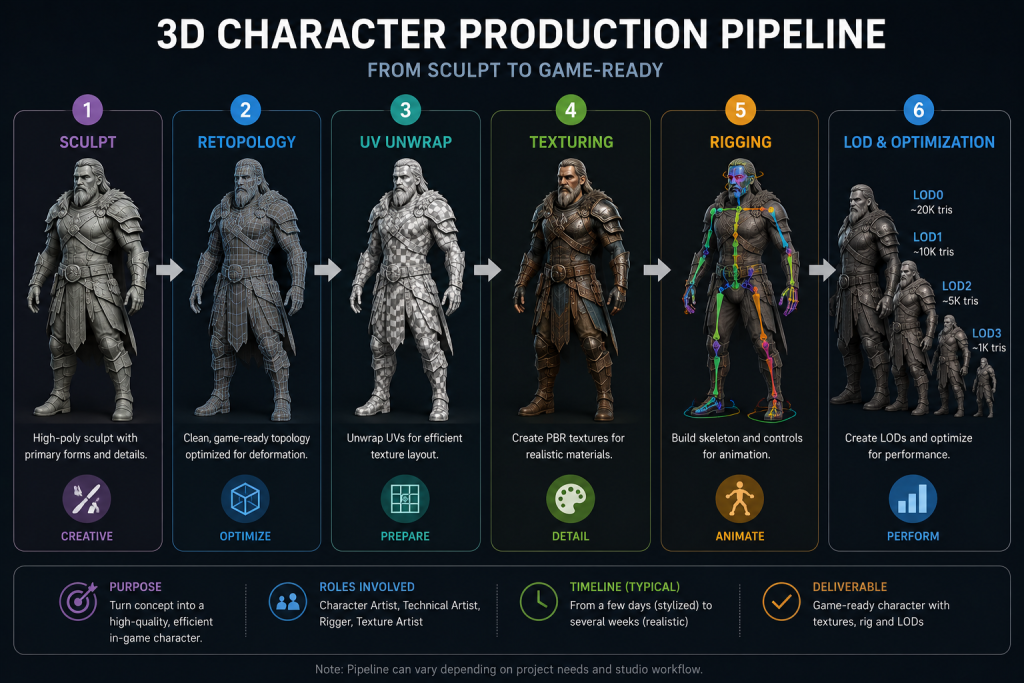
For anyone evaluating vendor quotes rather than producing in-house, the number on the invoice matters less than what’s inside it. A vendor quote should clearly state coverage for: high-poly sculpt, retopology to a game-ready mesh, UV layout, normal map baking, PBR texturing and material setup, and – where relevant – rigging and skinning, LOD (level of detail) generation, and in-engine import validation. Rigging in particular is worth confirming explicitly rather than assuming – some vendors bundle it into the base character price, others quote it separately. We’ve walked through this full sequence stage-by-stage, with the failure points at each one, in our UE5 character pipeline breakdown – a useful cross-check when a quote skips straight from “sculpt” to “final delivery” without naming what happens in between.
“Editorial illustration created for visual reference purposes. It does not represent a real project, client work, or official software screenshot unless stated otherwise.”
The stages that most often get silently dropped from a lowball quote are retopology (sometimes delivered as an unoptimized high-poly export that won’t run in-engine), baking validation (skipped as a separate pass, with bake artifacts only surfacing under in-engine lighting), and LODs (assumed to be the studio’s problem to generate later, at additional cost). None of these omissions are always intentional – but all three are worth confirming explicitly before a number gets compared against a competing quote, because two quotes with the same dollar figure can represent very different scopes of finished work.
It’s also worth noting that character modeling doesn’t happen in isolation from the stage before it. A character brief with clear concept art – orthographic views, material callouts, silhouette reference – tends to produce fewer revision cycles during 3D production, which is one of the more controllable levers a producer has over the final cost of a character that looked simple on paper but turned into three rounds of rework once modeling started.
Budgeting a Full Character Roster
A single character’s cost is useful for a spot-check. A production budget needs the roster view: how many hero characters, how many named secondary characters, and how many background NPCs a game actually needs, multiplied against the tier’s per-role ranges above.
This is also where prioritization pays off more than negotiating a lower unit rate. The most reliable way to control a character roster budget isn’t to compress every character’s price – it’s to be explicit about which characters are hero-tier and which are background-tier before production starts, and to hold that line during scope discussions. A background NPC that quietly gets treated like a hero character partway through production – extra revision rounds, upgraded texture resolution, a costume variant nobody budgeted for – is the single most common way a character roster line item runs over. The same tier-and-complexity logic scales beyond characters, too; our breakdown of 3D props production for AAA games covers the equivalent hero-vs-environmental distinction for props, and the budgeting discipline is nearly identical.
Regional Rate Differences
Studio location remains one of the larger, least-discussed variables in a 3D character quote. Publicly quoted rates often trend higher for specialists based in North America and Western Europe than for studios operating from Eastern Europe or parts of Asia, but the ranges overlap substantially – seniority, studio overhead, art direction depth, and QA process usually affect the final quote more than geography alone.
Geography is also an unreliable quality predictor by itself. A European full-cycle studio and a North American freelancer can both be the right choice for the same brief – the deciding factor is whether the deliverable matches what the production actually needs, not which region issued the invoice.
About Nasty Rodent
Nasty Rodent is a game art outsourcing studio based in Tallinn, Estonia, working across 3D character production, environments, props, concept art, and UX/UI for mid-core and AAA titles. Character pricing conversations at Nasty Rodent start from the same tier-and-role framework laid out above – production is scoped by narrative importance and complexity, not a flat per-character rate, which is what keeps hero characters getting hero-level attention and background rosters staying on budget.
Studios evaluating a production partner can review recent work across realistic and stylized character pipelines in the portfolio.