Stylized Game Art Vendor Selection: Portfolio, Paid Tests, and Production Fit
-

Written byDenys Zadoienyi
-

Updated on21.07.2026
-

Time to read12 min

- Two Different Reasons the Evaluation Criteria Shift
- Vetting a Stylized Portfolio: When Breadth Matters and When It Doesn’t
- How to Structure a Paid Test for a Stylized or Casual Vendor
- AI Governance: What to Actually Ask
- What Actually Drives Stylized and Casual Outsourcing Cost
- Where Evaluation Weight Actually Shifts, by Project Condition
- Where This Fits in a Broader Vendor Selection Process
How to choose a stylized game art outsourcing studio depends on separating two things that get bundled together in most procurement conversations: the visual target and the production model. Stylized describes an art direction — cartoon, semi-realistic, hand-painted, low-poly. Casual describes a market and gameplay segment, mobile describes a platform, and live ops describes an operating model. They often overlap, especially in mobile live-ops production, but each affects vendor evaluation differently — through content cadence, technical constraints, asset volume, and revision speed — and treating them as one category is how a scorecard ends up asking the wrong questions of the wrong vendor.
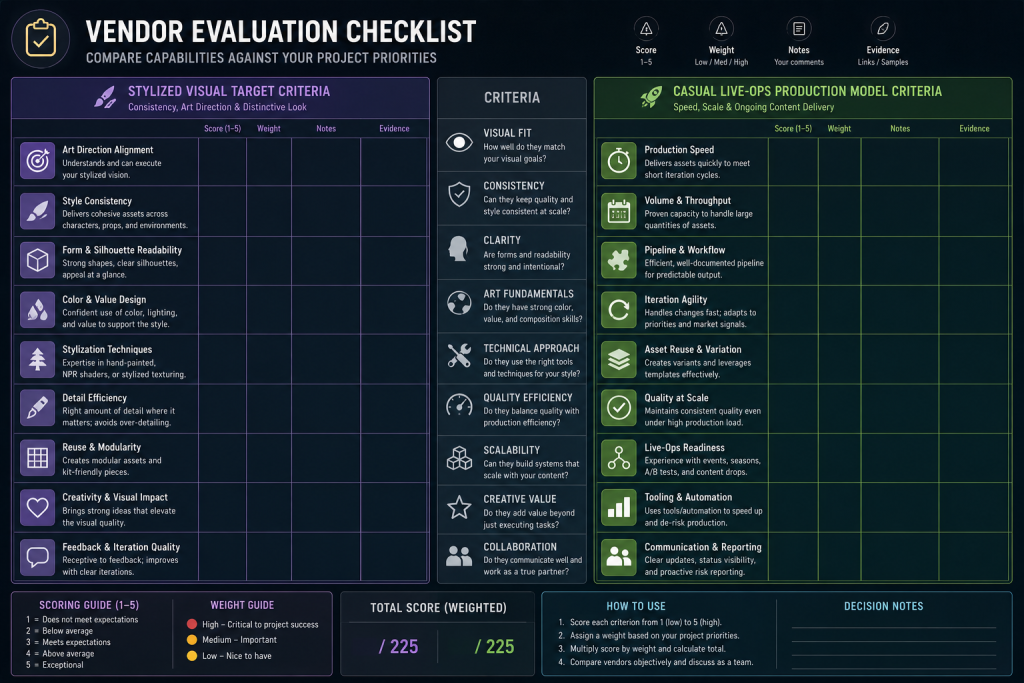
“Editorial illustration created for visual reference purposes. It does not represent a real project, client work, or official software screenshot unless stated otherwise.”
This guide assumes the decision to outsource is already made — if that’s still open, the in-house vs outsource framework covers it separately. What follows starts from the point where you’re evaluating specific vendors for a stylized brief, a casual production, or a project combining both, and need to know what to check that a generic scorecard won’t surface.
Two Different Reasons the Evaluation Criteria Shift
A weighted scoring framework for game art outsourcing vendor selection already exists on six criteria, calibrated for a context where technical pipeline alignment and process maturity carry the heaviest weight — a reasonable default for a high-fidelity realistic brief, but not a complete picture once the brief is stylized, casual, or both. Two separate variables are doing the work here, and it’s worth keeping them apart rather than folding both into a single “casual/stylized vs. AAA” axis:
A stylized visual target changes which artistic capabilities need verifying. Register match, hand-authored surface control, and consistency against project-specific style rules move up in priority — not because stylized work is inherently simpler, but because physical reference alone cannot validate a project-specific stylized language the way it often helps validate realistic work.
A casual or live-ops production model changes delivery cadence and staffing requirements. Seasonal content, rapid variant production, and short revision windows increase the weight of turnaround speed and scalable staffing — but this applies specifically to projects actually running on a live-ops or high-volume cadence, not to every casual or mobile title by default. A premium mobile title on a slower, milestone-based release schedule doesn’t need this weighting shift; a live-service PC title with frequent content drops does, regardless of how realistic or stylized its art direction is.
Neither of these automatically implies low fidelity, a smaller production scope, or a lower price. Both should supplement — not replace — the technical pipeline compatibility and process maturity the existing scoring framework already covers.
Vetting a Stylized Portfolio: When Breadth Matters and When It Doesn’t
Portfolio review for a stylized brief needs a different question than “is this good.” The right question depends on the shape of the engagement. For a project spanning multiple titles or an evolving visual target — a publisher commissioning work across several live-ops games, for instance — a vendor’s ability to work convincingly across the distinct stylized registers the engagement actually requires, with equal discipline, is a genuinely predictive signal. A portfolio that sits entirely in one narrow register is a real limitation there. For a single-title production with a locked art bible, the opposite is often true: proven depth in the exact target register outweighs broad range, and a generalist vendor with thin work in your specific style is a weaker fit than a specialist with less overall breadth.
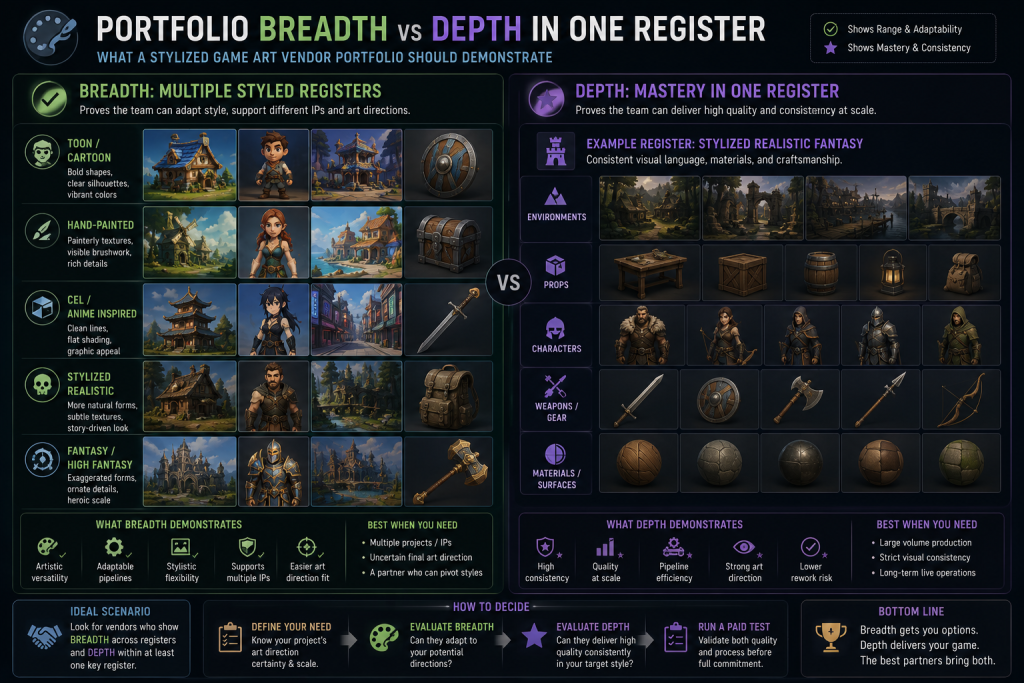
“Editorial illustration created for visual reference purposes. It does not represent a real project, client work, or official software screenshot unless stated otherwise.”
Practical checks:
- Match the check to the engagement shape. Multi-title or evolving-style work: ask for shipped projects in more than one register. Single-title, locked-style work: ask for the deepest available body of work in that exact register, and treat volume in unrelated styles as background context, not a qualifying signal. A hiring-manager perspective from ArtStation Magazine’s portfolio review coverage makes a version of this point about individual artists that applies to vendor portfolios too: a portfolio can be technically strong in one register and still be the wrong fit for a brief that needs a different one, or a broader one — strength in a single direction doesn’t predict range, and it shouldn’t be assumed to.
- Separate hand-authored work from procedural-stylized work in the samples you request. A portfolio built entirely on physically based materials pushed toward a stylized look demonstrates a different skill than manually authored color, value, and surface-detail decisions — general PBR competence doesn’t by itself demonstrate hand-painted proficiency, and neither predicts the other.
- Treat the portfolio as a shortlist filter, not a final decision. A paid test, covered below, is what actually confirms whether the studio’s portfolio-level capability holds up against your specific brief and revision process.
How to Structure a Paid Test for a Stylized or Casual Vendor
A portfolio shows peak capability under ideal conditions; a paid test shows how a vendor actually behaves against your brief, your feedback style, and your revision cadence — and for stylized or casual work specifically, a generic test asset misses the things that matter most. A few structural points worth getting right before the test starts:
- Keep it paid and appropriately scoped. Limited enough to avoid becoming unpaid or disguised production work, with a clearly defined schedule and deliverable agreed before it starts.
- Base the brief on the most representative production slice of your actual scope — ideally the hardest part of a typical asset in your target register (a limited hero-character stage such as a blockout, texture sample, or bust; a background prop set that needs to hold a palette across variants), not a generic sample unrelated to the project.
- Confirm who is performing the test. The test should be completed by the artist or pod expected to work on production, or the vendor should disclose upfront when the test team differs from the proposed delivery team — a strong test from a vendor’s best artist tells you little if that artist isn’t the one assigned to your engagement.
- Include one controlled style-change request mid-test. After the first pass, send a single specific note — a palette adjustment, a proportion tweak — and evaluate how accurately and quickly it’s absorbed. This is a useful signal for any stylized engagement, and becomes especially important for casual or live-ops fit specifically, since it tests revision turnaround under realistic conditions rather than just final output quality.
- Check more than the final render. Source-file hygiene, layer structure, naming conventions, and — if relevant — engine import behavior tell you as much about production readiness as the visual result does.
- Settle AI-use policy and IP terms before the test starts, not after. State whether AI-assisted tools are permitted at any stage, and confirm ownership of the test asset and any reference material shared, before work begins.
- Clarify confidentiality and data handling beyond AI specifically. Ask whether subcontractors may be involved, who has access to the brief and source assets, whether the test or later production work may appear in the vendor’s portfolio, and how client material is deleted or retained after the engagement ends.
- Score more than one dimension. A simple scorecard — brief interpretation, first-pass register match, revision response accuracy and speed, file/production hygiene, communication — gives you a comparable basis across multiple vendors instead of a subjective overall impression.
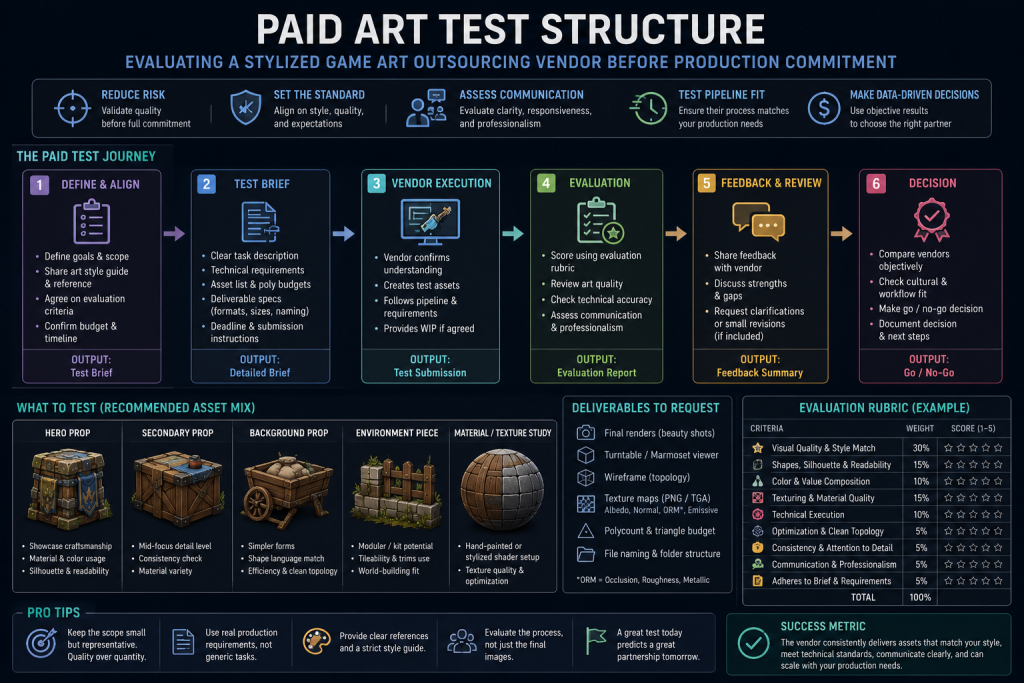
“Editorial illustration created for visual reference purposes. It does not represent a real project, client work, or official software screenshot unless stated otherwise.”
AI Governance: What to Actually Ask
Generative AI use is uneven across the outsourcing market — some vendors use it for research, brainstorming, or early concept exploration; others prohibit it entirely or restrict it to specific pipeline stages; client policies on this vary substantially, and there’s no single industry norm yet. That variation is exactly why it belongs in vendor evaluation as a governance question rather than a yes/no filter.
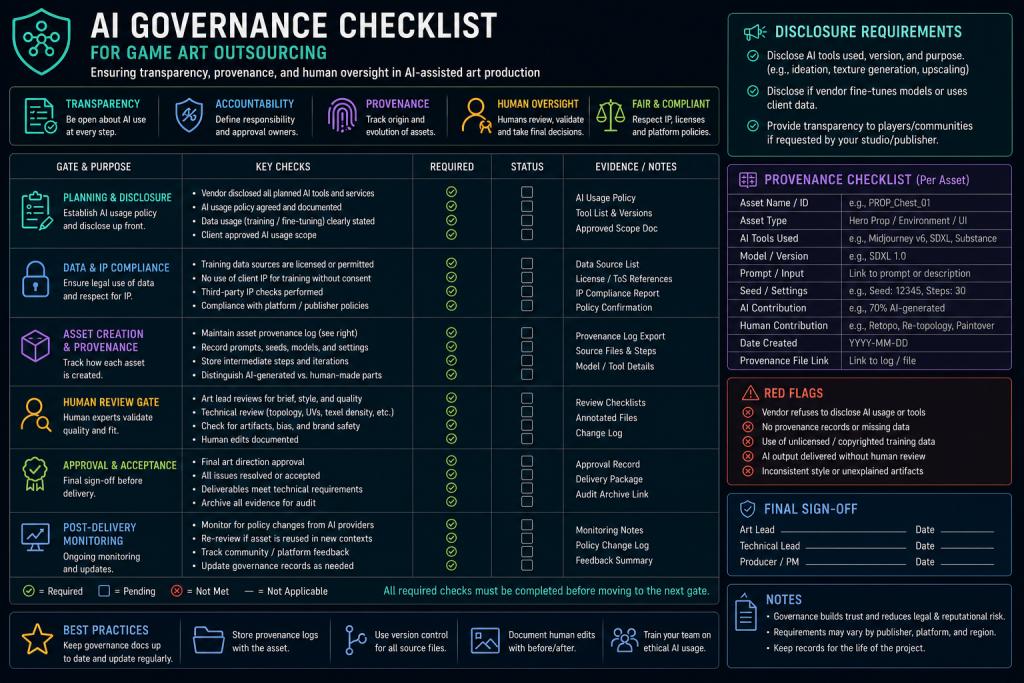
“Editorial illustration created for visual reference purposes. It does not represent a real project, client work, or official software screenshot unless stated otherwise.”
Industry sentiment on generative AI has shifted sharply in a way worth being aware of going into these conversations: the 2026 State of the Game Industry survey, based on responses from more than 2,300 game industry professionals, found that 52% now view generative AI’s impact on the industry as negative — up from 30% the year before and 18% the year before that — with workers in visual and technical art registering the strongest disapproval of any discipline surveyed, at 64%. That data measures sentiment and reported usage, not a direct measurement of output quality or style consistency, so it’s a useful signal about where the industry’s concern is concentrated rather than proof of a specific technical failure mode. The production concern it points toward is real regardless: generative outputs can introduce inconsistency in proportions, motifs, or surface treatment across a batch, which is why the vendor’s human review and correction process — not whether they use AI tools at all — is the actual thing to evaluate.
What’s worth asking a prospective vendor directly:
- Where in the pipeline are AI tools used, if at all, and where are they explicitly excluded?
- What is the human review and correction step before AI-assisted material enters a deliverable?
- What happens to your reference material and briefs if they’re uploaded to third-party AI systems — is there a data-retention or confidentiality policy covering that?
- Can AI use be restricted or prohibited contractually if your project requires it?
- Is AI-generated content disclosed as such, and does that affect deliverable ownership or IP terms?
A vendor who can answer these clearly is showing you a governed process. A vendor who can’t produce a sanitized example of AI-assisted work at an intermediate stage isn’t automatically a red flag on that point alone — NDA and confidentiality obligations to other clients are a legitimate reason to decline — but a written policy covering the questions above is a reasonable minimum to expect regardless.

What Actually Drives Stylized and Casual Outsourcing Cost
Public quotes for character or asset production are difficult to compare directly, because “character production” or “prop set” can mean very different deliverable bundles from one vendor to the next — concept art, high-poly sculpt, retopology, UVs, textures, hair, clothing, rigging, facial setup, LODs, engine integration, and revision allowance are not consistently included or excluded. A number quoted without that scope attached is close to meaningless as a comparison point, regardless of which side of the stylized/realistic line it sits on.
What does reliably move price, independent of the stylized/realistic label:
- Geometric and material complexity — how much detail the brief actually requires, not what the visual style implies by reputation.
- Reference-matching precision — how tightly the result has to match an approved concept, licensed IP, or established character proportions versus how much interpretive latitude the vendor has.
- Rigging, facial setup, and animation scope, if included.
- Revision allowance — how many rounds are built into the quote before additional scope applies.
- Engine integration and validation work, and how much of it the vendor owns versus your internal team.
When a stylized brief genuinely reduces geometric complexity, material fidelity requirements, or the need for exact physical reference matching, the resulting quote can fall below a realistic asset with an otherwise comparable deliverable list — but that’s a scope-to-scope comparison, not a rule that the word “stylized” predicts a lower price on its own. A stylized quote that lands close to a high-fidelity realistic quote for a comparable deliverable list isn’t automatically overpriced — senior team composition, a tight deadline, complex custom shader work, or a heavy revision allowance can all justify it. Treat a surprising quote, in either direction, as a reason to review scope and staffing assumptions with the vendor, not as an automatic accept or reject signal.
Where Evaluation Weight Actually Shifts, by Project Condition
Rather than a fixed “casual/stylized vs. realistic AAA” split, the table below maps specific project conditions to what deserves more evaluation weight — several of these can apply to the same project at once.
| Project condition | Increase weight on |
| Multiple titles or an evolving visual target | Portfolio adaptability across registers |
| Single title with a locked art bible | Exact register match and proven depth in that register |
| Live-ops or high-volume content cadence | Revision turnaround and scalable staffing |
| High-fidelity hero assets or licensed IP | Senior art direction involvement and stage-gate review quality |
| Hand-authored visual target | Painted color/value control and batch-level consistency |
| Procedural or reusable material pipeline | Material-system design and parameter governance |
| Mobile technical constraints | Optimization discipline, texture budgets, device validation |
| Custom NPR or stylized shader work | Shader, mesh-normal, and lighting validation |
Where This Fits in a Broader Vendor Selection Process
The checks above sit inside, not instead of, the general vendor selection process — use them to adjust the weighting of the existing RFP scoring framework for a stylized or casual brief, rather than replacing its technical pipeline and process-maturity criteria. Where custom shader work — NPR, cel-shading, non-standard normal or lighting treatment in Unity or Unreal — is central to the target style, a vendor’s ability to own that rendering pipeline is itself a technical criterion worth confirming early, not just an art-direction nicety; it’s worth surfacing during the portfolio and paid-test steps above rather than assumed from general stylized experience. Once a vendor is selected, the onboarding protocol for the first weeks of the engagement is where the art bible discipline and revision process you tested for gets confirmed at production scale. And for character-heavy stylized work specifically, the production-grade art direction principles for stylized 3D characters cover the rendering-stack and style-consistency questions — including the NPR/PBR/hybrid decision itself — in the depth this article doesn’t repeat.
At Nasty Rodent, we approach stylized game art outsourcing production by scoping a stylized or casual engagement as a set of distinct questions — target visual register, hand-authored texturing requirements, technical pipeline, asset volume, revision cadence — rather than treating “stylized 3D” as a single generic capability.

Let's work
together


in mind?
From 3D characters and environments to weapons, props, concept art and game UI/UX: ten years deep, 40+ artists strong, zero fluff. Tell us what you are making and get a free, no-pressure estimate.
estimate