Maintaining Visual Consistency Across an AAA Production Pipeline
-

Written byDenys Zadoienyi
-

Updated on22.07.2026
-

Time to read22 min

- What Is Visual Consistency in an AAA Production Pipeline?
- Why Generic Style Guides Don’t Prevent Drift
- The Governance Layer: What Happens After the Documents Already Exist
- The Review Gate System: Where Drift Actually Gets Caught
- The Technical Art Bridge: Where Consistency Meets the Engine
- Multi-Studio Governance: Consistency Across More Than One Vendor
- What Inconsistency Actually Costs a Production
- Auditing Visual Consistency Mid-Production: A Recovery Protocol
- Case in Miniature: Character Cast Consistency at Scale
- A Practical Checklist: Gates, Owners, Artifacts
- Change Management: Keeping Documentation and Reality in Sync
- How We Work at Nasty Rodent
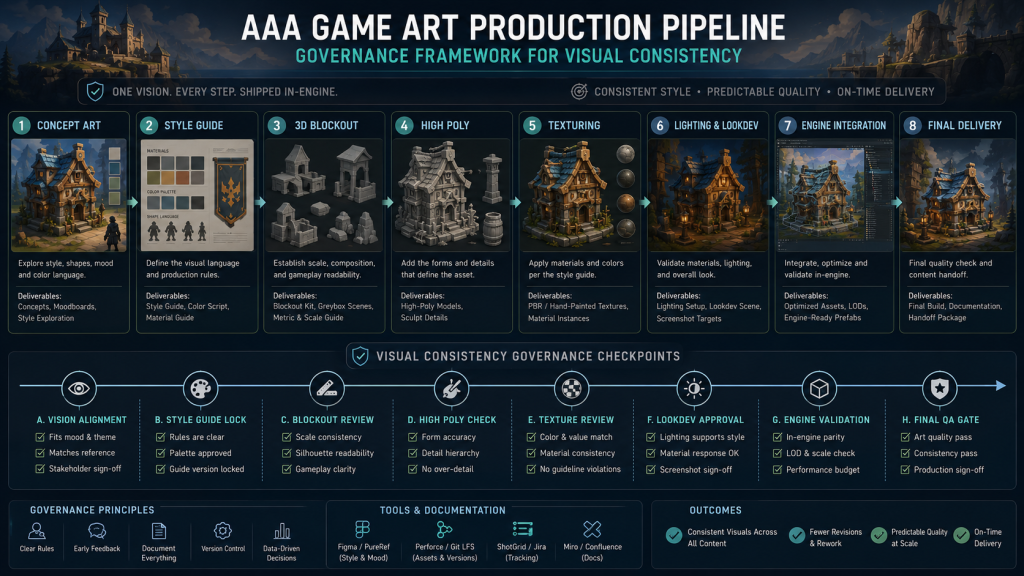
Visual consistency across the AAA production pipeline is not something a style guide produces on its own – it’s the output of a governance system that catches drift at specific checkpoints, before it compounds across hundreds of assets and multiple teams. Most studios already own the pieces of that system: an art bible, a style guide, a review process. What’s usually missing is the connective structure that ties those pieces into gates that actually get enforced, department by department, vendor by vendor, from the first concept sketch to the last asset that lands in the final build.
“Editorial illustration created for visual reference purposes. It does not represent a real project, client work, or official software screenshot unless stated otherwise.”
This matters because the failure mode is rarely dramatic. No single asset looks wrong in isolation. A character reads fine on its own. An environment passes review. A prop ships on schedule. Then someone lines up the vertical slice – character, environment, props, UI, lighting – and the world doesn’t cohere. Every individual decision was locally reasonable; the aggregate wasn’t governed. If you are an art director staring at a vertical slice that doesn’t hold together, the problem often traces less to individual artist skill than to a gate that didn’t exist, or existed on paper but wasn’t enforced at the moment it mattered.
This guide covers the governance system itself: the documentation layer that defines what “consistent” means for a specific project, the review gates that catch drift before it’s expensive to fix, the structure required when more than one team – internal or external – is producing against the same visual target, and the practical checklist that turns all of this from a philosophy into something a producer can actually track on a schedule.
What Is Visual Consistency in an AAA Production Pipeline?
Visual consistency in an AAA production pipeline is the discipline of keeping every asset – across concept art, 3D characters, environments, props, weapons, UI, and final engine lighting – aligned to a single documented visual target, verified at defined checkpoints rather than assumed at delivery. It is a production system with owners, artifacts, and gates, not a stylistic preference applied after the fact.
That definition matters because “consistency” gets used loosely in production conversations, usually to describe a feeling rather than a measurable state. A useful test: if you can’t point to the document a given asset was checked against, and the gate at which it was checked, you don’t have a consistency system – you have hope. AAA-tier teams that ship coherent worlds run the discipline described in this guide as a continuous process, not a checklist satisfied once at pre-production and never revisited.
Why Generic Style Guides Don’t Prevent Drift
A style guide is necessary and insufficient. It defines the rules – palette ranges, proportion ratios, material tiers, silhouette principles. What it doesn’t do is enforce that every artist interpreting those rules converges on the same output, and at AAA volume, that gap is where drift lives.
Three structural reasons commonly cause this on projects without active governance:
Interpretation variance compounds with headcount. A five-person internal team absorbs style intuition through daily proximity – shared references, hallway conversations, the art director walking past a monitor and correcting course in real time. That informal transmission doesn’t scale past a certain team size, and it doesn’t transmit at all across a studio boundary. An outsourced vendor, or even a second internal team working in a different office, has no access to the tacit knowledge that made the style guide feel unnecessary for the original core team.
Reference decay happens silently. A color standard or silhouette rule validated at milestone two becomes the implicit reference for milestone three without anyone formally re-verifying it. By milestone four, the working reference has drifted from the documented one enough to be visible in a side-by-side comparison – but by then, tracing the drift back to a specific decision point is difficult, and the fix touches every asset produced in between.
Review happens per-asset, not per-system. Most production QA checks whether an individual asset meets spec. Far fewer productions run a standing check for whether the asset holds up next to the rest of the cast, the rest of the environment kit, or the rest of the vendor pool’s output. An asset can pass every individual review gate and still be the one that breaks the world’s coherence, because nothing in the process compared it laterally.
Directing a team is a different discipline than directing your own hand. A solo artist faces fewer coordination-driven consistency problems, because most style decisions pass through the same judgment. The moment a project scales past one person, style stops being something an artist expresses privately and becomes something a director has to communicate, defend, and re-communicate as the team grows. Veteran art director Ron Ashtiani, whose credits span AAA titles and franchise films including Guardians of the Galaxy, has described this exact transition in an interview with ArtStation Magazine: working alone as an artist is inherently limiting compared to what a director can achieve by developing a visual style and communicating it to a team. His point is broader than production governance specifically, but it illustrates the underlying shift this article is built on: visual direction has to be actively communicated once more than one person is executing it, not assumed to transmit on its own. A formal governance system is what turns that communication into repeatable, checkable production checkpoints.
None of these are artist failures. They’re the predictable result of running production at scale without a governance layer that assumes drift will happen and builds in the checkpoints to catch it early, when the cost of correction is one revision cycle instead of a cast-wide rework.
The Governance Layer: What Happens After the Documents Already Exist
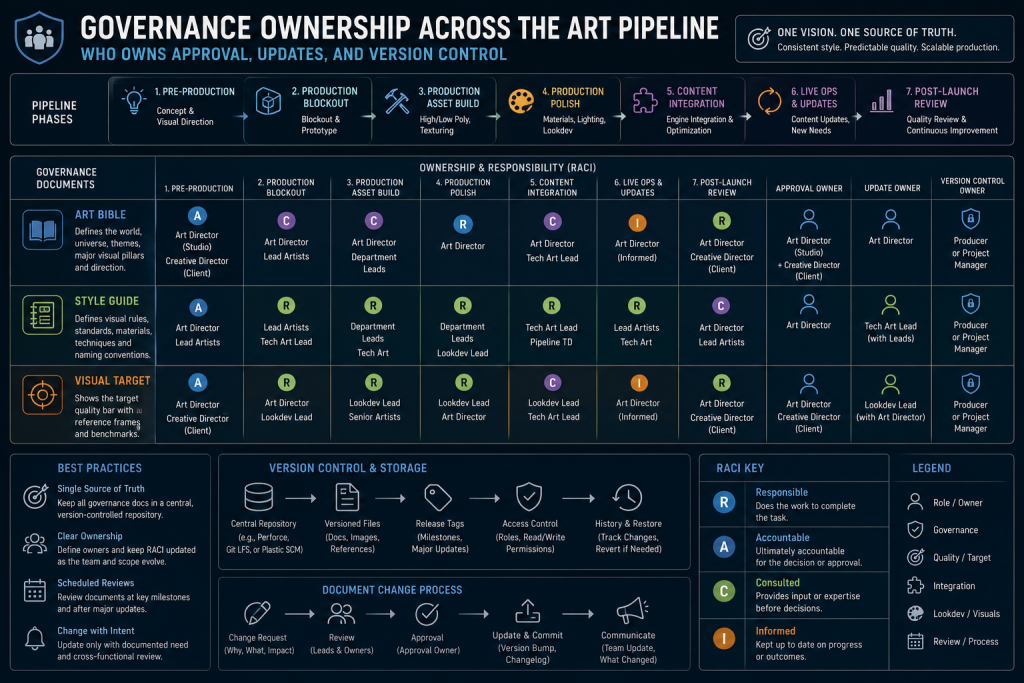
This article assumes the project already has an art bible, a style guide, and at least some approved visual targets – what those documents are and how to build them is its own subject, covered in dedicated production guides on this site. The governance problem starts after those documents exist: who owns them, how a change to any one of them propagates across every team working from it, and at which specific points in production compliance actually gets verified rather than assumed.
“Editorial illustration created for visual reference purposes. It does not represent a real project, client work, or official software screenshot unless stated otherwise.”
That distinction matters because most productions that still drift aren’t missing documentation – they’re missing ownership and propagation rules for documentation that already exists. Three questions expose the gap fast:
| Artifact | Governance question that actually matters |
| Art bible | Who has authority to approve a change to it, and how is that change communicated to every team already building against the old version? |
| Style guide | Who updates the technical standards, and what’s the mechanism for distributing a revision so a vendor two time zones away isn’t the last to know? |
| Visual target | Which specific version is binding for a given vendor at a given milestone – and can anyone point to it, or does it live in someone’s memory of the last review call? |
A production that can’t answer these three questions for its own documents doesn’t have a governance system, regardless of how thorough the documents themselves are. The rest of this guide is about building the answers into the pipeline as enforced checkpoints rather than as assumptions.
The Review Gate System: Where Drift Actually Gets Caught
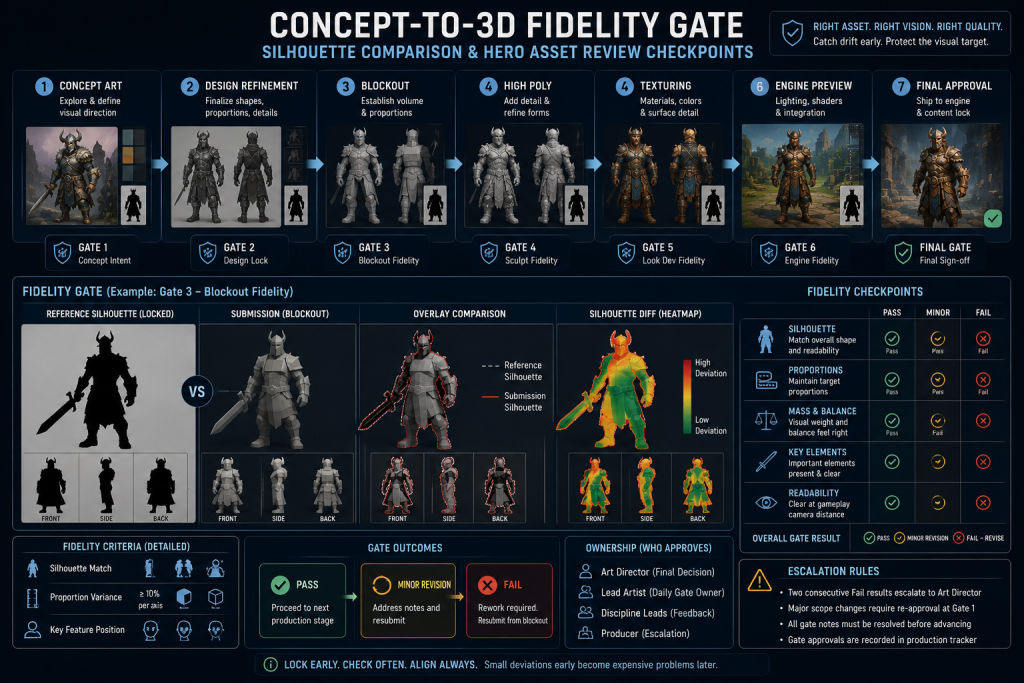
Documentation defines the target. Gates are where the target gets checked against reality, at a point early enough that correction is cheap. A practical consistency framework can be organized around four recurring review types – naming and exact ownership vary by studio, but the categories of drift they exist to catch don’t.
Concept-to-3D fidelity. A structural geometry check – silhouette, proportion, major shape language – before material authoring begins, catching the point where a 3D interpretation drifts toward what feels more comfortable to build rather than what the concept specified. This is the earliest and cheapest place to catch drift; the same correction becomes substantially more expensive once materials and downstream work have been built on top of the wrong geometry.
“Editorial illustration created for visual reference purposes. It does not represent a real project, client work, or official software screenshot unless stated otherwise.”
Lookdev validation. Material, lighting, and rendering checked together against the documented visual target – the stage that determines whether an asset holds up under close review or falls apart at the first pass. We’ve covered the full mechanics of this specific stage – what it checks, how it unfolds across a production pipeline, and where it sits in the concept-to-3D handoff – in our lookdev workflow breakdown. This article treats lookdev as one governed checkpoint inside a larger system; that guide is the right read for the checkpoint’s internal mechanics.
Hero comparison. Every new asset in a cast or kit gets rendered side-by-side against the hero asset that set the tone for its category, under matched lighting and camera. Drift surfaces faster in this lateral comparison than in solo review, where the eye adjusts to whatever’s in front of it. Useful as standing milestone procedure, not a one-time exercise run only after someone suspects a problem.
Color and value validation. Color decisions made intuitively at each stage – by a concept artist, reinterpreted by a 3D artist, shifted again by engine tone mapping – accumulate drift that’s invisible stage-by-stage and obvious at assembly. This gate checks a batch against the documented color script and any protected gameplay or faction colors, rather than against each artist’s individual sense of “close enough.” Where color drift specifically enters a pipeline and how to write a color-stable brief against it is covered in full in our color theory production guide.
The pattern across all four is the same: each one catches a category of drift that individual per-asset review misses, because per-asset review checks whether an asset is good, not whether it matches. A gate structure checks match, explicitly, at the point where correction is still cheap.
The Technical Art Bridge: Where Consistency Meets the Engine
A gate structure that only checks assets in a DCC tool or an offline renderer misses the last place drift enters a pipeline: the engine itself. An asset that passes lookdev and hero comparison in Marmoset or a render viewport can still read differently once it’s placed in-engine, under real-time lighting, next to assets from a different batch – and this is a distinct failure mode from anything a documentation or per-asset review gate catches, because it only becomes visible at integration. This matters most for hero and marketing-facing assets, where a close-camera pass is the relevant bar; background or systemic content is more often checked against a category-specific benchmark render than a beauty shot, and treating every asset class as if it needed the same scrutiny wastes review time that’s better spent on what players and cameras will actually get close to.
Three places this specifically happens on AAA productions:
Material response under target engine lighting. A material calibrated and approved under a neutral studio HDRI can shift meaningfully once it’s placed under the target engine’s actual lighting setup – dynamic GI, baked lighting, reflection captures, and exposure settings all affect material response differently, and dynamic GI is only one of several variables that can cause this. Two props authored to the same PBR spec sheet but tested under different lighting references during their respective lookdev passes can read as inconsistent in-engine even though both technically match the documented material tiers.
Texel density parity across a vendor batch. Texel density is usually documented as a tiered range by asset category and camera distance, not a single flat number – hero assets, background props, and UI-facing surfaces typically carry different targets on purpose. Consistency depends on every vendor applying those tiers and their exceptions the same way; a prop batch authored to the wrong tier for its category reads as visually mismatched against the kit it sits in the moment a player stands close to both, even though each asset individually meets a number on the spec sheet.
Tone mapping and color grading shifting authored intent. A color script validated against raw renders doesn’t automatically survive the engine’s tone-mapping and post-processing stack. Colors that were carefully differentiated in the concept and validated in lookdev can compress toward each other once the final grade is applied, quietly undermining a color-differentiation system that was correctly executed at every earlier stage.
The practical implication is that a consistency system needs at least one checkpoint that happens after integration, not only before it – a technical artist or lookdev lead reviewing a representative batch of assets together, in-engine, under the actual lighting and post-processing the final game will ship with. Reviewing assets exclusively in isolation, however rigorous that review is, structurally cannot catch a failure mode that only exists once assets are combined.

Multi-Studio Governance: Consistency Across More Than One Vendor
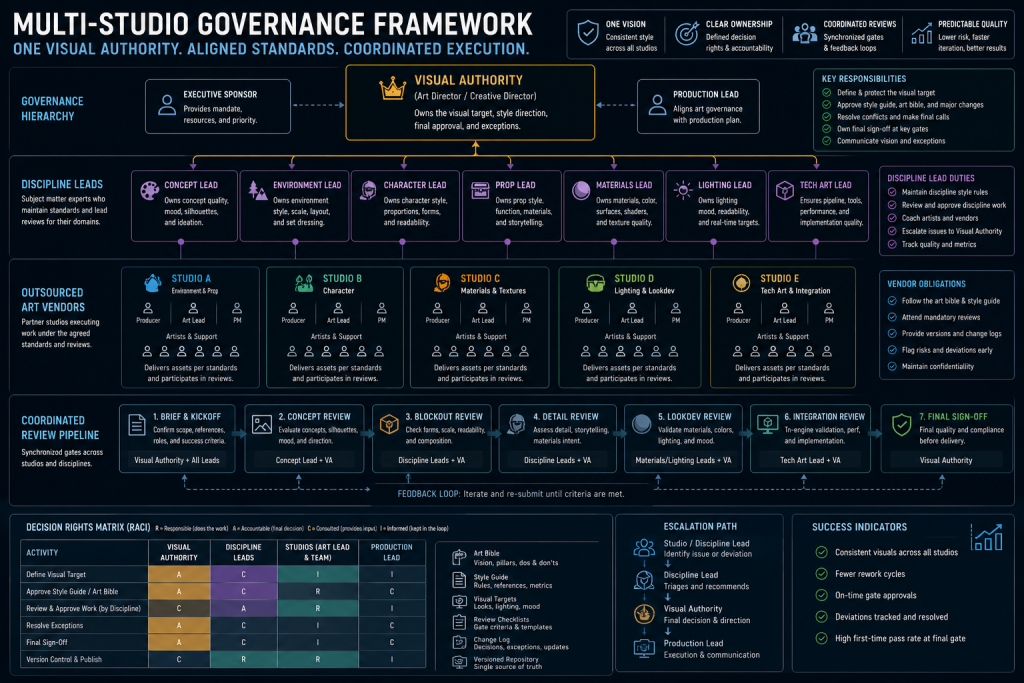
Everything above holds for a single team working under one roof. It gets structurally harder – not just logistically harder – the moment more than one studio, internal or external, is producing against the same visual target simultaneously. This is where consistency systems that work well for one team often start failing in practice, and it’s a distinct problem from documentation quality.
One visual authority, coordinated review ownership. The single highest-leverage governance decision at multi-vendor scale is refusing to let feedback fragment. At real AAA volume, a single person physically reviewing every asset from every vendor usually isn’t feasible – the practical structure is a hierarchy: one approved visual authority at the top (often a franchise or outsourcing art director), discipline leads reviewing their own asset categories underneath, and a clearly defined escalation path for when two leads’ notes conflict. What breaks consistency isn’t the existence of that hierarchy – it’s the absence of one, where each vendor gets feedback from whichever internal reviewer happened to be available that week, with no single point resolving contradictions between them. The moment two studios are getting subtly different, unreconciled notes on the same category of asset, they diverge – not because either studio is doing worse work, but because they’re now optimizing against two slightly different implicit targets.
“Editorial illustration created for visual reference purposes. It does not represent a real project, client work, or official software screenshot unless stated otherwise.”
A shared visual target, not a shared style guide. The style guide document can be identical across every vendor and still produce divergent output if each studio is working from its own accumulated interpretation of what the document means in practice. The visual target – the specific reference renders and comparison assets described earlier – needs to be the same living resource across every vendor, updated on the same cadence, so that studio A’s week-six reference and studio B’s week-six reference are the same file, not two documents that started identical and drifted apart independently.
Defined review cadence with a committed response SLA. Multi-vendor governance breaks down quietly when review turnaround varies by studio. If one vendor receives feedback within two business days and another waits a week, the slower vendor spends more production time working without validated corrections – which lets interpretation errors propagate into additional assets and grows the size of the next revision batch, which produces more schedule pressure, which is exactly the condition under which drift accelerates rather than resolves. This is also why the cadence needs to be established during onboarding rather than negotiated after the first missed review – we cover what that structured setup looks like in our vendor onboarding protocol, including where the review-cadence commitment specifically belongs in an eight-week ramp.
One example of this kind of structure, described by an outsourcing studio in an interview on 80.lv, is a discipline-based org chart with dedicated leadership and art direction support built into each specialization, so that a client working across multiple asset categories interacts with a coherent production structure rather than a set of loosely coordinated individual specialists. The transferable principle isn’t that every project has to copy that specific org chart – it’s that review ownership has to stay explicit and named as production scales, at the vendor’s organizational level and at the client’s level managing multiple vendors alike.
If you are a producer building a Q3 capacity plan that spans more than one outsourcing partner, the governance overhead described here is not optional infrastructure to add later if problems appear – it’s the difference between multi-vendor scale being a genuine capacity solution versus a coordination cost that erodes the capacity gain it was meant to deliver.
What Inconsistency Actually Costs a Production
The cost of unmanaged visual drift doesn’t show up as a line item. It shows up distributed across categories that a producer’s risk register tracks separately, which is part of why it’s chronically underestimated: revision cycles that get logged as normal iteration rather than as rework caused by a missing gate, milestone reviews that run long because the art director is doing lateral comparison work that a hero-comparison gate should have caught earlier, and – the least visible cost – a vertical slice review where “something feels off” triggers a broader investigation because nobody can point to which specific gate failed.
That last category is worth naming directly, because it can become one of the most expensive and least predictable. When a governance system with named gates exists and one of them fails, a producer can trace the failure to a specific checkpoint, a specific milestone, and a specific fix – a bounded problem. When no gate structure exists and inconsistency surfaces at vertical slice, the investigation itself becomes a cost center: reviewing every asset category against every other asset category, with no prior checkpoint narrowing the search space, to find where divergence entered the pipeline. The gate system described in this guide isn’t only a prevention mechanism – it’s also what keeps a failure, when one does happen, contained and diagnosable instead of open-ended.
Auditing Visual Consistency Mid-Production: A Recovery Protocol
Not every production reading this has the option of building the gate system in from day one. If drift has already surfaced – at vertical slice, at a publisher review, or simply because someone lined up the current cast and noticed it doesn’t hold together – the response needs to be triage, not panic, and the same gate structure described above doubles as a diagnostic tool.
Isolate the category, not the asset. The first question isn’t “which assets look wrong” – individually, several might pass review. It’s which category (characters, environment kit, props, UI) shows the widest spread when compared laterally against its own hero reference. That’s where the failure entered the pipeline, and triage should start there rather than spreading review effort evenly across every asset in production.
Reconstruct the reference chain backward. For the affected category, trace which version of the visual target each batch of assets was actually reviewed against – not which version currently exists, but which version was live at the time each batch was produced. Reference decay is a common root cause, and it’s only diagnosable by reconstructing this timeline, because the current documentation may already have been quietly updated past the point where the drift occurred.
Triage by production impact, not uniformly. Not every drifted asset needs a full rework. An asset that’s off-target but sits in the background of one level costs far less to leave than an asset that’s off-target and appears in marketing beauty shots or a hero moment. A recovery pass should rank affected assets by where they’ll actually be seen and judged, and spend the rework budget there first – full remediation across every drifted asset is rarely the schedule-realistic option, and treating it as mandatory usually means the highest-visibility assets get the same thin pass as the lowest-visibility ones.
Reset the gate, not just the assets. Fixing the current batch of drifted assets without adding the missing checkpoint just delays the next occurrence to the next milestone. A recovery pass that isn’t paired with adding the specific gate that would have caught the drift – hero comparison, in-engine cross-check, whichever was absent – is treating a systemic problem as a one-time content bug.
Case in Miniature: Character Cast Consistency at Scale
The pattern is easier to see applied to one category than described in the abstract. A common failure sequence: the hero character reaches final approval looking exactly like the concept. Secondary cast members, produced later by different artists or a different vendor, each individually pass review – and by vertical slice, the cast doesn’t read as belonging to the same game. One recurring driver is that artists may unconsciously normalize exaggerated proportions toward more familiar, anatomically comfortable choices, especially when model sheets and silhouette rules are incomplete – a drift that a hero-comparison gate is specifically built to catch, because it’s invisible in solo review and obvious the moment assets sit side by side.
We’ve written the full enforcement discipline for this specific case – concept-to-3D fidelity checks, silhouette testing, and keeping the original concept artist in the review loop through production – in our guide to stylized 3D character art direction.
A Practical Checklist: Gates, Owners, Artifacts
The table below consolidates the governance structure into something a producer can put on a schedule and an art director can enforce without relitigating the system at every milestone.
| Gate | Checked against | Typical owner | Failure signal if skipped |
| Concept-to-3D fidelity | Concept silhouette, proportions | Concept artist / art director | Silhouette, proportion, or primary shape language drifts from the approved concept |
| Lookdev validation | Documented visual target | Lookdev artist / art director | Asset fails the approved benchmark render or target presentation context |
| Hero comparison render | Hero asset, matched lighting | Art director | New cast members read as belonging to a different game |
| Color and value validation | Color script, palette constraints, protected colors | Art director / technical artist | Color drift compounds milestone to milestone, untraceable by vertical slice |
| In-engine technical cross-check | Assets combined under approved target lighting | Technical artist / lookdev lead | Assets pass isolated review but mismatch once integrated |
| Multi-vendor cross-check | Shared visual target across studios | Client art director / outsourcing art director | Two vendors’ output diverges despite identical style guide |
| Recovery audit (if drift already surfaced) | Reference chain at time of production | Producer / art director | Rework spreads evenly instead of targeting highest-visibility assets |
Each gate needs a named owner, not a department – accountability diffuses the moment “the art team” is responsible for something instead of a specific person with the authority to reject an asset that fails the check. And each gate needs to happen at a fixed point in the milestone structure, not “whenever there’s time,” because a gate that’s optional under schedule pressure gets skipped precisely when schedule pressure is highest – which is also when drift is most likely to occur.
Change Management: Keeping Documentation and Reality in Sync
A gate structure only works if the thing it’s checking against is current. Most consistency failures that trace back to “reference decay” have a change management gap underneath them: a document changed, and the change didn’t propagate to everyone still building against the old version. A production-grade governance system treats this as its own discipline, with its own artifacts:
Versioning and changelog. Every art bible, style guide, and visual target file carries a version number and a changelog entry – what changed, why, and who approved it. Without this, “which version is current” becomes a question someone has to ask in a chat thread instead of being answerable by opening the document.
Effective date and affected batch. A change isn’t just logged – it’s dated, and paired with an explicit statement of which asset batches are affected going forward versus which already-approved assets are grandfathered. Silent retroactive application of a new standard to already-approved work creates disputes that a clear effective date avoids entirely.
Vendor acknowledgment. A change to the visual target isn’t complete until every affected vendor has confirmed receipt and understanding, not just been sent an email. This is a small process step that closes the exact gap where multi-vendor drift enters: one studio working from the update, another still on the prior version because nobody confirmed the message landed.
Exception handling. Not every deviation from the documented target is a mistake – sometimes a specific asset needs a justified exception for a technical or narrative reason. A governance system that has no formal path for logging and approving exceptions ends up with informal ones instead, which are indistinguishable from drift when someone reviews the batch later.
A visual deviation register. Rather than relying on institutional memory, a running log of flagged deviations – what was found, at which gate, what the resolution was – turns pattern recognition into something the whole team can see rather than something only the art director remembers. Over a long production, this register is also what makes a recovery audit fast instead of starting from zero.
These artifacts aren’t bureaucracy for its own sake. Each one closes a specific, named failure mode from earlier in this guide: versioning closes reference decay, vendor acknowledgment closes the “two studios optimizing against different implicit targets” problem, and the deviation register is what makes a mid-production recovery protocol something you run against a written record instead of a group’s collective memory of what happened.
How We Work at Nasty Rodent
Visual consistency at scale is central to how we approach concept art and production handoff at Nasty Rodent. Depending on project scale, visual ownership sits with a dedicated art director or a coordinated group of discipline leads working under one approved visual direction – covering 3D characters, environments, props, weapons, and UI as a single reviewed system rather than independently managed tracks. When a project scales beyond what one internal team can absorb, we apply the same governance principles described in this guide to our own multi-discipline coordination: explicit review ownership, a visual target kept current rather than static, and a review cadence that doesn’t degrade as asset volume increases.
We’ve contributed production-ready visuals across mid-core and AAA titles including Squad, Ready or Not, Mutant Year Zero, Starship Troopers: Extermination, and Miasma Chronicles – projects where a character, an environment kit, and a weapons set all had to read as belonging to the same world, reviewed by the same standard, from the first concept sketch to final engine delivery.

Let's work
together


in mind?
From 3D characters and environments to weapons, props, concept art and game UI/UX: ten years deep, 40+ artists strong, zero fluff. Tell us what you are making and get a free, no-pressure estimate.
estimate