
In-House or Vendor-Led: Staffing Art Direction on an AAA Production
-

Written by Denys Zadoienyi
-

Updated on29.07.2026
-

Time to read11 min

- The Role, Briefly – and Where It Sits Relative to Others
- The Core Responsibilities That Define the Role
- What This Costs When the Role Is Under-Resourced
- In-House Art Director vs. Vendor-Provided Art Direction Leadership
- What to Evaluate When Art Direction Leadership Comes From an Outsourcing Partner
The art director’s role in AAA game development is defined differently depending on who you ask – HR writes a job description, artists describe a mentor, and producers describe whoever they call when a milestone review goes sideways.
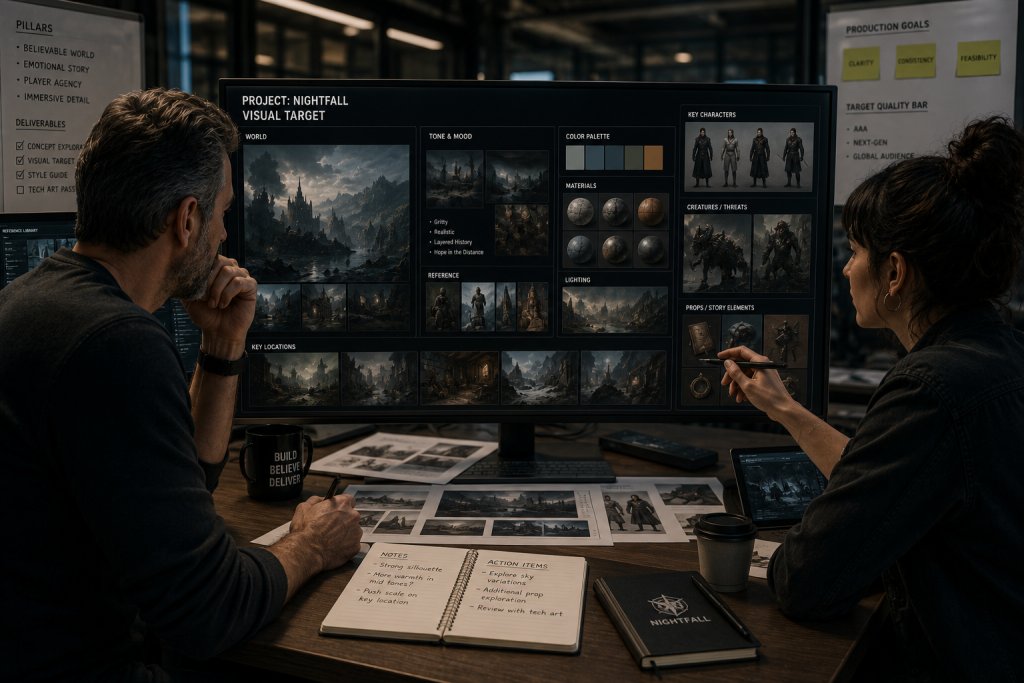
“Editorial illustration created for visual reference purposes. It does not represent a real project, client work, or official software screenshot unless stated otherwise.”
For a full breakdown of how the art director role compares with producer, game director, discipline lead, and technical artist positions across a development team, we cover that ground in our guide to game production roles. This piece has a narrower job: how a producer scopes and staffs art-direction ownership specifically, what the role should actually deliver, and – the question that comes up constantly in outsourced production – whether that ownership should sit in-house or with a vendor.
That’s the decision that actually costs money if it’s made carelessly. One studio’s art director signs off on final work and delegates day-to-day review to leads. Another is still personally hands-on with visual development work alongside the job. A third spends most of their capacity coordinating discipline leads and resolving cross-team calls. Same title, three different capacity commitments – and three different risks if the person, or the vendor standing in for that person, isn’t resourced correctly.
The Role, Briefly – and Where It Sits Relative to Others
At the level this article needs: an art director owns the visual target and cross-discipline consistency – how the game looks across characters, environments, UI, and VFX. That’s distinct from a creative director, who owns the combined creative vision across narrative, tone, art, and gameplay, and from a technical art director, whose strategy determines whether the visual target is actually achievable within engine and platform constraints. Titles and reporting lines vary between studios, and on smaller teams these functions often combine into one person – our production-roles guide linked above goes into that comparison in full, including a decision-authority breakdown for each role.
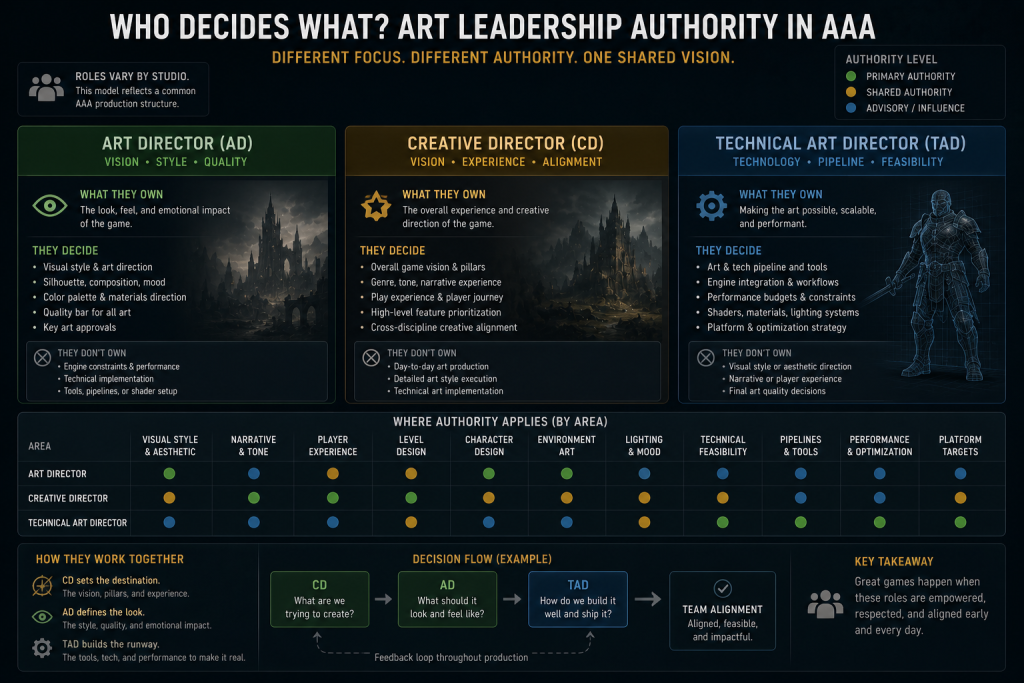
“Editorial illustration created for visual reference purposes. It does not represent a real project, client work, or official software screenshot unless stated otherwise.”
What matters for this piece is one distinction that trips up producers newer to art outsourcing: the art director owns the intended visual result, while the technical art director owns the technical strategy for achieving it. Shippability isn’t one role’s call – it’s a joint decision involving art direction, technical art, engineering, and production together.
The Core Responsibilities That Define the Role
Strip out studio-specific variation and an AAA art director’s core responsibilities generally fall into five areas.
Owning the visual target. Not choosing a mood board once in pre-production – maintaining a visual target that leads, designated reviewers, and artists can consistently use to evaluate every new asset, from the first blockout through the final beauty shot. On our own production work, this is the difference between a concept art phase that actually guides the pipeline and one that gets treated as a suggestion once 3D production starts.
Authoring and maintaining the art bible. The art bible is the tool that lets an art director delegate review authority without losing consistency. A studio running review gates off a real art bible can catch style drift during early batch reviews, before it reaches a representative milestone build – because an art director on an AAA-scale team typically cannot review every asset personally, and that authority has to be delegated to leads and designated approvers working from the same document.
Coordinating across disciplines that don’t naturally talk to each other. Character artists, environment artists, and UI designers each optimize for their own discipline’s best practices by default. Part of the art director’s job is making sure a hero character’s silhouette reads correctly against the environment lighting it will actually appear in, and that the UI doesn’t fight the world it’s overlaying.
Running the review and approval gate. Not a rubber stamp – a checkpoint with explicit criteria for what gets sent back: which silhouette, proportion, or shape-language deviations require revision rather than approval. Without explicit criteria, “art direction review” becomes a mood check that varies by how the director’s day is going.
Being the escalation point when art and production goals conflict. When a milestone deadline and a quality bar can’t both be hit, someone has to make the call – and defend it to the producer with a reason better than “it felt off.”

What This Function Should Produce
Depending on the production structure, the art director owns, maintains, or co-authors deliverables such as:
- A visual target package (mood boards, references, key art)
- A style bible with discipline-specific supplements (characters, environments, UI, VFX)
- Benchmark or hero assets that later work gets checked against
- Paintovers and annotated review feedback
- An approval matrix defining who can review, approve, reject, and escalate decisions
- Milestone review criteria with explicit accept/reject conditions
- A reference hierarchy (what overrides what when sources conflict)
- A handoff package for outsourcing partners
- A visual acceptance checklist used at delivery
Some of these – the approval matrix, milestone criteria – are governance artifacts the art director co-authors with production and technical art rather than owns outright. A formally staffed art-direction function should either maintain this set or have a clear plan for creating, validating, and updating the pieces relevant to the current production stage; the exact package and timing depend on scope and on whether visual-target ownership sits in-house or with a vendor.
What This Costs When the Role Is Under-Resourced
Here’s the part that turns “who does what” into a planning problem. In the projects we’ve supported, a production that runs without a dedicated, empowered art director – relying instead on a producer or lead artist absorbing the function part-time – has tended to surface the gap at a major cross-discipline review, often around vertical slice or the first representative content milestone, though the exact trigger varies; a first-batch review or an outsource-integration checkpoint can surface it just as easily.
The reason it’s expensive isn’t the art direction work itself – it’s the rework. A character that has drifted off-model through several review cycles may need substantial rework – across modeling, texturing, rigging, or dependent assets – rather than a small correction, and every asset built against it as a reference inherits some version of the same problem. In the productions we’ve supported, teams that treated art direction as a part-time add-on to a producer’s plate typically discovered the cost once a secondary character cast failed to match the hero asset at a milestone gate the hero asset had passed cleanly.
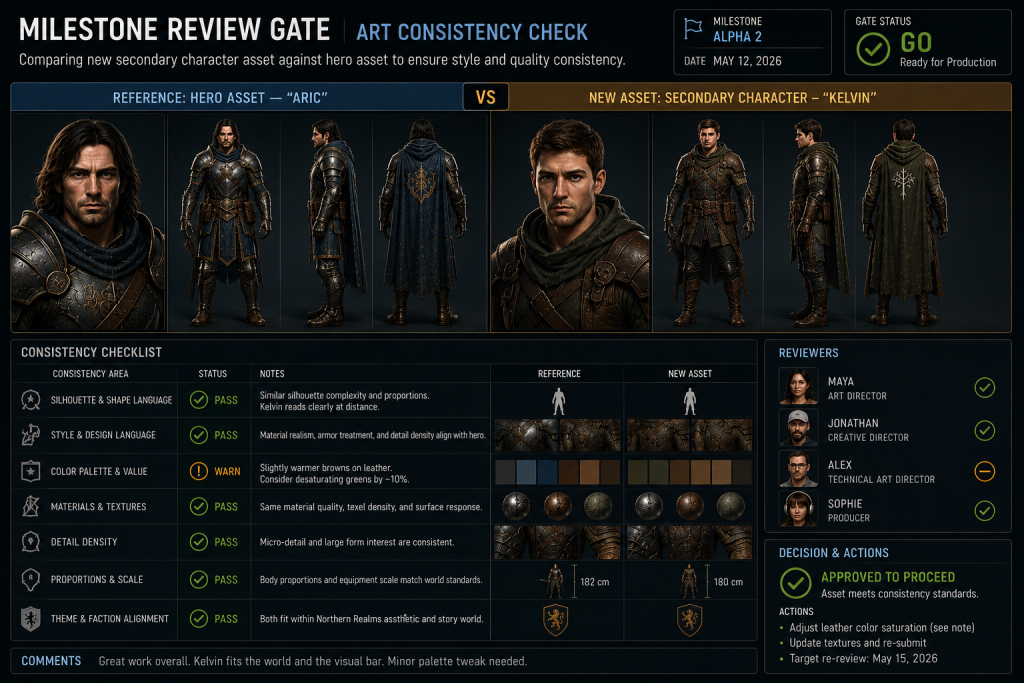
“Editorial illustration created for visual reference purposes. It does not represent a real project, client work, or official software screenshot unless stated otherwise.”
For a producer, this reframes art direction from a creative nice-to-have into a capacity-planning line item: the question isn’t whether the role adds value, it’s whether skipping it is actually cheaper than the rework it prevents. In our experience supporting mid-core and AAA engagements, it rarely is, once the rework is priced against a milestone slip rather than against the art director’s salary line alone.
In-House Art Director vs. Vendor-Provided Art Direction Leadership
This is the decision most producers evaluating outsourced production actually need to make, and it’s rarely framed honestly as a binary. The real options are: full in-house ownership, full vendor ownership of art direction for the outsourced scope, or – most commonly on the mid-core and AAA engagements we’ve run – a hybrid where an internal art director sets the visual target and a vendor-side art lead enforces it day-to-day against a shared art bible.
That hybrid model is worth being precise about, because “vendor-side art direction” gets used loosely. A vendor-side art lead typically interprets and applies the client’s art bible, runs day-to-day review within the outsourced scope, escalates genuine ambiguities, and maintains consistency across the vendor’s deliverables. A client-side art director typically retains ownership of the visual target itself, approves changes to the style language, and makes the final call on creative disputes that affect the project as a whole. Handing a vendor “art direction leadership” doesn’t automatically mean transferring that second layer of authority – in the most common hybrid model, it isn’t transferred, and that’s by design.
A quick self-check for where your production sits:
- Does your internal team have enough review capacity – across the art director, discipline leads, and designated approvers – to assess outsourced deliveries against the visual target, not just for technical correctness?
- Is the visual target itself stable, or still evolving through pre-production?
- Does the outsourcing scope span multiple asset types (characters, environments, props) that need to read as one world, not just individually competent deliveries?
If your review capacity is thin but the visual target is genuinely stable, vendor-side art leadership working from an art bible your internal team owns is usually more realistic than routing every review through a stretched internal team. If the target is still evolving, keep target-setting authority in-house regardless of your review capacity, and use the vendor’s lead to support interpretation, documentation, and controlled production tests rather than final creative calls – a vendor-side lead can enforce a target, but shouldn’t be expected to originate one that’s still changing weekly.
We go deeper into the mechanics of holding a visual target consistent through 3D production – the specific review gates, silhouette checks, and failure modes that show up in stylized character casts – in our production-grade art direction playbook, which picks up where this piece leaves off: once you’ve decided who owns the role, that’s how the role gets executed asset by asset.
A Vendor-Scope Authority Matrix
Once you’ve settled on a hybrid model, the practical question shifts to who can approve what within the outsourced scope specifically – distinct from the internal role authority our production-roles guide maps out. A starting structure that holds up on most hybrid engagements:
| Decision | Client Art Director | Vendor Art Lead | Technical Art | Producer |
| Change the visual target | Final approval | Recommend | Feasibility input | Scope impact |
| Approve a routine asset | Delegated / spot-check | Day-to-day approval | Technical validation | Track status |
| Accept an intentional deviation | Final approval | Escalate | Validate impact | Record scope |
| Reject for technical non-compliance | Consulted on visual impact | Coordinate fix | Validate and escalate | Track rework and scope impact |
Engine, platform, security, or certification constraints may still require final sign-off from engineering, QA, or a technical director beyond this table – treat it as a starting template for the art-vendor relationship specifically, not a complete production RACI.
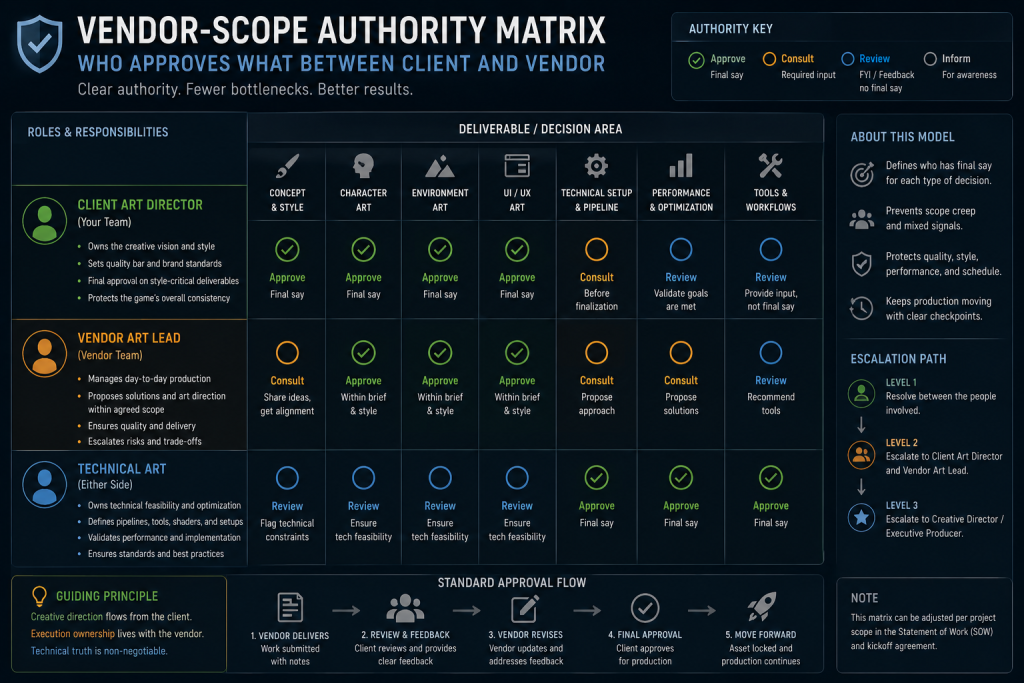
“Editorial illustration created for visual reference purposes. It does not represent a real project, client work, or official software screenshot unless stated otherwise.”
What to Evaluate When Art Direction Leadership Comes From an Outsourcing Partner
If you’re leaning toward vendor-provided art direction for some or all of your production, the evaluation criteria are different from evaluating individual artists. You’re not reviewing a portfolio – you’re reviewing a process.
Ask to see how the vendor’s art director or art lead runs a review gate: what the reject criteria actually look like on a real project, not just “we maintain quality control.” Ask how style drift gets caught between milestones, not just at delivery – a vendor that can only describe end-of-batch QA is describing quality assurance, not art direction. And ask directly how their art-direction authority is structured relative to your internal creative lead: who has final say when the two disagree on a call that affects the visual target, and how that gets resolved without stalling the pipeline.
A useful analogy for that evaluation comes from Magali Sonnet-Debard, art director at Square Enix Montréal, who described the role in an interview with ArtStation Magazine as being a bit like a conductor: musicians play their own instruments, but the outcome depends on trust between the conductor and the team, not on the conductor playing every part personally. Applied to vendor evaluation, the question becomes whether you’re being sold an individual who produces strong work personally, or a process that keeps an entire cross-discipline team reading as one coherent vision under deadline pressure.
Full vendor ownership of art direction – without any internal target-setting – is feasible when the outsourced partner has an explicit creative mandate, clear decision authority, and direct access to project leadership. Without those conditions, a hybrid structure is generally safer: the client retains visual-target ownership while the vendor art lead manages day-to-day interpretation and review within the outsourced scope.
Working with an outsourced production partner where the visual target keeps drifting between milestones – or planning a build where you’re not sure whether that leadership should live in-house or with the vendor – is exactly the kind of production-structure question worth walking through before the next milestone gate, not after it slips.
At Nasty Rodent, art direction is built into how we run outsourced production across 3D characters, environments, and props for mid-core and AAA clients, including Whimsy Games, Offworld Industries, Galaxy 4 Games, Benner Games, The Bearded Ladies Consulting, and Reburn. That’s the vantage point this piece is written from: what breaks when the role isn’t clearly owned, and what a producer needs to check before handing that ownership to a vendor.
Talk to a producer about a 48-hour pipeline compatibility audit – a straightforward look at where your current art direction ownership sits, and whether it’s positioned to catch drift before it compounds.

Let's work
together


in mind?
From 3D characters and environments to weapons, props, concept art and game UI/UX: ten years deep, 40+ artists strong, zero fluff. Tell us what you are making and get a free, no-pressure estimate.
estimate