Why Game Art Outsourcing Fails: 6 Failure Modes — and How to Prevent Each One
-

Written byDenys Zadoienyi
-

Updated on24.08.2026
-

Time to read15 min

- Failure Mode 1: The Brief That Leaves Room for Interpretation
- Failure Mode 2: No Art Bible — Or One Nobody Actually Enforces
- Failure Mode 3: Review Rounds Without Acceptance Criteria
- Failure Mode 4: Underestimating How Many Iterations a Real Asset Needs
- Failure Mode 5: The Technical Requirements Gap
- Failure Mode 6: Communication That Breaks Down Under Distance
- A Quick Way to Check Where You Stand
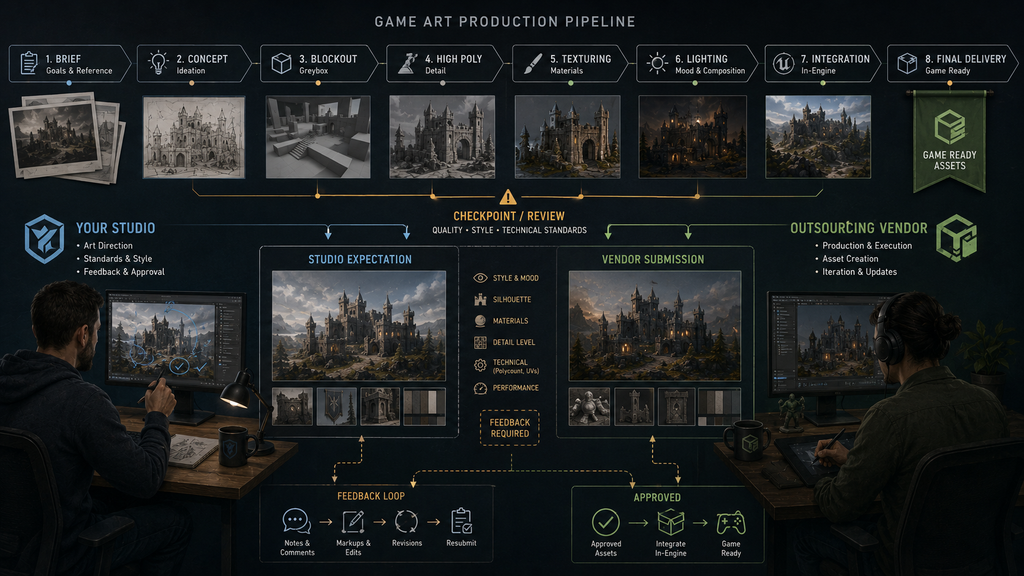
“Editorial illustration created for visual reference purposes. It does not represent a real project, client work, or official software screenshot unless stated otherwise.”
Most producers who have run one bad outsourcing engagement carry a quiet assumption into the next one: that the failure was about the vendor. Wrong studio, wrong portfolio fit, wrong price point. So the fix becomes “vet harder next time” — more portfolio review, more reference calls, a longer shortlist.
That diagnosis is often incomplete, and incomplete in an expensive direction. In our experience running outsourced art production across mid-core and AAA titles, the engagements that go sideways rarely do so because the vendor lacked the skill to produce the work. They go sideways because of six specific, repeatable process gaps — gaps that exist regardless of which studio sits on the other side of the contract. Vendor capability is necessary, but it isn’t sufficient on its own: a highly skilled vendor operating against a vague brief will still produce technically excellent assets that don’t fit the project, because capability and process solve two different problems, and a gap in one isn’t compensated by strength in the other.
This matters for how you read the rest of this article. None of the six failure modes below are about finding a “better” vendor. They’re about the structure and governance of the engagement itself — how expectations are specified, decisions are made, and feedback moves between both teams. Get the structure right, and outsourcing becomes what it’s supposed to be: controllable capacity. Get it wrong, and even a capable partner can’t save the schedule.
Failure Mode 1: The Brief That Leaves Room for Interpretation
This is one of the failure modes we encounter most often, and it rarely announces itself at kickoff. A brief that reads as “complete” to the person who wrote it can still leave enormous room for a vendor to fill gaps with assumptions — and every assumption a vendor makes is a coin flip against what you actually had in mind.
How it shows up in production. Two competent teams can read the same brief and arrive at different answers about silhouette complexity, material treatment, or finish level — and neither answer is unreasonable given what’s actually written down. The problem becomes visible not at the kickoff call, but the first time the vendor asks for approval on a decision the internal team assumed had already been made. By then, work has already been built on top of that assumption, and unwinding it costs more than defining it up front would have.
Why it happens. Producers who have spent months embedded in a project underestimate how much shared context they’re carrying that never got written down. Verbal alignment inside an internal team survives on proximity — people overhear each other, correct each other in the hallway, absorb tone from being in the room. None of that transmits across a studio boundary. A brief has to do, in writing, everything that internal proximity used to do implicitly.
The prevention mechanism. Treat the brief as a production document, not an introductory email. At minimum, it needs to answer what the asset looks like and what it explicitly does not look like — reference libraries with rejected examples are often more useful than approved ones, because they close off the interpretations you don’t want. It needs technical parameters stated as numbers, not adjectives: geometry budgets and LOD or Nanite requirements by asset category, texture resolution, target platform, and engine version, not “optimized” or “AAA-quality.” And it needs a named owner on your side who can answer a clarifying question within a committed window, because a brief that can’t be clarified quickly just relocates the ambiguity instead of removing it.
If your current brief is closer to a mood board with a deadline than a technical specification, it’s worth working through the difference before the next kickoff call — we’ve written a full breakdown of what a production-grade brief needs to cover for UE5 outsourcing specifically, including the engine-specific parameters that generic brief templates miss entirely.
Failure Mode 2: No Art Bible — Or One Nobody Actually Enforces
A brief tells a vendor what to build. An art bible tells them what “right” looks like once it’s built — and the two documents fail in different ways.
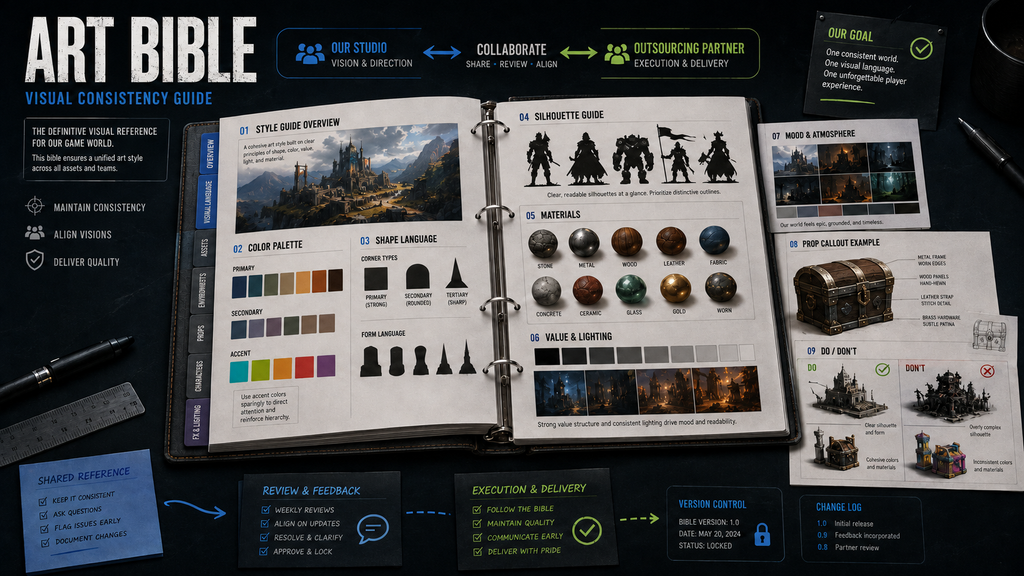
“Editorial illustration created for visual reference purposes. It does not represent a real project, client work, or official software screenshot unless stated otherwise.”
How it shows up in production. The first two or three assets look fine individually. By asset fifteen, something has drifted: silhouettes have gotten slightly busier, the material palette has widened past what was originally locked, and nobody can point to the exact moment it happened, because no single asset was the problem. It’s the accumulation. This is style drift, and it’s expensive precisely because it’s gradual — by the time it’s visible enough to flag, a full batch may need rework.
Why it happens. Two variants of the same failure. The obvious one: there’s no art bible at all, and the vendor is working from a handful of reference images and verbal notes from the kickoff call. The less obvious — and more common — variant: the art bible exists, but it’s treated as a one-time reference handed over on day one rather than a living document that every batch gets checked against. A style guide nobody re-opens after week two has the same practical effect as no style guide.
The prevention mechanism. The document needs to exist before the first asset enters production, not in parallel with it, and it needs an enforcement mechanism attached — a review step where every batch is checked against the bible specifically, not just against “does this look good.” For AAA-scale work with dozens of artists touching the same visual language, this checkpoint is what separates a project that holds together at asset two hundred from one that has quietly diverged.
If you’re building this document from scratch, our dedicated guide on what a production-grade game art bible actually needs to contain covers the structure AAA studios use — proportions, color logic, material treatment, and the translation layer that keeps 2D reference sheets accurate once they’re rebuilt as real-time materials under engine lighting.
Failure Mode 3: Review Rounds Without Acceptance Criteria
This failure mode is the one clients fear most and understand least, because it looks like a quality problem when it’s actually a governance problem.
How it shows up in production. A batch comes back from the vendor. The internal reviewer doesn’t love it, sends it back with notes, and the vendor addresses the notes — only to have the second round come back with a different set of objections from a different stakeholder who saw it this time. Three or four rounds in, nobody can say what “approved” actually requires, and the vendor is iterating against a moving target rather than a fixed standard. From the vendor’s side, this reads as an indecisive client. From the client’s side, it reads as a vendor who can’t get it right. Neither read is accurate — the real problem is that nobody defined, in advance, what “right” means at the acceptance stage.
Why it happens. Review without written acceptance criteria defaults to subjective judgment, and subjective judgment shifts depending on who’s looking, what mood they’re in, and what they compared the asset against most recently. Without a fixed standard, every review round is a fresh negotiation instead of a checklist.
The prevention mechanism. Acceptance criteria need to be defined and agreed before the first milestone is delivered, not discovered during the first review. That means: one clearly accountable final approval authority — even when the review work itself is distributed across discipline leads for different asset categories, which is normal and necessary at AAA volume — with an explicit escalation path for when two leads’ notes conflict; what specific technical and artistic standards a “pass” requires; how many revision rounds are included before additional rounds become a change order. The failure mode here isn’t having a review hierarchy. It’s having none — feedback arriving from multiple independent decision-makers with no defined path to resolve a disagreement between them. This is exactly the kind of specification that belongs in the procurement documentation — our guide to structuring RFP and SOW documents for game art outsourcing covers how to write acceptance criteria into the contract itself, so they’re a reference point rather than a debate.

Failure Mode 4: Underestimating How Many Iterations a Real Asset Needs
Producers new to outsourcing frequently budget review cycles as if the first submission should be close to final. It almost never is, and treating that as an anomaly rather than the baseline is where schedules start slipping.
How it shows up in production. The production schedule allocates one review pass per asset. The first batch needs two, sometimes three, and the schedule has no slack built in to absorb it — so either the deadline moves, or the extra rounds get compressed into less review time than the asset actually needs, which produces a worse result than if the rounds had been planned for from the start.
Why it happens. Needing more than one review round is normal for outsourced production, not a sign that something has gone wrong — but how many rounds is normal isn’t a single constant across every asset. It depends on asset type, production stage, how mature the art bible is, and whether a change request is a genuine correction against the brief or a scope or direction change in disguise. A production prop moving through a well-calibrated pipeline can clear first-pass review; a hero character or an early concept-exploration piece routinely needs several passes before it’s close. A vendor calibrating to a new client’s specific taste, technical constraints, and unstated preferences needs iteration to close that gap — the same way any new hire needs ramp-up time before hitting full velocity. Budgeting every asset as if the first pass will land clean sets an expectation the production usually can’t meet, and every missed expectation compounds pressure on both sides of the relationship.
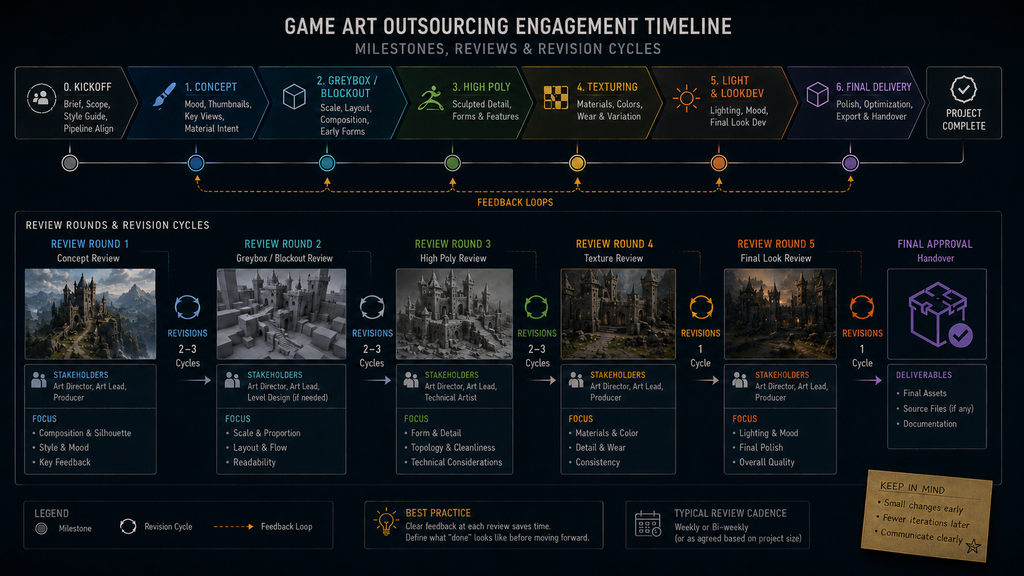
The prevention mechanism. Build revision rounds into the milestone schedule from the start, set by asset type and production stage rather than treated as one number for the whole batch.
“Editorial illustration created for visual reference purposes. It does not represent a real project, client work, or official software screenshot unless stated otherwise.”
Two to three rounds per asset is a reasonable planning allowance for early calibration milestones and for complex or hero assets specifically — not a universal figure, but a realistic baseline while the vendor is still calibrating to your style and technical requirements. A vendor who can tell you their typical first-pass approval rate up front, with a number rather than a vague reassurance, is signaling they track this metric internally rather than discovering it project by project. Our broader breakdown of outsourcing models and realistic production practices walks through how a locked art bible, milestone gates, and centralized feedback reduce the number of rounds needed over the life of an engagement — which is the actual lever available here, since eliminating revision rounds outright isn’t realistic.
Failure Mode 5: The Technical Requirements Gap
This is the failure mode most likely to be invisible until it’s expensive, because the asset can look completely correct in a viewport and still be wrong for the engine it’s headed into.
How it shows up in production. A batch of assets arrives. They look right in the vendor’s render. They import into the engine and need manual correction before anyone can actually use them — scale fixes, UV reconstruction, LOD reconfiguration, material channel-packing mismatches, or geometry that behaves fine in a DCC viewport but causes visible errors once it’s lit inside the engine. Any of that means the “delivered” asset wasn’t finished — it was handed off mid-process to whichever engineer or technical artist picks it up next. At production scale, this cost compounds: the same fix, repeated across dozens or hundreds of assets, eats far more time than getting the spec right once at the start.
Why it happens. Visual review and technical review are different disciplines, and outsourcing engagements too often only budget for the first one. A brief that specifies style, mood, and silhouette in detail but leaves scale baseline, UV channel convention, LOD generation method, naming structure, and collision standard unstated is only half a specification — and the half that’s missing is the half that determines whether the asset actually works once it leaves the vendor’s software and enters your build. This isn’t uniform across asset types, either: static environment geometry, hard-surface props, and skinned or deformable meshes each carry a different set of engine-specific constraints, so a spec written for one doesn’t automatically cover the others.
The prevention mechanism. The technical specification needs to be as explicit and non-negotiable as the visual one, treated as a hard contract rather than a set of suggestions: deterministic export settings that produce the same import result every time, documented conventions for every parameter a vendor or engineer might otherwise guess at, and — critically — an in-engine validation step before an asset is marked complete, not after a batch has already been delivered. For a deeper look at what a fully specified handoff needs to include, our guide to the asset import pipeline from DCC application to engine breaks down the parameters that most briefs leave undefined. This gap matters especially in UE5 productions using systems such as Nanite and Lumen: geometry that looks acceptable in a DCC viewport can expose lighting, distance-field, material, or performance issues only after in-engine validation. Requirements also differ by asset class — static environment geometry, skeletal meshes, foliage, and deformable assets don’t inherit one technical specification from another. Our broader real-time production experience spans titles including Squad and Ready Or Not.
Failure Mode 6: Communication That Breaks Down Under Distance
The first five failure modes are addressed primarily through specification, planning, and review governance — documents written and decisions locked before or at the start of production. This one is different: it depends on the operating cadence once the engagement is actually running, not on what was agreed going in.
How it shows up in production. A vendor delivers a batch and flags a question about an ambiguous callout. The internal reviewer, buried in other priorities, takes five or six days to respond. By the time the answer arrives, the vendor’s artists have already moved to the next asset in the batch, working from the same assumption that generated the original question — and the same interpretation gets replicated across everything produced in that window. What should have been a single clarifying answer becomes a full-batch rework.
Why it happens. Distance doesn’t just mean time zones, though that’s part of it. It means the informal correction loop that exists inside a co-located team — someone notices a problem and mentions it before it spreads — doesn’t exist across a studio boundary by default. It has to be built deliberately, with a committed response window, a named point of contact with actual decision-making authority on both sides, and an escalation path for anything that can’t be resolved at the working level.
The prevention mechanism. A documented feedback SLA — a maximum response time from vendor delivery to internal review, written into the SOW rather than assumed — is one of the highest-leverage controls here, because it converts an informal hope into an enforceable commitment. In our production experience, rework tied to informal outsourcing governance can consume a substantial share of art production labor — in our onboarding guide, we estimate that exposure at 20 to 40 percent — and that cost rarely shows up as a line item anywhere — it gets quietly absorbed by producers and written off as “the cost of working with external teams.” It isn’t. It’s a process gap with a specific fix. Our full 8-week vendor onboarding protocol covers how to build the communication and governance layer — response SLAs, review cadence, escalation structure — before full production begins, so this failure mode gets addressed at the start of the engagement rather than diagnosed after the fact.
A Quick Way to Check Where You Stand
Before the next engagement — or the next milestone on a current one — these six questions map directly onto the failure modes above:
- Does the brief specify what the asset explicitly does not look like, not just what it does?
- Is there a single art bible that every batch gets checked against, not just referenced once at kickoff?
- Is there one clearly accountable final approval authority — even if review work is distributed across discipline leads — working from written acceptance criteria and a defined escalation path?
- Does the milestone schedule budget realistic revision capacity by asset type and production stage, rather than assuming every asset clears in one pass?
- Is the technical specification (scale, UV, LOD, naming, pivot placement, collision) as explicit as the visual one?
- Is there a written, committed response-time SLA for vendor questions and delivery reviews?
A “no” on any of these isn’t a reason to avoid outsourcing — it’s a specific, fixable gap. That’s the practical difference between the studios that treat a bad engagement as proof outsourcing doesn’t work, and the ones that fix the actual process gap and get a materially better result the second time around.