How Game Art Scope Creep Starts — and How Producers Contain It
-

Written byDenys Zadoienyi
-

Updated on27.08.2026
-

Time to read11 min
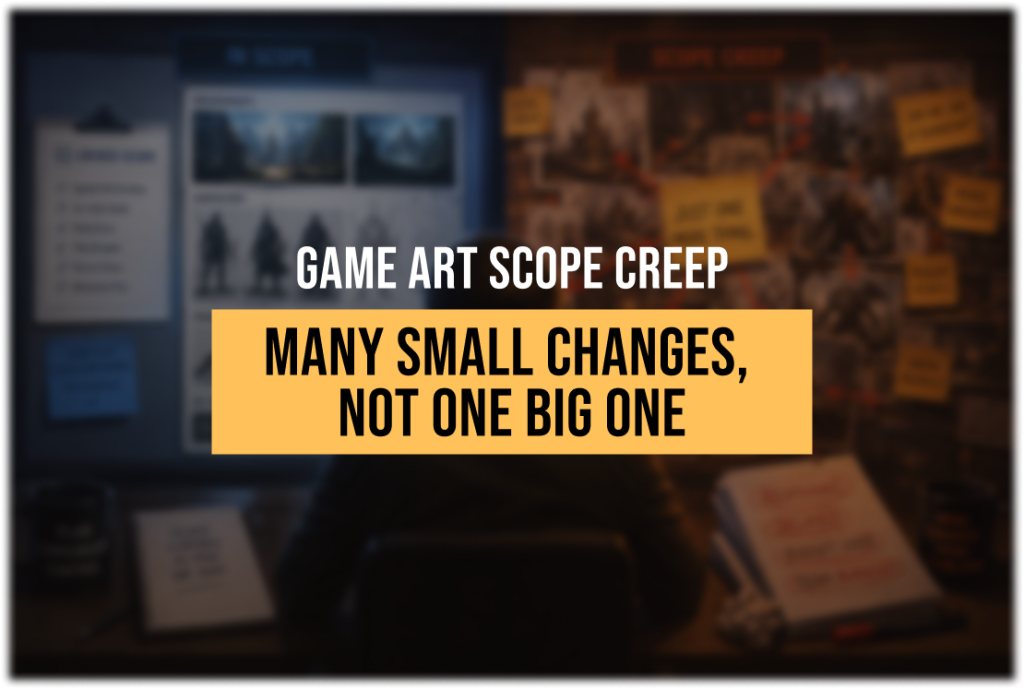

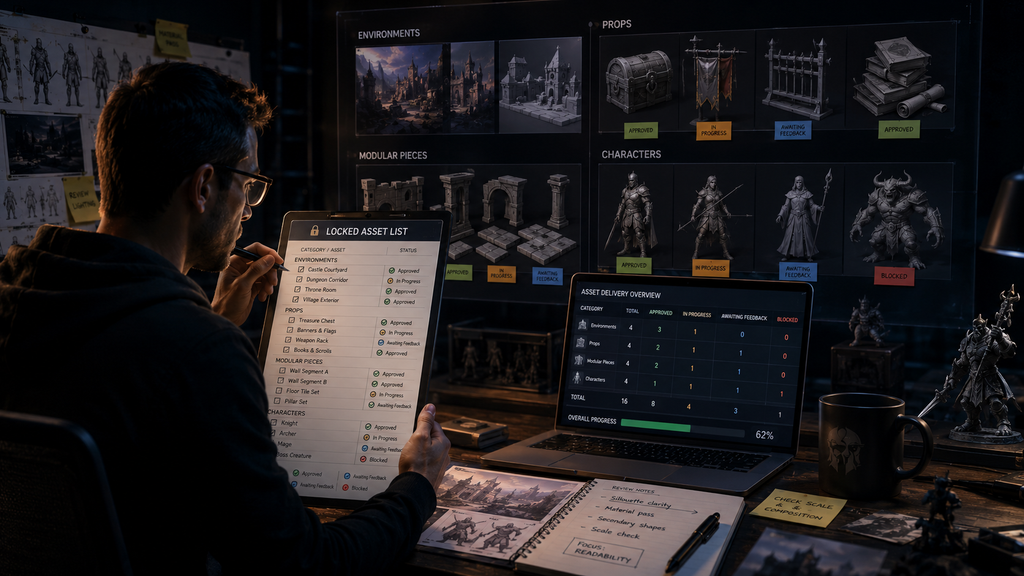
“Editorial illustration created for visual reference purposes. It does not represent a real project, client work, or official software screenshot unless stated otherwise.”
No producer signs off on a project expecting to lose control of its scope. It happens anyway, and it almost never happens through one decision anyone would have rejected outright. It happens through a sequence of small, individually reasonable requests that nobody stopped to add up.
By the time a producer notices that a 3D art budget is running short with two milestones still ahead, the cause is rarely a single dramatic change. It’s usually eleven small ones, made over ten weeks, none of which triggered a conversation about cost or timeline on its own.
How Scope Creep Actually Starts
Scope creep in outsourced game art production follows a small number of recognizable patterns. None of them look dangerous in isolation. That’s the mechanism — each one is small enough to approve without a second thought, and the accumulation is what does the damage.
“Just a small tweak” requests
One of the most common entry points is the revision that doesn’t read as a revision. A prop gets a slightly different silhouette. A character’s proportions shift half a head-height. A weapon’s material callouts change from matte to semi-gloss after the first render comes back. Individually, each of these fits inside a normal feedback round. Collectively, across forty props or a full character roster, “just a small tweak” repeated at scale is a different production event than the single revision round the schedule budgeted for.
The problem isn’t that feedback happens — feedback is the point of a review cycle. The problem is that small tweaks rarely get logged as scope movement. They get absorbed into “the current revision round,” which means nobody is tracking that round three has quietly become round six.
Reference drift mid-production
A second, subtler pattern: the reference material itself changes after production has started. An art director swaps out the mood board reference two weeks into environment blockout because a competitor title shipped a screenshot that reset the internal bar. A creative lead sees a new film release and decides the lighting direction should lean warmer. None of this is unreasonable — creative direction evolves, and locking it too early has its own cost. But when the reference shifts after assets are already in production against the original one, every asset built against the old reference either gets reworked or creates a visible inconsistency in the final build.
Reference drift can be one of the most expensive forms of scope creep, because it doesn’t just add new work — it can invalidate work already completed against the previous target. A studio that swaps its environment reference at 60% completion isn’t asking for “a bit more,” it’s asking for a partial restart with a different label on it.
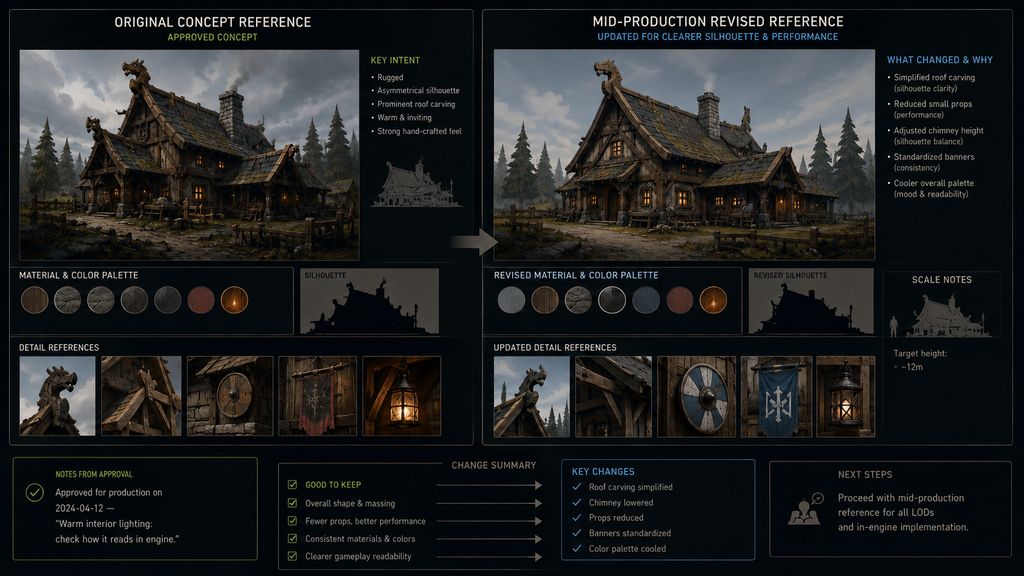
“Editorial illustration created for visual reference purposes. It does not represent a real project, client work, or official software screenshot unless stated otherwise.”
Additional variations beyond the agreed asset list
The third pattern shows up at the asset-count level rather than the asset-detail level. The brief specified twelve weapon variants; production is midway through and the request comes in for three more skins “since the pipeline is already set up for it.” The logic is intuitive — the rig exists, the material library exists, why not get more coverage out of the same base work? But variant production isn’t free just because the base asset is done. Each variant still needs its own texture pass, its own QA, its own place in the milestone schedule. An asset list that grows by 25% mid-production without a corresponding schedule or budget adjustment isn’t a bonus — it’s an unplanned second phase wearing the first phase’s deadline.
Why This Is a Production Risk, Not a Creative One
For an art director, scope creep often reads as a stylistic problem: keeping visual consistency while the target keeps moving. For a producer managing production capacity across a quarter, it’s a different kind of risk entirely. Every hour absorbed into unlogged scope movement on one title is an hour not available for the next milestone gate, the next parallel pipeline, or the vendor capacity you already committed elsewhere.
The compounding effect is what makes scope creep specifically dangerous to a production schedule, as opposed to a single large change, which at least triggers a re-planning conversation by its own size. Small, cumulative scope movement rarely triggers that conversation until the budget or the calendar has already absorbed the cost — which is precisely when renegotiating it is hardest, because the sunk cost is already spent and the deadline is already close.
There’s a reason project management literature treats scope creep as a distinct failure mode rather than just “changes happening.” Analyses of project scope management consistently identify the absence of a formal change control process — not the existence of change itself — as the mechanism that lets scope drift go unchecked. Change is normal. Uncontrolled change is the risk.

Three Mechanisms That Contain It
None of the three mechanisms below prevent creative iteration or stop a studio from responding to new information mid-production. What they do is make every scope movement visible, priced, and scheduled — the moment it happens, not the moment someone notices the budget is gone.
1. Fixing the scope before production starts
The earliest control point is a locked, itemized asset list — not a paragraph brief, but a document that names every deliverable, its fidelity tier, its revision allowance, and what counts as “done” for each one. If a task doesn’t have a written definition of done, it shouldn’t enter a production milestone; there’s nothing to measure a later request against.
This is where the connection to vendor selection becomes concrete. A studio that chose its art partner primarily on portfolio strength and hasn’t stress-tested how that partner handles ambiguous requirements is discovering the gap at exactly the wrong moment — mid-production, under deadline pressure. How to Vet a Game Art Outsourcing Studio covers what to check before the contract is signed, precisely because a vendor’s discipline around scope shows up long before the first asset does.
A locked scope isn’t a creative straitjacket. It’s a baseline. Every request that falls outside it is now visibly outside it, instead of blending into “the current phase.”
2. A named change request procedure
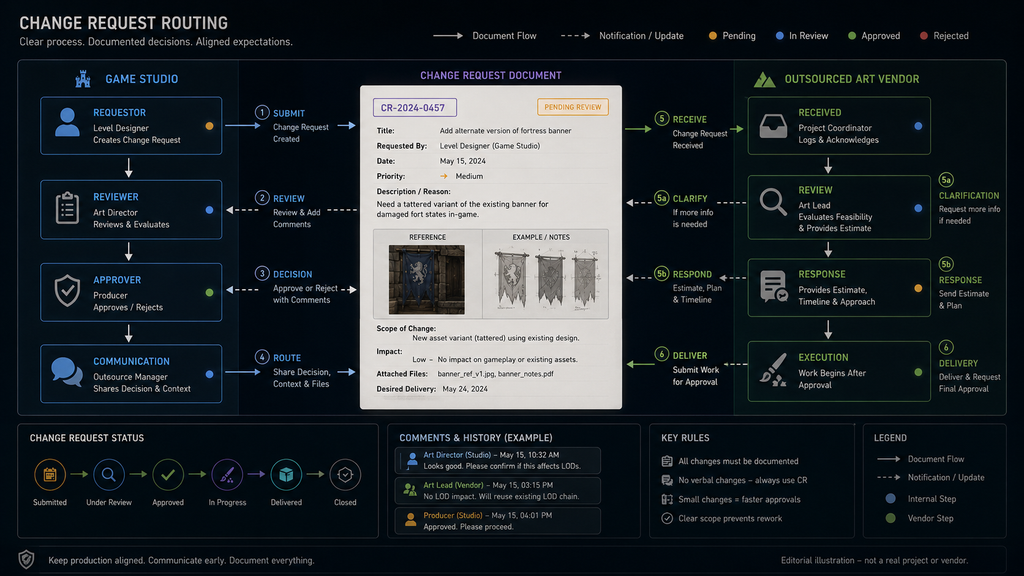
The second control is procedural, and it only works if it’s lightweight enough that people actually use it instead of routing around it in a Slack message. A workable change request procedure needs four things: a single point of submission, a named person with authority to approve or reject it, a standard turnaround time for pricing the change, and — critically — a rule that work on the changed scope doesn’t start until the request is approved.
“Editorial illustration created for visual reference purposes. It does not represent a real project, client work, or official software screenshot unless stated otherwise.”
That last rule is particularly easy to bypass, because saying “let’s just start on it and sort out the paperwork later” feels efficient in the moment. It’s exactly how change requests turn into disputes: once the work exists, the conversation about whether it should have been approved becomes a conversation about who pays for something already delivered, which is a much harder conversation than pricing a request before it starts.
It’s worth being precise about what this procedure covers versus what a vendor contract already covers. The Nasty Rodent guide to RFP and SOW documentation walks through the contractual language — the Change Request and Change Order clauses that define this process on paper, before a project even starts. What this article is describing is the operational habit that makes that clause actually function: catching a scope shift when it’s a single email, not after it’s three milestones of absorbed rework. The contract sets the rule; the daily discipline is what makes the rule matter.
The same logic applies to co-development arrangements, where the line between “revision” and “new scope” is even easier to blur because the outsourced team is embedded directly inside the internal pipeline. A studio evaluating co-development versus outsourcing for its next production cycle should treat “how do you handle a sprint where direction changes mid-cycle” as a standard vendor question, not an edge case — because in a co-dev model, mid-cycle direction changes are more likely to be part of normal production governance than a rare exception.
3. A separate budget line for change requests
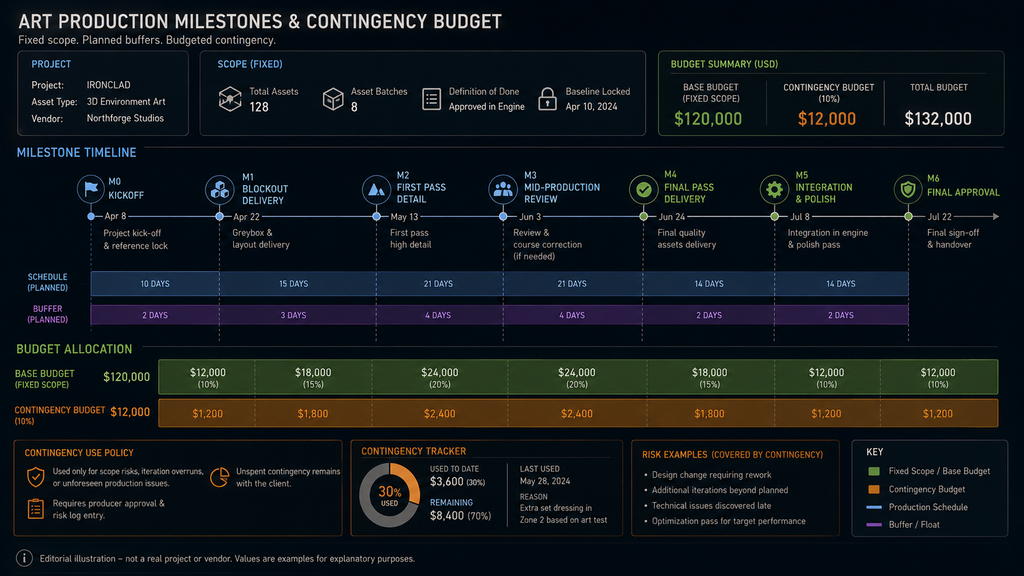
The third mechanism is easy to overlook, but it’s the one that turns the first two from theory into practice: a contingency line, set aside at project kickoff, specifically for approved change requests. Not a vague buffer folded into the general budget — a named line item that everyone involved knows exists and knows is finite.
“Editorial illustration created for visual reference purposes. It does not represent a real project, client work, or official software screenshot unless stated otherwise.”
The reason this matters operationally: without a dedicated change budget, every approved scope addition competes directly against the original deliverables for the same finite pool of money and time. That turns every change-request conversation into a zero-sum argument — approve this variant, cut that prop — which is exactly the kind of conversation that makes internal stakeholders start routing around the change process instead of using it. A separate line reduces that friction. Approved changes no longer have to compete immediately with the original deliverables for the same budget line, because the money for legitimate changes was never going to come out of the original scope’s budget in the first place.
Sizing that contingency is itself a production estimate, not a guess — it belongs in the same conversation as the rest of the asset budget. For studios working out how to size that initial estimate before the change-request layer even comes into play, the same estimation discipline that prevents mid-project renegotiation starts at the brief stage, with a properly scoped asset list and a realistic per-asset time budget.
What This Looks Like Across a Full Production Cycle
These three mechanisms compound. A locked asset list gives the change request procedure something concrete to compare a new ask against — without it, “is this in scope” is a matter of opinion instead of a fact you can check against a document. The change request procedure gives the contingency budget a gate to pass through — without it, the contingency line gets drawn down by whoever asks first, not by what actually needs it. And the contingency budget gives everyone permission to say yes to legitimate creative improvements without treating every one of them as a threat to the deadline.
On a long-running production — the kind of multi-milestone engagement common on tactical shooters and live-service titles, where new weapon variants, environment expansions, and UI iterations arrive continuously across a release cycle — this isn’t a one-time setup cost. It’s infrastructure the project runs on for its full duration. Studios that treat their outsourced art partner as an extension of internal production discipline, rather than a vendor to manage at arm’s length, tend to be the ones where a producer can say “we added six asset variants across the quarter” as a fact on a spreadsheet, instead of discovering it as a budget shortfall two weeks before ship.
That kind of visibility is a governance outcome, not a luck outcome. It comes from a vendor relationship structured to log scope movement as it happens, with named ownership on both sides of every review — the same governance layer that makes the difference between an onboarding process that surfaces problems in week two instead of week twelve, when the cost of fixing them is still low.
Where This Fits Into How We Work
At Nasty Rodent, scope control is built into how our game art outsourcing services are structured, not added as a clause after a client asks for it. The project-based model locks a defined scope and milestone payments before work starts; the ongoing support model allocates monthly capacity so that legitimate scope growth has a pre-agreed home instead of colliding with a fixed budget. Either way, a change to what’s being built is a conversation that happens before the work does, not an argument after it’s already delivered.
That discipline is part of what our long-term partners describe when they talk about working with us across full production cycles — coordinated art direction, structured pipelines, and a team that catches drift before it becomes a milestone-review surprise, rather than after.
If your current production is already showing the signals described above — untracked “small” revisions stacking up, a reference that’s shifted since the brief was written, an asset list that’s grown without a matching schedule adjustment — the fastest way to get it back under control is a scoped conversation, not a bigger contract. Share where the project stands and we’ll help map what’s original scope, what’s legitimate new scope, and what a contained path forward looks like from here.