How Much Does a 3D Environment Cost? Budget Drivers by Scope
-

Written byDenys Zadoienyi
-

Updated on08.10.2026
-

Time to read10 min

- Define the Delivery Scope: Assets, Assembly, or Both
- Starting Point: Concept, Blockout, or an Existing Kit
- Reuse and Custom Content: Where the Work Changes
- Visual Requirements: Style, Density and Camera Access
- Engine and Platform Targets: What Still Needs Scoping
- Handover Requirements: Define the Delivery Package
- How the Six Drivers Combine
- The Same Location, Three Different Scopes
- Reading an Environment Quote Against These Drivers
- What We Need to Estimate Your Environment
3D environment cost depends on the deliverable behind the word “environment.” A modular kit, a scene assembled from an existing library, and a new location with custom assets and agreed engine validation require different work. Before comparing prices, define what the vendor must deliver and what your team will complete internally.
This guide explains six budget drivers: delivery scope, starting point, reuse strategy, visual requirements, engine and platform targets, and handover requirements. It does not publish a rate card or a universal price range. Instead, it shows which work belongs in an environment estimate and how changes to the brief can change that work.
A 3D environment art budget covers the agreed work needed to create assets, build a reusable kit, assemble a scene, or combine these tasks. The estimate should state the starting materials, visual and technical requirements, delivery boundary, and treatment of revisions and unresolved scope.
Define the Delivery Scope: Assets, Assembly, or Both
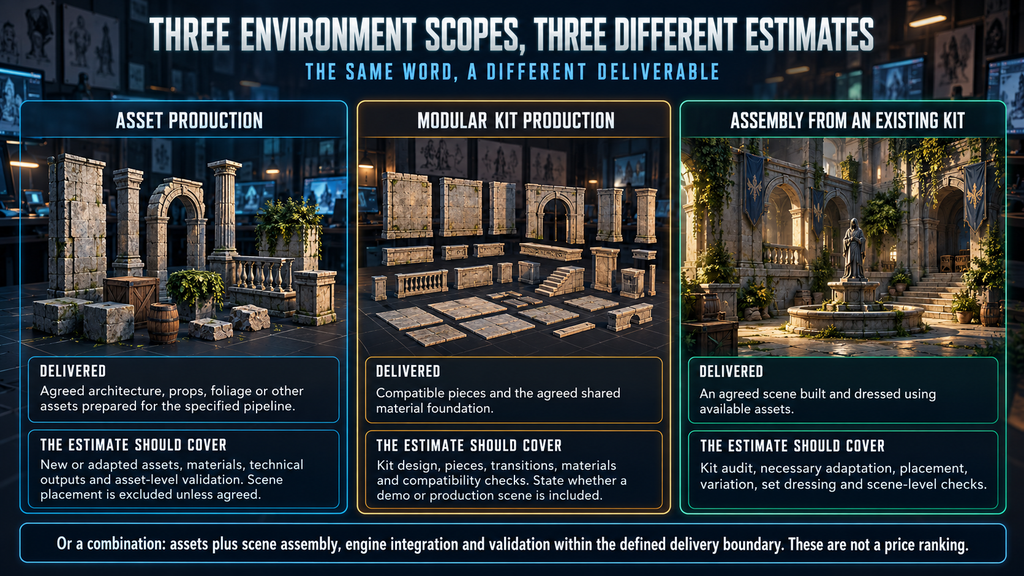
The first question for our 3D environment art services is what the client needs delivered: assets, a reusable kit, an assembled scene, or a combination. These are separate scopes, rather than mandatory steps in a single package. On our service page the choice follows what you already have: assets only if you have level designers and artists and need production capacity, assets plus assembly if you have design and a blockmesh, and assembly only if you have a kit and a library.
| Scope | What is delivered | What the estimate should cover |
| Asset production | Agreed architecture, props, foliage or other assets prepared for the specified pipeline | New or adapted assets, materials, required technical outputs and asset-level validation; scene placement is excluded unless agreed |
| Modular kit production | Compatible pieces and the agreed shared material foundation | Kit design, pieces, transitions, materials and compatibility checks; specify whether a demo scene or production scene assembly is included |
| Assembly from an existing kit | An agreed scene built and dressed using available assets | Kit audit, necessary adaptation, placement, variation, set dressing and scene-level checks |
| Assets plus scene assembly | Agreed custom content and an assembled location | Asset and shared-system production, assembly, engine integration and validation within the defined delivery boundary |
“Editorial illustration created for visual reference purposes. It does not represent a real project, client work, or official software screenshot unless stated otherwise.”
Lighting-ready delivery and final lighting are different outcomes. The quote should also state who owns gameplay-driven changes, collision setup, performance validation and any additional implementation work. A dense close-view interior can require more custom work than a larger location built from a suitable library, so these rows are not a universal price ranking.
Starting Point: Concept, Blockout, or an Existing Kit
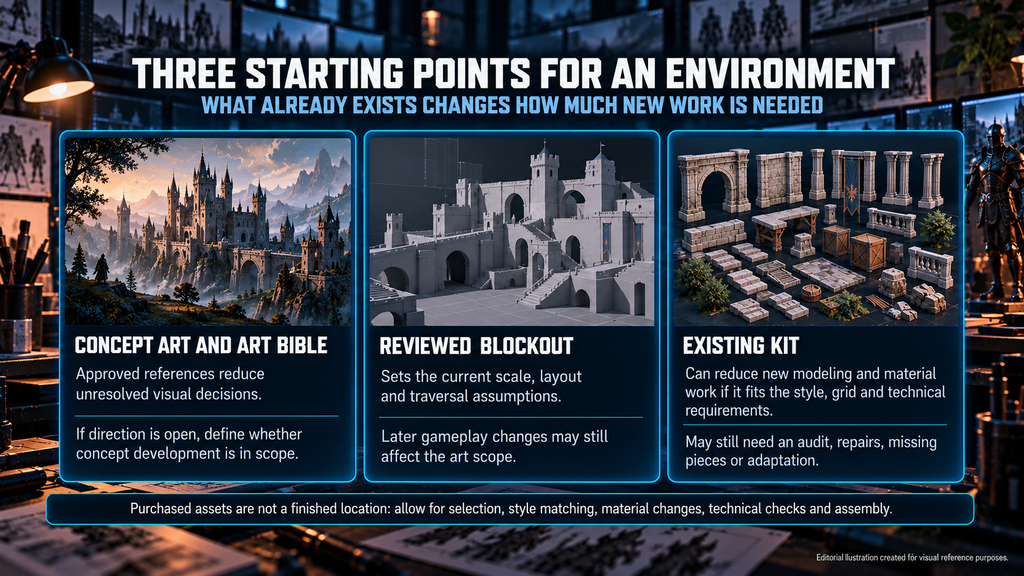
The starting point changes how much new work the environment needs. Approved references and an art bible reduce unresolved visual decisions. A reviewed blockout establishes the current scale, layout and traversal assumptions, although later gameplay changes may still affect the art scope.
An existing kit can reduce new modeling and material work if it fits the agreed style, grid and technical requirements. It may still need an audit, repairs, missing pieces or adaptation. Those tasks should be distinguished from new game-ready prop production.
“Editorial illustration created for visual reference purposes. It does not represent a real project, client work, or official software screenshot unless stated otherwise.”
Purchased assets are another possible starting point, but the purchase price is not the cost of a finished location. Allow for selection, style matching, material changes, technical checks and assembly. A hybrid scope can combine a suitable library with custom focal assets or missing kit pieces. Confirm the license, dependencies and agreed source-file delivery before treating the library as a production-ready foundation.
If visual direction is still open, define whether environment concept development is part of the assignment. An unresolved input may need clarification, an explicit assumption or a separately scoped task; it should not automatically become an unspecified contingency. For turning a brief into a counted list, see our guide to environment scope estimation.
Reuse and Custom Content: Where the Work Changes
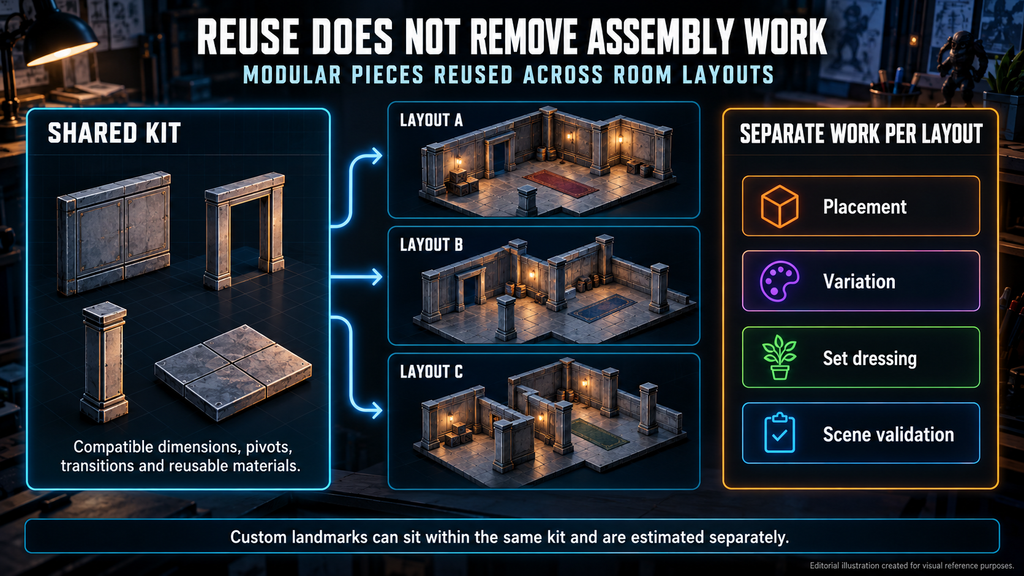
A modular kit shifts some work into a shared foundation: compatible dimensions, pivots, transitions and reusable materials. The budget benefit depends on how much suitable content can actually be reused. Kit pieces are still distinct assets that must be built; their repeated placements are a separate assembly task. Our guide to modular prop kits explains the production structure.
Production example: The overview of GDC 2016’s session on Fallout 4’s modular level design describes how Bethesda combined modular art kits with iterative level design to build a large world. It offers a practical example of organizing production around reusable content.
“Editorial illustration created for visual reference purposes. It does not represent a real project, client work, or official software screenshot unless stated otherwise.”
Reuse does not remove placement, variation, set dressing or scene validation. Custom landmarks can sit within the same modular environment, and their additional production should be estimated separately. A subsequent location may reuse the foundation, but it still needs its own assembly and checks; a new biome or visual direction may require new systems.
Visual Requirements: Style, Density and Camera Access
Neither realistic nor stylized art is cheaper by default. Both may use physically based rendering (PBR) materials, while some stylized projects require hand-painted textures or custom shading. The effort depends on the reference quality, material workflow, shape language, variants and review requirements, rather than the style label alone.
Camera access and content density also matter. A distant facade, an enterable building and a close-view damaged interior are different art scopes. More accessible surfaces, custom dressing, interactive states or damage variants can add work even when the location’s footprint stays the same.
State the visual target and inspection distance in the brief, with references for focal elements and repeated areas. This makes it possible to distinguish fidelity requirements from unresolved art direction instead of treating both as “style.”

Engine and Platform Targets: What Still Needs Scoping
Engine features change which technical tasks an environment needs; they do not make technical delivery free. For suitable content, Nanite handles geometry detail automatically, reducing the need for manually authored level-of-detail (LOD) chains in its rendering path. Epic’s technical documentation explains that enabling Nanite on a static mesh generates a fallback mesh used for features such as complex collision and for rendering where Nanite is unsupported. Collision, material compatibility, scene profiling and any required fallback delivery still need to be scoped.
Name the engine version, rendering setup, target platforms and acceptance criteria before estimating the work. Additional hardware targets or an existing kit that needs adaptation can change the validation scope. For the wider production stages, see our 3D environment pipeline guide.
Handover Requirements: Define the Delivery Package
Handover requirements should follow the asset’s intended use and the agreed pipeline. An exchange format such as FBX or OBJ is not the same requirement as an editable authoring project, a collision setup or an in-engine package. Required outputs vary: lightmap UVs matter where baked lighting is used, and LOD requirements depend on the rendering setup and target platforms.
Define the required sources, exports, materials, dependencies and verification steps before production. Our guide to source files and handover covers that package in detail. Requirements added later may change the scope; the commercial effect depends on what was already included and the agreed change-control terms.
For a producer, an omitted delivery requirement can hold up acceptance or integration. For a founder, it can create an unplanned budget request. Separate corrections needed to meet the agreed specification, included revision rounds, and changes to the brief; they should not automatically be treated as the same billable event.
How the Six Drivers Combine
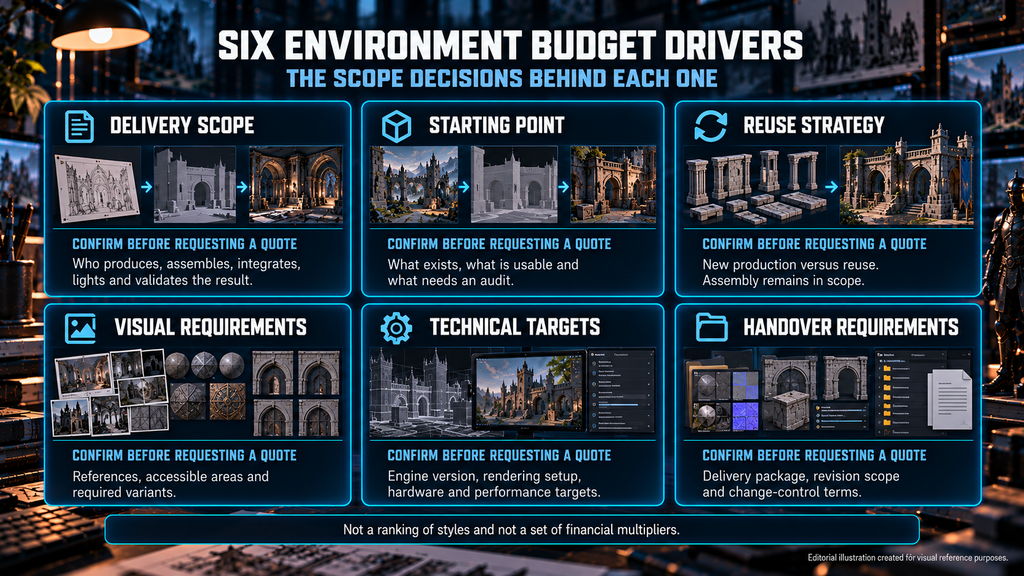
This matrix identifies work that can change an estimate. It is not a ranking of styles or a set of financial multipliers; comparisons require the other scope assumptions to stay consistent.
“Editorial illustration created for visual reference purposes. It does not represent a real project, client work, or official software screenshot unless stated otherwise.”
| Driver | What can reduce new work | What can add work | Confirm before requesting a quote |
| Delivery scope | Client retains clearly defined assembly or lighting tasks | Vendor takes on additional agreed deliverables | Who produces, assembles, integrates, lights and validates the result |
| Starting point | Suitable approved references, blockout and reusable content | Missing direction, asset repair or a new foundation | What exists, what is usable and what needs an audit |
| Reuse strategy | Compatible kit and materials reused across locations | New kits, transitions, custom landmarks or variants | New production versus reuse; assembly remains in scope |
| Visual requirements | Defined camera access, fidelity and material workflow | Added interiors, denser dressing, closer inspection or extra states | References, accessible areas and required variants |
| Technical targets | Suitable existing setup and defined acceptance criteria | Platform adaptation or additional validation requirements | Engine version, rendering setup, hardware and performance targets |
| Handover requirements | Agreed outputs and sources prepared within production | New outputs or dependencies added outside the agreement | Delivery package, revision scope and change-control terms |
The drivers interact. A detailed stylized interior can require more custom work than a larger realistic scene assembled from a suitable library. The useful comparison is what changes between two defined scopes, not which style or location label sounds more expensive.
The Same Location, Three Different Scopes
Consider an industrial courtyard with an approved blockout. This is a hypothetical example for comparing scope, not a client project or a pricing benchmark.
| Scenario | Starting point | What changes in the estimate |
| Assembly from a suitable existing kit | Approved kit and material library | Audit, required adaptation, assembly, variation and scene validation |
| Custom kit plus assembly | No suitable kit or shared materials | New kit and material foundation, new assets, then assembly and validation |
| Expanded version of the custom scope | Same starting point as the second scenario | Enterable interiors or damage states add assets, materials, dressing and checks |
These are different work packages even though the location name stays the same. Shared foundations should be accounted for once or allocated transparently across locations. Placement and QA remain real tasks after the kit exists.
Reading an Environment Quote Against These Drivers
A useful quote separates new asset work, adaptation, shared kit and material systems, scene assembly, integration and validation. It also names the required delivery package, review assumptions, unresolved decisions and change-control terms. State whether production management and risk allowances are included in the quoted lines so they are not added twice.
If the budget needs to change, ask which deliverable, variant or area can be reduced or deferred. Moving assembly or lighting to your team changes who does the work; it does not remove that effort from the project. For billing models and commercial risk, see our game art outsourcing cost guide.
What We Need to Estimate Your Environment
A rough brief is enough to start a scoping conversation. For a useful estimate, send:
- the level or location list and the delivery scope: assets, kit, assembly, or a combination;
- visual references, the art bible and any reviewed blockout or blockmesh;
- existing kits, materials and the known need for new content or variants;
- the engine version, rendering setup, target platforms and technical acceptance criteria;
- the required sources, exports and engine delivery package;
- the deadline, approval process and unresolved decisions.
On Starship Troopers: Extermination for Offworld Industries, Nasty Rodent produced environment assets and assisted in developing game locations. That work combined asset production with location support. See more visual examples in our realistic environment portfolio.
Get an environment cost estimate for your level list – send it, your target platforms and delivery requirements to sales@nastyrodent.com. We usually reply within 1–2 business days.