Vendor Lock-in in Game Art Outsourcing: Keeping Your Pipeline Portable
-

Written byDenys Zadoienyi
-

Updated on07.10.2026
-

Time to read15 min

- Six Places Dependence Hides in an Art Pipeline
- Whose Standards Does the Project Run On?
- Naming, Folders and Shared Resources: What Must Remain Accessible
- Style Knowledge: Keeping Taste Out of One Person’s Head
- Toolchain and Version Dependencies
- The Extension Test: Check Portability Before You Need It
- What to Put in Writing
- How Much Portability Is Worth Paying For
- Check Portability Before You Commit to One Vendor
- Start With One Asset Family and One Written Standard
Vendor lock-in in game art outsourcing can build up even when deliverables and ownership are defined. Dependencies may remain in undocumented conventions, shared resources the client cannot access independently, required vendor-only tools or unrecorded style decisions. These become transition barriers when another qualified team needs to continue the work.
If you are an outsourcing decision-maker, this guide covers the technical side of that exposure: what to keep accessible and under your control to run a portable art pipeline, how to test continuation by another team, and how much additional portability an engagement justifies. It addresses usage rights where they affect continuation, without repeating a full guide to IP ownership or termination.
What is vendor lock-in in game art outsourcing? Vendor lock-in in game art outsourcing occurs when supplier-specific dependencies prevent another qualified team from continuing the work, or make that transition disproportionately costly. The barrier may be access to resources, undocumented decisions or necessary usage rights. Ordinary onboarding and minor rework do not, by themselves, establish lock-in.
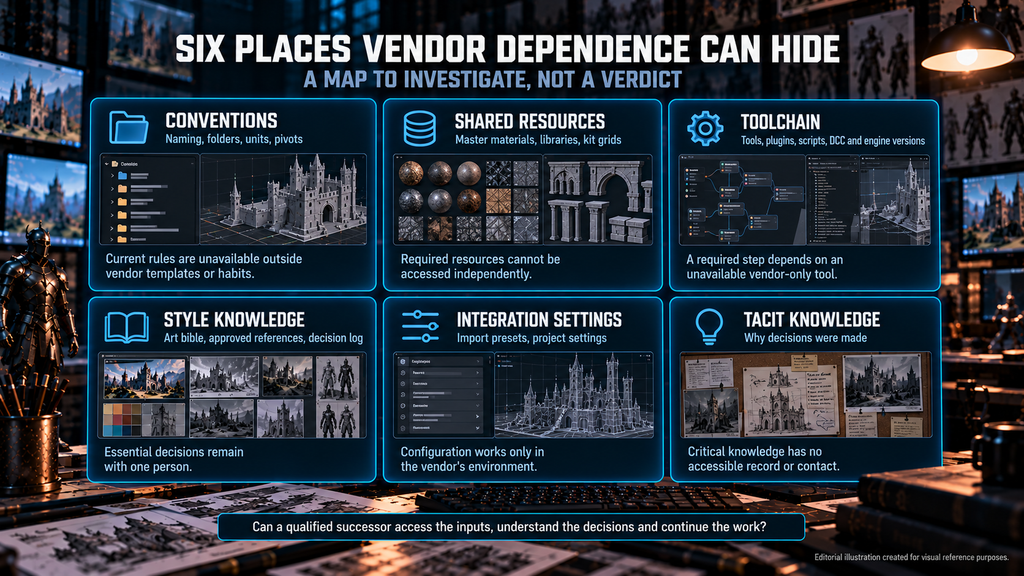
Six Places Dependence Hides in an Art Pipeline
The six areas below are a practical map of potential dependencies, not an exhaustive classification or an industry standard. For each one, ask whether an appropriately qualified successor can access the required inputs, understand the decisions and continue the work.
A transition under schedule pressure leaves less time to resolve missing inputs or undocumented decisions. Separate normal onboarding from dependencies that require the incumbent vendor’s cooperation or substantial replacement work.
For an art director, undocumented style decisions create a risk of inconsistent interpretation. An approved reference set, current guidance and an available reviewer can reduce that risk, although a new team may still need calibration.
“Editorial illustration created for visual reference purposes. It does not represent a real project, client work, or official software screenshot unless stated otherwise.”
| Area | Potential dependency | What supports portability | Responsibility |
| Conventions: naming, folders, units, pivots | Current rules are unavailable outside vendor templates or habits | An accessible, versioned project specification and examples | The client approves project rules; contributors follow them |
| Shared resources: master materials, libraries, kit grids | Required resources or dependencies cannot be accessed independently | Approved versions, complete dependencies, appropriate usage rights and a named maintainer | A maintainer designated by the client |
| Toolchain: tools, plugins, scripts, DCC and engine versions | A required step depends on an unavailable vendor-only tool | An obtainable, licensed and tested toolchain, or a validated alternative | Technical owner, with vendor input |
| Style knowledge: art bible, approved references, decision log | Essential decisions remain with one person | Current guidance, approved references, recorded decisions and an available reviewer | A reviewer and documentation owner designated by the client |
| Integration settings: import presets, project settings | Necessary configuration is missing or works only in the vendor’s environment | Accessible presets and configuration validated in the target project | Technical owner |
| Tacit knowledge: why decisions were made | Critical knowledge has no accessible record or alternative contact | Documented reasoning, knowledge sharing and defined handover support | Relevant leads and documentation owners |
Whose Standards Does the Project Run On?
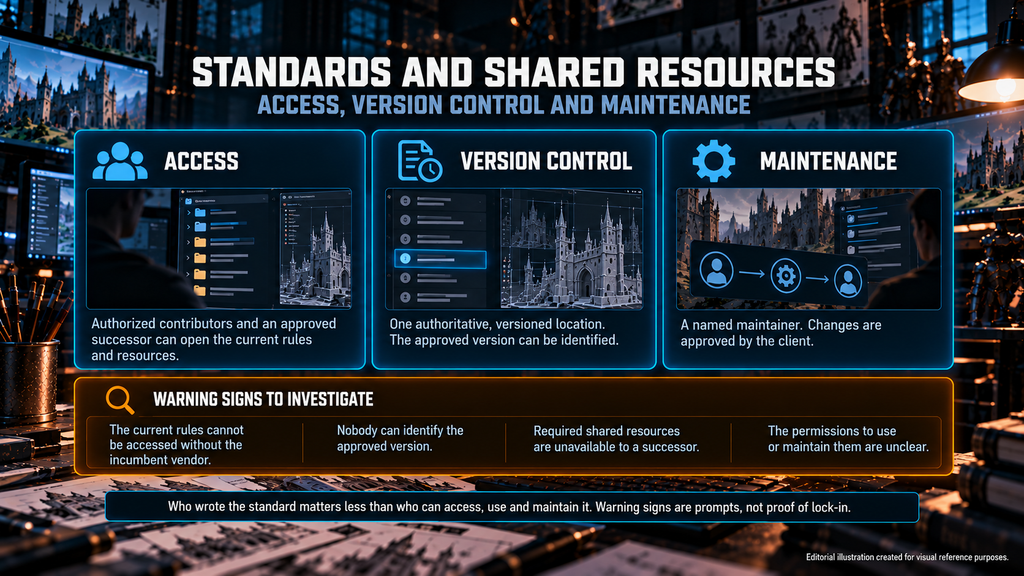
Portability depends less on who originally wrote a standard than on whether the client and an approved successor can access, use and maintain the current project rules. A vendor-supplied template can be portable if the necessary permissions and documentation remain available after the engagement ends.
Ask who approves changes, where the authoritative version is kept and what access remains available during a transition.
“Editorial illustration created for visual reference purposes. It does not represent a real project, client work, or official software screenshot unless stated otherwise.”
Four warning signs deserve investigation:
- the current rules cannot be accessed without the incumbent vendor;
- nobody responsible for the project can identify the approved version;
- required shared resources or dependencies are unavailable to a successor;
- the permissions needed to use or maintain those resources are unclear.
These are prompts for investigation, not proof of lock-in. Receiving a documented resource package from a vendor can support portability; it does not have to remain inside the live client project.
Our asset import guide describes treating the agreed pipeline specification as a contract rather than a guideline. For portability, that specification also needs an accessible current version and a defined change process.
Our Terms & Conditions exclude the company’s proprietary tools, scripts, pipelines and pre-existing IP, and third-party components under separate licenses, from IP transfer unless the project agreement states otherwise. If continuation depends on any such component, clarify its permitted use, availability and alternatives.
Epic’s guidance for Unreal projects recommends establishing a common asset naming convention early for large projects, and says project requirements take precedence. It does not assign ownership of conventions. Our practical recommendation is to agree project rules, name their approver and make the current version available to every authorized contributor.
Conventions and shared resources should remain accessible in an authoritative, versioned location that an approved successor can use. That may be the client’s project, a repository or a documented resource package. Name who maintains it and how changes are approved.
Record the naming convention in the technical specification, together with folder structure, units and pivot placement, and check that delivered assets follow it. For modular work, also document the dimensions and connection rules needed to extend the kit. Our modular kit guide describes naming that identifies the kit family and connection type. Naming helps identify compatible pieces; it does not replace the kit’s geometric and technical requirements.
A shared master material centralizes maintenance, as our Material Editor guide explains. For portability, retain the approved material version and its required dependencies, including referenced textures, functions and any necessary plugins or configuration.
Changes in a vendor’s separate project do not automatically update a delivered client copy. The relevant questions are which version the client uses, whether all dependencies are available, and who approves updates. Validate the resource in the successor’s intended environment rather than relying on its storage location.
The principle applies across engines: identify the approved resource, its dependencies, the rights needed to use it and the process for maintaining it.
Style Knowledge: Keeping Taste Out of One Person’s Head
Undocumented or outdated style guidance makes continuation harder because a new team must infer decisions from existing work. Current references and an available reviewer reduce that uncertainty, but documentation does not replace artistic judgment or calibration.
An art bible covers the written part. Our art bible guide is clear that someone has to own updates and that a visible version history tells a vendor which version is current. For portability, three more items matter: an approved reference set, meaning approved assets and relevant visual references that demonstrate the intended quality and style; a log of the decisions that changed the style, and why; and a named reviewer on the client side who can approve or reject without waiting for the vendor’s lead.
A useful decision-log entry is short: the decision, the date, the reason, the reference asset that shows it and the person who approved it. Written that way, a log lets a new reviewer see why an earlier call was made instead of guessing from the result.
Without these records, a second studio may have to infer the reasoning behind delivered assets. That creates a risk of carrying forward an earlier interpretation that no longer matches the project’s intent.
Toolchain and Version Dependencies
Continuing the work requires a compatible workflow, not necessarily every tool used by the original vendor. Identify what is needed to edit the agreed source formats, extend the asset family and integrate the result into the target project.
Our hidden costs guide recommends asking which source files are included, in what formats, and whether proprietary tools or plugins are required to open them. For portability, also ask what is required to produce and validate new work to the same acceptance criteria.
Record the required engine, DCC, plugin and script versions; where each component can be obtained; the applicable usage permissions; and any tested alternatives. A version list alone is insufficient if a required build is unavailable or a successor cannot lawfully use it. Do not assume a newer application version will preserve compatibility.
Separate required dependencies from tools used only for the vendor’s internal convenience. An internal tool does not need to be transferred if another qualified team can meet the agreed requirements without it.
For each required vendor-controlled dependency, choose a supported route: agreed access or a suitable license; a tested replacement workflow; or explicit acceptance of the dependence and its consequences. A manual alternative needs validation for output quality, effort and integration before it can be treated as a solution.
A commercial plugin available independently may create cost or toolchain dependence without creating dependence on the art vendor. Record those risks separately.

The Extension Test: Check Portability Before You Need It
An extension test asks an appropriately qualified artist who has not worked on the asset family to create one new member using the agreed brief, current standards, authorized resources and a compatible toolchain. It can reveal barriers to continuation. Questions are evidence to investigate, not automatic proof of lock-in.
The steps are:
- Pick a representative asset family with accepted examples and define the new asset’s scope, acceptance criteria and test budget.
- Choose an artist with the relevant discipline, style and tool skills who has not worked on that family.
- Provide the current specification, style guidance, approved examples, required editable files, shared dependencies and access to a compatible toolchain. Confirm the applicable permissions and confidentiality arrangements before sharing materials externally.
- Run the work in a separate test workspace or branch. Allow normal clarification and record questions and answers, regardless of the communication channel.
- Review the asset against the agreed criteria, including integration into the target project. Record blockers, rework and any support required from the incumbent vendor.
- Distinguish missing dependencies or undocumented requirements from ordinary clarification, new creative decisions and skill gaps. Assign actionable issues to owners, apply the relevant fixes and repeat affected checks where necessary.
A delivery check can establish whether the agreed source files, exports and engine content work in the agreed environment, as explained in our guide to source files and handover. The extension test adds a different observation: whether another qualified artist can produce and integrate new work. Neither check replaces the other.
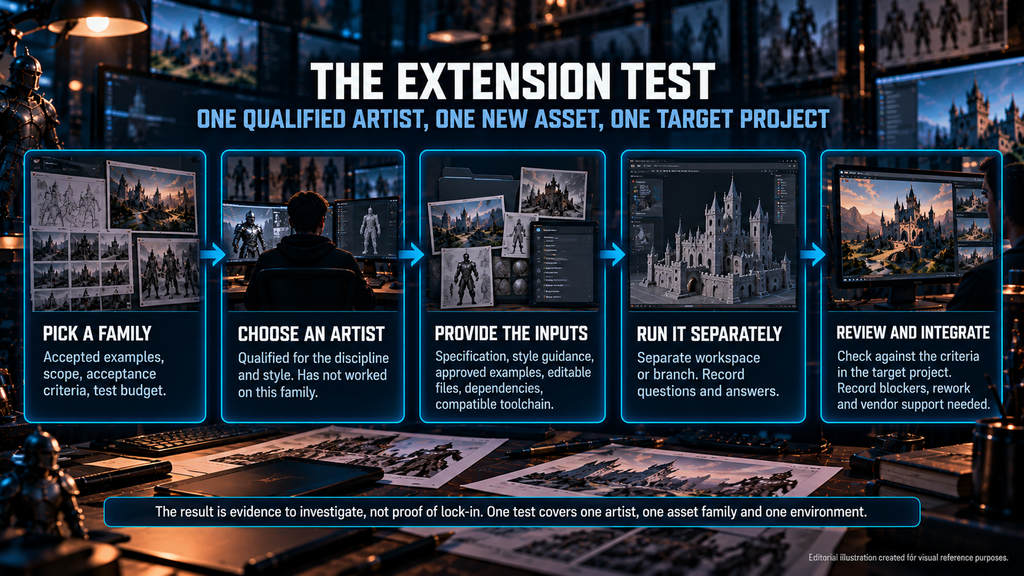
“Editorial illustration created for visual reference purposes. It does not represent a real project, client work, or official software screenshot unless stated otherwise.”
Consider an invented log. It is not a client project and not a benchmark.
| Observation | Possible issue | Follow-up |
| Which prefix do wall pieces use? | Missing or unclear convention | Check the current specification and add the rule if absent |
| Where is the painted-metal master material? | Missing shared resource or dependency | Provide the approved version and dependencies, confirm permitted use and validate integration |
| Which plugin generates the trim sheet? | Required toolchain dependency | Confirm whether it is necessary, obtain a compatible licensed version or test an alternative |
| Is this wear level appropriate? | Unclear reference or a new creative decision | Ask the designated reviewer; record guidance if it should govern future assets |
| Why are collision shapes simplified here? | Undocumented integration requirement | Confirm and document the applicable rule, then validate the result |
One test covers one artist, asset family and environment. It does not certify the entire pipeline or rank all dependencies. Prioritize verified blockers by their effect on continuation, not by the number of questions asked.
If no suitable artist is available in-house, a paid test with a second studio can play that role; our vendor selection checklist covers the paid test stage.
What to Put in Writing
Each area has something that belongs in the technical specification or the SOW, and some of them are easy to omit.
| Area | What to record | Where it fits |
| Conventions | Current naming, folder, unit and pivot rules; authoritative location; approver | Technical specification exhibit |
| Shared resources | Approved versions, dependencies, access location, permitted use, maintainer and change process | Technical specification and applicable rights terms |
| Toolchain | Required compatible versions, availability, licensing responsibilities, vendor-controlled dependencies and tested alternatives | Technical specification or delivery terms |
| Style knowledge | Current art bible, approved references, decision log and designated reviewer | Documentation exhibit |
| Integration settings | Required presets, configuration and target environment; how integration is validated | Technical specification |
| Tacit knowledge | Relevant roles, knowledge records and agreed transition support | SOW and transition cooperation terms |
Our RFP and SOW guide shows the technical specification exhibit and the termination terms; the table above adds what the specification should name for portability.
Ownership of delivered work and delivery of source files are separate questions, as our guide to NDA, IP and contracts explains, and neither replaces the items above. A client can own the work and still depend on the vendor to extend it.
Where continuation requires vendor-owned or third-party material, agree what the client and an approved successor may use, modify or receive. Check the applicable license and confidentiality terms; ownership of final deliverables does not automatically grant these permissions.
If transition support is needed, agree its scope, responsible roles, availability, duration and fees before relying on it. That may include a handover session or answers to defined technical questions. This is a practical planning suggestion, not a standard clause or a promise that support will be free.
How Much Portability Is Worth Paying For
The appropriate investment depends on expected reuse, asset criticality, shared dependencies, replacement options and the consequences of a transition. Engagement length is one input, not a sufficient rule.
Every engagement needs usable agreed deliverables and the rights required for their intended use. If future editing or extension is required, the relevant inputs and dependencies also need an agreed access route. Additional portability work may include documentation, maintenance, licenses, testing and remediation. A designated maintainer can be internal or external; the client needs control and continuity, not necessarily an entirely in-house team.
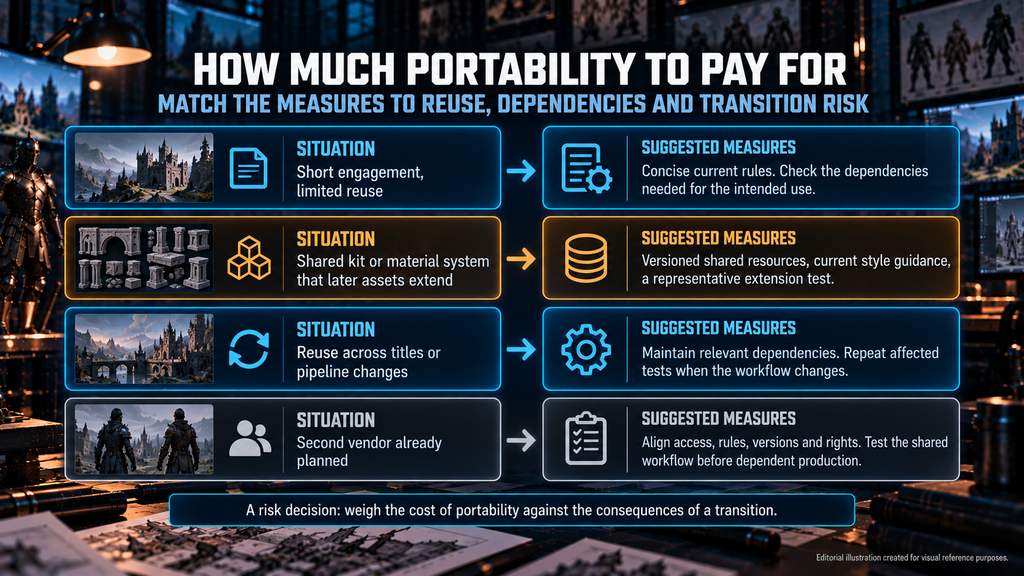
“Editorial illustration created for visual reference purposes. It does not represent a real project, client work, or official software screenshot unless stated otherwise.”
| Situation | Suggested additional measures | Reason |
| A short engagement with limited reuse and few shared dependencies | Concise current rules and a check of dependencies needed for the intended use | Keep the effort proportionate while retaining usable deliverables and necessary rights |
| A shared kit or material system that later assets will extend | Versioned shared resources, current style guidance and a representative extension test | Later work depends on the delivered system |
| Reuse across titles or substantial pipeline changes | Maintain relevant dependencies and repeat affected tests when the workflow changes | Earlier evidence may no longer cover the new environment |
| A second vendor already planned | Align access, rules, versions and rights; test the shared workflow before dependent production | Both teams need a usable common baseline |
How much exposure to accept is a risk decision. Our vendor risk register guide treats single-vendor dependency as one of the risks to weigh, including when dual-sourcing is worth its coordination cost.
Work across several titles can increase the value of maintaining reusable standards. The following examples illustrate repeat engagements, not verified reuse of a shared pipeline.
Our case pages describe work for The Bearded Ladies on Mutant Year Zero: Road to Eden, Miasma Chronicles and Corruption 2029, with weapons part of the work described on each.
Our case pages also describe work for Offworld Industries on Squad and Starship Troopers: Extermination.
Repeat engagements show that a relationship continued. They do not show that the pipeline behind it was portable, and we do not claim that these clients tested portability. A client who returns may do so for reasons unrelated to how easy leaving would have been.
Check Portability Before You Commit to One Vendor
Use these ten checks to identify unresolved dependencies. Look for evidence of access and usability, not just the existence of a document.
- Current naming, folder, unit and pivot rules are accessible to the client and authorized contributors.
- The approved version and the person responsible for changes can be identified.
- Required shared resources and dependencies are accessible in approved versions, with a named maintainer.
- The necessary toolchain is documented, obtainable and usable under the applicable permissions; vendor-controlled items are identified.
- Required editable formats and engine, DCC and plugin compatibility have been checked in the intended environment.
- The art bible has an update owner and an identifiable current version.
- Approved references, relevant decisions and a designated reviewer are available.
- A qualified artist unfamiliar with the family has produced and integrated a representative new asset, or the test’s omission and resulting uncertainty are recorded.
- The agreement identifies required documentation, usage permissions and any transition support being relied on.
- The investment matches the consequences of dependence, with unresolved items and accepted limitations recorded.
An open item identifies uncertainty or a dependency to investigate. It is not a verdict on the vendor. Even a completed test applies only to the scope and environment actually checked.
Start With One Asset Family and One Written Standard
Start with one asset family. Assemble the current rules, required resources and dependencies, toolchain information, usage permissions, style references and review contacts. Ask a qualified artist unfamiliar with the family to create and integrate a representative new asset.
Use the observed blockers to choose the next improvement. One test provides evidence about the work tested; it does not identify the weakest part of the entire pipeline. The aim is to make continuation by another team a realistic option, so the decision to stay with a vendor remains a choice.
Want a portable art pipeline another qualified team can use? Ask for a portability review: send your asset spec and technical brief to sales@nastyrodent.com, or use the request form on our services page. We get back to you within 1–2 business days to discuss the scope.