
Generative AI in Game Development: A 2026 Production Reality Check
-

Written byDenys Zadoienyi
-

Updated on27.07.2026
-

Time to read13 min

- Why the “AI Revolution” Narrative Doesn’t Match the Data
- What to Actually Check Before You Adopt an AI Tool
- Where Generative AI Fits in a Production Pipeline – and Where It Doesn’t
- Where the Trap Is Hidden: Studio-Tier Context Changes the Math
- AI Governance Questions Before Any Production Pilot
- Why the Craft Layer Still Matters
- How to Adopt Generative AI Without Wasting Budget
- How Nasty Rodent Approaches AI in Production
AI in game development means different things depending on who’s talking. This article is specifically about generative AI – large language models, image generators, coding assistants, and related production tools – not the traditional game AI that’s existed for decades in pathfinding, behavior trees, procedural systems, and NPC decision-making. That distinction matters because most of the 2026 data on adoption and sentiment, including the GDC survey this article draws on, measures generative AI usage specifically, not “AI” as a whole.
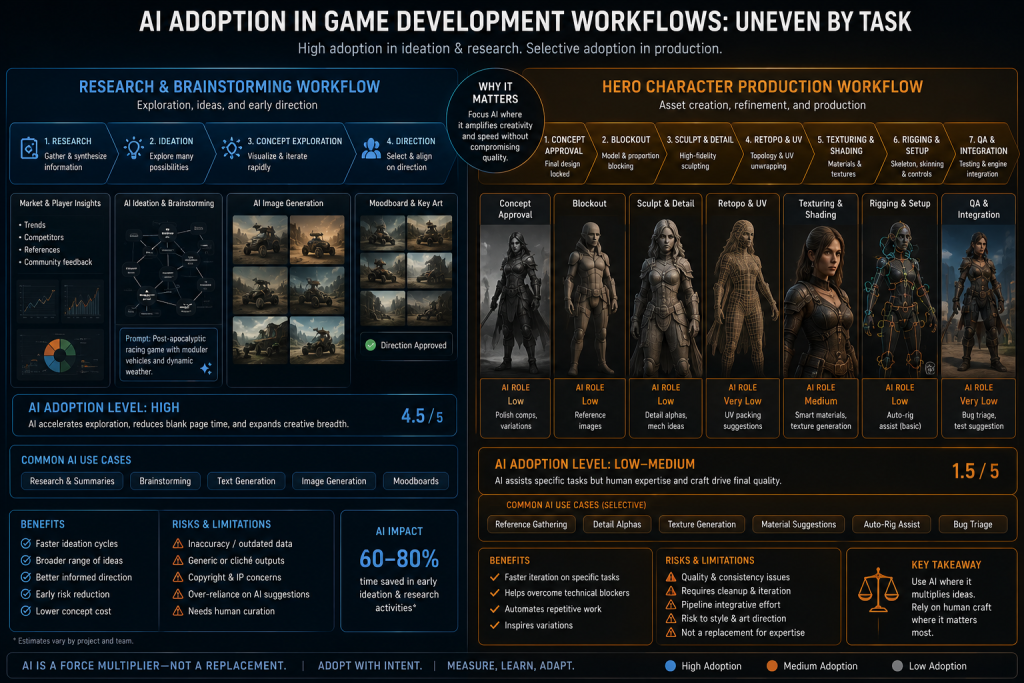
“Editorial illustration created for visual reference purposes. It does not represent a real project, client work, or official software screenshot unless stated otherwise.”
With that scope set: according to the 2026 State of the Game Industry survey – more than 2,300 professionals surveyed by the organizers of the GDC Festival of Gaming – 36% of surveyed game industry professionals use generative AI tools as part of their job, while separately, 52% of respondents believe generative AI is having a negative impact on the industry. Together, these two separate measures describe the actual state of generative AI in game development right now: real, measurable adoption, alongside substantial, measurable skepticism.
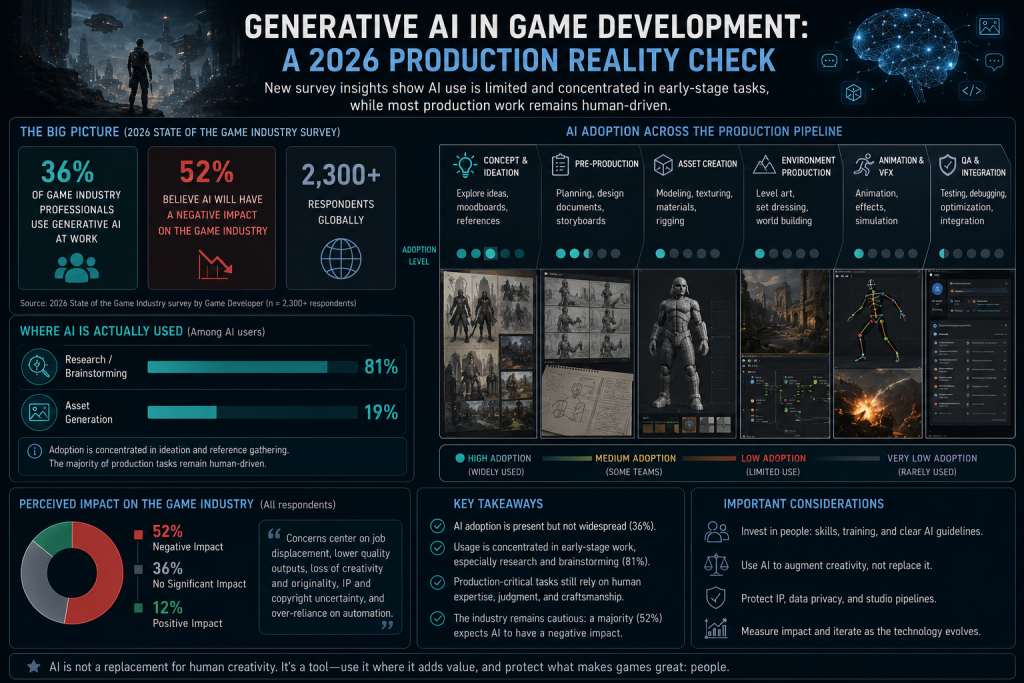
“Editorial illustration created for visual reference purposes. It does not represent a real project, client work, or official software screenshot unless stated otherwise.”
If your studio is evaluating whether – and where – to bring generative AI into your pipeline, the noise makes that decision harder, not easier. Vendor marketing tends to describe AI as a blanket transformation: faster art, cheaper production, infinite content. The GDC data tells a narrower and more specific story. This guide breaks that story down by role, by task, and by production stage – so a producer building a capacity plan or an art director setting a pipeline standard can work from numbers instead of hype.
AI in game development, as used in this article, refers to generative AI tools applied across research, ideation, production, and QA stages of building a game. In 2026, adoption is uneven across roles and tasks: it’s highest for research and administrative work, and lowest for the creative and technical-art tasks that define a game’s final quality.
Why the “AI Revolution” Narrative Doesn’t Match the Data
Most AI-in-gaming content published this year describes a single, uniform trend: AI tools embedded across engines, automating content creation, unlocking smaller teams to compete with AAA studios. That framing isn’t fabricated – parts of it are directionally true – but it collapses a genuinely uneven adoption curve into one flat storyline. For a producer trying to plan next quarter’s capacity, or an art director deciding whether to greenlight an AI tool in the character pipeline, a flat storyline is less useful than a precise one – it tells you AI is “happening” without telling you where.
The GDC 2026 survey breaks adoption down by role, and the split is significant. 58% of respondents in publishing, marketing, and business roles report using generative AI tools, compared to just 30% of respondents working directly at game studios. Upper management uses AI tools at nearly twice the rate of individual contributors (47% vs. 29%). The survey doesn’t measure why pilots succeed or fail, but the pattern is worth noting for any studio rolling out a tool: reported usage at the leadership level isn’t matched by reported usage on the studio floor, which is a reasonable prompt to involve the people who’ll actually use a tool daily before committing to it studio-wide.
The sentiment data cuts the other way. Workers in visual and technical art reported the highest negative sentiment of any discipline, at 64%, ahead of game design and narrative (63%) and programming (59%). The survey doesn’t identify a single cause for that sentiment – it could reflect concerns about output quality, authorship, training-data practices, job security, or creative control, individually or in combination. What the number does establish reliably is that the discipline closest to hands-on craft is also the most skeptical, which makes their concerns worth investigating directly during any tool evaluation, rather than dismissed as general resistance to change.

What to Actually Check Before You Adopt an AI Tool
For a mid-core or AAA producer weighing an AI tool pitch, or an art director evaluating whether a vendor’s AI-assisted workflow belongs in a production pipeline, the GDC task-breakdown data gives a genuinely useful filter. Among respondents who reported using generative AI at work, use cases broke down as follows:
- Research and brainstorming – 81% of generative-AI users. The single most common use case by a wide margin.
- Daily administrative tasks (emails, meeting notes) – 47%.
- Code assistance – 47%.
- Prototyping – 35%.
- Asset generation – 19%. A sharp drop-off from research-oriented use – this is where AI touches shippable creative content directly.
- Procedural generation – 10%. Worth reading carefully: procedural content generation existed in games long before generative AI, so this figure reflects generative-AI use within procedural workflows specifically – it isn’t a measure of how common procedural generation is overall.
- Player-facing features – 5%. The lowest reported use case among generative-AI users.
Before you greenlight an AI tool, check which bucket its primary use case falls into. A tool pitched for “asset generation” or “player-facing content” is entering the two categories where the industry’s own generative-AI users report the least usage – which is a reason to validate the tool carefully rather than proof of any single reason for the low adoption (cost, tool maturity, legal restriction, and simple lack of need can all produce the same low number). A tool pitched for research, prototyping, or admin work is entering the categories where usage is already common practice among the people using these tools at all.
The scale of the gap matters: among generative-AI users, research and brainstorming was reported more than four times as often as asset generation – a gap wide enough that “AI-assisted research” and “AI-generated game art” describe two largely different populations of practitioners and use cases, even though both get bundled under the same “AI in game development” headline.
Where Generative AI Fits in a Production Pipeline – and Where It Doesn’t
The table below reflects GDC’s usage-frequency data in the left two columns; the right-hand risk notes are Nasty Rodent’s own production-editorial assessment, not a finding from the survey itself.
| Production stage | Reported generative-AI usage pattern | Production risk to manage |
| Concept exploration / moodboard iteration | High – aligns with the survey’s top use case, research/brainstorming (81%) | Treating AI output as final concept art rather than a divergence tool feeding a human concept artist |
| Reference gathering / research | High – same category | Citing AI-summarized facts in a production brief without verifying the original source |
| Prototyping / blockout iteration | Moderate – prototyping reported at 35% | Letting prototype-stage AI shortcuts leak into production-tier asset specs without a rebuild pass |
| Texture / material variation on non-hero assets | Not separately measured by GDC; a possible low-visibility pilot area, subject to client approval | Skipping provenance, tiling, and channel-consistency checks before any variant ships at hero-asset visibility |
| Hero character art / final lookdev | Low – asset generation overall reported at 19% | Treating an AI-generated 2D concept as approved final art without construction and turnaround review, or an AI-generated 3D mesh as game-ready without validating topology, UVs, rigging compatibility, and LODs |
| NPC dialogue / narrative content | Not separately broken out in the survey’s headline data | Shipping unreviewed AI-drafted dialogue into a system with brand or tone requirements |
| Player-facing generative content | Lowest reported category – 5% among generative-AI users | Assuming low reported adoption equals poor technical fit, rather than reflecting current governance, latency, moderation, and cost constraints that are still being worked out industry-wide |
Where the Trap Is Hidden: Studio-Tier Context Changes the Math
The right generative-AI posture isn’t the same across production tiers, and this is where the narrative most often breaks down for teams reading generic AI coverage. A five-person indie team faces a different risk calculation than a AAA studio managing multiple concurrent titles – but “different” isn’t automatically “lower-stakes.” A small team may reasonably tolerate a rougher AI-assisted experiment when the realistic alternative is not attempting the task at all, since it has no spare department to fall back on. At the same time, that same small team has less slack to absorb wasted engineering or production time if the experiment doesn’t pan out – a failed pilot costs a five-person studio proportionally more than it costs a AAA studio running the same test. A mid-core or AAA producer evaluating a tool, meanwhile, is comparing it against an existing, staffed pipeline with an established quality bar – a different comparison entirely, not simply a “safer” one.
Studio scale also shapes governance capacity, not just adoption appetite. Building and maintaining an internal, access-controlled AI tool – one that doesn’t send client assets or proprietary data to a third-party model – takes engineering, legal, and security resources that larger organizations are generally more likely to have in place, though this varies by studio and isn’t guaranteed at any given AAA company. That doesn’t mean larger studios get better production results from AI by default; it means they’re generally better positioned to evaluate and govern it. For a growing mid-core studio without dedicated tooling capacity yet, the practical takeaway isn’t “adopt less AI” – it’s “adopt it first in categories where mature external tools already exist (research, prototyping) and move more cautiously in categories where governance typically needs to be in place first (asset generation, anything touching client or player-facing content).”
AI Governance Questions Before Any Production Pilot
For a producer or art director evaluating an AI tool – or an outsource vendor’s AI practices – the technical fit question (“can it do the task”) is usually easier to answer than the governance question, and the governance question is the one that actually determines whether a pilot is safe to run on client work. Before approving any generative-AI tool for use on production assets, it’s worth getting clear answers to:
- Is the tool approved for use with confidential client material, and does the client’s contract permit or restrict AI tool usage?
- Does the provider retain prompts, uploaded files, or generated outputs, and for how long?
- Can project assets be used to train or fine-tune the underlying model, and can that be disabled contractually?
- Is commercial use of the output explicitly permitted under the tool’s terms?
- Can the asset’s provenance – human-authored vs. AI-assisted, and at what stage – be documented if a client or platform asks?
- Does the target platform require disclosure when AI-assisted or AI-generated content ships with the game or is generated at runtime? Steam, for example, explicitly excludes AI-powered development efficiency tools from its disclosure requirement, but requires disclosure for AI content that ships with the game (pre-generated) or is created while the game is running (live-generated) – the distinction matters and is easy to get wrong.
- Who owns final review and sign-off on any AI-touched asset before it enters the production repository?
- Are voice, likeness, or performer rights involved anywhere in the pipeline the tool touches?
- What’s the fallback plan if the tool’s terms, pricing, or capabilities change mid-production?
A studio – or an outsource partner – that can answer these clearly is evaluating AI as a pipeline-governance question. One that can’t is running an ungoverned experiment on production assets, regardless of how good the output looks in a demo.
Why the Craft Layer Still Matters
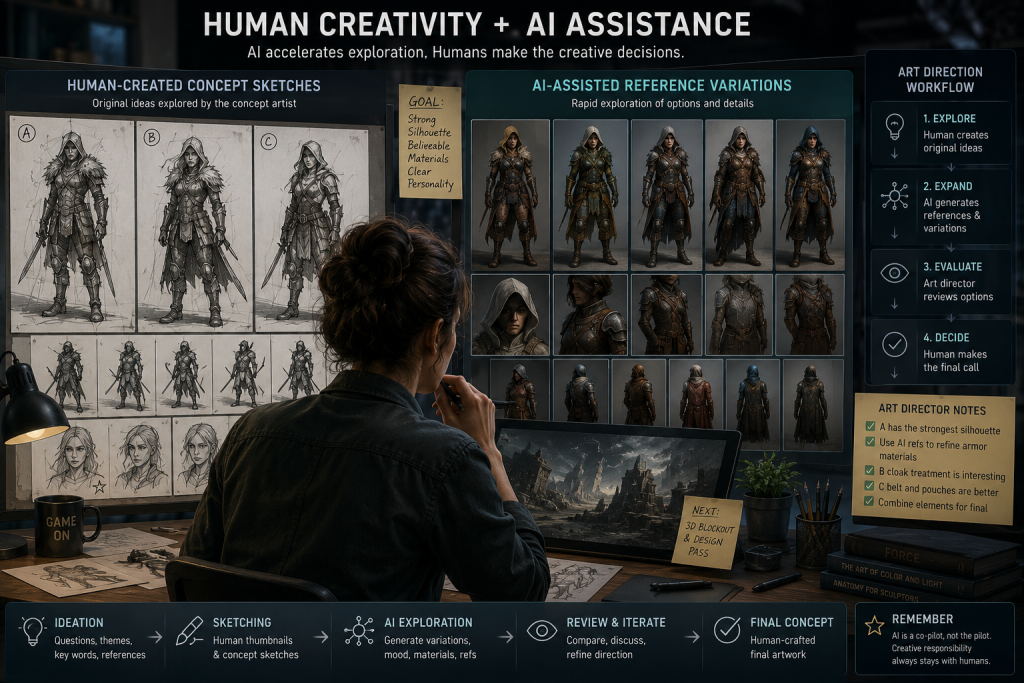
“Editorial illustration created for visual reference purposes. It does not represent a real project, client work, or official software screenshot unless stated otherwise.”
A separate but related data point, from the consumer side rather than the developer side: Deloitte’s 2026 Digital Media Trends survey of US consumers found that nearly 40% of self-identified entertainment fans would accept clearly labeled AI-created content across streaming video, social media, music services, and video games combined. That figure is cross-media, not games-specific, so it’s best read as a broad consumer-attitude signal rather than a direct measurement of how players react to AI-generated game assets specifically – but even as a broad signal, “40% acceptance, conditional on clear labeling” is a meaningfully more cautious number than the adoption enthusiasm found in most AI-tool marketing material.
For a producer, the practical cost of skipping the craft layer shows up at the moment it’s most expensive to fix: milestone review. A hero asset that was AI-accelerated at the concept stage but rushed through production without a full retopology, rigging, and lookdev pass doesn’t fail quietly – it fails at the review gate, forcing rework that a properly staffed pass would have caught earlier. For an art director, the risk compounds differently: once a single hero asset ships below the established fidelity bar, it can affect how the whole visual cast reads, not just that one asset. The 64% negative sentiment among visual and technical art professionals doesn’t prove this specific failure mode caused their view – the survey doesn’t isolate a cause – but it does mean the discipline closest to catching these issues is also the one voicing the most concern, which is a signal worth weighing during tool evaluation.
How to Adopt Generative AI Without Wasting Budget
A practical adoption sequence, based on where the 2026 data shows usage is already common among generative-AI users versus where it’s still limited:
- Start in research and prototyping. These are the categories with the highest reported usage (81% and 35% respectively) among generative-AI users – established practice, with immediate time savings for both producers scoping a project and artists exploring early direction.
- Consider piloting texture and material variation on non-hero assets, with provenance and consistency checks built in from day one. This isn’t a category the GDC survey measures separately, and it’s not a workflow every studio will find fits their pipeline – but for teams exploring where to start, it’s a lower-visibility area to test governance before touching anything hero-tier, subject to client approval.
- Keep hero asset production and player-facing content on the human-owned side of the line for now. Low reported usage in these categories (19% and 5%) doesn’t prove AI can’t do the work, but it does show these use cases remain uncommon among current generative-AI users – a reason to validate them carefully before relying on them for production, rather than an assumption about why adoption is low.
- Build (or ask a vendor for) governed AI usage before scaling past pilot stage. Larger studios generally have more resources to build and control internal tooling – that’s a governance-capacity difference, not proof that internal tools produce better creative outcomes by default. If you’re weighing outsourcing a production stage instead of building that governance internally, ask a prospective partner the same nine questions above.
- Re-evaluate on a defined cadence, not a fixed calendar guess. Reported negative sentiment moved from 18% to 30% to 52% across three consecutive annual surveys – a fast-moving trend. Tying tool and policy review to major milestones, or to changes in a model’s terms or capabilities, is more reliable than picking an arbitrary review interval.
How Nasty Rodent Approaches AI in Production
Our position on generative AI is that it’s a pipeline-governance question, not a blanket productivity claim. When a client or internal team proposes using an AI tool on a project, our standard is to evaluate it against the same governance categories outlined above – client policy, confidentiality, data handling, provenance, and review ownership – rather than adopting it simply because it’s fast or trending. Hero character work and other production-critical deliverables are held to the same technical review standards we apply across our pipeline, regardless of what tools were used to get there. If you’re evaluating an outsource partner’s AI practices as part of a vendor decision, the useful question to ask any partner – including us – isn’t whether a studio “uses AI,” but which specific pipeline stages it touches and how that use is governed. You can see the production standard we hold across shipped mid-core and AAA titles in our portfolio.

Let's work
together


in mind?
From 3D characters and environments to weapons, props, concept art and game UI/UX: ten years deep, 40+ artists strong, zero fluff. Tell us what you are making and get a free, no-pressure estimate.
estimate