Outsourcing Studio vs Freelance Marketplace: Total Cost of Ownership for Game Art
-

Written byDenys Zadoienyi
-

Updated on12.10.2026
-

Time to read12 min

- Why the Rate Comparison Misleads
- Two Ways to Source Game Art: What You Actually Buy
- When a Marketplace Freelancer Is the Right Call
- The Eight Areas to Check
- A Like-for-Like Cost Worksheet
- An Illustrative Scenario: Comparing the Same Delivery Scope
- What Studio-Led Delivery Looks Like
- Comparing a Studio Quote with a Freelancer Budget
- Quick Readiness Checklist for Managing Marketplace Freelancers
- What We Need to Compare a Quote
Choosing between a game art studio and freelancers hired through a marketplace requires comparing the full cost of delivery and ownership. The quoted production price is the starting point. Briefing, art direction, reviews, integration, continuity and handover may be included, excluded or shared with your team under either arrangement.
This guide compares individually contracted marketplace freelancers with a studio-managed team. It maps eight areas to check beyond the production price, explains when freelancers can be a good fit, and provides a worksheet and readiness checklist. Use the same scope, acceptance criteria and comparison period for both routes. Check current platform fees and contract terms before committing.
Total cost of ownership (TCO) for game art is the cost of acquiring, integrating and using the assets over a defined period. It includes vendor payments, retained internal work, applicable fees and licenses, handover, and any planned maintenance or later changes. Compare equivalent deliverables and count each cost once.
Why the Rate Comparison Misleads
An hourly rate needs an effort estimate before it becomes an asset cost. A fixed-price quote needs a clear scope and acceptance criteria. For either route, identify which tasks are included and which remain with your team. Who writes the brief and the acceptance criteria? Who reviews each delivery and keeps the style consistent? Who finds a replacement if a contributor becomes unavailable? Who checks that the rights to the work are yours? Each of these is work with an owner, and under either route that owner may be you, the vendor or both.
This article compares two ways of buying outside capacity. If the alternative you are weighing is hiring staff, see our guide to in-house versus outsourced game art, or, for a AAA (triple-A) production, our comparison of hiring a 3D artist versus outsourcing to a studio. Here the question is narrower: individual freelancers contracted through a marketplace, or a studio-managed team.
For a founder, the practical consequence is how internal capacity is allocated. Time your art lead spends on coordination, review or integration belongs in the project estimate, even when it does not appear on a vendor’s invoice.
Two Ways to Source Game Art: What You Actually Buy
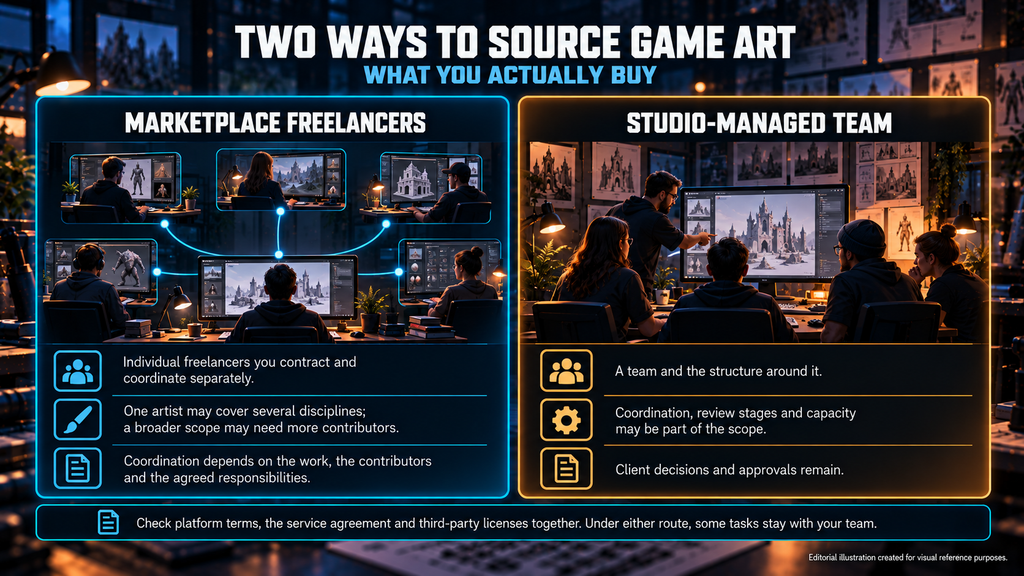
A marketplace is a sourcing channel. It may offer individual freelancers, agencies or managed teams. This comparison focuses on individual freelancers whom you contract and coordinate separately. One artist may cover several related disciplines; a broader scope may require additional contributors. The amount of coordination depends on the work, the contributors and the responsibilities agreed in their contracts.
“Editorial illustration created for visual reference purposes. It does not represent a real project, client work, or official software screenshot unless stated otherwise.”
Check the platform terms, the service agreement and any third-party asset licenses together. Confirm applicable fees, payment and dispute procedures, confidentiality obligations, and the conditions governing ownership and permitted use of the delivered work.
A studio sells a team and the structure around it. Our game art outsourcing services cover concept art through engine-ready assets under one contract. Our About page describes a dedicated project manager on every project, milestone delivery with defined acceptance criteria, and capacity that scales to the production schedule, under an EU-based legal entity with a standard non-disclosure agreement (NDA) and master services agreement (MSA) structure. These are descriptions of how Nasty Rodent works, not a guarantee about any other studio; check the same points on any quote.
When a Marketplace Freelancer Is the Right Call
A freelancer is often the right choice, and a studio is not always the better one. The route works best when most of these conditions hold:
- The task is small, self-contained and easy to specify in a brief: a single prop, a one-off illustration, a prototype asset.
- The task has a clear visual target, or exploratory work has a defined review process and budget.
- A senior artist or art director has allocated capacity to review deliveries and resolve decisions within the agreed schedule.
- The schedule has room for rework and for finding a replacement if needed.
- The work is low-risk for confidentiality, or you can manage non-disclosure and rights assignment for each person.
Agree who owns briefing, art direction, reviews, technical validation, contracts and handover. Some tasks may be handled by a lead freelancer or included in the vendor’s scope; others remain with your team. The freelance route can be cost-effective when these responsibilities are covered and included in the comparison.
The Eight Areas to Check
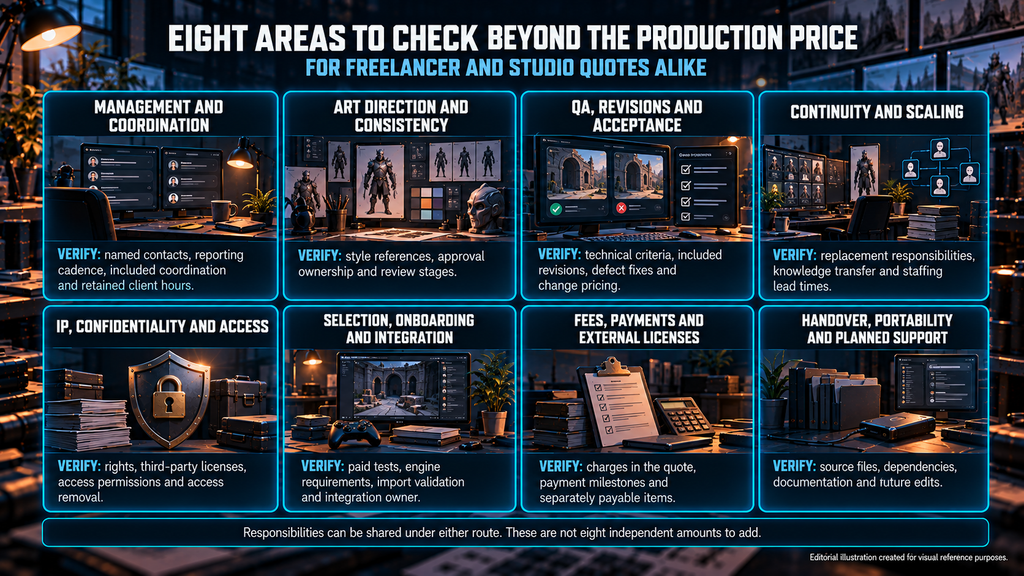
These eight areas identify work and charges that may sit outside the quoted production price. Responsibilities can be shared under either route. Use the table to check both proposals; the rows are not eight independent amounts to add automatically.
“Editorial illustration created for visual reference purposes. It does not represent a real project, client work, or official software screenshot unless stated otherwise.”
| Cost area | Individually contracted marketplace freelancers | Studio-managed team | What to verify on both sides |
| Management and coordination | Client-led unless coordination is assigned to a lead contributor | Vendor coordination may be included; client decisions and approvals remain | Named contacts, reporting cadence, included coordination and retained client hours |
| Art direction and consistency | Owned by the client or an appointed contributor | An art lead may be included in the scope | Style references, approval ownership and review stages |
| Quality assurance (QA), revisions and acceptance | Checks and revisions depend on the agreed scope | Internal checks may be included; client acceptance is still required | Technical criteria, included revisions, defect fixes and change pricing |
| Continuity and scaling | Backup capacity and onboarding need an agreed plan | Internal reassignment may be available, subject to capacity and terms | Replacement responsibilities, knowledge transfer, staffing lead times and any extra cost |
| Intellectual property (IP), confidentiality and access | Platform terms and service agreements need checking | Studio agreements and subcontractor arrangements need checking | Rights, third-party licenses, access permissions, file handling and access removal |
| Selection, onboarding and integration | Selection, test work and pipeline setup may require client effort | Vendor evaluation, pipeline setup and integration may also require client effort | Paid tests, engine requirements, import validation and ownership of integration tasks |
| Fees, payments and external licenses | Platform, payment, currency and license charges may apply | Payment, currency and license charges may also apply | Charges included in the quote, payment milestones and separately payable items |
| Handover, portability and planned support | Editable files, documentation and later support depend on the agreement | The same deliverables and support need to be specified | Source files, dependencies, documentation, future edits and transfer to another provider |
Continuity and quality control depend on the delivery setup. If a contributor has no backup or independent review process, those responsibilities need an owner elsewhere. A studio may provide both, but confirm the people, capacity and contract terms behind that promise. Our guide to game art outsourcing failures covers issues to check under either route. For the legal side, see our guide to IP, NDAs and contracts.

A Like-for-Like Cost Worksheet
Use the same cost structure for both routes:
TCO for each route = V + I + E + P
- V – Vendor payments: the quoted work and agreed additional vendor services.
- I – Retained internal work: selection, briefing, coordination, art direction, reviews, legal administration, integration and acceptance performed by your team. Estimate hours by role and apply the same internal costing method to both routes.
- E – External charges: applicable platform and payment fees, licenses and other third-party costs not already included in V.
- P – Planned post-delivery work: support, edits, documentation or transfer work within the comparison period, excluding anything already counted above.
Count each item once. Included revisions belong in the vendor price; additional revisions need a separate estimate. Vendor QA does not remove the client’s acceptance and integration work.
The cost break-even point occurs when the two totals are equal for equivalent deliverables. A higher vendor quote can still produce a lower total if it reduces other costs sufficiently. That result must come from the project estimates. Evaluate uncertain replacement, rework and delay separately as scenarios. State what triggers each scenario and add only its incremental cost. Avoid counting the same internal hours a second time as another charge.
| Input | Freelance route | Studio route |
| Vendor scope and payment | Record included deliverables, checks and revisions | Record the same |
| Internal hours by role | Estimate selection, management, review and integration | Estimate the same retained tasks |
| Internal cost basis | Use a stated, consistent method | Use the same method |
| External charges | Identify fees and licenses outside the quote | Identify charges outside the quote |
| Planned post-delivery work | Estimate within the chosen period | Use the same period |
| Risk scenarios | Record assumptions for replacement, rework or delay | Test equivalent scenarios |
This worksheet is a comparison structure, not a researched forecast of savings.
Factors that can change the comparison
- More contributors and handoffs: coordination and review effort may rise. Estimate the actual team structure; one artist may cover several disciplines.
- Tightly connected visual work: a shared art direction process becomes more important. Check how either proposal provides it.
- Limited internal capacity: retained management and review work may compete with other priorities under either route.
- Milestone dependence on one contributor: compare backup capacity, knowledge transfer and the cost of disruption.
Small, well-defined tasks and available internal review capacity can favor freelancers. A studio may be a better fit when its agreed services reduce work your team cannot absorb. A mixed model is also possible, provided someone owns the interfaces between contributors.
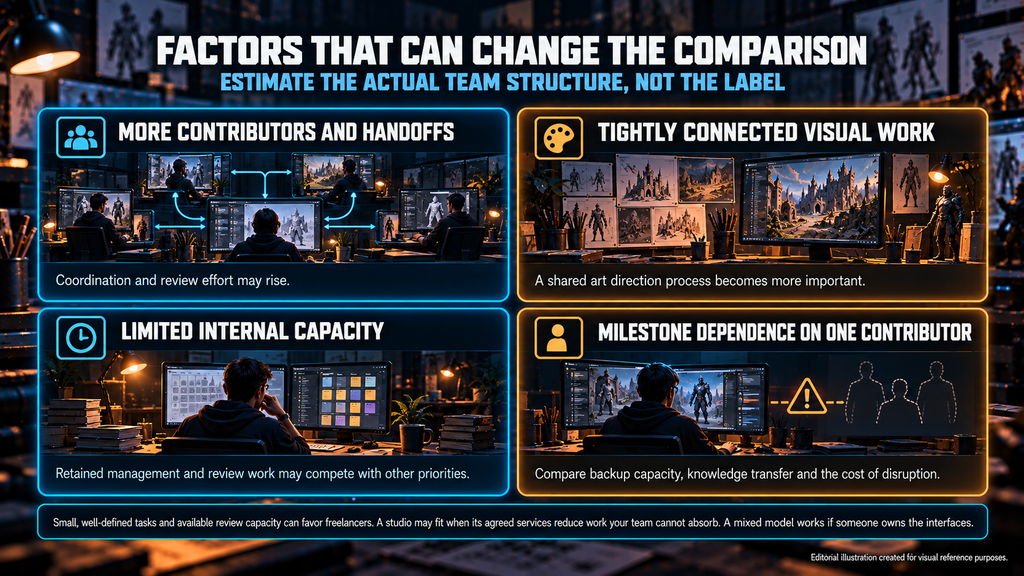
“Editorial illustration created for visual reference purposes. It does not represent a real project, client work, or official software screenshot unless stated otherwise.”
An Illustrative Scenario: Comparing the Same Delivery Scope
This is a hypothetical scenario, not a client case. A small team needs a modular environment kit and props. It considers several individually contracted freelancers and a studio-managed team. Both receive the same asset list, visual references, technical requirements and acceptance checklist.
The freelancer estimate includes each contributor’s scope, coordination by the producer, shared reviews, integration and a backup plan. The studio estimate identifies included art direction, QA and coordination, plus the client’s remaining review and integration work.
If production starts with freelancers and the team later considers a studio, the new quote also needs an audit of existing files, reusable work and any conversion or rework. Switching providers has a cost under either model.
The decision follows the comparable totals and delivery requirements. Either route can be the better fit, depending on scope and available capacity.
What Studio-Led Delivery Looks Like
On Wild Rage, Nasty Rodent partnered with Whimsy Games to lead and develop the art direction for the game, covering concept art, character design, weapons, props and environment assets, with the aim of a cohesive visual style and consistent quality across the project. For Offworld Industries, we worked on two separate projects: Squad, with concept art and unique skins plus final vehicle and weapon assets, and Starship Troopers: Extermination, with props, environment assets and help developing game locations.
In a testimonial on our About page, Whimsy Games CEO Denys Kliuch describes support from 15+ specialists across several disciplines, including pipeline structuring, art direction and team coordination. The testimonial illustrates production scope and organization; it does not quantify savings against freelancers.
Comparing a Studio Quote with a Freelancer Budget
A fair comparison puts both sides on the same footing:
- Same scope and deliverables. Specify required asset exports, editable source files, engine setup, documentation and acceptance checks. These deliverables can be required together; each needs a clear definition. Our guide to the source files handover package covers what to ask for, and our guide to hidden costs in game art outsourcing lists items a quote can leave out, such as revisions beyond included rounds, engine adaptation and post-delivery support.
- Your hours under both routes. Include retained selection, briefing, management, review, legal administration, integration and acceptance work using the same costing method.
- What the studio price includes. Ask which management, art lead review and quality control are inside the number.
- Revision and acceptance terms. Compare included rounds, acceptance criteria and how extra rounds are priced.
- Replacement and continuity. Ask what happens if a person leaves, on either route.
- Rights, confidentiality and access. Compare ownership terms, third-party licenses, subcontractor coverage and practical file-access arrangements.
- Payment terms. Compare schedules, currency and any platform fees or charges.
If either quote is higher, identify which responsibilities it covers and compare the remaining client work before deciding.
Quick Readiness Checklist for Managing Marketplace Freelancers
Use these questions to identify uncovered responsibilities. This checklist assesses readiness; it does not predict which route will cost less.
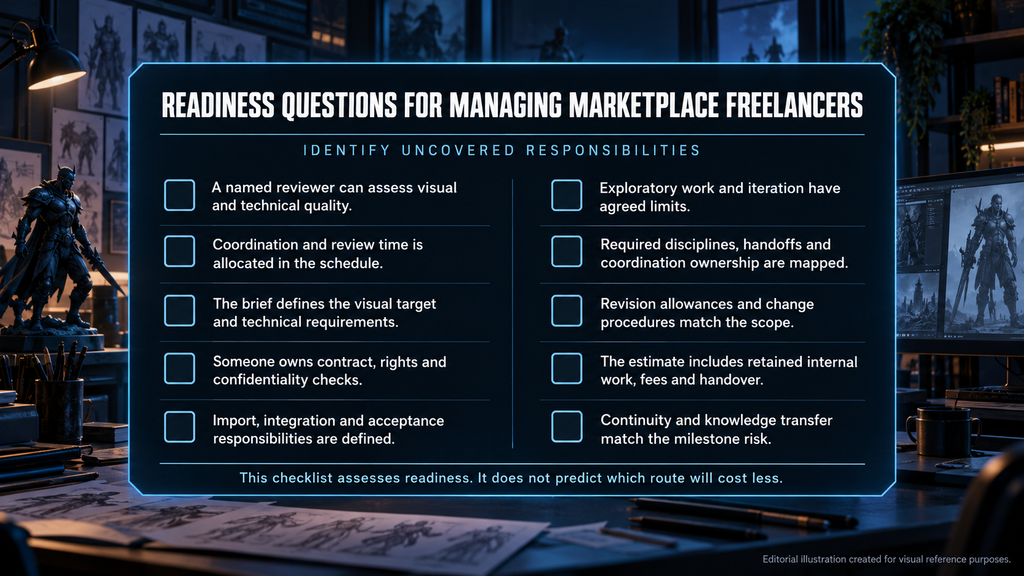
“Editorial illustration created for visual reference purposes. It does not represent a real project, client work, or official software screenshot unless stated otherwise.”
- A named reviewer can assess visual and technical quality.
- Coordination and review time is allocated in the current schedule.
- The brief defines the visual target and technical requirements.
- Someone owns contract, rights and confidentiality checks.
- Import, integration and acceptance responsibilities are defined.
- Exploratory work and iteration have agreed limits.
- Required disciplines, handoffs and coordination ownership are mapped.
- Revision allowances and change procedures match the scope.
- The estimate includes retained internal work, applicable fees and handover.
- Continuity and knowledge-transfer arrangements match the milestone risk.
For each unanswered item, assign an owner, estimate the work or resolve it before production starts. A studio quote may cover some gaps, but verify that coverage in writing. Once responsibilities and deliverables are comparable, use the worksheet to compare costs.
What We Need to Compare a Quote
A rough brief is enough to start. Send:
- asset types, approximate counts and the intended scope;
- visual references and any art bible;
- engine version, target platforms and technical requirements;
- required exports, editable sources, documentation and integration responsibilities;
- deadlines, milestones and acceptance criteria;
- your reviewer, available internal capacity and the freelancer estimate being compared;
- any planned support or later changes within the comparison period.
Compare a studio quote against your freelancer budget – send your asset list to sales@nastyrodent.com. We usually reply within 1–2 business days.