How to Read a Game Art Studio’s Estimate: Line Items Explained
-

Written byDenys Zadoienyi
-

Updated on07.09.2026
-

Time to read8 min

- What a Line Item Actually Represents
- A Sample Estimate, Annotated Line by Line
- Line Items That Signal a Well-Structured Quote
- Line Items That Often Go Missing From a First Draft
- When One Line Is Hiding Several Deliverables
- Vague Line Item vs. Well-Defined Line Item
- How We Structure Estimates at Nasty Rodent
“Editorial illustration created for visual reference purposes. It does not represent a real project, client work, or official software screenshot unless stated otherwise.”
Reading a game art outsourcing estimate is a different skill from comparing two estimates against each other. Comparing quotes is about spotting why two numbers differ – billing model, assumptions, team composition – and we’ve covered that ground in our guide to what drives game art outsourcing cost. Reading one is narrower and more literal: knowing what a specific line on the document is actually pricing, so a single total doesn’t hide five different deliverables you never separately agreed to.
What a Line Item Actually Represents
A line item is supposed to isolate one deliverable, or one clearly bounded piece of work, so it can be reviewed, questioned, and changed independently of everything else on the estimate. In practice, how granular a studio makes its line items varies widely – some break a single character down into modeling, texturing, and rigging as three separate rows; others fold all three into one “character – complete” line and let the accompanying scope notes carry the detail instead. Neither approach is inherently wrong. What matters for reading the document is knowing which one you’re looking at, because a single broad line item is only as trustworthy as the scope notes sitting next to it.
A Sample Estimate, Annotated Line by Line
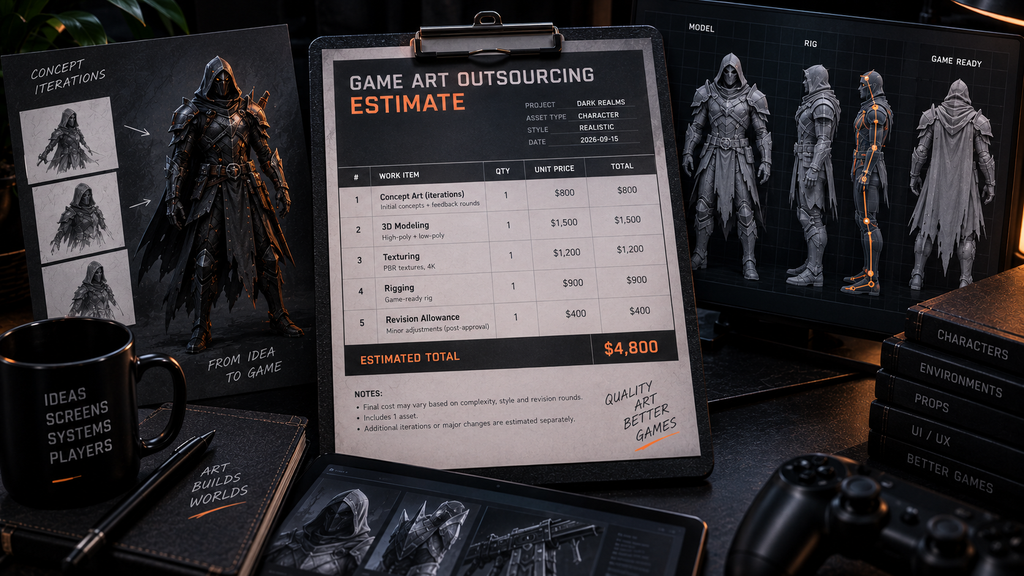
The table below is an illustrative example built for this article – it does not represent an actual Nasty Rodent quote, client data, or real pricing, and none of the figures should be read as representative of what any specific project would cost. It’s built around a hypothetical character batch for a stylized fantasy-style title, purely to give each common line item type something concrete to sit next to. Not every category below will necessarily appear as its own separately priced row – depending on the studio and billing model, some may live in the scope notes, stated assumptions, or inclusions/exclusions instead.
| Line item | What it typically covers | What to check for |
| Concept iteration | Early visual exploration – silhouette studies, style-direction passes, sometimes multiple concepts per asset before one is approved | How many rounds are included before an additional round is billed separately |
| 3D modeling / sculpting | The core 3D form of an asset, from high-detail sculpt through to a production mesh | Whether the line covers high-detail modeling only, or also includes the game-ready mesh |
| Retopology and optimization | Rebuilding a high-detail model into a clean, game-ready mesh at an agreed poly budget | Whether LOD levels are included, and how many |
| UV layout, baking, and texturing | Unwrapping the model, baking detail maps, and producing the texture set – for example base color/albedo, normal, roughness, metallic, AO, or project-specific packed maps | Texture resolution and map count, since both vary widely by fidelity tier and engine target |
| Rigging | Building the skeleton and control system that lets the asset animate or deform in-engine | Whether this covers a standard humanoid rig or a custom rig for non-standard anatomy |
| Revision allowance | A defined number of feedback cycles included in the price before further rounds are billed separately | What counts against the allowance – a studio error, a direction change, and new scope are not the same thing |
| PM / production coordination | Project management, scheduling, client communication, and delivery tracking required to run the engagement | Whether this is a visible line or folded into the rate elsewhere on the estimate |
| Contingency | A risk allowance for unresolved ambiguity in the brief, more commonly relevant to fixed-price estimates where the studio is absorbing defined scope risk | Whether it’s stated explicitly or embedded, and what specific uncertainty it’s intended to cover |
| Engine integration and validation | Importing and testing the asset inside your actual engine, rather than delivering a static export | Whether this is included at all, or listed as a separate, optional line |
| Source file delivery | The editable working files behind the final asset – not just the exported, game-ready result | Format, and whether any proprietary tools are needed to open them |
This is an illustrative example, not a rate card or a claim about any specific project’s real numbers. The categories are common across the industry; the specific line count, grouping, and terminology will vary by studio and by project.
Line Items That Signal a Well-Structured Quote
A well-structured line item does two things at once: it names a deliverable specifically enough that you could describe it back to the studio in your own words, and it states what would move it – what triggers an additional charge, and what’s covered by the number already on the page. “Character modeling – base mesh only, retopology and UV billed separately” tells you exactly what you’re getting and what comes next. “Character – complete” tells you almost nothing until you read the scope notes, and if there are no scope notes, you’re reading a placeholder rather than a line item.
The same test applies to revision allowances and contingency. A revision line that states a specific round count and what counts against it is something you can hold the studio to. A contingency line with no stated basis is a number you can’t evaluate, because you don’t know what risk it’s actually covering. None of this means a vague line is dishonest – studios structure quotes differently, and some genuinely fold detail into an accompanying scope document rather than the line-item table itself. It means a vague line item is a prompt to ask a specific question before signing, not a reason to assume the worst about the number.

Line Items That Often Go Missing From a First Draft
A handful of deliverables tend to get left off an estimate not because a studio is hiding them, but because they’re easy to treat as implied rather than itemized. Source file delivery is easy to leave implicit – a quote can price the final, exported asset clearly while staying silent on whether the editable project files are included at all, which is a meaningfully different commitment. Engine integration and validation is another: a static export that “looks right” in a viewer is not the same deliverable as an asset tested and confirmed working inside your actual build. PM and coordination time can be overlooked as well – it’s real cost either way, whether it shows up as its own line or gets absorbed into the rate, and a quote that’s silent on it isn’t necessarily hiding it, but it’s worth asking where that time is actually priced.
Building the fuller list of what to specify before an estimate is even requested is the job of a well-structured RFP – we cover that process directly in our guide to RFP and SOW practices for game art outsourcing, and how source-file ownership specifically should be written into the resulting contract is covered in our breakdown of what belongs in a game art outsourcing contract.
When One Line Is Hiding Several Deliverables
The riskiest pattern in a quote isn’t a high number – it’s a single broad line item covering what is actually several distinct pieces of work, with no visible way to tell where one ends and the next begins. “Character batch” can mean concept-to-final for every character in the batch, or it can mean production only, starting from concepts you’ve already approved separately. “Environment set” can include or exclude modular kit variants, lighting passes, and optimization for a specific target platform. Neither reading is more correct by default – the point of reading the line item carefully is catching which one you’re actually being quoted before you agree to it, not assuming the more generous interpretation is the one that was intended.
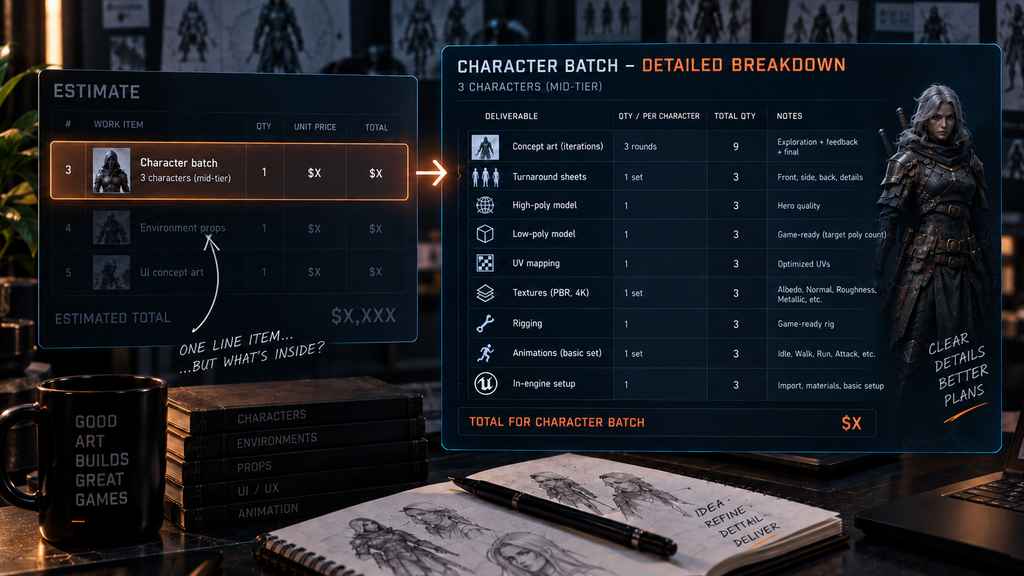
“Editorial illustration created for visual reference purposes. It does not represent a real project, client work, or official software screenshot unless stated otherwise.”
Asking a studio to break a broad line into its component parts is a reasonable pre-contract request when the underlying scope is already well understood on their side. A studio that can’t decompose its own line item on request is telling you something worth noting before the contract stage, not after production has started – which is exactly the kind of signal our studio-vetting checklist is built to catch earlier in the process.
Vague Line Item vs. Well-Defined Line Item
| Vague line item | Well-defined line item | |
| Naming | “Character – complete” | “Character – base mesh, retopology, UV, texture (2K), no rig” |
| Revisions | Not mentioned | “3 consolidated rounds included; scope changes billed separately” |
| Contingency | A flat percentage with no explanation | States what ambiguity it’s covering |
| Source files | Not mentioned | States format and what’s included versus withheld |
| Engine work | Assumed included | States whether in-engine validation is in or out of scope |
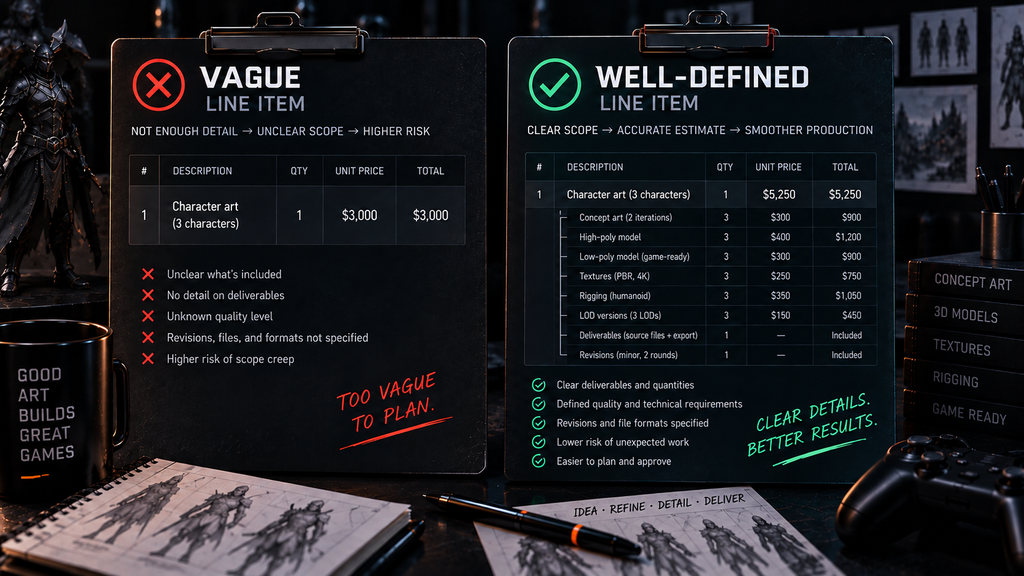
“Editorial illustration created for visual reference purposes. It does not represent a real project, client work, or official software screenshot unless stated otherwise.”
A quote built entirely of well-defined lines isn’t automatically the cheaper one, and a quote with a few vague lines isn’t automatically a red flag on its own – it’s a starting point for a short, specific set of questions before you sign, not a verdict on the studio that wrote it.
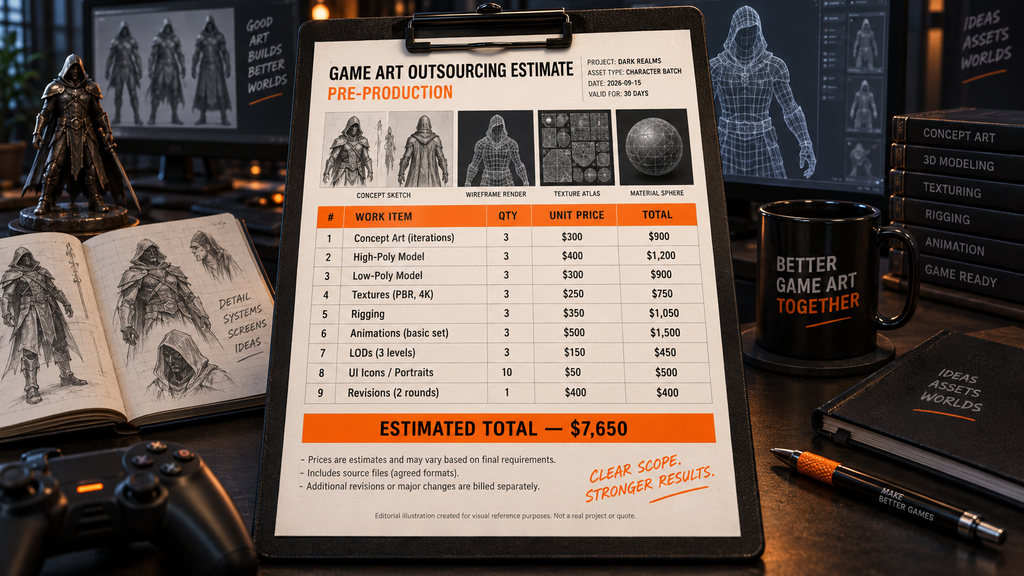
“Editorial illustration created for visual reference purposes. It does not represent a real project, client work, or official software screenshot unless stated otherwise.”
How We Structure Estimates at Nasty Rodent
The line items covered in this article reflect common industry practice rather than any single studio’s exact format, including our own. If you’re preparing a brief and want to see how these categories translate into an actual request, our guide to what drives game art outsourcing cost covers the factors that move a quote once the line items themselves are defined. Once a quote is agreed and signed, our 8-week vendor onboarding protocol covers what a structured kickoff looks like on the other side of that line-item table.