What Drives Game Art Outsourcing Cost: Factors & Estimation Models
-

Written byDenys Zadoienyi
-

Updated on07.08.2026
-

Time to read11 min

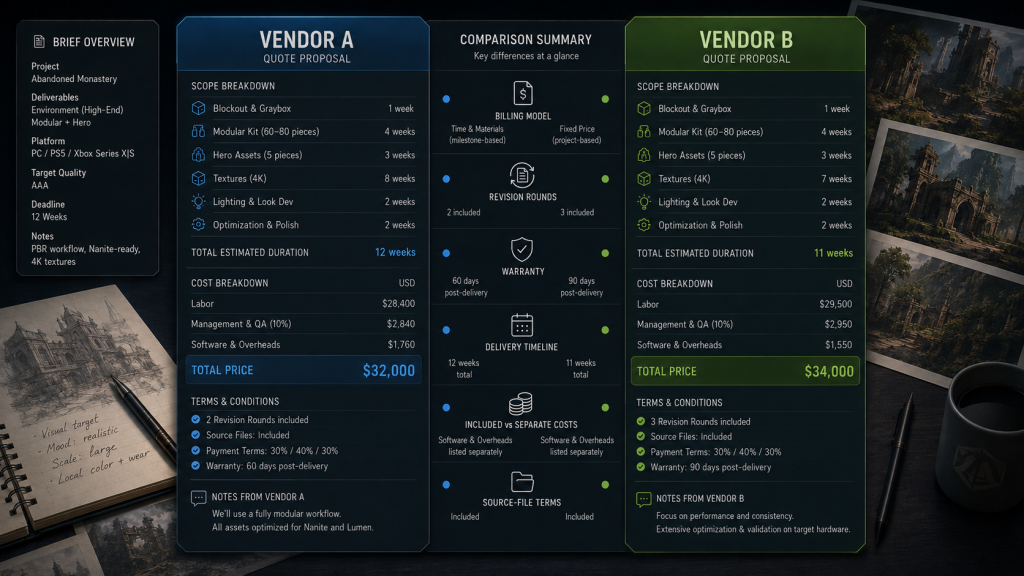
Send the same brief to three game art outsourcing studios and you’ll get back three numbers that don’t just differ – they sometimes don’t overlap at all. It’s tempting to read that spread as one studio being greedy and another being desperate for work. Sometimes commercial positioning does play a role, but the numbers can also reflect something less visible: how each studio builds the quote, how it handles the parts of your brief that aren’t fully resolved yet, and what it’s folded into the number versus what it plans to bill separately later.
“Editorial illustration created for visual reference purposes. It does not represent a real project, client work, or official software screenshot unless stated otherwise.”
This isn’t a piece about what makes one asset more expensive than another – a stylized prop and a realistic hero character were never going to cost the same, and the client-side drivers behind that – complexity, fidelity tier, engine optimization, revision count – are worth reading on their own. This is about a narrower, less obvious question: given the same brief, why do two studios land on different numbers at all? The answer lives in the estimation methodology, not in the asset.
The Pricing Model Changes How Scope Risk Is Priced
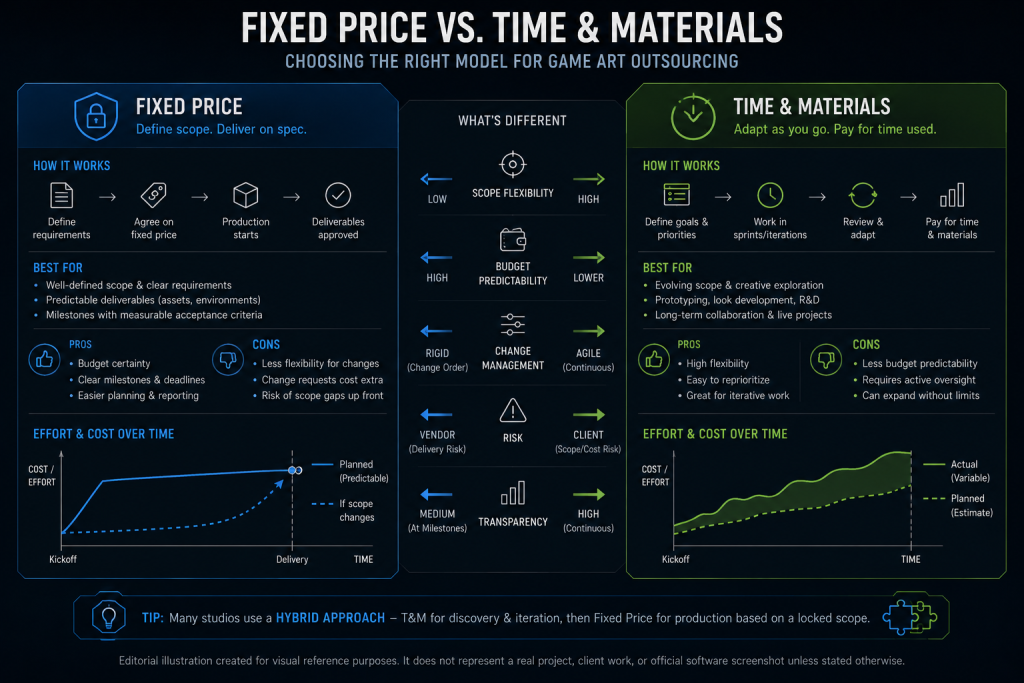
Before a studio even looks closely at your brief, it has already made one decision that shapes the quote in ways unrelated to the specific assets: whether the work will be billed as fixed price or time and materials. That choice doesn’t replace scope as the basis of the estimate – there’s no quote without an underlying read of the work – but it changes who carries the risk of that read being wrong, and the party carrying the risk prices it in.
“Editorial illustration created for visual reference purposes. It does not represent a real project, client work, or official software screenshot unless stated otherwise.”
A fixed-price quote commits the studio to an agreed price for a defined scope, subject to the assumptions and change-control terms written into the agreement – it’s a price for that scope, not a blanket guarantee against anything that could happen. Because the vendor is carrying more of the estimation risk within that boundary, the quote may include contingency for uncertain effort, review latency, or technical dependencies. How large that contingency is isn’t a standard percentage across the industry – it depends on how clearly the scope is defined, how reliable the reference material is, and how much comparable production data the studio has to estimate from. If the actual work drifts outside the agreed scope – more assets, a higher fidelity tier, changed approval criteria – that’s normally handled through a change request, not absorbed silently into the original number.
Time and materials works differently: you pay for recorded effort at agreed rates rather than a locked total. That can end up cheaper than an equivalent fixed-price commitment once contingency is factored out, but it isn’t guaranteed to be – a T&M forecast can just as easily run higher if the work turns out more involved than expected, and unlike fixed price, it doesn’t hand you a single number to hold the studio to. It shifts more of the budget-tracking responsibility onto you, in exchange for not pre-paying for risk that might never materialize.
Neither model is the “honest” one and neither is a trick – they’re different answers to the same question of who carries schedule and scope risk. The useful move on your side isn’t picking the cheaper-looking number, it’s asking which model each quote actually reflects, since a fixed-price commitment and a T&M forecast for the same brief aren’t the same kind of figure and were never meant to be compared as if they were.
It’s also worth separating pricing model from a retainer or capacity arrangement, since the two get discussed in the same breath but answer different questions. Fixed price and T&M describe how the work itself gets billed and where estimation risk sits. A retainer or reserved-capacity arrangement is about access – the client reserves a team or a defined amount of production capacity over a period – and the billing logic underneath it can still resemble fixed-scope pricing or T&M. It’s a separate axis, not a third option on the same scale.
Where Ambiguity Gets Priced
A brief is rarely exhaustive, and every studio has to decide what to do with whatever gaps remain – the parts where the reference material doesn’t say how many material variants a modular kit needs, or doesn’t specify whether “AAA quality” means a presentation-ready asset, an engine-integrated production asset, or a hero asset with layered source files, LODs, collision, and full technical validation. This is where two studios reading the identical document can land on genuinely different numbers without either one misreading anything.
Some studios handle ambiguity by asking clarifying questions before quoting at all, which produces a slower but tighter number. Others quote against their own working assumptions, which produces a faster quote – but a fast quote leans more heavily on those internal assumptions than a slower, question-driven one does. A higher number in that situation may reflect broader contingency or a wider reading of scope; a lower one may reflect a narrower interpretation. Neither is improper, and neither reliably predicts which studio is more careful – team utilization, specialization, and existing reusable pipeline all shape a number too, independent of how the ambiguity was handled. What actually matters is whether the quote states its assumptions. A studio that writes down what it assumed has priced the ambiguity explicitly and given you something to check against your own intent; a studio that doesn’t leaves you unable to tell what’s driving the difference between two numbers.
The practical lever on your side is the same one that shows up throughout outsourcing procurement generally: a tighter brief tends to reduce the spread between quotes, because it leaves less room for each studio’s assumptions to diverge from each other’s. It doesn’t eliminate the gap – regional cost base, utilization, and pricing methodology still vary independent of how well-specified the brief is – but it stops ambiguity from being the dominant driver of it.

What’s Included in the Number – and What Isn’t
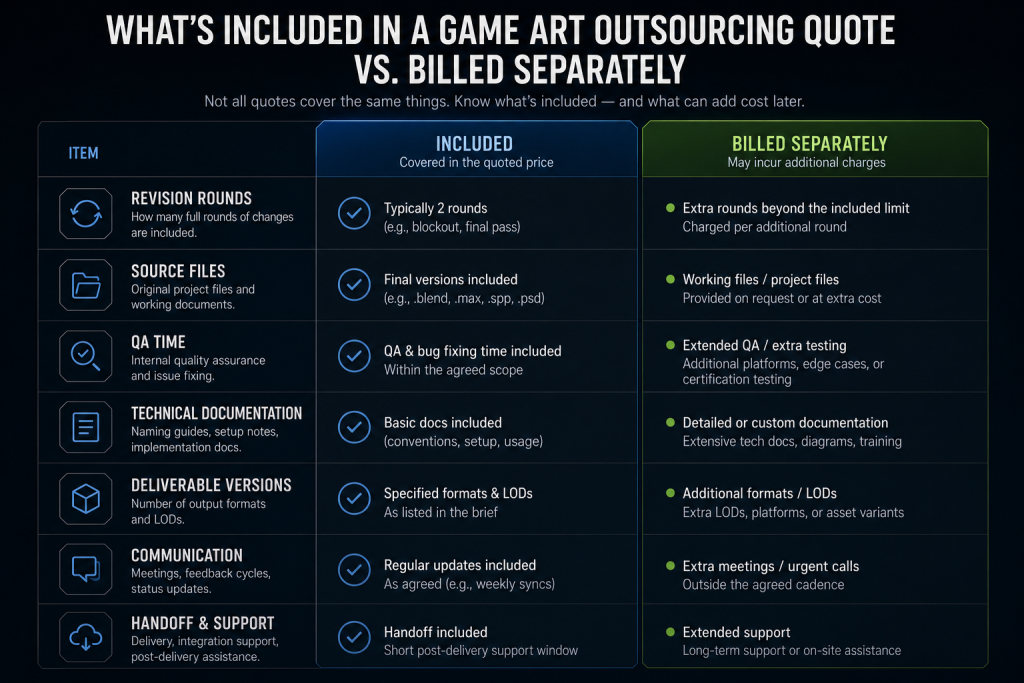
Two quotes that look close on the headline figure can still represent very different commitments, because studios don’t all draw the line between “included” and “billed separately” in the same place. This is a common reason two similar-looking headline figures turn into very different total commitments once production actually begins.
“Editorial illustration created for visual reference purposes. It does not represent a real project, client work, or official software screenshot unless stated otherwise.”
Revision rounds. Some studios include a defined number of consolidated feedback cycles in the base price; others estimate revisions separately, or draw a line between a correction of the studio’s own error, a client-requested direction change, and out-of-scope rework. There’s no industry-standard count to expect – what matters is whether the quote defines both the allowance and what counts against it.
Source and project files. Delivering the final baked asset is not the same commitment as delivering the layered, editable source files behind it, and the gap between the two goes beyond a simple price line. A clear quote should state which source files are included, in what format, whether any proprietary tools or plugins are required to open them, whether third-party assets are involved, who owns the newly created work, and whether any background IP stays with the vendor. Without those specifics named, “source files included” can mean very different things.
Art direction and internal QA time. A studio running every asset through an internal lead-artist review before it reaches you is absorbing that review time somewhere – priced into the rate or carried as overhead. A quote in which the client retains more of the first-pass review responsibility can look lower for that reason, and that’s not necessarily a weaker setup – some outstaffing arrangements are built deliberately around the client’s own art lead keeping creative approval. The question worth asking isn’t which arrangement is better, it’s who owns each review gate, and whether that labor is actually showing up in your side-by-side cost comparison.
Engine integration and technical validation. Whether the price covers in-engine testing and fixes versus a static export you have to validate yourself is rarely spelled out unless you ask – and it’s one of the more expensive gaps to discover after the fact.
None of this makes a lower quote suspect by default. It makes “compare the number” the wrong first move – compare what the number is a price for.
Regional Cost Base and Team Composition
Two studios of comparable quality can carry structurally different cost bases simply because of where their team is located and how senior a mix they staff a project with, and this shows up in the quote independent of anything about your brief. A studio staffing a project with a senior lead plus mid-level production artists will price differently than one running the same scope through an entirely senior team – not because one is inflating the number, but because the actual labor cost underneath the quote is different.
This is also where “cheaper” and “lower risk” can pull apart, though not automatically. A lower quote built on a leaner or more junior-weighted team isn’t by itself a worse choice – a specialized mid-level team with strong lead supervision can outperform a more senior but less relevant one – but a leaner mix does tend to lean more on lead oversight or client-side review, particularly on ambiguous or high-fidelity work, which is worth surfacing explicitly rather than inferring from the rate alone.
Team seniority mix is also tied to which cooperation structure a studio proposes. The cooperation models Nasty Rodent structures engagements around – project-based, ongoing capacity, or outstaffing inside your own pipeline – each carry a different default assumption about who staffs the work and who owns review, which is worth asking about directly rather than reading off the rate.
How to Read Two Quotes Side by Side
None of the above is a reason to distrust quotes – it’s a reason not to compare them as if “the number” were a single, comparable thing. A structured way to read two quotes for the same brief:
| What to check | Why it matters |
| Billing model (fixed price vs. T&M) | Determines how effort is billed and who carries estimation risk |
| Engagement structure (single project vs. retainer/reserved capacity) | Determines whether you’re buying a defined output, recurring access, or dedicated ongoing capacity – a separate question from how that work gets billed |
| Deliverables and acceptance criteria | Two vendors can be pricing different definitions of “finished” for the same brief |
| Feedback cycles and change policy | A lower headline price with revisions billed separately can end up costing more than a higher all-in quote |
| Source file delivery, ownership, and licence terms | Final-asset-only and editable-source delivery are different commitments, even at the same price point |
| Who owns each review gate before you see the asset | Internal review absorbed by the vendor vs. your team doing the first pass changes the real cost, not just the invoice |
| Engine integration and technical validation | A static export you validate yourself and an in-engine-tested delivery aren’t equivalent, even if both are called “delivered” |
| Dependencies and client-side responsibilities | Late references, approvals, or builds on your end can change both cost and schedule regardless of the quote |
| Currency, taxes, and pass-through costs | Keeps a lower base figure from turning into a higher payable total once these are added |
| Assumptions stated in the quote | A studio that documents its assumptions has priced the ambiguity explicitly; one that doesn’t may be assuming the simplest case |
Reading a quote this way turns a single number into a set of decisions you can actually compare – and it’s the same discipline that a properly scoped SOW is meant to lock in before work starts, so none of these gaps have to be discovered mid-production.
If you’re comparing environment-art candidates rather than pricing a chosen vendor, a small paid trial is often a more direct way to test estimation and production discipline than a written quote alone.
For the cost structure of hiring individually versus engaging a studio at all, that comparison runs on a different set of variables entirely – pricing methodology matters once you’ve chosen the model, but the model choice itself is a separate decision.