Stylized vs Realistic 3D Production: What Actually Drives Your Team, Schedule, and Cost
-

Written byDenys Zadoienyi
-

Updated on18.09.2026
-

Time to read8 min

- Why “Style Determines Team” Is the Wrong Starting Question
- What Five Real Engagements Actually Show – and What They Don’t
- Where Team Composition Actually Comes From
- Time and Cost: What Actually Moves the Needle
- A Practical Team-Gap Check
- Stylized vs Realistic Production: What Actually Controls Each Variable
- Conclusion: Ask Where the Style and Asset Mix Concentrate Effort
Stylized vs realistic 3D production is usually framed as a fixed team-structure question, but the honest answer is that style alone does not determine who you need to hire. A producer who assumes “realistic” automatically means a hard-surface-heavy team, or “stylized” automatically means a concept-heavy one, is scoping against a stereotype rather than the asset list in front of them – and the gap between the two is where staffing plans quietly go wrong.
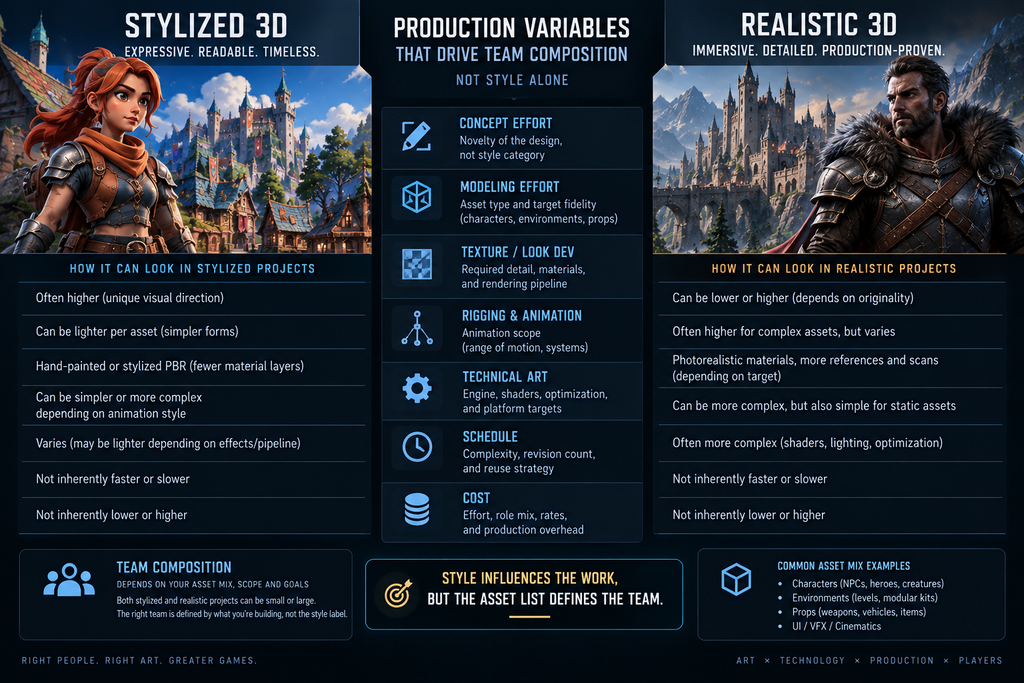
“Editorial illustration created for visual reference purposes. It does not represent a real project, client work, or official software screenshot unless stated otherwise.”
Style and team composition are not the same variable. Style changes the kinds of visual decisions a team has to resolve – reference-matching versus internally defined visual rules. Team composition is driven more directly by asset mix, target fidelity, animation scope, rendering approach, platform constraints, and how mature the visual direction already is. This article separates the two deliberately, because collapsing them is a common scoping mistake before a milestone plan is even drafted.
Why “Style Determines Team” Is the Wrong Starting Question
Realistic characters, realistic creatures, stylized weapons, stylized vehicles, and stylized hard-surface work are all common in shipped games – style is not a proxy for asset category. A realistic project can carry a large concept and design department when its content is fictional rather than directly referenced (grounded sci-fi, invented factions, speculative equipment). A stylized project can run with a comparatively lean concept overhead once its art bible is locked and mature. Nasty Rodent’s own character service positions realistic and stylized character work as a shared discipline rather than separate departments.
The more useful producer question isn’t “which style needs the bigger team” – it’s where does this specific style and asset mix concentrate specialist time, given the fidelity target, the animation scope, and how settled the visual direction already is.
What Five Real Engagements Actually Show – and What They Don’t
Illustrating this with real scope is more useful than an abstract framework, as long as the illustration isn’t overstated into a universal rule.
- Squad and Starship Troopers: Extermination, both for Offworld Industries – weapons, vehicle art, and skin concepts on Squad; props, environment assets, and assistance developing game locations on Starship Troopers: Extermination.
- Mutant Year Zero: Road to Eden, for The Bearded Ladies – the detailed case page describes weapons, props, and environment assets, while Nasty Rodent’s broader project listings also mention character art.
- Wild Rage, for Whimsy Games – full art direction: concept, characters, weapons, props, environment, and UI/UX.
- Bubble Quest of Vikings, for Whaleapp – full artistic production covering concept design, character creation, environments, UI, and visual effects.
These five engagements illustrate the scope Nasty Rodent delivered on each specific project – they are not evidence of a universal “realistic team” or “stylized team” staffing model. A hard-surface-and-environment-heavy scope on a realistic title (as on Squad and Starship Troopers: Extermination) reflects what those specific engagements needed, not what every realistic production needs.

Where Team Composition Actually Comes From
If style alone doesn’t set the team shape, five variables are especially useful when scoping it:
- Asset mix. A weapon- and vehicle-heavy scope concentrates capacity in hard-surface modeling regardless of style. A character-heavy scope concentrates it in character art and rigging capacity, regardless of style.
- Target fidelity. A hero asset built for close-up camera time usually carries a higher fidelity target, more production effort, and tighter review requirements than a background asset, on either a realistic or a stylized track.
- Animation scope. Rigging and technical-animation needs come from how much a project’s characters or creatures need to move and deform convincingly – not from whether the style is realistic or stylized. Character artists need to build topology and forms that support the intended deformation; the rigging and technical-animation work itself is commonly a distinct specialist role rather than a default skill folded into character art.
- Rendering approach. Technical-art workload – shaders, custom lighting, procedural tooling, optimization, content validation – scales with rendering complexity and pipeline choices on both realistic and stylized projects, not with style alone. A stylized project can be hand-painted, procedural, or hybrid; our hand-painted vs procedural pipeline guide covers how that specific choice, not “stylized” as a category, determines whether the team needs a technical artist fluent in material graphs.
- Art-direction maturity. Both realistic and stylized projects lean on art-direction review to hold consistency – realistic work can use physical reference as one validation layer, while stylized work depends more heavily on internally defined visual rules, since there’s no physical reference to fall back on for every decision. That’s a difference in what the review checks against, not proof that one style needs more review than the other overall.
Time and Cost: What Actually Moves the Needle
We are not using NR-specific FTE data or a single industry-wide benchmark for a clean stylized-vs-realistic time or cost split, because such comparisons depend heavily on asset type, complexity, and production assumptions. What can be stated reliably is which drivers move time and cost for a given asset, and how style shifts which of those drivers dominates:
| Asset type | Typical effort drivers | What may differ by style |
| Background/filler prop | Reuse, material complexity, integration | Reference-matching vs shape-language interpretation |
| Modular environment piece | Modularity, reuse, optimization | Reference fidelity vs invented visual grammar |
| Hero prop | Camera proximity, unique materials, revision rounds | Fidelity/detail priorities |
| Weapon | Moving parts, attachments, animation-readiness | Mechanical fidelity vs stylized design iteration |
| Character | Anatomy/design, topology, grooming, rig, variants | Realistic material/anatomical scrutiny vs stylized silhouette/design iteration |
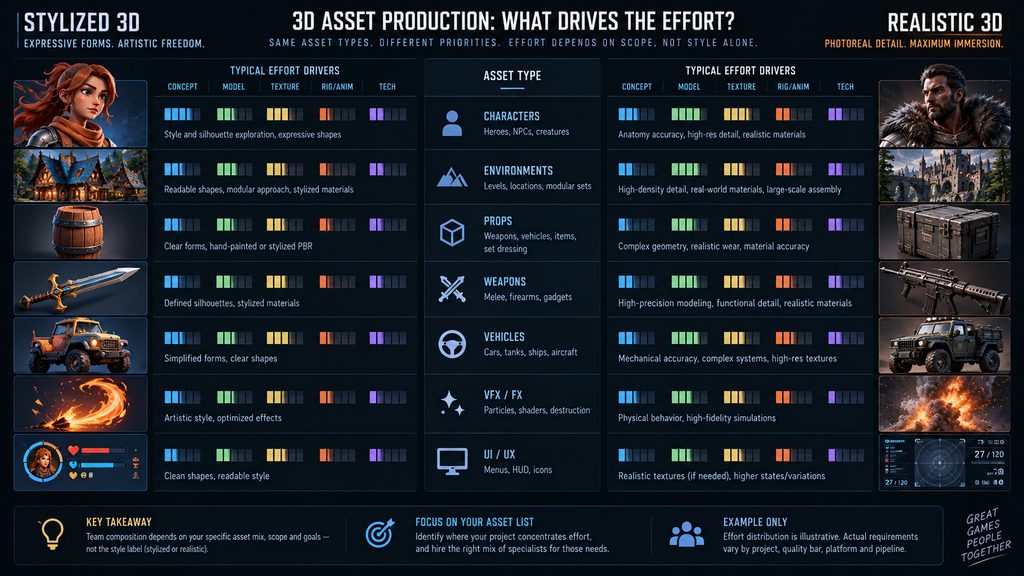
“Editorial illustration created for visual reference purposes. It does not represent a real project, client work, or official software screenshot unless stated otherwise.”
As a rough decomposition rather than a literal formula, cost follows the amount of production effort weighted by the roles and rates involved, plus review/rework overhead, plus tooling and integration overhead. Style doesn’t multiply that total on its own – a realistic asset can add effort through material and anatomical fidelity or mechanical accuracy; a stylized asset can add effort through visual development, custom shading, or extra iteration rounds before the art bible settles. Reuse and tooling investment can lower marginal cost on either track, and animation or variant count can outweigh the style label as a cost driver.
For a producer building a milestone budget, the practical move is to price the asset list against these drivers directly, rather than applying a flat “stylized” or “realistic” multiplier to the whole project.
A Practical Team-Gap Check
Whichever track you’re staffing, run your current team against the actual drivers above rather than against a style label:
- We have senior capacity in the discipline this specific asset mix leans on most (hard-surface, character, or environment – whichever dominates the list).
- We have dedicated rigging/technical-animation capacity sized to this project’s animation scope, separate from character-art headcount.
- Our technical-art capacity matches this project’s rendering approach (hand-painted, PBR, procedural, custom-shader, or hybrid), not last project’s approach.
- Our art-direction review bandwidth is sized to the asset count and revision expectations, not just the hero pieces.
- Our concept-to-production ratio reflects how settled this project’s visual direction already is, not a habit carried from the last brief.
If several of these don’t hold, the problem may be team composition rather than total headcount – and the fix depends on the gap: a temporary or narrowly scoped shortfall (missing rigging capacity for one milestone, a technical artist for a procedural pipeline) is often a good fit for a scoped partner engagement; a structural, ongoing gap may be worth solving by hiring or retraining instead. Our in-house vs outsource decision framework walks through that fuller cost comparison.
Stylized vs Realistic Production: What Actually Controls Each Variable
| Dimension | Realistic tendency | Stylized tendency | What actually controls it |
| Visual reference | More anchored to real-world or physical reference | More dependent on internally defined visual rules | How the visual target is defined |
| Concept effort | Lower for directly referenced assets, high for fictional or hero designs | Often high while the visual language is still being defined | Novelty of the design, not style category |
| Modeling effort | Mechanical or material accuracy can dominate review | Shape language and silhouette can dominate review | Asset type and target fidelity |
| Texturing approach | PBR and reference-matching common | Hand-painted, PBR, procedural, or hybrid | Material pipeline choice |
| Technical art | Optimization, shaders, tooling, validation | Optimization, shaders, tooling, custom rendering | Rendering complexity and pipeline |
| Character / rigging | Scoped to the project’s character and creature content | Scoped to the project’s character and creature content | Animation scope, not style |
| Schedule | Not inherently slower or faster | Not inherently slower or faster | Complexity, revision count, reuse strategy |
| Cost | Not inherently higher or lower | Not inherently higher or lower | Production effort, role/rate mix, revisions, tooling and integration overhead |
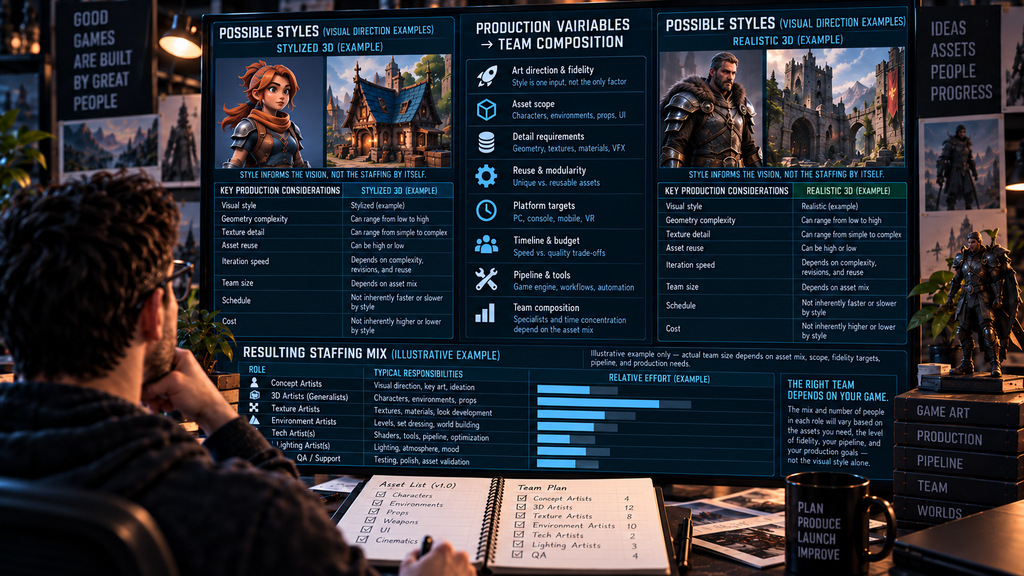
“Editorial illustration created for visual reference purposes. It does not represent a real project, client work, or official software screenshot unless stated otherwise.”
Conclusion: Ask Where the Style and Asset Mix Concentrate Effort
Style changes the kind of visual decisions a team has to resolve. It doesn’t fix the team’s shape on its own – asset mix, target fidelity, animation scope, rendering approach, and how mature the visual direction already is do that work. The producer question worth asking before a milestone plan is drafted isn’t “which style needs the bigger team,” but where this specific asset list and style combination will actually concentrate specialist time – and whether the team in front of you already has capacity there.
Send us your asset list and target style, and we’ll help you identify where specialist time is likely to concentrate and whether a scoped partner engagement makes sense for the gap.
Get a production cost estimate for your project – stylized or realistic →