Inside the Game Production Pipeline: What Changes From Pre-Production to Live Ops
-

Written byDenys Zadoienyi
-

Updated on17.09.2026
-

Time to read12 min

- What Each Phase Is Actually Trying to Prove
- Pre-Production: Reducing Uncertainty Before Committing to Volume
- Full Production: Repeatable Execution at Scale
- From Full Production to Alpha, Beta, and Launch
- Live Operations: The Phase That Keeps Changing the Game Safely
- How Offworld Industries and Whimsy Games Illustrate Different Production Scope
- Game Production Pipeline: Phase Comparison at a Glance
- A Useful Way to Think About the Vertical Slice
- Conclusion: The Phase Decides the Fit, Not the Portfolio
“Editorial illustration created for visual reference purposes. It does not represent a real project, client work, or official software screenshot unless stated otherwise.”
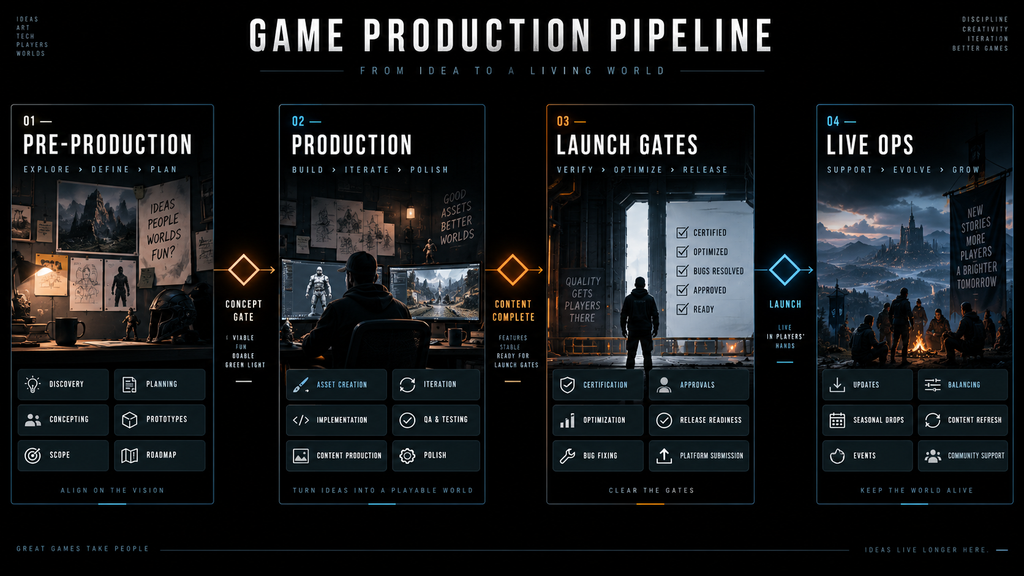
A game production pipeline is the sequence of phases a project moves through from an early concept to a live, updated product, and studios name and slice those phases differently. For this guide we group them into three broad operating phases – pre-production, full production, and live operations – while treating milestones such as the vertical slice, alpha, beta, certification, and launch as gates or transitional stages inside that lifecycle rather than as a fourth and fifth phase in their own right. Producers who plan around the wrong phase do not usually end up with bad work; they end up with work that arrives at the wrong moment, scoped for a phase that has already closed.
Definition. In this article, “game production pipeline” refers to the project-level production lifecycle – the ordered phases a title passes through between concept and live operation. Individual disciplines run their own pipelines inside those phases too: concept, model, retopology, UV, texture, rig, and engine integration is a production pipeline in its own right for a single 3D asset, operating inside the broader project lifecycle described here.
What Each Phase Is Actually Trying to Prove
Before splitting the pipeline into sections, it helps to name what each phase is optimizing for, because that is what actually explains why the work, the staffing, and the risk look so different from one phase to the next.
| Phase | Dominant production question |
| Pre-production | Can we build the right thing? |
| Full production | Can we build it repeatedly, at the required quality and rate? |
| Launch transition (alpha, beta, certification, launch) | Can we ship the integrated product safely? |
| Live operations | Can we keep changing it without destabilizing the live game? |
Everything below follows from those four questions – including where outside art capacity tends to add the most value, and where it tends to create the most risk if it is scoped for the wrong one.
Pre-Production: Reducing Uncertainty Before Committing to Volume
Pre-production is where a team turns an idea into a validated concept: a design worth building, a visual direction that holds up, and a plan that survives contact with the real schedule. It is not only an art exercise. Design validation, prototypes, technical feasibility, scope, platform assumptions, performance constraints, staffing, and proof that the intended pipeline actually works are all part of the same gate – our guide to the pre-production phase goes deeper into the GDD, prototyping, and the vertical slice review that many mid-core and AAA pipelines use as a major readiness gate before scaling into full production.
For an art-focused partner, that broader gate narrows to a specific question: is the visual target achievable and consistent enough to build a schedule and a budget around? The deliverables that answer it are concept art, a style guide or art bible, and a small number of representative pieces – not yet the full asset volume the game will eventually need. A vertical slice can, and often should, contain near-final-quality representative work; the point of pre-production is reducing uncertainty about the target, not withholding quality until later.
Wild Rage illustrates an engagement with unusually broad creative ownership: Nasty Rodent led the game’s art direction for Whimsy Games and worked across concept art, character design, weapons, props, environment assets, and UI/UX. That scope of ownership – shaping the visual target itself rather than only executing against one already handed over – is the kind of broad creative ownership that can be valuable while a project’s visual direction is still being defined, though the publicly documented case does not specify exactly when in the project’s timeline the engagement began.
What a Pre-Production Engagement Should Not Look Like
A “concept exploration” batch that quietly grows into a full production-scale asset list is a sign the phase has already moved into production without anyone deciding that on purpose. If a pre-production budget is absorbing production-scale volume, the project is effectively funding production-scale execution before formally acknowledging that transition.

Full Production: Repeatable Execution at Scale
Production takes a validated direction and turns it into the actual content of the game – whichever mix of characters, environments, props, weapons, vehicles, levels, and systems the design calls for. The defining trait is not simply volume; it is repeatable execution: turning the design, technical, and visual assumptions validated in pre-production into content that holds the same quality and integrates the same way, asset after asset, milestone after milestone. For many titles, that means sustained demand for engine-ready assets, which is why external production capacity often becomes especially relevant at this stage.
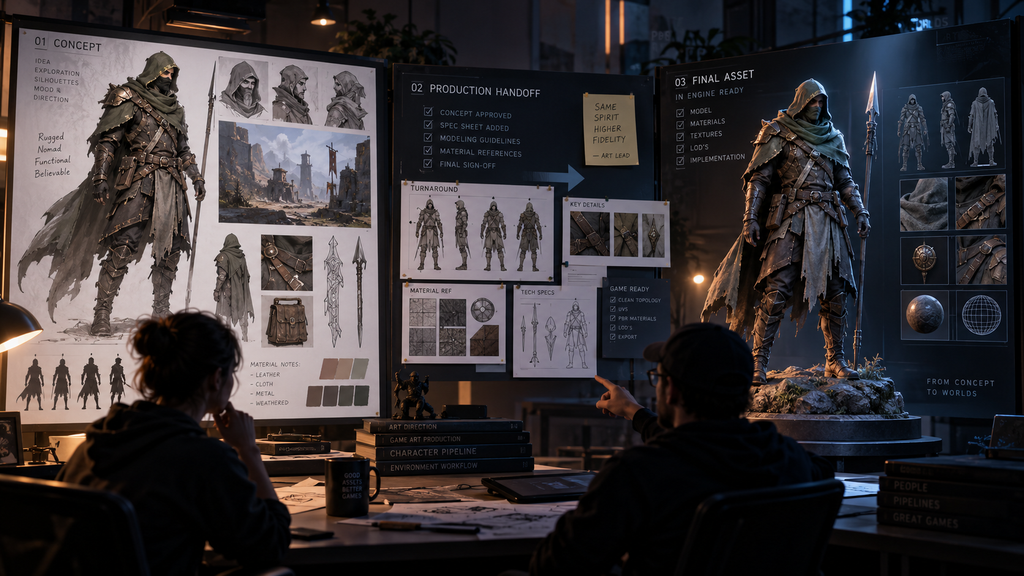
Internal ownership matters as much as the vendor’s output here. A producer typically owns schedule and coordination, while art directors, discipline leads, technical artists, or outsource managers define and maintain the creative and technical requirements a vendor works against – performance budgets, technical constraints, naming conventions, and integration requirements. How completely that brief transfers context is usually what separates a batch that integrates cleanly from one that generates rework nobody scheduled for; in a co-development-style arrangement, the vendor may also feed back into those decisions rather than only executing against them.
“Editorial illustration created for visual reference purposes. It does not represent a real project, client work, or official software screenshot unless stated otherwise.”
Two Offworld Industries titles show how differently production-phase scope can land. On Squad, Nasty Rodent’s work covered weapon production, vehicle art, and skin concepts for the existing arsenal – a scope characteristic of full-production asset work inside an established pipeline. On Starship Troopers: Extermination, the documented scope is props, environment assets, and assistance developing game locations – another scope typical of production-stage asset support, on a separate title. Both illustrate scopes commonly associated with production-phase execution, but neither public case documents exactly when the engagement began relative to the project’s own lifecycle.
Studios comparing production realities across indie, AA, and AAA scope will recognize that this handoff gets harder, not easier, as a team grows: more disciplines, more stakeholders, more places for a brief to lose fidelity between an art director’s intent and a vendor’s task list.
From Full Production to Alpha, Beta, and Launch
This is the stretch of the pipeline that gets skipped most often when “production” and “live-ops” are treated as adjacent boxes on a slide. In practice, several gates usually sit between them, and the exact terminology and exit criteria vary by studio and platform:
- Alpha commonly marks a substantially integrated or feature-complete build, although exactly what qualifies as alpha varies significantly by studio, publisher, and project. The game may be broadly playable while content, polish, performance, and stability remain unfinished.
- Beta typically shifts the emphasis toward stability, bug fixing, balancing, performance, compatibility, and remaining content polish, with major feature additions becoming less desirable as release approaches.
- Some teams also define internal gates such as content lock, feature lock, or code lock. Their names and meanings vary by studio; broadly, they restrict particular classes of changes as the build approaches release.
- Certification is especially visible and formalized in console publishing, where the platform holder reviews a build against its own technical and content requirements before it can ship.
- Release candidate describes a build considered potentially shippable, pending final sign-off.
- Launch is an operational boundary more than an art-production milestone – the point at which the game becomes a live product with real players, not simply another internal build.
None of these gates is primarily an art deliverable, but each one changes what “done” means for the assets already built and for anything still being finished. A studio bringing in outside art capacity late in this stretch often needs narrowly bounded support for specific remaining gaps rather than broad direction-setting work – though late-stage scopes can also include marketing art, cinematics, or platform-specific asset work running in parallel.
Once players are on the live build, the production problem changes again.
Live Operations: The Phase That Keeps Changing the Game Safely
Live operations becomes the dominant operating model once a game is live, though the systems, tooling, content cadence, and staffing it needs are usually built and tested before launch, not improvised afterward. As a discipline, live-ops is broader than content production: patches and hotfixes, telemetry and analytics, balancing, backend and configuration changes, experimentation, player support, and operational QA all sit inside it, alongside the recurring content itself.
For an art vendor specifically, that broader live-ops loop usually translates into smaller content drops delivered on a recurring or scheduled cadence – seasonal cosmetics, new maps or levels, event-specific props, periodic character variants – each smaller than a full production batch. Once players are expecting that cadence, schedule slippage can become visible to players rather than remaining an internal scheduling issue. As one GDC session on running a live-ops pipeline frames it, live operations is a continuous discipline built around player behavior and studio process, not a single deliverable with a finish line.
That cadence changes what “the right partner” means, though not as a rigid rule. Recurring, evolving live-ops demand often favors a retainer or dedicated-team model, because capacity stays available as the content roadmap shifts. Clearly bounded content drops – a single seasonal pack, one new map, a defined cosmetic batch – can still work perfectly well as fixed-scope, project-based engagements. Our breakdown of cooperation models and what actually drives cost goes deeper into how project-based, retainer, and dedicated-team structures map onto different production realities.
How Offworld Industries and Whimsy Games Illustrate Different Production Scope
Lining these engagements up against the phases above is useful less as a chronology and more as a picture of how differently “art production” can be scoped even within the same broad phase:
- Wild Rage (Whimsy Games) – full art direction: concept, characters, weapons, props, environment, and UI/UX, the kind of broad creative ownership that can be valuable while a project’s visual direction is still being defined.
- Squad (Offworld Industries) – a scope characteristic of full-production asset work: weapons, vehicle art, and weapon-skin concepts inside an established pipeline.
- Starship Troopers: Extermination (Offworld Industries) – another scope typical of production-stage asset support, on a separate title: props, environment assets, and assistance developing game locations.
The pattern worth taking away is not which phase each engagement began in – that is not something either case study documents publicly – but that the right scope for an outside partner depends on how much of the visual target is already decided versus still being defined, whichever phase that decision happens to fall in.
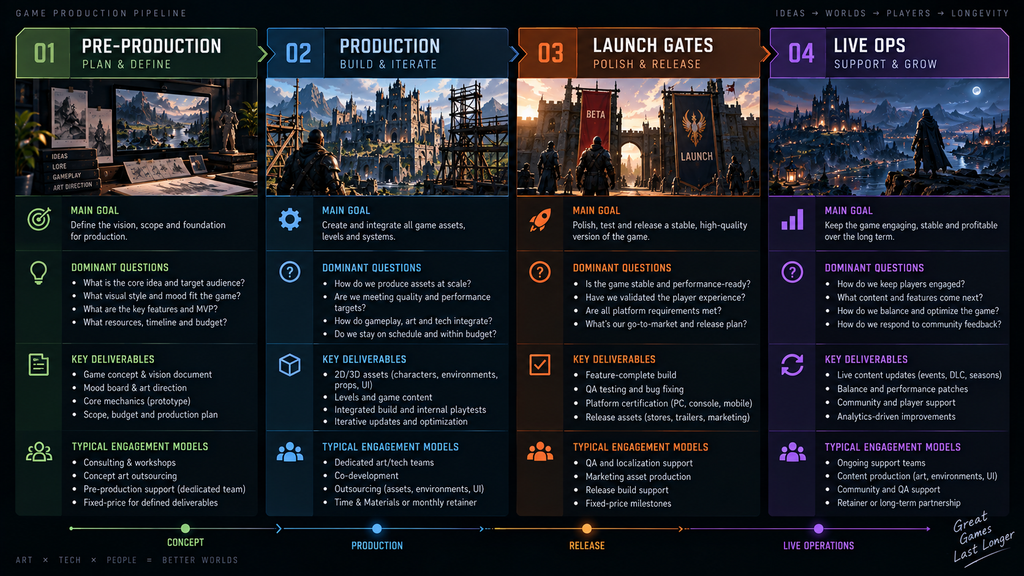
Game Production Pipeline: Phase Comparison at a Glance
“Editorial illustration created for visual reference purposes. It does not represent a real project, client work, or official software screenshot unless stated otherwise.”
| Phase | Core production outcome | Typical art-vendor role | Dominant question | Best-fit engagement model | Main risk if mismatched |
| Pre-production | Validated direction, feasibility, and production approach | Concept art, style guide, representative pieces | Can we build the right thing? | Project-based, small scope | Production-scale volume built on an unvalidated style |
| Full production | Game features and content built repeatably at target quality | Sustained volume of engine-ready assets | Can we build it repeatedly? | Project-based or dedicated team | Rework from a brief that assumes missing context |
| Launch transition | Integrated, stabilized, releasable build | Narrow support closing specific remaining gaps | Can we ship it safely? | Narrow, time-boxed engagement | Late changes destabilizing an already-stabilized build |
| Live operations | Safe, ongoing updates and recurring content | Recurring content on a scheduled cadence | Can we keep changing it safely? | Often retainer or dedicated team; project-based for bounded drops | Vendor structured for one-off work, not sustained cadence |
A team that revisits this table at each phase transition, not only once at kickoff, is usually the one that avoids paying production rates for pre-production uncertainty, or discovering mid-launch that its production vendor was never structured for a live-ops cadence.
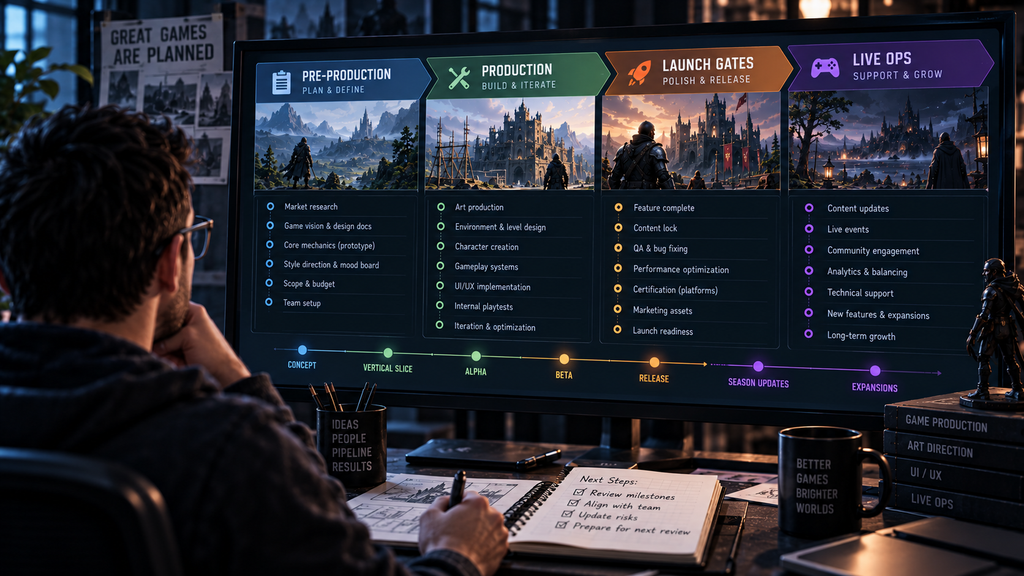
“Editorial illustration created for visual reference purposes. It does not represent a real project, client work, or official software screenshot unless stated otherwise.”
Nasty Rodent supports different project scopes and cooperation models across game production, which is why matching the engagement model to the current need matters more than treating one contract structure as universal.
A Useful Way to Think About the Vertical Slice
A vertical slice is not useful because it proves a single polished section can be built. It helps test whether that quality can be reproduced within the project’s real technical, staffing, and schedule constraints once production scales. On many mid-core and AAA pipelines, a strong vertical slice is one of the clearest signals that a project is actually ready to leave pre-production, rather than simply out of time to stay in it.
Conclusion: The Phase Decides the Fit, Not the Portfolio
A vendor’s portfolio shows what they can build. It does not show whether they fit the phase a project is actually in right now. Pre-production needs a partner comfortable with ambiguity and small, exploratory batches. Production needs a partner that can hold a brief at scale without drifting from it. Late launch-stage support often becomes narrower and more time-sensitive, focused on specific remaining gaps rather than broad exploratory work. Recurring live-ops work favors a partner built for cadence rather than a single finish line. Matching the engagement to the phase, and revisiting that match every time the project moves into the next one, is what keeps outside art capacity from becoming something a producer has to manage around instead of the capacity that was supposed to make the schedule easier.
Send us your current scope and production context, and we can help map the art capacity, engagement model, and handoff structure that fit the stage you are approaching.
Get a pipeline-fit assessment →