
Keeping an Outsourced Art Team on Schedule Across the Full Production Cycle
-

Written byDenys Zadoienyi
-

Updated on26.08.2026
-

Time to read12 min

“Editorial illustration created for visual reference purposes. It does not represent a real project, client work, or official software screenshot unless stated otherwise.”
A schedule that’s about to slip rarely announces itself the day it starts slipping. By the time a delay is visible at a formal milestone review, the leading indicators have usually already been showing it for a while — which means the review isn’t catching the problem early. It’s confirming something that was already true and just hadn’t been named yet.
This is about the part of an outsourced art engagement that comes after the risk window our 8-week vendor onboarding protocol covers. Onboarding is about getting a new vendor relationship correctly calibrated in its first weeks. This is about the discipline that keeps a schedule on track for the rest of the production cycle that follows — months, sometimes a year or more, after the onboarding window has closed and the engagement has settled into a working rhythm.
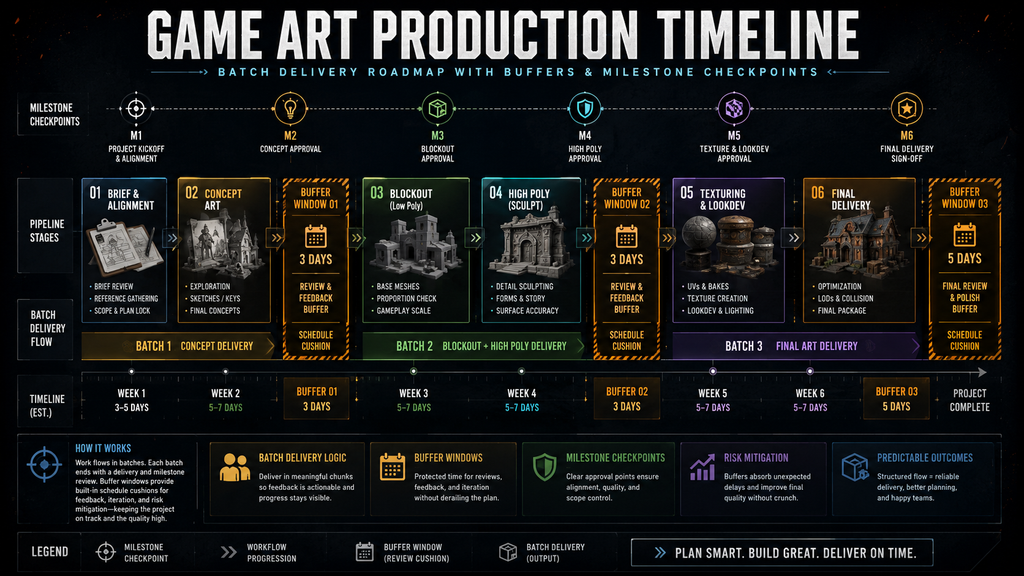
Three things determine whether that rhythm holds: how the milestones themselves are cut, how much buffer sits around them, and whether anyone is watching for the signals that show up before a milestone review does.
Cutting Milestones That Actually Function as Checkpoints
A milestone defined only by a date isn’t a checkpoint — it’s a deadline with no way to verify anything until the deadline arrives. The distinction matters more than it sounds like it should, because a date-only milestone gives you exactly one moment to discover a problem: the day everything was supposed to be done.
Define milestones by deliverable, not by date alone. “Delivery by the 15th” creates no accountability for what’s actually being delivered. “Ten hero environment props, blockout-approved, textured to first-pass standard per the agreed reference sheet, by the 15th, reviewed against the acceptance criteria on file” creates an actual checkpoint — something you can pass or fail, not just something you can be late or on time for. This is the same discipline our guide to structuring RFP and SOW terms covers for writing milestones into the contract in the first place; the point here is that the discipline doesn’t stop once the contract is signed — it’s what makes every milestone review after that one actually mean something.
Calibrate the interval to asset volume and complexity, not a fixed cadence. A modular environment kit with dozens of small, similar assets benefits from more frequent checkpoints on representative samples rather than waiting for a full batch — style drift accumulates quietly between reviews and gets more expensive to correct the longer it goes unchecked. Hero assets need the opposite logic applied differently: not necessarily fewer checkpoints, but checkpoint frequency and depth that follow the production stages and the cost of a late direction change — a hero character moving through concept, blockout, high-poly, low-poly, bake, and texture often needs a gate at more of those stages precisely because getting one of them wrong late is expensive to unwind. Our guide to briefing a game art studio for UE5 production covers this calibration in more depth for the specific case of engine-targeted production. There’s no single right interval — the mistake is picking one cadence at the start of a project and never revisiting whether it still fits the batch of work currently in production.
Build an intermediate approval gate appropriate to the asset type into every milestone, not just a final check. What that gate looks like depends on the discipline. For 3D asset production, a blockout-approval gate before detailed work begins is often one of the highest-leverage checkpoints available, because it catches proportion, scale, and layout problems while they’re still cheap to fix — before texturing, rigging, or engine integration has been built on top of a foundation that turns out to be wrong. Concept art, UI, and animation each have their own equivalent — a checkpoint early enough in the discipline’s own process that catching a problem there is still cheap. Treating any of these gates as optional under schedule pressure, specifically because the schedule is already tight, tends to produce the opposite of the intended effect: the underlying problem doesn’t disappear, it just gets discovered later, at a stage where fixing it costs more.

Sizing the Buffer Without Guessing
The instinct to pad every milestone by a flat percentage — add two weeks to everything, just in case — is understandable, and it’s also not a real buffer strategy. A flat pad either wastes schedule on the milestones that didn’t need it or runs out exactly on the milestone that needed more than the flat number allowed. A working buffer is sized to something specific, not applied uniformly.
Size it against approval rate together with rework turnaround, not approval rate alone. A high first-pass approval rate doesn’t automatically mean low schedule risk if a failed asset takes a week to cycle back through review; a lower approval rate paired with a same-day turnaround can carry less actual exposure. What matters is the combination — how often work fails review, and how expensive each failure is to correct — not either number in isolation. Testing this on a paid trial batch before committing full production scope, the way our decision framework for in-house versus outsourced art recommends, gives you empirical inputs for that calculation instead of relying entirely on assumptions — though a trial batch reflects calibration-stage performance, not necessarily how the same numbers hold at full production scale and asset mix.
Size it against production stage, not a constant across the whole engagement. Early milestones in a new engagement — even after onboarding has formally closed — still carry more calibration risk than milestones deep into a mature, well-running production. A vendor team that has been working from the same art bible and the same feedback loop for six months needs less schedule cushion than the same team three weeks into full production, because the gap between what they assume and what you actually want has had time to close. Sizing every milestone’s buffer identically ignores that the risk itself isn’t constant.
Size it against complexity and volume together, not one or the other. A milestone with twenty simple, well-specified props doesn’t carry the same revision risk as a milestone with three hero characters — but asset count isn’t a risk-free variable either. A large batch of simple assets still creates real exposure through review bandwidth, QA throughput, and the chance that one common defect replicates across the whole batch. Complexity drives deeper iteration risk; volume drives throughput and review-capacity risk. A buffer sized around only one of the two will consistently under-protect whichever risk it ignored.
The output of all three isn’t a single number you can quote as an industry standard — there isn’t one, and treating this as if there were is how buffers end up either padding schedules that didn’t need it or failing exactly where the risk was actually concentrated. The output is a planning method: look at what you actually know about approval rate paired with rework turnaround, calibration maturity, and complexity together with volume for the specific milestone in front of you, and size accordingly.
The Signals That Show Up Before the Milestone Does
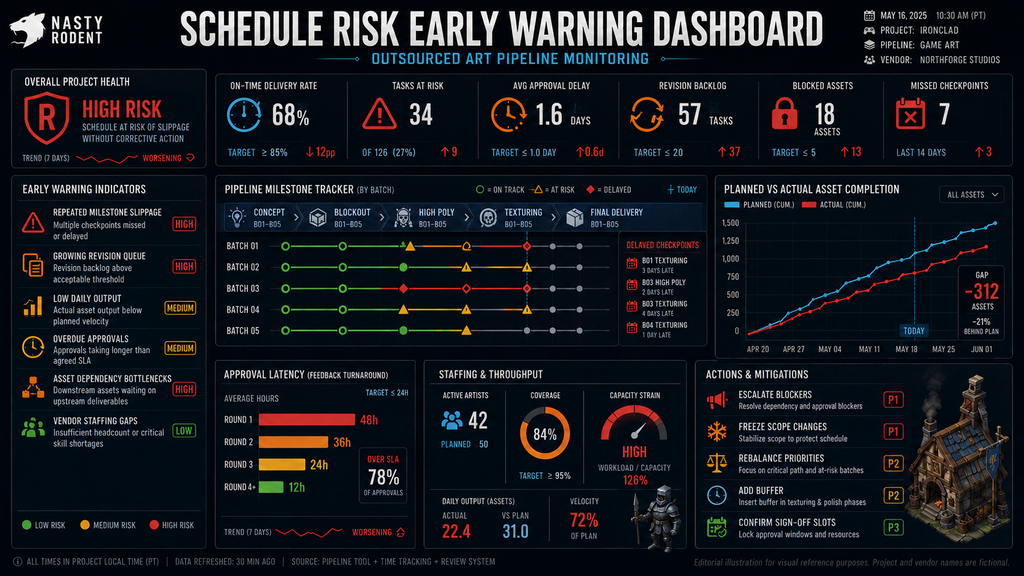
A milestone review tells you whether a deadline was hit. It doesn’t tell you why a deadline that’s still two weeks away is already at risk — that information exists earlier, in signals that are easy to miss if nobody’s specifically watching for them. The most reliable of these come from the production data itself, not from reading a vendor’s tone; behavioral signals are worth watching too, but they’re a secondary layer on top of the operational metrics below, not a substitute for them.
“Editorial illustration created for visual reference purposes. It does not represent a real project, client work, or official software screenshot unless stated otherwise.”
Work-in-progress aging against the milestone plan. If assets are consistently spending longer than planned at a given stage — blockout, texturing, technical validation — the schedule is already consuming its available float, even while the final milestone date still looks intact on paper. This is one of the most direct signals available, because it comes from the work itself rather than from an inference about why the work might be slow.
Throughput falling below the run rate the milestone needs. A batch doesn’t need to be visibly late for the milestone to already be at mathematical risk. If the remaining asset count divided by the observed completion rate no longer fits inside the remaining production window, the risk exists now, whether or not anyone has noticed it yet. This is the calculation an outsource producer or the production role that owns vendor coordination should be running continuously, not just at the milestone gate.
SLA response time drifting, even slightly. A vendor who consistently answered clarifying questions within a day and is now taking three isn’t necessarily doing anything wrong on any single occasion — team members get sick, priorities shift for a day, or a question is simply waiting on a decision from your side rather than theirs. A pattern of drift, tracked across several consecutive exchanges, is an early signal that something in the operating cadence has changed and is worth checking directly — capacity pressure is one possible cause, not the automatic conclusion. Timezone overlap shapes what a realistic baseline even looks like before drift enters the picture — our breakdown of geography as a production decision covers how overlap width changes what a same-day response actually costs a vendor to deliver.
Revision demand moving materially above its recent baseline. A single milestone needing one extra round on top of an otherwise stable pattern is normal variance. A sustained increase relative to what’s been normal for that asset type — not a fixed count of consecutive milestones, since the right threshold depends entirely on how tight the existing baseline is — usually points to something specific worth naming: brief clarity degrading as the project moves into less-specified territory, art direction shifting faster than the reference material is being updated, or a team member change on the vendor’s side that hasn’t been flagged.
Batch composition quietly shifting toward simpler work. If a milestone scoped to include a mix of complex and straightforward assets comes back weighted more heavily toward the straightforward ones, with harder pieces pushed to “next batch,” that’s a sign the original sequencing assumptions may no longer hold. Capacity pressure on the vendor’s side is one possible explanation; an unresolved dependency, a missing approval, or a blocked reference on your side can produce the identical pattern. Either way it’s worth surfacing directly rather than discovering only once the postponed assets pile up in a later milestone.
Proactive updates becoming reactive ones. This is a qualitative secondary signal, not a schedule metric on its own — worth watching alongside the indicators above, not in place of them. A team with schedule headroom tends to flag small issues before they’re asked about; a team running close to capacity tends to answer only what’s directly asked, with thinner status notes and less visible problem-solving in progress. On its own it’s weak evidence. Alongside WIP aging or a slipping throughput number, it corroborates what the harder data is already suggesting.
None of these signals individually means a milestone will be missed. Trending in the same direction, especially when a behavioral signal lines up with what the WIP and throughput data already show, they’re the closest thing to an early warning system a producer actually has access to during active production.
What to Do When a Signal Fires
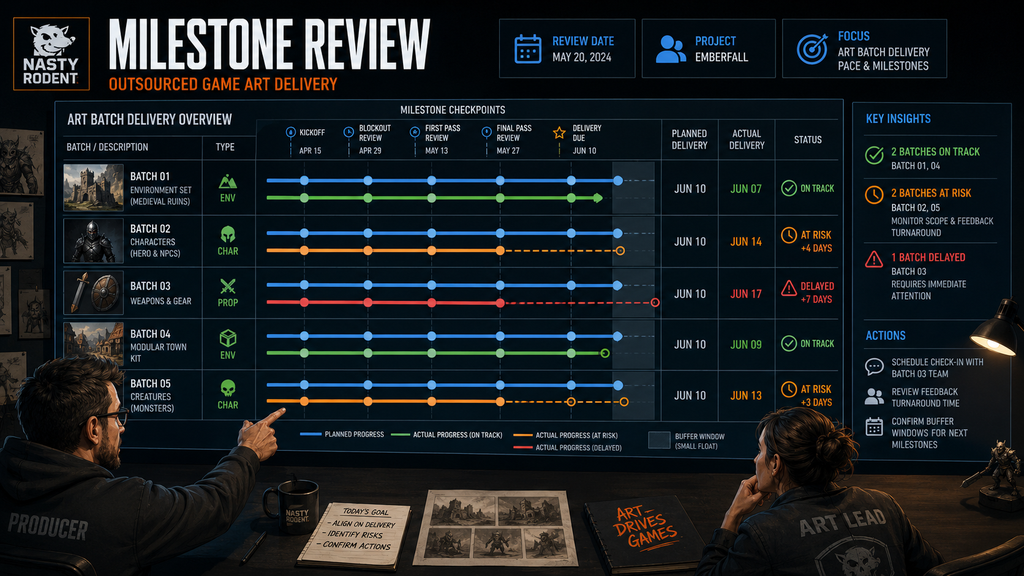
The instinct when a signal shows up is either to panic — assume the whole engagement is at risk — or to ignore it because nothing has technically failed yet. Neither is the right response, and the useful middle path depends on having an escalation structure already defined, not improvised in the moment.
“Editorial illustration created for visual reference purposes. It does not represent a real project, client work, or official software screenshot unless stated otherwise.”
Raise it directly and early, before it’s confirmed. A conversation that starts with “response times have been slower this week, is something going on with capacity” costs nothing and often surfaces the actual cause — a team member out sick, a parallel project competing for the same specialists, a misunderstanding about scope that hasn’t yet become a missed deadline. Waiting until the milestone is actually late to have that conversation means having it under worse conditions, with less room to adjust.
Use the escalation path that’s already in the contract, not one built on the spot. Who owns escalation on a production team — whether that’s a dedicated outsource producer or a broader production role — matters here specifically because an escalation raised to the wrong person on either side gets acknowledged without actually being resolved. If the SOW named an escalation contact and a resolution window when it was signed, that’s the path to use now, not a new one improvised because the original one feels slow.
Reforecast first; only re-baseline through an explicit change decision. The instinct once a slip is confirmed is to just move the milestone date and carry on. Resist doing that quietly. Preserve the original milestone baseline so the variance stays visible — quietly rewriting the plan to match reality erases the exact signal that would tell you, three milestones from now, whether this is a one-off or a pattern. Instead, agree a recovery forecast first: revised sequencing, a scope split, or temporary added capacity. Only formally re-baseline the plan once both sides have explicitly agreed that the underlying commitment itself is changing — not automatically, the moment a date moves.
A Quick Way to Check Your Own Schedule Discipline
- Are milestones defined by deliverable and acceptance criteria, or only by date?
- Is the checkpoint interval matched to the type of work currently in production, or fixed from project kickoff regardless of what’s changed since?
- Is the buffer sized against approval rate and rework turnaround together, or against approval rate alone?
- Does anyone track WIP aging and throughput against the milestone’s run rate, or only find out at the review whether the pace was enough?
- Is there a named escalation contact and resolution window already agreed, or would one need to be improvised if a signal fired today?