
Turning a Character Roster Brief Into a Production Scope You Can Schedule
-

Written byDenys Zadoienyi
-

Updated on01.09.2026
-

Time to read13 min

- Why “How Many Characters” Is the Wrong First Question
- Two Dimensions of Scope: Unit Complexity and Production Volume
- Production Tier and Anatomy Class Are Two Separate Axes
- Technical and Pipeline Factors That Refine the Estimate
- From Roster to Work Units: Five Scope Layers to Track
- Where Rosters Quietly Grow: Variant Creep and Reuse Assumptions
- Case Notes: What This Looks Like in Practice
- Scope, Capacity, and the Quote Request
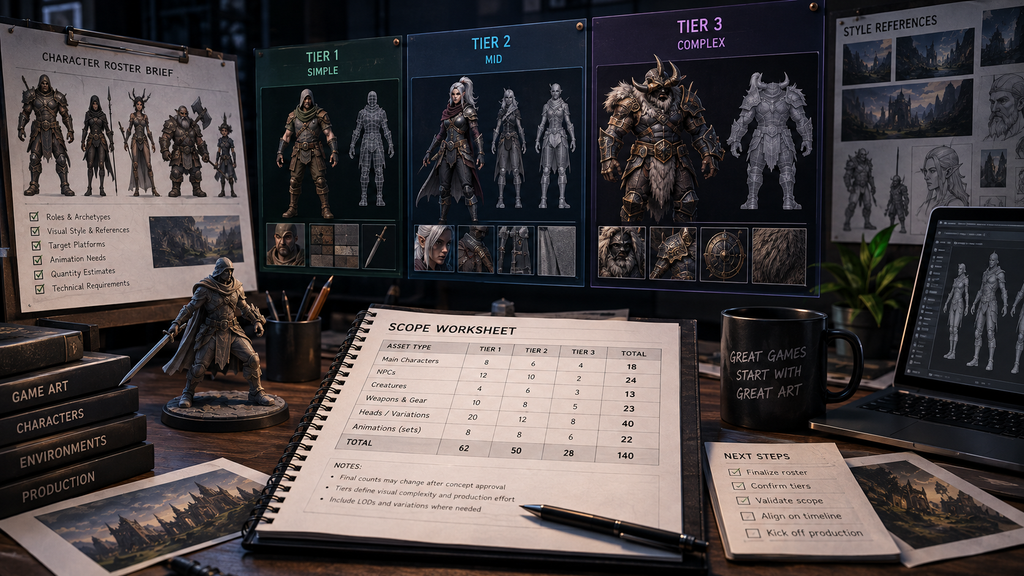
Character art scope estimation is the process of translating a character roster brief into a structured production plan – production tier, anatomy and rig class, unit complexity, and reuse volume – before a schedule or a quote gets assessed against it. A brief that lists character names and one-line descriptions isn’t a scope. It’s an intent. Scope is what you get once every name on that list has been classified against these dimensions and counted at the level production actually happens: not characters, but work units.
“Editorial illustration created for visual reference purposes. It does not represent a real project, client work, or official software screenshot unless stated otherwise.”
Most roster briefs skip that step, and the uncertainty shows up later, not earlier – in padded estimates, quote mismatches, or a milestone review where a 12-character roster can expand into dozens of production deliverables once outfits, modular parts, and variants are counted separately.
Why “How Many Characters” Is the Wrong First Question
A producer opening a new project’s character brief almost always starts with a headcount: “we need 12 characters” or “a roster of 20.” That number feels like scope. It isn’t – it’s a name count, and name count and production scope diverge the moment a project has more than a handful of characters.
The divergence comes from several places a headcount doesn’t touch at all: how many of those 12 names actually need bespoke modeling versus a shared base body with swapped outfits and materials; how deep the rig, facial, and technical requirements go for each one; and how many variants of each named character will exist by the time the roster ships – seasonal skins, faction recolors, damage states, or simply “the same enemy type at three armor tiers.”
A roster brief that reads as 12 lines in a design document can resolve into 12 unique character builds, or it can resolve into 4 unique builds, a shared modular kit, and 30 material and gear variants of those 4 – and those are two entirely different production engagements, with different timelines, different team compositions, and different quotes. Scope estimation is the step that tells you which one you’re actually looking at.
Two Dimensions of Scope: Unit Complexity and Production Volume
Once a roster brief exists, the useful way to size it is to stop treating “complexity” as one thing and split it into two independent dimensions. Conflating them is one common reason a scope estimate can feel off even when someone clearly put effort into it.
Unit complexity is how much work a single build carries on its own: silhouette and surfacing complexity (how much unique shape and material information the character carries – a uniformed background NPC reads at a glance and can share a base mesh with dozens of others, while a hero character with bespoke armor and a distinct silhouette carries surfacing work that doesn’t transfer to anyone else), rig and deformation depth (a shared humanoid skeleton with standard deformation is a different problem from a bespoke skeleton with custom deformation, facial setup, and secondary motion – this is a separate question from how many animations the character will use, which is an animation-scope question, not a rig-complexity one), and the technical and pipeline factors covered in the next section.
Production volume and reuse is a separate question: how many genuinely unique builds does the roster actually contain, versus how much of the apparent headcount is modular components and variants of those unique builds? A tier of “background enemies” often isn’t 15 unique builds – it’s 3 base builds with 5 material and prop-attachment variants each. Whether a character is a genuinely unique asset or a variant of something already scoped can produce a very different workload from a fully bespoke build, and a brief that doesn’t separate the two may force the studio pricing it to price uncertainty into the estimate – conservative assumptions about how much of the roster is unique, carried as padded scope nobody named directly.
Neither dimension replaces the other. A character can carry low unit complexity and still sit in a high-volume tier (a simple background enemy type with a dozen recolors), or carry high unit complexity with almost no reuse (a hero with a bespoke rig and no planned variants). Scope estimation means checking both dimensions independently for every entry on the roster, not eyeballing whichever one is easiest to judge from a concept sketch.
Production Tier and Anatomy Class Are Two Separate Axes
A common mistake in roster planning is folding “how important is this character” and “what kind of body does it have” into one tier list. They’re different axes, and keeping them separate makes the rest of the estimate hold together.
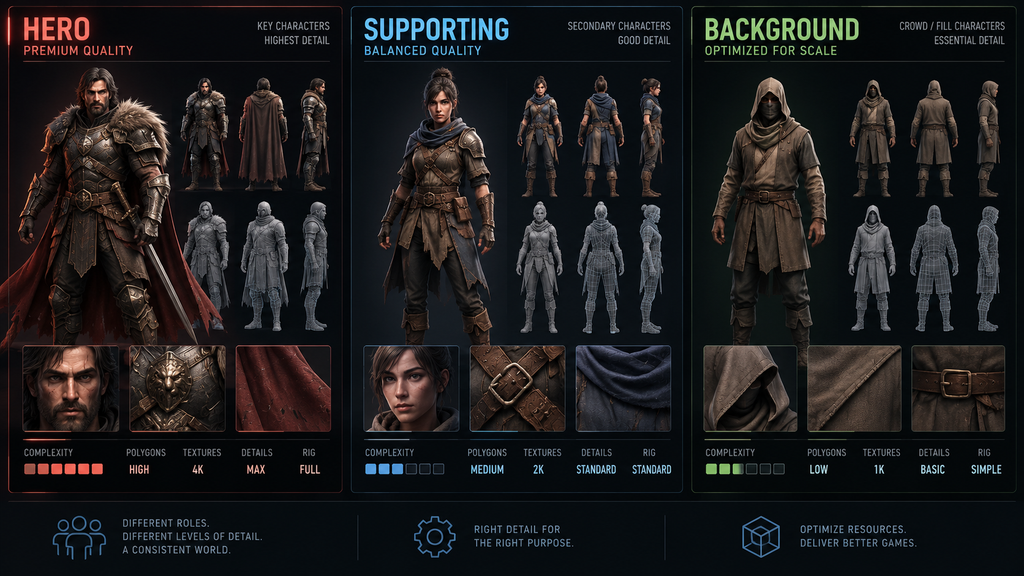
Production tier describes where a character sits in the game’s fidelity and screen-time hierarchy:
“Editorial illustration created for visual reference purposes. It does not represent a real project, client work, or official software screenshot unless stated otherwise.”
- Hero / Principal – player-facing or camera-scrutinized, typically carrying the highest visual scrutiny and often higher unit complexity – though not automatically: a boss creature, a technically demanding mount, or a photoreal supporting character can carry a harder rig or groom problem than the nominal hero. Variant count is project-dependent rather than fixed: a cinematic principal character may carry few variants, while a player-facing or live-service hero can carry extensive outfit, skin, or customization scope.
- Supporting / Named – meaningful screen time but not the camera’s primary focus. Facial and rig scope may be lighter where dialogue and close-up requirements are limited, but that has to be confirmed per project rather than assumed.
- Background / Crowd – often designed with reuse in mind, relying more heavily on shared bases, modular parts, or variants than on bespoke unique builds. That’s a common production strategy for this tier, not a fixed definition of it – some background entries still need a genuinely unique build.
Anatomy and rig class is an entirely separate parameter that cuts across all three tiers: standard humanoid, non-standard humanoid, quadruped, creature, or multi-limbed/custom anatomy. A hero can be a creature. A background character can be a standard humanoid. Collapsing anatomy class into the tier list – treating “creature” as if it were a fourth production tier alongside hero, supporting, and background – produces a table that looks complete but mixes two different classification questions, and a roster planned against it will misprice whichever characters don’t fit neatly into one column.
Technical and Pipeline Factors That Refine the Estimate
Production tier, anatomy class, and the two complexity dimensions give a first-pass scope. Turning that first pass into an estimate a studio can actually schedule against means checking a further layer of technical factors, most of which a rough brief won’t specify on its own:
- Concept readiness – locked concept art, partial references, or a verbal description change how much of the unit-complexity question is even answerable yet.
- Facial requirements – dialogue closeups, procedural facial animation, or a shared facial rig pipeline all carry different scope than a character with no facial performance at all.
- Hair and grooming – card-based hair, strand-based grooms, and fur behave as distinct production lines with different tooling and review cycles.
- Cloth – layered or static garments, skinned cloth, and simulated cloth can carry very different setup and validation requirements; this is a meaningful scope difference, not a texture choice.
- Skeleton reuse and modularity – whether a character shares a skeleton and modular gear system with others on the roster, or requires a fully custom rig.
- LOD requirements – project-specific, and frequently absent from an early brief entirely.
- Texture and material budgets, target platform and engine integration, and animation deliverables – existing, new, or retargeted.
None of this needs to be resolved before a first-pass tier estimate exists. It does need to be tracked as a known unknown, rather than silently assumed, because each of these factors can move a character between complexity brackets once it’s actually answered.

From Roster to Work Units: Five Scope Layers to Track
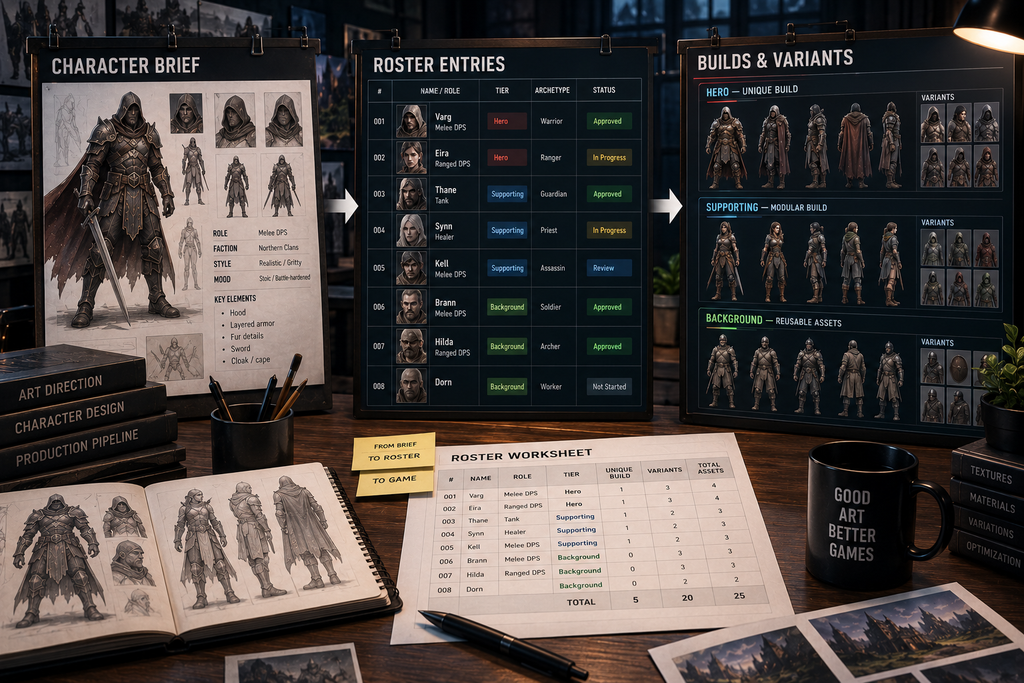
The mistake that undoes most character scope estimates – including an earlier framing we used ourselves before this revision – is treating “unique character builds” as the final number. In modular production, a single roster entry can break down into a base body, head, hair, torso, gear pieces, accessories, material sets, morphs, a rig, and LOD packages. There is no single “real asset count” hiding inside a roster; there are several layers, each answering a different production question.
A usable model separates the roster into five layers: roster entries (the names on the original brief), unique character builds (substantially new builds that require their own modeling and surfacing work, even when they reuse an existing skeleton or parts of the rig pipeline – a unique build doesn’t require a unique rig), modular or reusable components (shared bodies, gear kits, hairstyles that get combined across multiple entries), variants (material, geometry, or skin differences applied to an existing unique build or component), and technical deliverables (LOD packages, engine-ready skeleton/rig setups, collision and physics assets, and engine-specific exports). A production estimate works with these five layers together, not with a single number labeled “characters.”
“Editorial illustration created for visual reference purposes. It does not represent a real project, client work, or official software screenshot unless stated otherwise.”
The worksheet that produces these counts needs more than a handful of columns to be useful to a producer:
| Field | What it captures |
| Roster entry | Character or archetype name |
| Production tier | Hero / Supporting / Background |
| Anatomy / rig class | Standard humanoid / non-standard humanoid / quadruped / creature / custom |
| Unique or reuse status | New build / shared base / derivative of an existing build |
| Modular components | Head, outfit, gear, hair – tracked separately from the whole |
| Variants | Material, geometry, or skin differences on top of a unique build |
| Concept state | Locked / partial reference / to-be-defined |
| Rig requirement | Existing shared rig / custom rig / facial rig needed |
| Hair / groom | Cards / full groom / not applicable |
| Cloth | Static / simulated |
| Technical target | Platform and engine |
| LOD requirement | Project-specific |
| Animation scope | Existing library / new / retargeted |
| Assumption status | Confirmed / assumed / to-be-confirmed, with an owner named |
The last column matters more than it looks. A worksheet that fills every cell with a number but doesn’t flag which numbers are confirmed and which are assumptions produces a false sense of precision – and a false sense of precision in a scope document is worse than an honest range, because it gets treated as a commitment by whoever reads it next.
Once this worksheet exists, it’s also the input the 3D character pipeline is actually scheduled against – concept lock, blockout, high-poly, retopology, and rig each get budgeted per unique build and component, not per name on the original brief.
Where Rosters Quietly Grow: Variant Creep and Reuse Assumptions
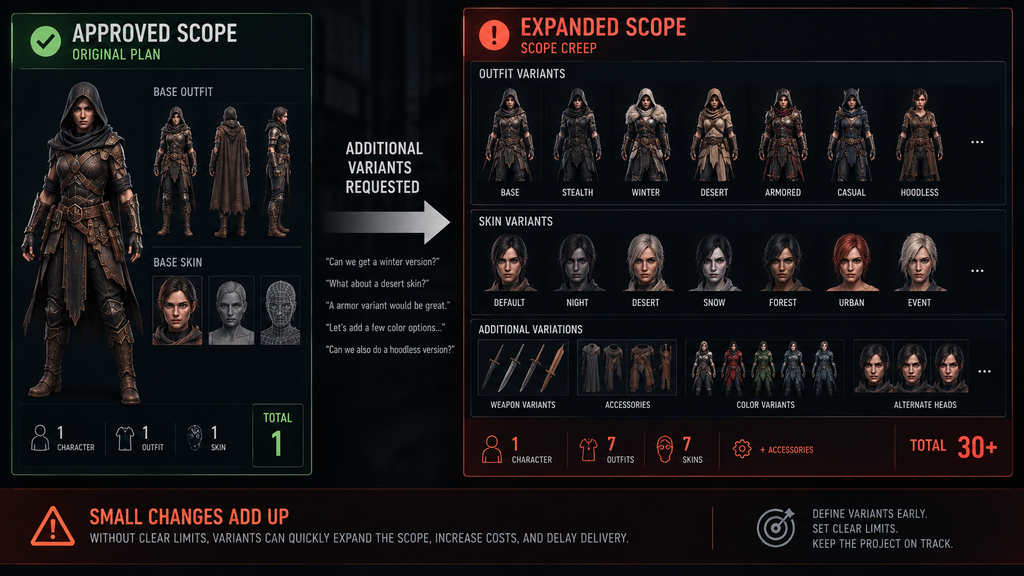
One common way a scoped roster drifts upward after production has started isn’t a new character being added – it’s variant creep on characters that were already counted. A background-tier enemy type scoped at “1 unique build, 3 material variants” becomes 5 variants once art direction wants a distinct look per difficulty tier. A hero character scoped with minimal planned variants picks up a seasonal cosmetic mid-production because a content drop needs one.
“Editorial illustration created for visual reference purposes. It does not represent a real project, client work, or official software screenshot unless stated otherwise.”
The arithmetic is straightforward once it’s made explicit: if a tier’s approved variant list has 25 entries and five more get added without re-scoping, that’s a 20% increase over the approved baseline – worth flagging even when each individual addition seemed small on its own. What makes variant creep expensive specifically is that it’s rarely re-scoped when it happens. A “quick extra skin” request gets treated as a small addition rather than run back through the worksheet, and several quick additions later, the roster has grown materially beyond the approved scope with nobody having re-approved that growth as a decision.
The practical fix isn’t refusing changes – production plans reasonably change – it’s keeping the worksheet alive after the initial estimate, so a new variant request gets logged against the tier it belongs to and the schedule impact is visible before the work starts. This is the same discipline that shows up under a different name in how art scope creep starts and gets contained – variant creep on a character roster is a specific, common instance of that general pattern.
Case Notes: What This Looks Like in Practice
On Wild Rage, a stylized MMORPG project for Whimsy Games, Nasty Rodent led the overall art direction, including character design, concept, weapons, props, environment, and UI/UX. A roster of that kind illustrates why production tier, anatomy class, unit complexity, and variant planning need to be checked separately rather than eyeballed as one number: a stylized MMORPG cast can combine bespoke principal characters, reusable enemy archetypes, modular components, and visual variants in a mix that depends entirely on the game’s design – not a fixed pattern every stylized roster follows.
Nasty Rodent also contributed to Mutant Year Zero: Road to Eden, a PC/console title by The Bearded Ladies. For any roster that includes creatures or non-standard anatomy, the anatomy-class axis can become a major estimation factor: a silhouette that looks straightforward in concept art may conceal substantial rig and deformation requirements.
The worked example below is a hypothetical roster built to show how the five scope layers apply in practice – it is illustrative only and does not represent the actual production breakdown of Wild Rage, Mutant Year Zero, or any other named project.
Worked example: a hypothetical 26-entry stylized roster
| Roster brief says | Scope layer it actually is |
| 2 principal characters | 2 unique builds |
| 6 enemy archetypes | 3 new unique builds + 3 derivatives of those builds |
| 18 background entries | Modular combinations of shared bodies and gear, not 18 unique builds |
| 4 hairstyles | Reusable components, shared across multiple entries |
| 9 gear pieces | Modular components |
| 12 skin/material variants | Variants layered on top of existing unique builds |
| LOD sets + engine export | Technical deliverables |
The design document still calls this a “26-character roster.” Treating the brief as 26 equivalent units would obscure the actual mix of unique builds, reusable components, variants, and technical deliverables – roughly 5 unique builds, a shared modular kit, and a variant/technical layer on top. Scoping it through the five layers prices what the roster actually requires to build.
Scope, Capacity, and the Quote Request
A tiered, counted roster – production tier and anatomy class assigned, unit complexity and reuse volume tracked at the five work-unit levels above – is the input a production quote actually needs. A tiered, counted roster lets a studio quote with fewer assumptions and a narrower uncertainty range than a name list alone, which forces the studio to scope the project on its own assumptions before pricing it. That said, a rough brief isn’t disqualifying – a studio can still return an estimate built on explicit assumptions and ranges; a scoped roster simply narrows those ranges before the number is quoted.
The worksheet also surfaces a capacity question worth asking before the quote request goes out: if the unique-build count is high and several tiers need to move through modeling, texturing, rigging, and engine integration in parallel, the honest question isn’t only “how much would this cost” but “does this make more sense as an internal hire or as outsourced production capacity” – a decision the roster worksheet feeds directly, since it’s the same unique-build and parallel-workstream count that determines whether an in-house team can realistically absorb the volume on schedule.
Once the roster is tiered and counted, Nasty Rodent’s character production team can return a quote built on the worksheet rather than on assumptions – and the next question, naturally, is what each layer costs. That’s a separate calculation from the one covered here: our 3D character cost breakdown picks up exactly at that point, once the production scope and work-unit mix are clear.

Let's work
together


in mind?
From 3D characters and environments to weapons, props, concept art and game UI/UX: ten years deep, 40+ artists strong, zero fluff. Tell us what you are making and get a free, no-pressure estimate.
estimate