Fixed Price vs Time & Materials for Game Art: Which Model Actually Fits Your Project
-

Written byDenys Zadoienyi
-

Updated on28.08.2026
-

Time to read12 min

“Editorial illustration created for visual reference purposes. It does not represent a real project, client work, or official software screenshot unless stated otherwise.”
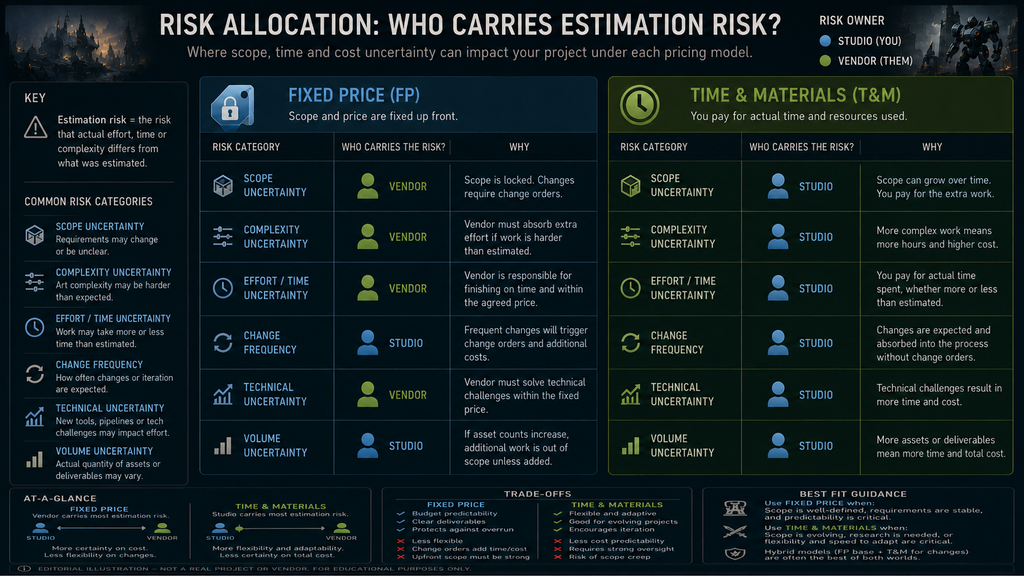
Ask a vendor which pricing model is better, and you’ll usually get an answer that fits whatever they’d rather offer this quarter. Ask which one fits your project, and the question gets more useful — because fixed price and time and materials aren’t competing for the same title. They’re two different answers to the same underlying question: who carries the risk if the estimate turns out to be wrong.
What actually drives the number on a quote — the assumptions a studio makes, what’s included versus billed separately, regional cost base — is a separate question from which billing model you should be asking for in the first place. This is about the second question: given what you know about your project right now, which model puts the risk where it belongs.
This is narrower than choosing a cooperation model overall — project-based, retainer, dedicated team, staff augmentation, or co-development. Fixed price and T&M sit specifically inside the contract mechanics layer: once you know roughly which cooperation shape fits, this is about how the billing and risk allocation underneath it should actually work, including where hybrid structures fit that a model-selection overview doesn’t have room to cover.
What Each Model Actually Commits To
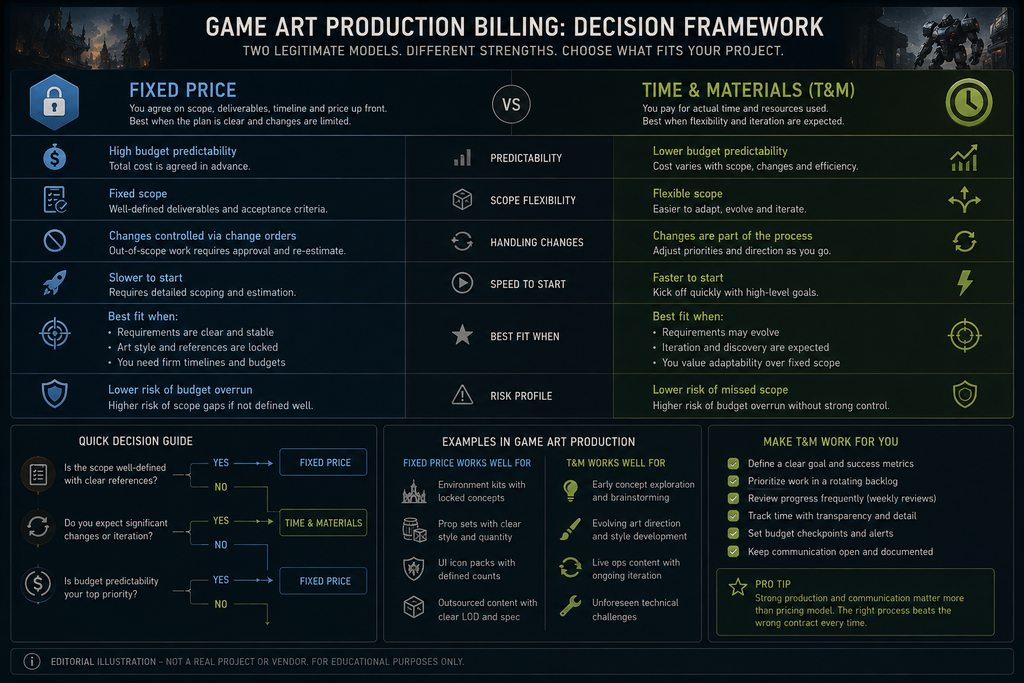
A fixed-price agreement commits the vendor to a defined scope for an agreed price, subject to the assumptions and change-control terms written into the contract. The vendor is pricing the risk that its own estimate is wrong, which is why a fixed quote often carries contingency that may be embedded in the quoted price rather than shown as a separate line item. In exchange, the client gets a number that doesn’t move as long as the scope doesn’t.
T&M reduces the vendor’s direct exposure to estimation risk, because the client pays for actual effort at agreed day or blended rates rather than a locked total. In an uncapped arrangement, the final spend isn’t fixed in advance; capped or not-to-exceed variants — covered below — add a contractual ceiling back in. Because the vendor carries less estimation risk under T&M, the commercial buffer built into the overall price may be lower — which can make T&M cheaper for the same work, though not necessarily, since a T&M forecast can also run higher if the work turns out more involved than expected. What T&M changes isn’t whether a ceiling can exist, but who is responsible for watching the number as it moves: T&M places more budget-monitoring responsibility on the client, who needs to track burn rate and forecasted total spend alongside whatever reporting the vendor provides, rather than holding the vendor to a single number set in advance.
Neither model is more honest than the other, and neither is a red flag. They’re a risk-allocation choice, not a quality signal — which is exactly why “which is better” is the wrong question to bring into a vendor conversation. The useful question is which allocation your project can actually tolerate.
“Editorial illustration created for visual reference purposes. It does not represent a real project, client work, or official software screenshot unless stated otherwise.”
When Fixed Price Fits
Fixed price works when the thing being priced is genuinely knowable in advance. That’s a narrower condition than it sounds, and it’s worth checking against specifics rather than gut feel:
The asset list is closed. Not “roughly twelve weapon variants” — an itemized list naming every deliverable, its fidelity tier, and its revision allowance. If the list is still being negotiated internally on your side, a fixed quote against it is a fixed quote against a moving target, and a prudent vendor is likely to price some of that uncertainty into the quote, or protect itself through stated assumptions and change-control terms, whether or not you see it named as contingency.
The reference material is stable. Not that a style guide can never be touched, but that the major visual targets inside it are unlikely to change mid-production. Updates that clarify or document already-approved direction are normal; a shift in the underlying target is different. If your creative direction is still being validated — waiting on a publisher pitch, a platform decision, or an internal art-direction review — locking a price against a target that might still shift transfers the eventual rework cost onto whoever absorbs the change request, and that’s rarely a clean split.
The engagement is a discrete batch, not an ongoing relationship. A one-time character roster for a vertical slice, a defined prop set, a concept art package for a pitch deck. Fixed price handles a bounded piece of work well; it handles an open-ended production relationship less naturally, because every new ask outside the original scope becomes its own negotiation.
You want stronger budget predictability, without hour-by-hour cost oversight. Fixed price generally reduces the need for hour-by-hour cost tracking on your side — the management focus shifts toward milestones, acceptance criteria, and change control rather than watching a running hour count. That’s a real advantage for a procurement function managing several vendors at once, where day-to-day hour tracking on each one isn’t a realistic use of internal capacity. It also assumes you’ve already confirmed the vendor’s own scope discipline before signing — a fixed price only holds up if the vendor’s estimation process holds up.

When Time & Materials Fits
T&M fits the inverse conditions, and it’s worth being honest that those conditions describe a fair share of real game-art engagements, not an edge case:
The scope is genuinely still forming. Early production, a title still finding its visual direction, a pipeline being built out in parallel with the assets running through it. Pricing this as fixed means either quoting against assumptions that will be wrong, or padding contingency heavily enough that you’re effectively pre-paying for uncertainty that may not materialize.
The engagement is ongoing rather than a single deliverable. A live-service title adding weapon variants, environment expansions, and UI iterations across a release cycle doesn’t have a single “scope” to fix a price against — it has a stream of work that keeps arriving. T&M, or a capacity-based structure billed on the same logic, matches that shape better than a series of individually negotiated fixed quotes for each new batch.
Your team is positioned to track hours and catch drift early. T&M shifts budget oversight onto you, and that only pays off if someone on your side is actually watching the burn rate against the plan — not discovering at month three that the run rate implies a total nobody approved. A vendor scorecard that includes burn-rate transparency, not just delivery quality, is worth asking for explicitly in a T&M arrangement.
You want the flexibility to redirect mid-production without renegotiating a fixed price for every pivot. T&M makes redirection commercially easier to accommodate, because additional or changed effort is usually billed under the existing rate structure instead of triggering a new price negotiation. That doesn’t mean T&M runs without a scope baseline — a T&M engagement can and should still work against an approved backlog, milestones, and acceptance criteria. What it removes is the renegotiation step each time the backlog shifts, which is exactly why active hour-and-backlog tracking matters more under T&M, not less: nothing in the billing model itself will flag a drift for you.
The Genuinely Undefined Middle
Most real projects don’t land cleanly on either side. A studio knows the general shape of what it needs — a character roster of roughly this size, an environment of roughly this scope — without having a locked asset list yet. Forcing that into a fixed quote produces a number built on assumptions the studio hasn’t validated; forcing it into open-ended T&M with no cap reduces the vendor’s direct financial exposure to an inaccurate estimate and shifts more of the forecasting risk onto the client, since nothing in the arrangement itself compresses effort toward a target.
The practical move in this middle zone isn’t picking a model and hoping — it’s sequencing two of them. A short, separately scoped discovery or pre-production phase, billed T&M or as a fixed small deliverable, produces the itemized asset list and validated reference pack that a fixed-price quote for the main production phase can then be built against. This isn’t a workaround; it’s the same logic that governs how a properly scoped SOW gets written in the first place — you can’t fix a price against a scope that hasn’t been defined yet, so the definition step gets its own, smaller commitment before the larger one.
Hybrid Schemes That Actually Work
Pure fixed price and pure T&M are the two ends of a spectrum, not the only two points on it. A handful of hybrid structures show up in real game-art engagements, each solving a specific version of the risk-allocation problem:
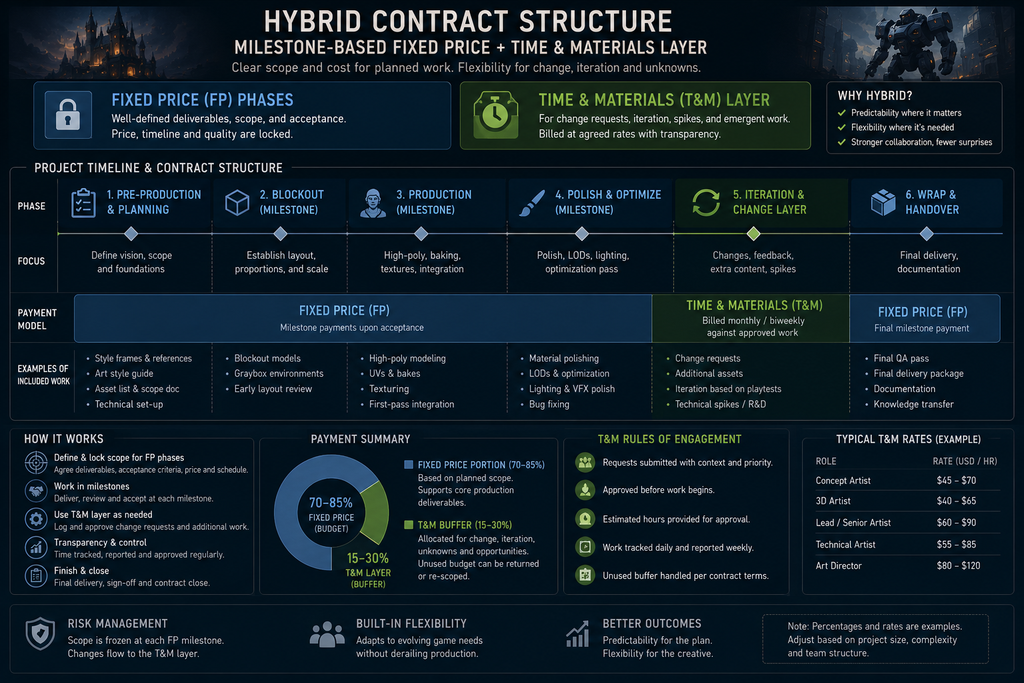
Capped T&M (not-to-exceed). Billing runs on logged hours, exactly as with standard T&M, but the contract sets a ceiling the vendor won’t bill past without a separate approval. This gives the client a worst-case number to budget against while preserving T&M’s flexibility for the portion of the work that’s genuinely uncertain. The tradeoff: a vendor pricing a not-to-exceed cap may use more conservative time estimates than an uncapped T&M quote, since they’re now carrying some of the ceiling risk themselves.
Fixed price with a defined change layer. The base scope is fixed and priced normally, but the contract names a separate, pre-agreed rate for anything routed through the change-request process — rather than treating every change as a one-off renegotiation. This is the structure that makes fixed price viable for projects where the core scope is stable but some iteration is expected; it’s also the model most directly protected by having a change request procedure and a dedicated contingency budget already in place, since the change layer only functions if scope movement gets routed through it instead of absorbed silently.
Milestone-based hybrid. Each production phase gets its own fixed quote, negotiated as the previous phase closes and the next one’s scope is known. Pre-production and early concept work might run T&M while direction is still forming; full production locks to fixed price once the asset list and style guide are validated; live-ops support after launch may move to T&M or a capacity retainer, since post-launch work rarely has a fixed shape. This is close to how a multi-milestone engagement naturally structures itself once you stop trying to force one billing model across every phase of a project that doesn’t have one uniform shape from start to finish.
“Editorial illustration created for visual reference purposes. It does not represent a real project, client work, or official software screenshot unless stated otherwise.”
None of these are exotic. They show up whenever a studio and a client are both trying to solve the actual problem — risk allocation that matches the project’s real uncertainty — instead of defaulting to whichever model is administratively simpler to sign.
Reading This From a Procurement Seat
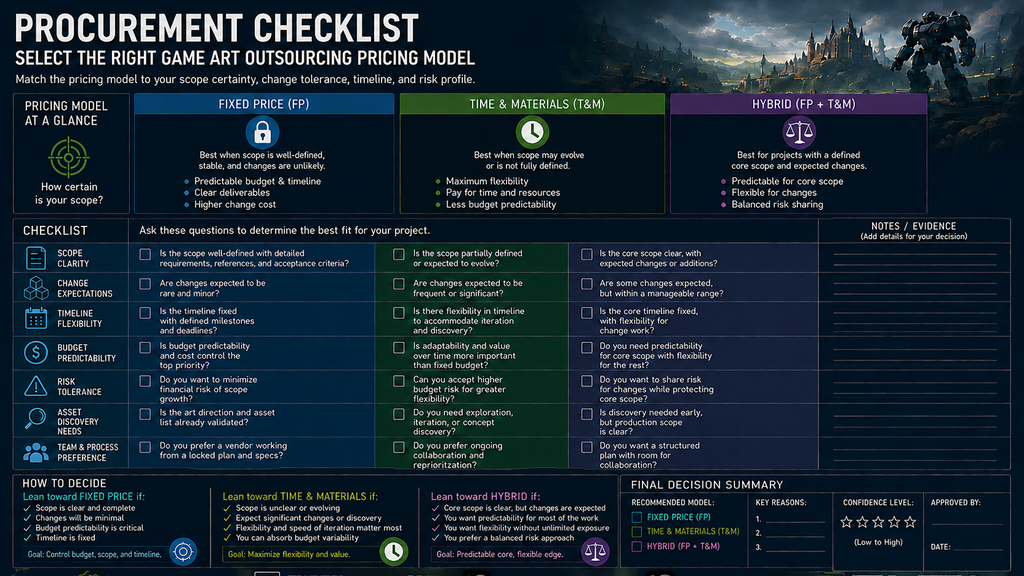
For a vendor manager running an RFP across a shortlist, the pricing-model question isn’t really about this one project. It’s about what the model implies for the ongoing relationship: how change requests get priced, how disputes over “is this in scope” get resolved, and who owns the escalation path if the numbers start drifting from the plan.
A useful diagnostic to build into vendor evaluation: ask each shortlisted studio not just for their quote, but for their preferred model and why. A vendor that defaults to fixed price for everything may be optimizing for administrative simplicity over fit; a vendor that pushes uncapped T&M regardless of how defined your scope already is may be shifting more estimation and budget risk onto you than the scope actually requires. Neither answer disqualifies a vendor by itself, but the reasoning behind it says more about how that vendor will handle a change request eighteen months into an MSA than the headline day rate does. That reasoning is also worth documenting during the first weeks of onboarding, so both sides start from the same assumptions about reporting, approvals, and how scope changes get priced.
This is also where pricing model intersects with vendor pool strategy. A studio managing several art vendors across different asset categories doesn’t need every vendor on the same billing model — a fixed-price arrangement for a well-defined prop pipeline and a capacity-based T&M arrangement for an evolving environment pipeline can sit inside the same overall vendor pool without creating inconsistency, as long as the reasoning for each is documented rather than inherited from whatever the first vendor happened to propose.
“Editorial illustration created for visual reference purposes. It does not represent a real project, client work, or official software screenshot unless stated otherwise.”
How We Structure This at Nasty Rodent
Our project-based and ongoing-support models map onto this directly rather than forcing every engagement through one billing logic. Project-based work locks a defined scope and milestone payments once the asset list is validated — the fixed-price end of the spectrum, for projects where that’s the right fit. Ongoing support allocates monthly capacity for evolving production needs — closer to the T&M or capacity end, for projects where the scope is still forming or the work is genuinely continuous. Which structure fits your project is part of the conversation before the engagement is scoped, not something worked out after a mismatch shows up mid-milestone.
If your project doesn’t cleanly fit either end — a roadmap with a validated first phase and a less certain second one, or a live title where some work is predictable and some isn’t — that’s normal, and it’s usually the strongest argument for a milestone-based or capped hybrid rather than forcing a single model across the whole engagement. Share where your project currently stands and we can map which structure actually fits it, rather than defaulting to whichever one is easier to quote.