Hire 3D Artist vs Outsource 3D Studio for AAA: The Decision That Determines Your Production Risk
-

Written byDenys Zadoienyi
-

Updated on25.05.2026
-

Time to read18 min

- What “AAA 3D Art” Actually Requires Operationally
- The Freelance Individual 3D Artist: When It Works and When It Doesn’t
- The In-House 3D Team: The Hidden Cost Calculation
- The Outsource 3D Studio: What You Are Actually Buying
- The Decision Matrix: Which Model for Which Production Scenario
- The Hybrid Model: How AAA Studios Actually Structure This in Practice
- The Build-vs-Buy Inflection Point for 3D Art
- Risk Profiles Side by Side
Most studios approach this decision the wrong way. They look at a rate card, compare an hourly figure for a freelance 3D artist against a studio’s project quote, and choose based on which number is smaller. Then they encounter production pressure at the third milestone and discover that the decision they made on price was actually a decision about operational risk — and they made it without understanding what they were buying.
This guide is built for the outsource decision-maker who has already moved past the budget conversation and needs to evaluate these two models against the actual variables that determine whether production succeeds: capacity at scale, style consistency over time, IP governance, revision accountability, and single-point-of-failure risk. The cost structure matters, but it matters as a function of these operational factors, not as a substitute for them.
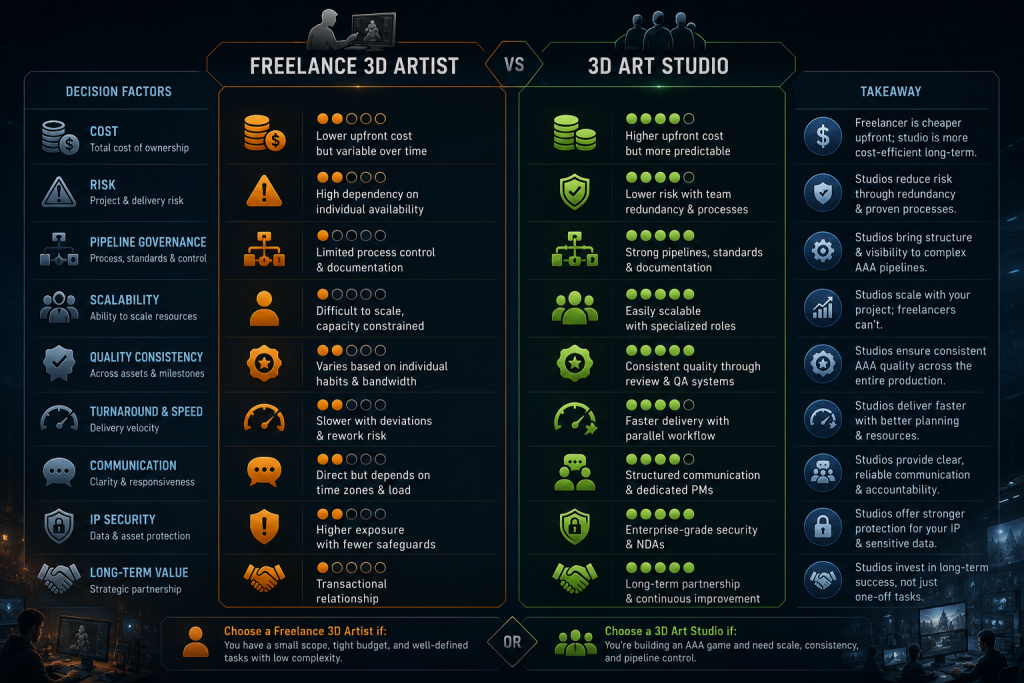
“Editorial illustration created for visual reference purposes. It does not represent a real project, client work, or official software screenshot unless stated otherwise.”
The three models in this comparison are: hiring a freelance individual 3D artist, building or expanding an in-house 3D team, and outsourcing to a dedicated 3D art studio. For AAA-level production — where asset counts run into the hundreds, visual consistency is contractually required across art directors and engine builds, and milestone slippage has downstream consequences across QA, publishing, and marketing — each model has a specific set of conditions under which it works and a specific set of conditions under which it breaks.
What “AAA 3D Art” Actually Requires Operationally
Before comparing models, it is worth being precise about what AAA 3D art production actually demands from a vendor, because the requirements are more specific than the phrase “high quality” suggests.
At the asset level, a AAA-grade 3D character or environment delivery includes: high-poly sculpt, clean retopology with production-ready polygon budget, UV unwrapping at the agreed texel density, PBR texture set in the agreed channel-packing format, material set up in-engine on the project’s master material framework, LOD chain where required, collision geometry, and naming conventions that integrate into the project’s version control without manual cleanup. A AAA 3D character asset may move through six to ten distinct production steps before it is engine-ready. Each step is a quality gate. Each gate requires a reviewer on your side.
At the pipeline level, AAA production requires batch production capability: the ability to deliver consistent quality across dozens or hundreds of assets that share the same style guide and technical specification, produced by a team where individual artist variation is managed through internal QA rather than absorbed by your art director’s review cycles.
At the governance level, AAA production requires: documented acceptance criteria, defined revision terms, clear IP ownership language, a named point of contact with decision-making authority, and a feedback loop with a committed response SLA on both sides.
A freelance individual 3D artist can satisfy the first requirement on a per-asset basis. Meeting the second and third requirements consistently — at scale, over a multi-month engagement — is where the model diverges sharply from a dedicated studio.
The Freelance Individual 3D Artist: When It Works and When It Doesn’t
The freelance model has a genuine use case in AAA production, and studios that dismiss it entirely are leaving a useful tool unused. The model works when:
The scope is precisely bounded. A single hero character, a specific set of weapons for one faction, a defined environmental kit that can be fully specified in a brief before work begins. When the scope is clear, the deliverable is singular, and the style guide is locked, a skilled freelance 3D artist can execute at AAA standard.
The internal team can absorb the management overhead. A freelance artist does not bring a production manager, an internal QA reviewer, or an escalation path for technical questions. Your team provides all of that. The art director reviews every deliverable directly. The producer manages the revision loop. If your internal team has the bandwidth for this, the model is workable.
The project timeline allows for sequential rather than parallel production. A single artist produces sequentially. If your milestone requires 40 environment assets by the same date, one artist is not the right model regardless of their skill level.
Where the freelance model breaks down in AAA production is predictable:
Scale. When asset volume grows beyond what one artist can deliver in the required window, the natural response is to add freelancers. Now you have a coordination problem: multiple artists interpreting the same style guide differently, no internal QA to catch divergence before delivery, and your art director spending their time correcting style drift rather than directing production.
Continuity risk. A freelance artist is a single point of failure. If they become unavailable mid-project — illness, a better-paying engagement, technical problems — there is no backup production capacity. The asset gap has to be filled through emergency replacement, which means onboarding a new artist under deadline pressure, which means quality variance and schedule risk.
Governance gaps. Freelance arrangements rarely include the formal documentation structure of a studio engagement: no MSA, no structured SOW with defined acceptance criteria, no IP transfer language that has been reviewed by legal. For a AAA title where the art is a commercial asset and the IP chain of ownership matters to publishers and investors, informal arrangements create exposure.
The GDC Vault talk on Guerrilla Games’ approach to asset production illustrates how a top-tier AAA studio resolved exactly this tension: by choosing to keep a small, senior internal team focused on art direction and concept, while routing nearly all asset production through vetted external studios with formal pipelines. The key insight is that the decision was not about cost — it was about where the value of an internal artist is highest and where the operational leverage of a structured external partner is highest.
The In-House 3D Team: The Hidden Cost Calculation
The in-house model is often presented as the premium option — full control, seamless collaboration, cultural integration. All of those things are real. They come at a cost that is systematically underestimated.
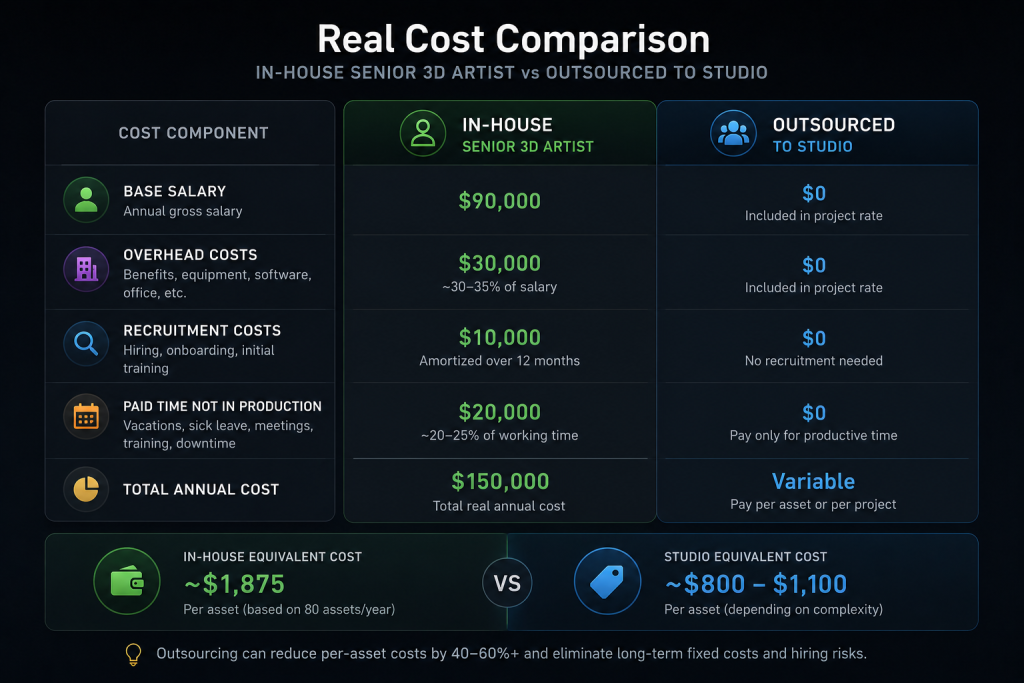
A senior 3D environment or character artist in the UK earns between £50,000 and £90,000 in base salary, with experienced leads reaching higher. In the US, a senior 3D artist at an AAA studio earns between $83,000 and $130,000 annually in base compensation, with specialized roles — character TD, technical artist — at the upper end of that range and above.
That number is not the actual cost. According to an analysis by 80.lv on the cost-efficiency of outsourcing versus in-house gamedev, the real cost of an internal specialist is approximately two times their base salary once you account for benefits, equipment, office overhead, HR, and management time. Recruitment alone — finding, screening, and hiring a senior 3D artist — typically runs $10,000 to $20,000 before day one.
“Editorial illustration created for visual reference purposes. It does not represent a real project, client work, or official software screenshot unless stated otherwise.”
For a studio that has a continuous, high-volume need for 3D art across the full project lifecycle — not just during the production peak but through post-launch content and live service — this cost amortizes well. For a studio building toward a production peak with a defined end, or scaling specific asset types that will not require a full-time position once the crunch passes, the in-house model leaves you with headcount you cannot efficiently right-size without the cost and reputational impact of layoffs.
The game industry’s 2023–2025 wave of studio restructuring and layoffs — which affected over 14,800 employees in 2024 alone — was in significant part a consequence of studios that hired aggressively at peak production and then could not sustain the headcount. The studios that navigated this period best shared a common structural approach, documented directly by studio leadership: hire senior specialists to establish pipelines and art direction, and route bulk production to outsource partners who absorb the scaling risk. As one studio founder described their model in a 2025 interview on 80.lv: “We hired only senior-level people — principals, directors, highly experienced leads. Their job was to establish pipelines and styles, and then we outsourced the bulk of production.”
The in-house model is the right call when the workload is continuous, the art direction requires constant real-time collaboration that cannot be asynchronous, or the asset type is sensitive enough that it needs to be adjacent to design and engineering at all times. It is the wrong call when it is being used to avoid the management work of running an external partner.
The Outsource 3D Studio: What You Are Actually Buying
An outsource 3D studio is not a collection of freelancers under a brand. The operational difference matters and is worth being precise about.
A structured studio brings: an internal production pipeline with defined review stages before delivery reaches you, an art lead or producer assigned to your account who owns quality outcomes and communication, a staffing bench that can absorb artist turnover without your project stopping, formal contractual infrastructure (MSA, SOW, NDA, IP transfer), and — for studios with AAA track records — a calibrated understanding of what “engine-ready at AAA fidelity” means technically.
What you are paying for in a studio engagement is not just the artist’s time — it is the operational infrastructure that makes the artist’s time reliable at scale. For a mid-size AAA project requiring 200 to 500 environment and character assets, this infrastructure is not a luxury. It is the difference between a production that delivers to schedule and one that spends its milestones absorbing variance.
The cost-per-asset comparison with freelancers is more nuanced than it first appears. A freelance artist quoting 30 percent less per asset than a studio is quoting for their time only. The studio quote includes internal QA, a dedicated lead, revision accountability, and the production management that your internal team would otherwise be providing for the freelancer. When you account for the internal overhead your team absorbs when managing individual freelancers — art director review time, producer coordination, onboarding each new artist to the style guide — the total cost of a freelance arrangement at scale is often comparable to or higher than a structured studio engagement.
The studio model has its own failure modes, and they are worth naming clearly:
Pipeline opacity. A studio that does not give you visibility into which artists are on your project, what their individual review process is, and what happens if the lead artist changes is selling you a black-box service rather than a production partnership. For AAA work, where continuity of style judgment matters, this opacity is a risk.
Calibration cost. Every new studio engagement has a calibration period — the first one to three milestones where the vendor is learning your specific style guide and technical requirements. This cost is real and should be budgeted: allocate 10 to 15 percent of the studio’s total engagement budget to calibration assets, and plan for first-month deliverables to require approximately twice the review time of later milestones.
Rate versus outcome confusion. A studio that quotes aggressively and then delivers assets requiring three revision rounds per piece is not cheaper than a studio that quotes higher and delivers at 85 percent first-pass approval. The unit of comparison should be cost per approved asset, not cost per submitted asset.
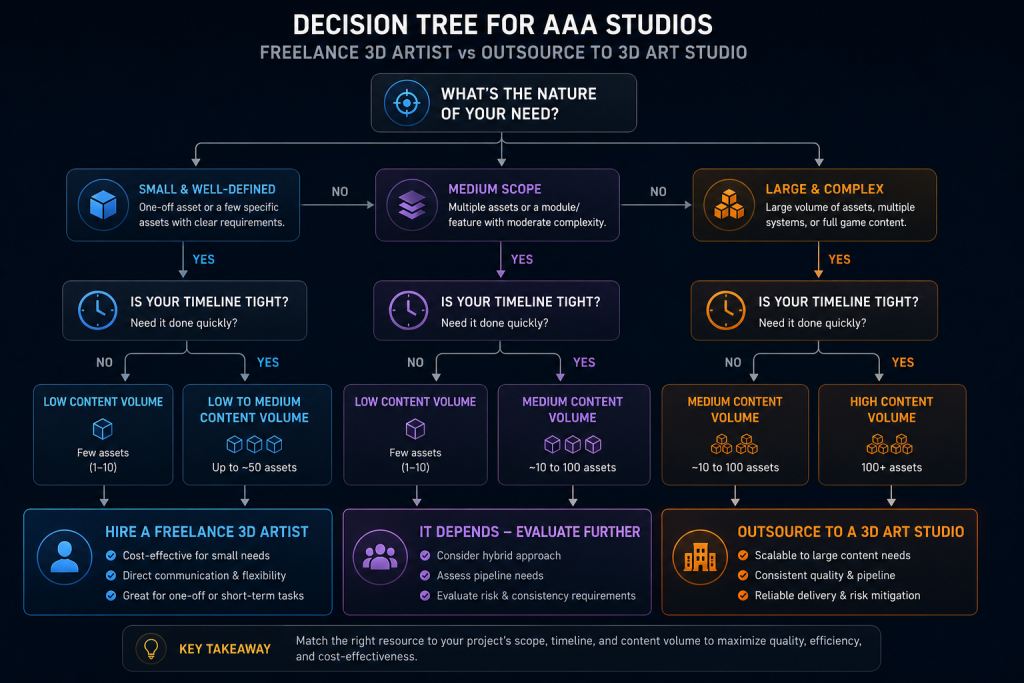
The Decision Matrix: Which Model for Which Production Scenario
The choice between a freelance artist, an in-house hire, and an outsource studio is not a universal preference — it is a function of five variables. Matching these variables to the scenario determines the right model.
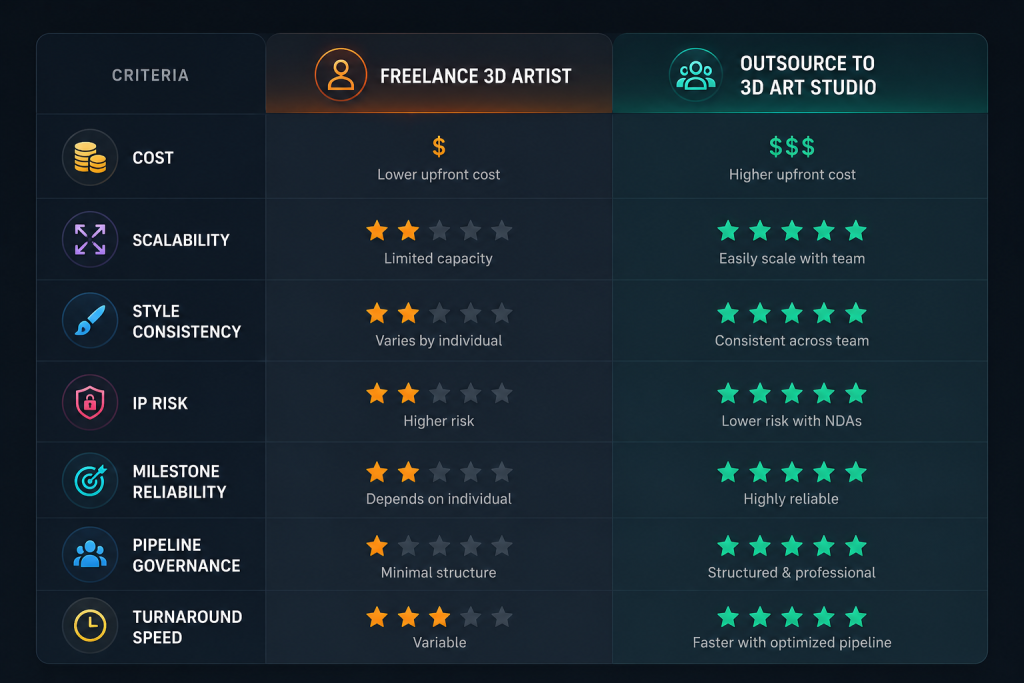
“Editorial illustration created for visual reference purposes. It does not represent a real project, client work, or official software screenshot unless stated otherwise.”
Variable 1: Asset Volume and Timeline
Freelance individual: Up to approximately 20 to 30 assets within a defined window, provided the scope is locked. Above that volume, coordination overhead and sequential production limits make the model inefficient.
In-house hire: Justified when the asset need is continuous across the full project lifecycle and post-launch. If a 3D environment artist will be working at high utilization for 18+ months, the in-house model becomes competitive on total cost.

Outsource studio: The right model for batch production runs of 40 or more assets with parallel delivery requirements. Studios run production in parallel across multiple artists with internal QA, delivering to milestone dates that individual freelancers cannot match.
Variable 2: Style Consistency Requirements
Freelance individual: Workable when you have one artist handling a coherent body of work within one style. Breaks down when you add a second or third freelancer to the same project — managing style consistency across multiple independent artists without internal QA is a full-time job for your art director.
In-house hire: Maximum style consistency, because the artist is embedded in your studio’s daily creative conversation. They absorb art direction passively, iterate in real time, and build institutional knowledge of the visual target over time.
Outsource studio: Style consistency depends on the studio’s internal systems: a single source of truth for the style guide, overlay feedback processes, calibrated look-dev references. Ask specifically how the studio prevents style drift across a large batch — studios with mature pipelines can answer this in operational terms, not just promises.
Variable 3: IP Sensitivity and Legal Governance
Freelance individual: The weakest governance structure. Freelance NDAs are often informal, and IP transfer language may be absent or legally insufficient if the artist is based in a jurisdiction with different default copyright rules. For a AAA title with publisher involvement, this is meaningful legal exposure.
In-house hire: The strongest IP governance — the work product of an employee belongs to the employer in most jurisdictions by default, though proper employment agreements should document this explicitly.
Outsource studio: A structured studio engagement with a properly drafted MSA includes IP transfer, NDA, and work-for-hire language that has been through legal review on both sides. For projects where IP chain of title will be audited by a publisher or acquirer, this is the minimum viable governance standard.
Variable 4: Production Risk Tolerance
Freelance individual: High risk concentration. The unavailability of one artist stops or delays the asset stream with no backup capacity. For a single, self-contained hero asset this is manageable. For an asset stream that feeds into downstream production (animation, VFX, level design), an interruption compounds.
In-house hire: Lower risk during production, higher structural risk at the project lifecycle level — see the layoff discussion above.
Outsource studio: Distributed risk. A studio’s production capacity is not dependent on one artist’s availability. Artist rotation is handled internally, and quality continuity is maintained through the studio’s institutional knowledge of your style guide and spec, not through individual tribal knowledge.
Variable 5: Management Overhead Your Team Can Absorb
This variable is the most consistently underestimated in the hire-vs-outsource decision. Every artist, whether freelance, in-house, or external studio, requires management input from your side: feedback, direction, review, escalation handling. The question is how much of that overhead lives with you versus with the vendor.
Freelance individual: Highest management overhead on your team. You are the production manager, the QA reviewer, the brief writer, and the escalation path. An experienced freelance artist reduces the creative direction burden, but not the operational coordination burden.
In-house hire: Moderate overhead during onboarding, lower during steady-state once the artist is integrated into your workflow. The overhead is paid in salary and management time rather than explicit coordination cost.
Outsource studio: Lowest operational overhead on your team at scale, provided the vendor has a dedicated lead and a defined communication structure. The management work shifts from daily coordination to milestone review and quality governance.
The Hybrid Model: How AAA Studios Actually Structure This in Practice
The real-world answer to the hire-vs-outsource question at AAA scale is almost never a pure choice. Most studios producing at AAA volume use a structured hybrid:
Internal art team — small and senior — owns art direction, visual target definition, hero asset production, and the internal QA role for outsourced work. These artists are not producing the bulk of the asset count. They are setting the standard that everything else is measured against.
Outsource studio — or multiple studios with different specializations — handles batch production of secondary characters, environment assets, props, weapons, and vehicles to a locked spec and approved style guide. These assets flow through the studio’s internal pipeline and arrive at your team’s review gate, not your art director’s desk.
Freelance individual artists fill gap roles: a specific visual style not covered by the studio partner, a specialized skill (photogrammetry, MetaHuman customization) needed for a small portion of assets, or a burst of capacity needed faster than the studio’s onboarding window allows.
This structure — which the game industry’s most production-efficient studios have converged on — is what allows a team of 40 internal artists to ship a title that required 500 unique 3D assets without overbuilding headcount and without accepting the quality variance of a freelance-only approach.
For studios building 3D characters for a AAA or mid-core title, the question to ask an outsource partner is not “can you do AAA quality” but “what does your internal review process look like, and what is your first-pass approval rate on comparable projects.” The answer reveals whether you are evaluating a production system or a portfolio.
“Editorial illustration created for visual reference purposes. It does not represent a real project, client work, or official software screenshot unless stated otherwise.”
The Build-vs-Buy Inflection Point for 3D Art
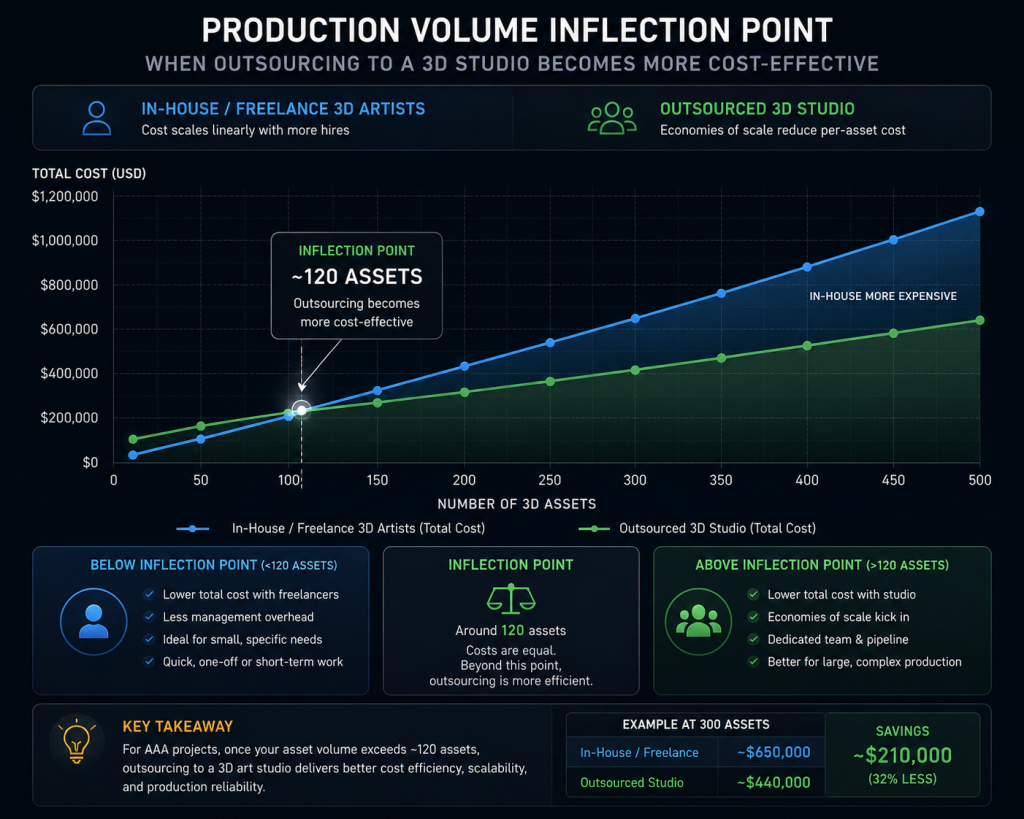
There is a quantifiable inflection point at which outsourcing a studio becomes more cost-effective than hiring individual 3D artists, even accounting for the studio’s overhead premium.
The calculation is straightforward but rarely done explicitly. If a senior 3D environment artist costs your studio $130,000 per year fully loaded (salary plus benefits, equipment, office, and management overhead at 2× multiplier), they produce approximately 2,000 to 2,500 hours of output in that year, or 40 to 50 billable hours per week. At AAA production rate, a senior environment artist might produce three to five production-ready modular assets per week.
A studio engagement for equivalent output — three to five environment assets per week at AAA specification — will typically be priced between $3,000 and $8,000 per week depending on asset complexity, studio location, and engagement model. Over 52 weeks, that is $156,000 to $416,000 for comparable output.
At first glance the numbers suggest in-house is cheaper. But the calculation changes in three important ways:
First, the in-house artist is not at maximum utilization for 52 weeks. Studios that have been through production cycles know that art teams run at 60 to 80 percent effective production capacity even during crunch — the remainder goes to meetings, reviews, revision cycles, and onboarding. The outsource studio’s asset count is the output after their internal overhead.
Second, the studio scales and de-scales without the hiring and severance costs of headcount changes. If your production needs double for a quarter and then return to baseline, the outsource studio flexes. The in-house artist stays on salary.
Third, the comparison is only valid for one artist. Most AAA 3D art pipelines require multiple specializations: environment, character, hard surface, technical art. Building a fully staffed internal art team for all of these at senior level is a multi-million-dollar annual commitment. A studio partnership covers the same specialization breadth without the full headcount.
The inflection point where outsourcing a studio beats hiring individual artists typically occurs when the project requires more than two specializations simultaneously, runs for less than 18 months (insufficient time to amortize recruiting and onboarding costs), or has variable volume where utilization will drop below 70 percent during portions of the lifecycle.
“Editorial illustration created for visual reference purposes. It does not represent a real project, client work, or official software screenshot unless stated otherwise.”
The Game Art Studio behind this article — Nasty Rodent — operates with this structure explicitly: a mid-core and AAA art production pipeline across 3D environment, character, and props, with teams that plug into your version control, your review process, and your milestone schedule. If your project is approaching the inflection point described above, the brief conversation is the right next step.
Risk Profiles Side by Side
Freelance 3D artist
- Best for: Bounded single-asset scope, specialized one-off skill, burst capacity for a short window
- Breaks down at: Volume above 30 assets, parallel production requirements, IP-sensitive deliverables, absent management bandwidth
- Key risk: Single point of failure; no internal QA; governance gaps
In-house senior 3D artist
- Best for: Continuous high-utilization need across the full project lifecycle; hero asset production; internal art direction and QA role
- Breaks down at: Peak-and-trough production volume; projects under 18 months; multiple specializations needed simultaneously
- Key risk: Structural cost at scale; headcount inflexibility; recruitment timeline
Outsource 3D studio
- Best for: Batch production of 40+ assets; parallel delivery across multiple asset types; structured governance requirements; scalable capacity
- Breaks down at: Undefined brief; absent internal art direction; pipeline opacity from the vendor side
- Key risk: Calibration period; rate-vs-outcome confusion; style drift without strong governance
Nasty Rodent — AAA & Mid-Core 3D Art Production
Nasty Rodent is a game art outsourcing studio based in Tallinn, Estonia, producing 3D characters, environments, props, vehicles, and weapons for mid-core and AAA game projects. Our pipeline integrates with Unreal Engine, Unity, Perforce, and Shotgrid. Projects include work for Offworld Industries, The Bearded Ladies Consulting, Reburn, and Galaxy 4 Games.
If your project is at the hire-vs-outsource decision point — or already past it — the next step is a brief conversation about scope, timeline, and fit.
→ Explore our 3D environment production or learn about the studio.