Composition in Concept Art: Production Standards for Game Teams
-

Written byDenys Zadoienyi
-

Updated on28.10.2026
-

Time to read10 min

- How Composition Requirements Change With the Deliverable
- Five Composition Areas an Art Director Can Review
- Where Composition Gets Decided: Thumbnails, Lock, and Acceptance Tests
- Static Frame, Moving Camera: What Survives Inside a Game
- From Concept to Level and Shot Design: What Gets Handed Over
- Composition Decision Matrix for Game Concepts
- A Composition Note and Acceptance Checklist for Your Team
- Our Experience With Concept Art for Production
- Where Composition Is Checked
- See How We Build Concepts That Hold in Production
Concept art composition decides whether a scene reads at a glance, and for environment concepts in games it also decides what camera, level and shot design inherit. Composition in concept art is easy to approve as a good-looking picture and easy to lose in the blockout, when the focal point turns out to depend on a single angle. This guide covers what an art director can review, where composition gets checked and what to hand over.
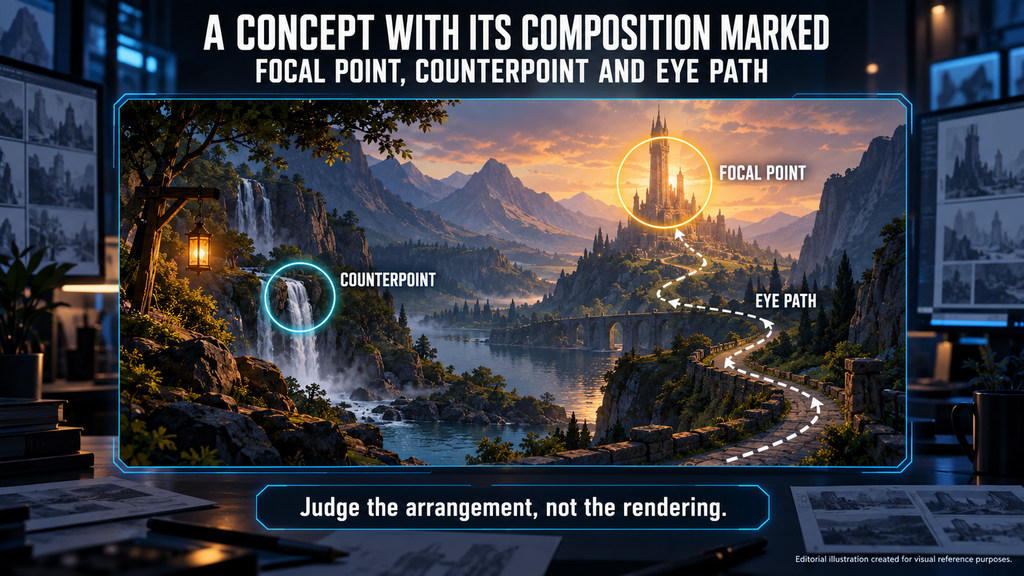
“Editorial illustration created for visual reference purposes. It does not represent a real project, client work, or official software screenshot unless stated otherwise.”
Concept art composition is the arrangement of shapes, values, focal areas and directional cues to communicate a design or scene. This guide focuses on environment and scene concepts for game production, where teams need to distinguish the intended image from the spatial and camera assumptions behind it.
How Composition Requirements Change With the Deliverable
Not every concept has the same job. A mood shot sets tone, a fixed-camera scene is judged inside its frame, and a gameplay environment has to work from positions the player chooses. Vizlab Studios lead artist Andreas Husballe separates mood shots from functional callouts: a lit mood shot may hide elements that a modeling team needs.
Our guide to concept art vs illustration explains why the distinction matters: illustration is measured by composition, impact and polish, while concept art is a specification that other disciplines must reproduce.
When the concept is a gameplay environment, level designers, environment artists and the camera work from it, and our explainer on what concept art is describes it as the visual specification for those teams. The rest of this guide assumes that case.
If you are an art director or a concept lead, one recurring risk is leaving important composition decisions undocumented. A scene approved on looks can fail when the team builds it, particularly if it had to work from more than one position, and reworking it in 3D touches layout, assets and schedule instead of a sketch. Written decisions can be checked while changes are cheap.
Five Composition Areas an Art Director Can Review
“Editorial illustration created for visual reference purposes. It does not represent a real project, client work, or official software screenshot unless stated otherwise.”
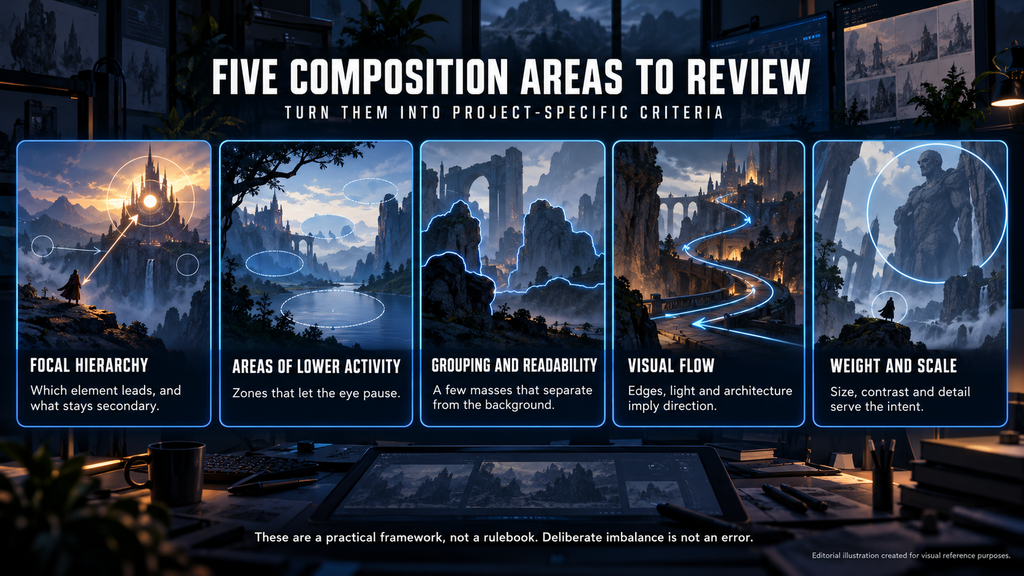
Mateusz Piaskiewicz’s Game Developer article on level composition (2014) treats a vista like a painting built around a dominant, often balanced by a counterpoint, with elements that lead the eye. The following five review areas are a practical framework. Teams should turn them into project-specific acceptance criteria based on the concept’s purpose, camera and art direction.
- Focal hierarchy. Identify the intended hierarchy for the view or gameplay state, including any secondary anchor. Note which decorative elements should stay subordinate and when gameplay events may intentionally redirect attention.
- Areas of lower activity. Zones of lower visual activity that support the hierarchy. Without them, focus dilutes. They are not necessarily safe or walkable zones.
- Grouping and readability. The scene separates into a few masses against its background (figure–ground), and the silhouette of a key object or mass group reads against the scene at the size used in play.
- Visual flow. Edges, architecture, light and, where figures appear, poses, gaze and staged action imply direction. Open compositions can carry lines through a scene without ending on a dominant.
- Weight and scale. Visual weight (size, contrast, detail) is organized according to intent; deliberate imbalance is not an error. Scale cues use approved references for the camera, such as character or object scale.
Characters add their own silhouette test, covered in our guide to character concept art in a 3D pipeline.
Here, we focus on value grouping: a few tonal masses and their separation. How value and color are chosen is covered in our color theory for game art guide.
Did you know?
The same interview notes that compositional sketches can be built in 3D with simple shapes, so an artist can explore multiple camera angles without redrawing.
Where Composition Gets Decided: Thumbnails, Lock, and Acceptance Tests
In our concept art process, thumbnails and silhouettes settle direction at low cost, most changes happen at that stage, and an explicit direction lock follows, after which work is refinement only. Reopening a locked direction is possible, but its effect on scope and schedule should be agreed. A rough 3D blockout can also test spatial and camera assumptions during exploration.

Judge the arrangement, not the rendering. Three quick checks make feedback more specific and easier to compare. They support artistic judgment and do not replace it:
- Thumbnail check. View the image at a small size suited to its use. Does the intended focus still read?
- Grayscale check. Inspect value grouping without hue, use it to diagnose tonal relationships, then review the full-color image against the art direction. Lower clarity in grayscale is not automatically a failure.
- Squint check. Blur the image or squint. Do the masses group into a few readable shapes?
Concept art composition rules and project standards are different things. The rule of thirds and the golden ratio can start a thumbnail, and the Game Developer article above calls the golden ratio an aid. A project standard is a criterion a reviewer can apply: focal hierarchy, visual flow, areas of lower activity and the views that matter.
Put the requirement in the brief too: the views that matter and the intended focal hierarchy. Our concept art brief guide covers the rest.
Static Frame, Moving Camera: What Survives Inside a Game
“Editorial illustration created for visual reference purposes. It does not represent a real project, client work, or official software screenshot unless stated otherwise.”
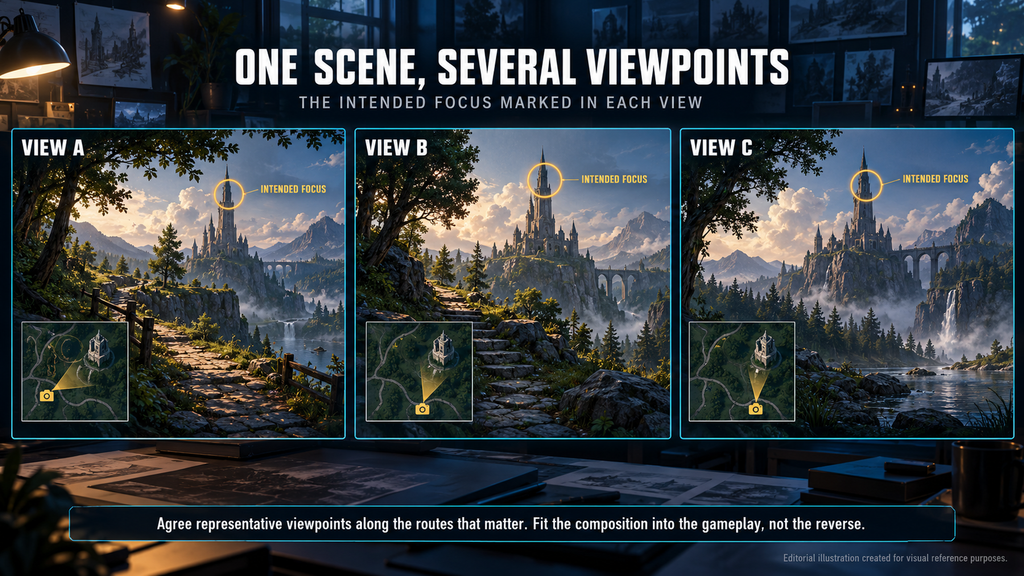
A concept frame is a single crop. In a game the viewer may move, so the same space can be seen from several positions, and the camera setup changes how large things look. For spaces viewed from multiple positions, agree representative viewpoints along relevant player routes. For fixed-camera scenes or individual shots, validate the intended framing and any planned camera movement.
When relevant, record the camera in the composition note:
- camera mode, projection type, position, height and orientation;
- aspect ratio and the intended crop;
- field of view for a perspective camera, stating whether it is horizontal or vertical;
- the size of the area covered for an orthographic camera.
The level design article is blunt about priorities: fit the composition into the gameplay, not the reverse.
A hero view may communicate mood or a key moment without documenting the whole space. If the deliverable is intended for marketing, its requirements differ; see our guide to key art vs hero asset.
From Concept to Level and Shot Design: What Gets Handed Over
“Editorial illustration created for visual reference purposes. It does not represent a real project, client work, or official software screenshot unless stated otherwise.”
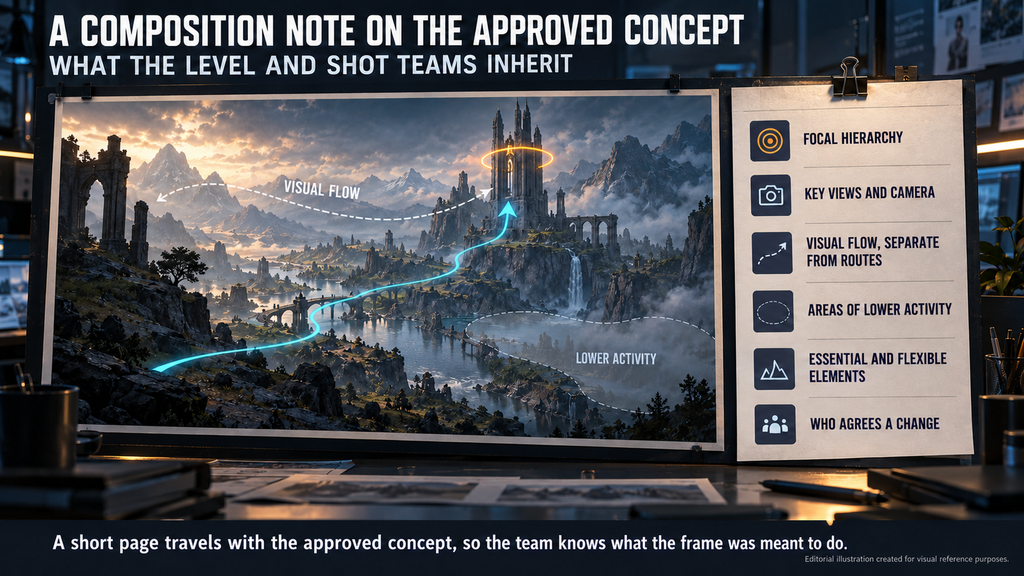
Handover is where concept art for level design either works or fails. For environment concept art composition, a note travels with the approved concept so the people who inherit the scene know what the frame was meant to do. For a single shot, hand over framing, staging, focal hierarchy and planned camera movement; for a sequence, how emphasis shifts between shots.
Identify which relationships are essential and which elements remain flexible. Agree changes with the relevant owners: art direction for visual intent, level or game design for traversal and gameplay constraints, and camera and lighting owners where affected. A small prop or a light can define the focus, so flexibility is a decision.
Blockout review is the later check: does the focus survive from the agreed views? How a blockout is built is covered in our 3D environment design guide.
In the viking village workflow shown in our portfolio, line art establishes building placement, paths, scale and prop placement before color development.
Composition Decision Matrix for Game Concepts
| Area | What it settles in the concept | What level and shot design inherit | What breaks if it is lost | Acceptance check | Red flag |
| Focal hierarchy | Which element leads in a view or state, and what stays secondary | The intended hierarchy and planned redirects | Several things compete; the wrong landmark gets read | Thumbnail check: the intended focus reads | Decor outranks the focus without intent |
| Lower-activity areas | Where the eye can pause | Areas of lower visual activity that support the hierarchy | Everything shouts; focus dilutes | Marked on the frame | Detail spread evenly over the frame |
| Grouping and silhouette | Masses and a key silhouette separate from the background | Clear separation at play size | The scene turns to noise as props are added | Grayscale and squint checks, used as diagnostics | Key object merges with the background |
| Visual flow | Where the eye is directed, marked apart from routes | Directional cues, and which of them might imply a route | Flow suggests a route that does not exist | Mark flow and traversable routes separately | A cue unintentionally implies an accessible route |
| Weight and scale | How visual weight serves the intent, with scale references | Scale references and intended balance | The space feels wrong at game scale | Compare with approved character or object scale | Holds from one view when several matter |
A Composition Note and Acceptance Checklist for Your Team
A composition note is a short page attached to the approved concept. A workable note contains:
- the intended focal hierarchy for each key view;
- camera assumptions, when relevant, and the views that matter;
- visual flow, marked apart from traversable routes;
- areas of lower visual activity;
- essential relationships and flexible elements;
- who agrees a change.
Before the direction lock, an art director can adapt this checklist to the project:
- the intended focus reads in the thumbnail check;
- grayscale is inspected and the full-color image checked against the art direction;
- visual flow is marked apart from routes;
- the views that matter are checked and camera assumptions recorded.
Illustrative example (not a client project). A forest-edge concept is approved on its hero view. In the blockout the player enters from the side, a ridge hides the tower that anchored the frame, and the eye lands on a bright foreground prop. A note naming the tower as the intended focus, with a second view, would let the team test options such as moving the ridge or changing the prop against gameplay constraints.
Our Experience With Concept Art for Production
We make concept art as a production document: our concept art for game production service uses thumbnails to settle direction and an explicit lock before refinement. Our work includes Wild Rage as part of full art direction, Bubble Quest of Vikings and Wave Master; the scope of any project is agreed with each client.
Where Composition Is Checked
| Stage | Question | Who checks | Pass sign |
| Thumbnails | Which option has the strongest composition? | Concept artist and art director | The intended focus reads at small size |
| Direction lock | Is the direction final before detail is invested? | Art director | Composition note attached; later changes are agreed with scope impact |
| Handoff | Does level or shot design know what must hold? | Art direction with level or game design | Hierarchy, flexible elements and key views are agreed |
| Blockout review | Does the focus survive in 3D? | Level designer, environment artist, art director | The focus reads from the agreed views |
See How We Build Concepts That Hold in Production
Our stylized concept art portfolio shows concepts made for game production. Share your game, target platforms and the concept art you need, and we’ll discuss the scope and the materials needed at sales@nastyrodent.com or through our contact form. We usually reply within 1–2 business days.
Explore our concept art portfolio →
Let's work
together
in mind?
From 3D characters and environments to weapons, props, concept art and game UI/UX: ten years deep, 40+ artists strong, zero fluff. Tell us what you are making and get a free, no-pressure estimate.
estimate