UI/UX Co-Development vs Outsourcing for Game Production: How to Choose the Right Model
-

Written byDenys Zadoienyi
-

Updated on27.05.2026
-

Time to read14 min

- Two Models, One Interface: What Co-Development and Outsourcing Actually Mean
- When Full UI/UX Outsourcing Is the Right Call
- When Co-Development Is the Model You Actually Need
- The Hidden Cost Map: What Each Model Fails to Show in the Rate Card
- The Decision Framework: 8 Signals That Determine Which Model Fits
- What Happens When Studios Mismatch the Model
- What to Look for in a UI/UX Partner Before You Commit
- The Comparison at a Glance
- How We Work at Nasty Rodent
- The Conversation Worth Having Before Your Interface Becomes a Bottleneck
UI/UX is the layer players never stop touching. Every menu transition, every HUD element competing for attention during a firefight, every inventory flow that either respects the player’s cognitive load or quietly destroys retention — all of it passes through decisions your UI/UX team makes during production.
Which means the question of who that team is, and how they connect to your pipeline, isn’t a procurement formality. It’s a production architecture decision. Get it wrong and you spend the back half of development patching an interface that was never integrated with your gameplay systems. Get it right and UI/UX stops being a bottleneck and starts being a multiplier.
If you are an outsource manager or procurement lead responsible for this choice, the hire-vs-outsource framing misses the real decision. The real decision is between two models that differ not in vendor quality, but in pipeline position, shared ownership, and accountability structure. Co-development puts a UI/UX team inside your production. Outsourcing puts one alongside it. Understanding what that difference produces — in scope flexibility, in communication overhead, in first-pass approval rates and milestone risk — is what this guide is built around.
“Editorial illustration created for visual reference purposes. It does not represent a real project, client work, or official software screenshot unless stated otherwise.”
Two Models, One Interface: What Co-Development and Outsourcing Actually Mean
The industry uses these terms loosely. Pinning down what each model means operationally matters before you can compare them.
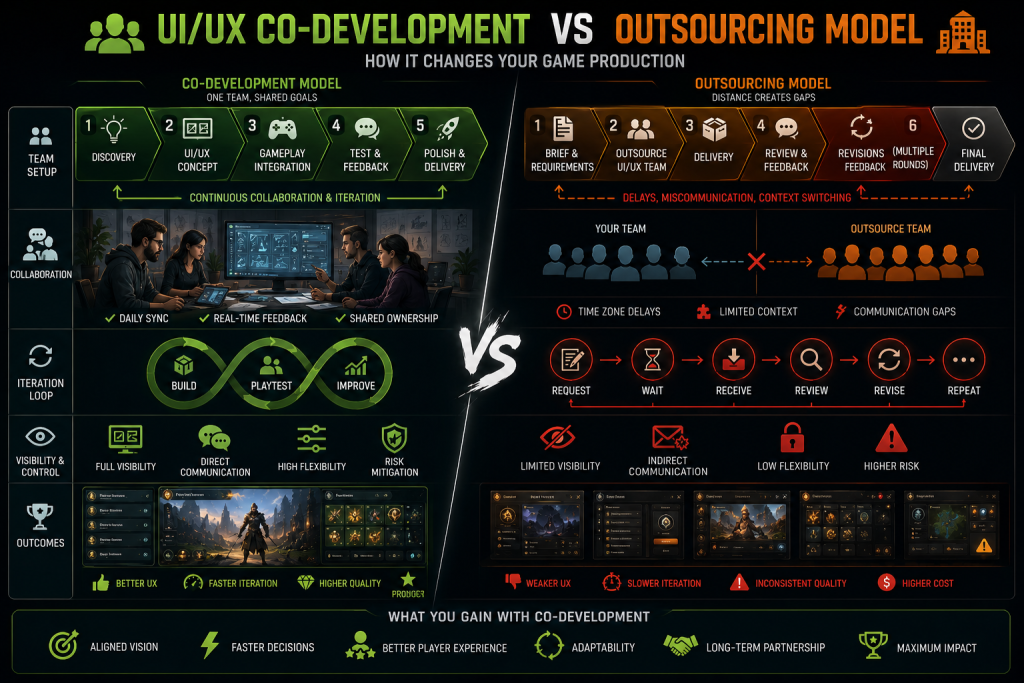
UI/UX co-development is a production model where an external team works directly inside your pipeline, participating in sprint cycles, design reviews, and feature decisions alongside your internal developers and game designers. Ownership of interface systems is genuinely shared: the co-development partner doesn’t wait for a finalized brief — they contribute to shaping it. Communication runs through the same channels as internal teams: shared boards, daily standups, unified QA gates. The co-development team is a functional extension of your studio, not a parallel track delivering work for review.
UI/UX outsourcing is a production model where an external team receives a defined brief and delivers against it. Your studio owns the direction; the outsource partner owns the execution. Communication is structured around milestone checkpoints rather than continuous integration. The outsource studio handles its own internal workflow — design iterations, QA, version control — and surfaces the output to you at agreed delivery points. Your involvement is review and approval, not shared decision-making.
The practical test that separates them: can you write a complete UI/UX brief before the work starts and evaluate success against it? If yes — outsourcing works. If the work requires ongoing creative decisions as the project evolves, where the interface must respond to gameplay changes that aren’t fully defined yet — co-development is the correct model.
Neither is superior. They serve different production realities.
When Full UI/UX Outsourcing Is the Right Call
Outsourcing delivers maximum value when the scope is bounded and the brief is stable.
Production phases with defined deliverable sets. Menu systems with locked information architecture, HUD layouts built against a finalized gameplay spec, UI asset production for a feature branch that won’t change direction — these are well-suited to outsourcing. The partner gets a SOW with clear acceptance criteria, delivers against it, and your milestone gate closes on schedule.
Studios with strong internal UX direction. If your in-house art director or lead UX designer can own the interaction design and visual language, and the external team’s role is execution rather than creative contribution, outsourcing provides clean accountability. The studio delivers implementation-ready files; your team integrates and reviews. The communication overhead is predictable because the decision surface is narrow.
Cross-platform asset production at volume. When UI/UX work scales to high asset counts — icon sets, localization-ready screen variants, platform-specific layout adaptations — a full-cycle outsource studio handles the volume efficiently. The brief defines the system; the studio handles the batch.
Budget structures requiring fixed-price certainty. Outsourcing supports per-deliverable and project-rate pricing models that give procurement teams a clean cost line. When your finance structure requires committed spend, milestone-gated outsourcing is easier to defend than a co-development retainer.
What makes outsourcing fail isn’t vendor quality — it’s scope drift on the client side. When gameplay systems evolve mid-production and the UI brief gets invalidated three weeks into the engagement, rework cycles compound fast. A partner delivering against last month’s brief is producing work for a game that no longer exists.
When Co-Development Is the Model You Actually Need
Co-development is the correct choice when the production is complex enough that the interface and the gameplay need to evolve together.
Live-service and GaaS titles. Games with ongoing seasonal content, battle passes, event-driven UI cycles, and frequent feature additions cannot operate on isolated outsource briefs. The interface must respond to gameplay and economy changes in real time. A co-development partner embedded in your sprint cycle adapts as the product adapts — without the brief-revision-rebrief overhead that slows outsource-based iteration.
Mid-production reinforcement without rebuilding internal teams. When a game hits full production and the UX workload exceeds internal capacity — but the complexity of the systems means a new hire would spend six months ramping up — a co-development partner provides immediate capacity with contextual awareness built through embedded participation. They attend your design reviews. They understand why the inventory system was restructured in sprint 14. That context doesn’t need to be re-documented in a brief.
Titles where UX and gameplay are architecturally coupled. Navigation hierarchies that change when new game modes are added. HUD systems that must respond to ability unlocks. Diegetic UI elements tied to world-state changes. These aren’t brief-and-deliver problems. They require a partner who is present for the decisions that generate the work, not just the work itself.
Studios without a dedicated internal UX lead. When there is no senior UX practitioner internally to own the direction-setting process, a co-development partner fills that structural gap. They don’t just execute — they bring the usability heuristics framework, the interaction design vocabulary, the information architecture thinking. That’s a different scope than executing a spec, and it requires a different engagement model.
At Nasty Rodent, we support both models. When studios come to us for game UI/UX outsourcing and the production description has the signature of a co-development scenario — evolving gameplay systems, no locked brief, live service roadmap — we say so before the SOW is signed, because the model mismatch costs more than the model itself.
The Hidden Cost Map: What Each Model Fails to Show in the Rate Card
The rate card comparison between co-development and outsourcing is the least useful part of the decision. Both have predictable and unpredictable costs. Understanding which costs land where changes the calculation.
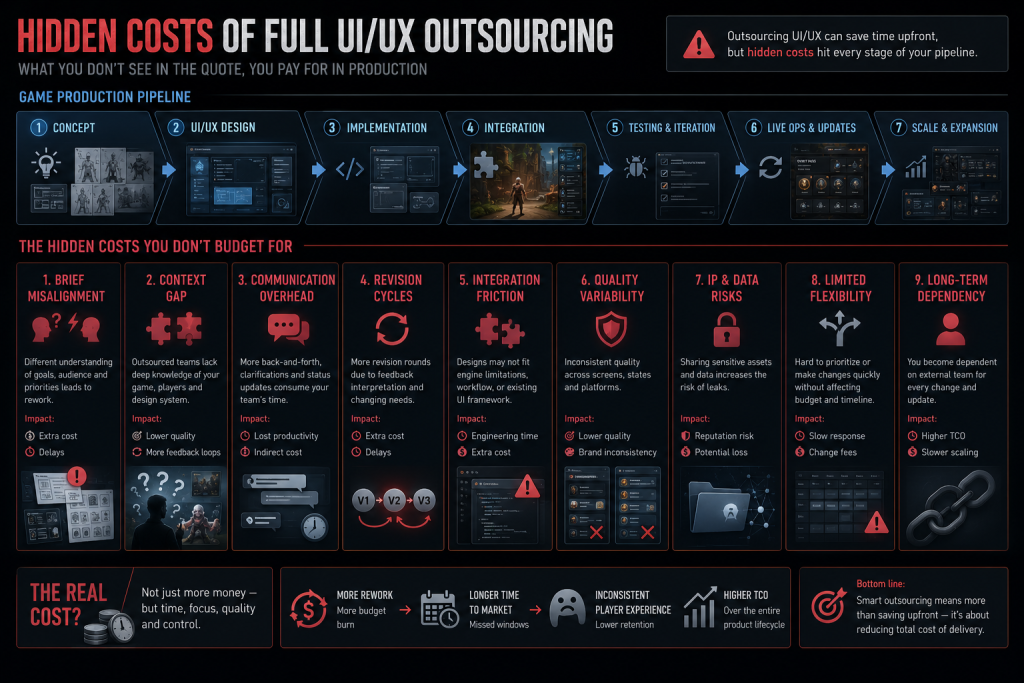
Co-development: visible cost, invisible overhead. Co-development retainers are continuous — you pay for the team’s time regardless of sprint output variance. The visible cost is higher than project-rate outsourcing for equivalent scope. The less visible cost is management bandwidth: co-development requires active integration on your side. Daily standups, shared board maintenance, design review participation — these aren’t heavy, but they’re not zero. Studios that run co-development relationships passively — treating the partner like an outsource team they happen to talk to daily — lose the primary benefit of the model.
Full outsourcing: lower entry cost, concentrated rework risk. Outsourcing keeps the visible cost per deliverable lower. The invisible cost accumulates in revision cycles when the brief and the production reality diverge. Game UX outsourcing with high iteration requirements — UI assets reworked three times because the gameplay spec moved — can reach a total engagement cost significantly above what the original milestone-gated budget suggested. The cost of a UX rework cycle that invalidates implementation-ready files already integrated into the engine is rarely captured in the rate card. It shows up in QA overhead and delayed milestone approvals.
“Editorial illustration created for visual reference purposes. It does not represent a real project, client work, or official software screenshot unless stated otherwise.”
The engagement model switch cost. Switching from outsourcing to co-development mid-production — because the title turned out to be more complex than the original brief assumed — carries the highest hidden cost of all. Onboarding a co-development partner mid-sprint means they catch up to production context that’s already two quarters deep. That catch-up period is real time on your schedule and theirs. Planning the correct model before pre-production locks is categorically cheaper than correcting a model mismatch at milestone 3.
Game UX costs range from $400–$900 for simple mobile screen mockups to $15,000–$35,000 for complete mid-core interface systems, according to 2026 market data. Those ranges assume the brief is stable and the revision count is controlled. When neither is true, the numbers move outside the range.
The Decision Framework: 8 Signals That Determine Which Model Fits
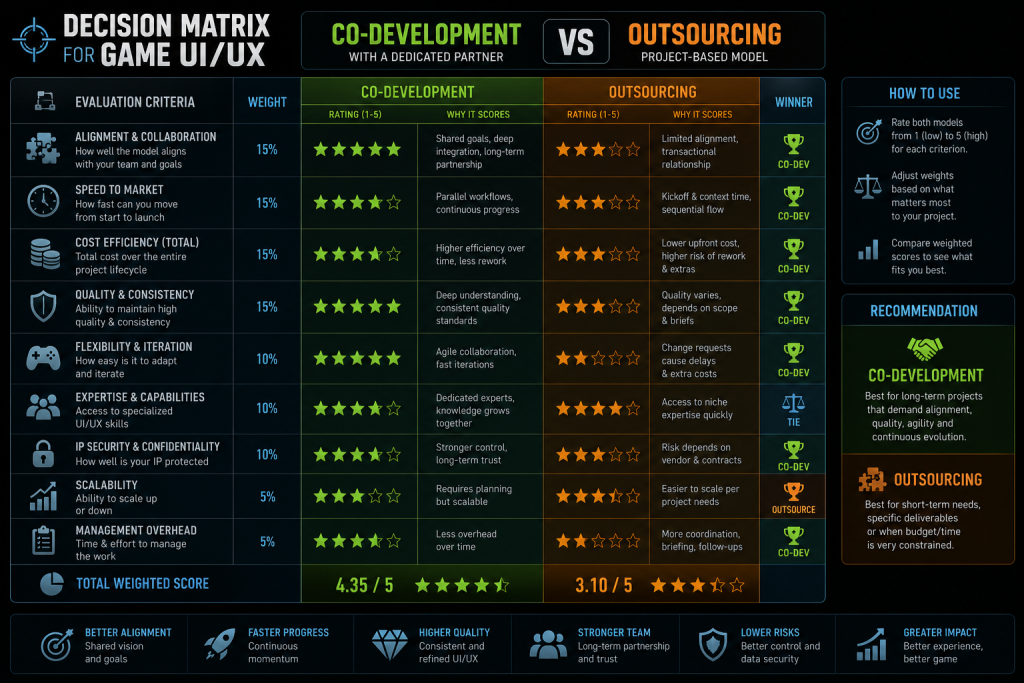
Use this as a structured assessment before the vendor conversation begins. No single signal is determinative — three or more signals pointing the same direction is the reliable threshold.

“Editorial illustration created for visual reference purposes. It does not represent a real project, client work, or official software screenshot unless stated otherwise.”
| Signal | Points to Outsourcing | Points to Co-Development |
| Brief stability | UX brief locked before production starts | Interface must evolve with gameplay systems |
| Scope volume | High-volume asset production, defined deliverable set | Feature systems requiring ongoing design decisions |
| Internal UX direction | Strong in-house UX lead with bandwidth | No senior UX practitioner internally |
| Production phase | Defined production phase with milestone gates | Full production or live service with rolling scope |
| Communication model | Milestone-checkpoint reviews preferred | Continuous integration, shared sprint cycle |
| Budget structure | Fixed-price or per-deliverable preferred | Retainer or dedicated team sustainable |
| Pipeline change frequency | Gameplay systems stable, interface spec locked | Frequent gameplay changes invalidating interface specs |
| Title type | Single-release title with defined scope | GaaS / live service / ongoing content roadmap |
A title in full production with a locked scope, strong internal UX direction, and defined deliverable sets is a clean outsourcing scenario. A live-service title in mid-production where the interface must respond to weekly game design changes, with no internal UX lead, is a co-development scenario — and treating it as outsourcing is where production timelines break.
As a producer mapping Q3 capacity, running this assessment before vendor conversations start saves a milestone’s worth of misalignment. The model choice is a production architecture decision, and architecture decisions are cheap before ground is broken.
What Happens When Studios Mismatch the Model
The failure mode is consistent enough to describe with precision.
A studio engages a full-cycle UI/UX outsourcing partner on a title that has live-service ambitions and an evolving game design. The initial brief is clear and the first milestone delivers cleanly. Then the gameplay lead restructures the progression system. The UX partner receives a revised brief. Rework begins. By milestone 3, the co-investment in earlier deliverables — wireframes, menu flow prototypes, implementation-ready screen layouts — has been partially invalidated. The outsource model, designed for stable scope, is now absorbing the cost of unstable scope on behalf of a contract structure that wasn’t built for it.
We see the reverse less often but it happens: a studio that genuinely needs only implementation-ready UI assets for a locked feature set enters a co-development retainer because it felt like the safer option. The management overhead of daily integration exceeds what the team has bandwidth for. The co-development relationship drifts toward a de facto outsource engagement — milestone reviews replace sprint participation — and the studio has paid retainer pricing for outsource-level integration.
The mismatch costs money in both directions. The correction costs more.
What to Look for in a UI/UX Partner Before You Commit
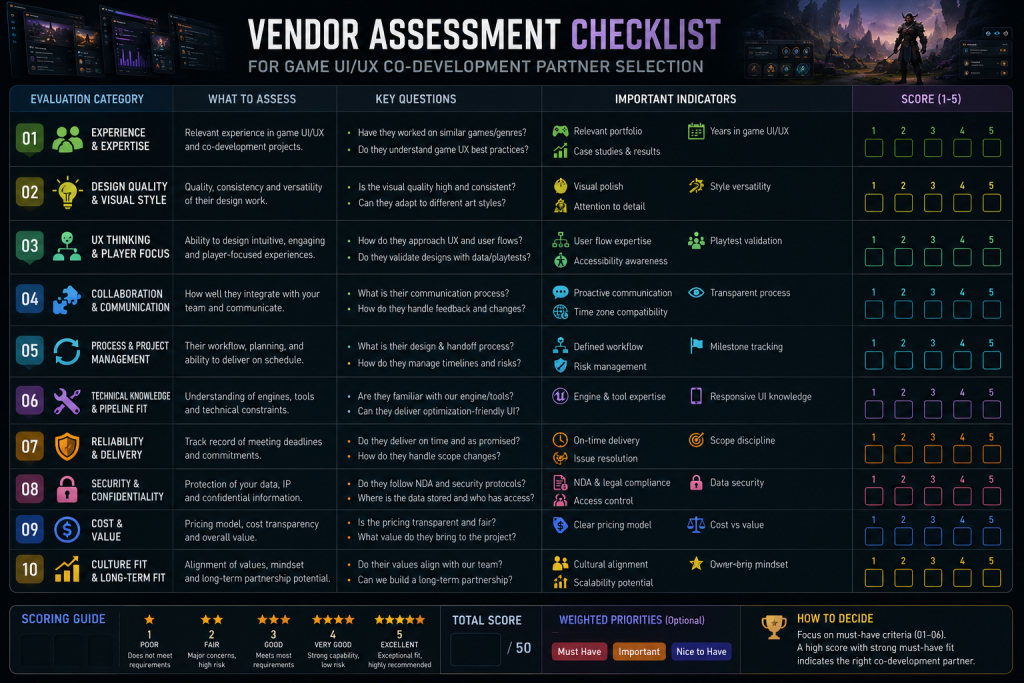
The portfolio review is necessary and insufficient. The questions that reveal operational fit are different.
Do they distinguish between UX wireframes, visual design, and implementation-ready output? A partner who conflates these is not describing a production pipeline — they’re describing an output list. Understanding where in the production chain each deliverable lands, and who on your side receives it, is the foundation of pipeline compatibility.
What is their process when a gameplay change invalidates a delivered UI spec? The answer reveals whether they have a brief-revision protocol or absorb the scope change informally. A structured studio has a change request process: documented delta, revised acceptance criteria, adjusted timeline. A studio without it discovers the scope change when the rework arrives without warning.
How do they handle engine-specific implementation requirements? UI assets that don’t account for Unreal Engine’s UMG widget constraints, or Unity’s UI Toolkit scaling behaviour, become integration problems. A partner who produces visually correct assets without engine-awareness transfers that integration cost to your engineering team. Ask explicitly whether their output is implementation-ready or design-complete.
For co-development specifically: what tooling do they use for shared workflow? Pipeline compatibility between studios requires aligned tooling — shared project management boards, agreed version control protocol, compatible file delivery formats, overlapping working hours for synchronous communication. A co-development partner who operates on incompatible tooling creates integration friction that accumulates over every sprint.
Nielsen Norman Group’s usability heuristics for video games — including visibility of system status, user control and freedom, and error prevention — serve as a useful baseline for evaluating whether a UI/UX partner’s work reflects genuine interaction design thinking or surface-level visual production. A partner who can articulate how their HUD designs address cognitive load and feedback loop design is operating at a different level than one who references only visual style. You can review NN/g’s framework at nngroup.com.
For UI pattern benchmarking during the brief stage, the Game UI Database at gameuidatabase.com provides 55,000+ interface screenshots across 1,300+ games, searchable by screen type, HUD element, and game genre — a practical tool for alignment conversations with any external partner.
“Editorial illustration created for visual reference purposes. It does not represent a real project, client work, or official software screenshot unless stated otherwise.”
The Comparison at a Glance
| Factor | Full UI/UX Outsourcing | UI/UX Co-Development |
| Entry cost | Lower — per-deliverable or project rate | Higher — retainer or dedicated team |
| Brief requirement | Stable, complete before production starts | Can evolve with gameplay systems |
| Scope change absorption | Client-side — rework billed or renegotiated | Partner absorbs within sprint cadence |
| Pipeline integration depth | Parallel track — milestone checkpoints | Embedded — shared sprint cycle |
| Management overhead | Low on client side | Higher — requires active integration |
| Best for | Stable-scope phases, high-volume asset production | Live service, evolving systems, no internal UX lead |
| Communication SLA | Defined by SOW milestone schedule | Continuous, agreed in onboarding protocol |
| Vendor onboarding cycle | 2–4 weeks | 4–8 weeks (deeper context alignment required) |
How We Work at Nasty Rodent
“Editorial illustration created for visual reference purposes. It does not represent a real project, client work, or official software screenshot unless stated otherwise.”
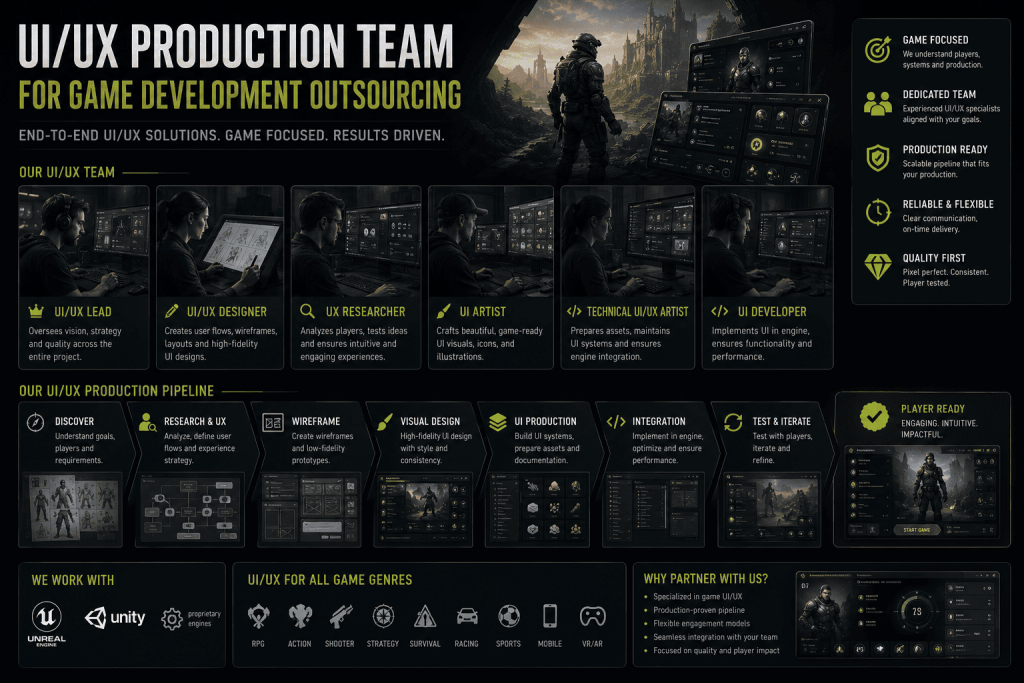
Nasty Rodent provides UI/UX production support for game studios through both embedded co-development models and full-cycle outsourcing pipelines. Our teams work alongside internal developers, game designers, and art departments to build scalable interface systems, UX flows, HUDs, and player-centered design solutions adapted to real production environments.
From early wireframes and visual direction to implementation-ready assets and live production support, we focus on maintaining usability consistency, communication transparency, and pipeline compatibility across every stage of development. The studio has experience supporting cross-functional game production workflows where UI/UX must evolve together with gameplay systems, live operations, and technical constraints.
Whether a project requires a dedicated UI/UX team extension or a fully outsourced production partner, we adapt the collaboration model to the needs of the pipeline — not the other way around.
We work in the tools your pipeline already runs: Figma, Adobe Creative Suite, Unreal Engine UMG, Unity UI Toolkit, and Spine for motion graphics. When a project requires visual development beyond interface systems, our game art collaboration workflow connects UI/UX production with concept art and visual direction under one studio roof.
You can review our full production portfolio, including shipped game projects across mid-core and AAA titles, at nastyrodent.com/portfolio.
The Conversation Worth Having Before Your Interface Becomes a Bottleneck
UI/UX stops being a background production track around milestone 2 or 3, when the gameplay is mature enough that the interface is the most visible unsolved problem. Studios that enter that phase without a production-fit partner spend the back half of development in firefighting mode — rework cycles, integration fixes, accessibility gaps discovered late.
The model choice — co-development or outsourcing — needs to be made before that phase, not during it.
At Nasty Rodent, we offer a free vendor capability assessment delivered within 48 hours. Share your production scope, your interface requirements, your milestone structure, and whether your gameplay systems are stable or evolving. We return a vendor scorecard covering first-pass approval rate projection, time-zone overlap, communication SLA, and a direct recommendation on which engagement model fits your production — not a pitch for the model that benefits us.
If you are building a preferred vendor list and want to know whether Nasty Rodent fits your UI/UX pipeline, this is where that conversation starts.
For studios at an earlier stage of vendor evaluation, the Nasty Rodent blog covers production strategy across UI/UX, 3D, and concept art disciplines.