How to Brief a Game Art Studio for UE5 Production
-

Written byDenys Zadoienyi
-

Updated on28.05.2026
-

Time to read18 min

- The Brief Is the Only Quality Control That Scales
- Lock Scope Before You Write a Single Line
- The Art Bible: Foundation, Not Decoration
- The UE5 Technical Spec: What Generic Briefs Miss
- Milestone Design: Gates, Not Deadlines
- Revision Protocol: Write It Down Before Production Starts
- Reference Assembly: What Needs to Exist Before the Brief Ships
- One Voice, One Contact, No Exceptions
- In-Engine Integration: The Gate That Catches Everything Else
- What a Complete Brief Contains
- How Nasty Rodent Approaches This in Practice
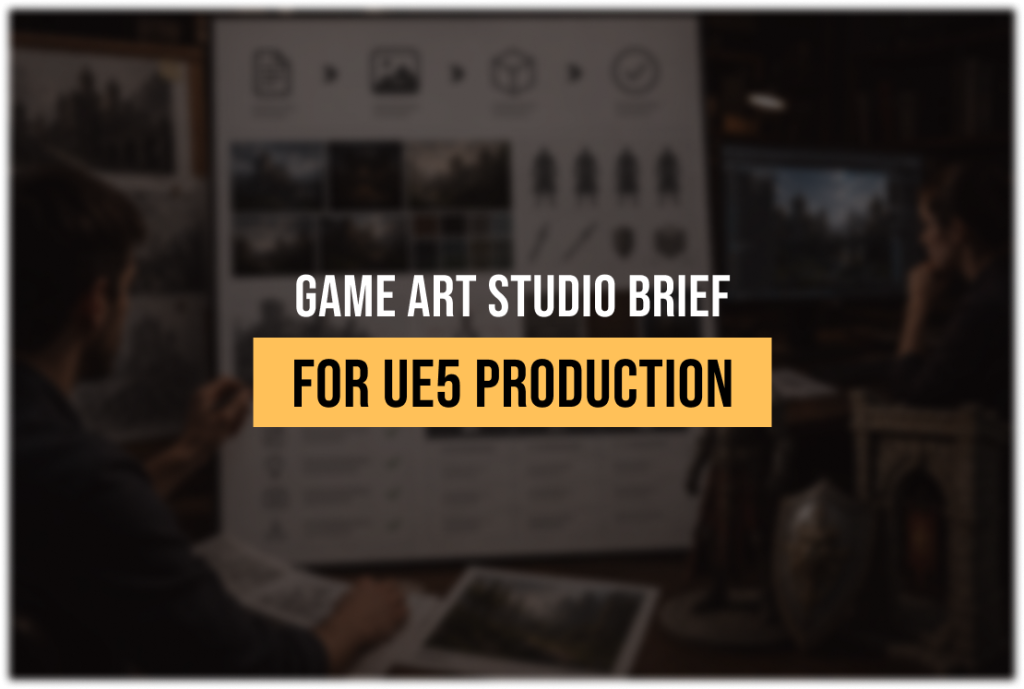
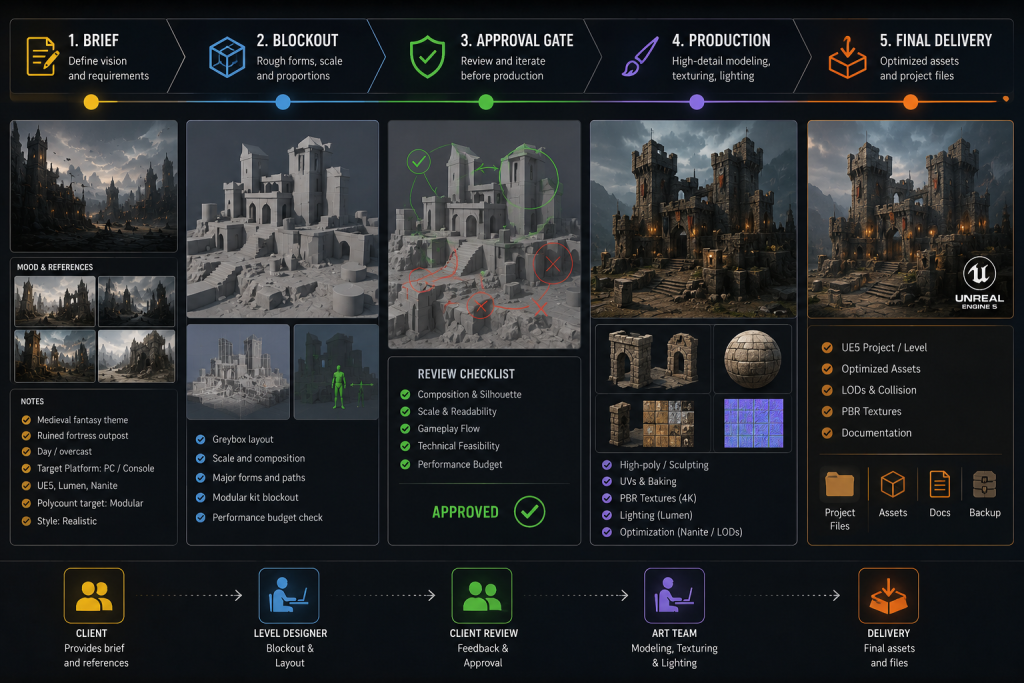
The single most expensive mistake in game art outsourcing is not choosing the wrong vendor — it is giving any vendor a brief that leaves too much to interpretation. Misalignment between what a studio expects and what an external team produces does not announce itself at the kickoff call. It surfaces four weeks into production, during the first milestone review, when the assets look technically correct but feel like they belong to a different game.
“Editorial illustration created for visual reference purposes. It does not represent a real project, client work, or official software screenshot unless stated otherwise.”
Writing a brief that actually prevents this is not difficult, but it requires treating the document as a production tool rather than a formality. For Unreal Engine 5 specifically — where Nanite geometry behavior, Lumen lighting response, World Partition streaming logic, and material instance architecture all affect how outsourced art integrates into a real build — a surface-level brief creates compounding problems that are far more expensive to fix late than to prevent early.
This guide covers every layer of a production-grade art brief for UE5 outsourcing: from scope definition and reference structure to technical spec depth, milestone design, and the approval mechanics that determine whether revision cycles stay controlled.
The Brief Is the Only Quality Control That Scales
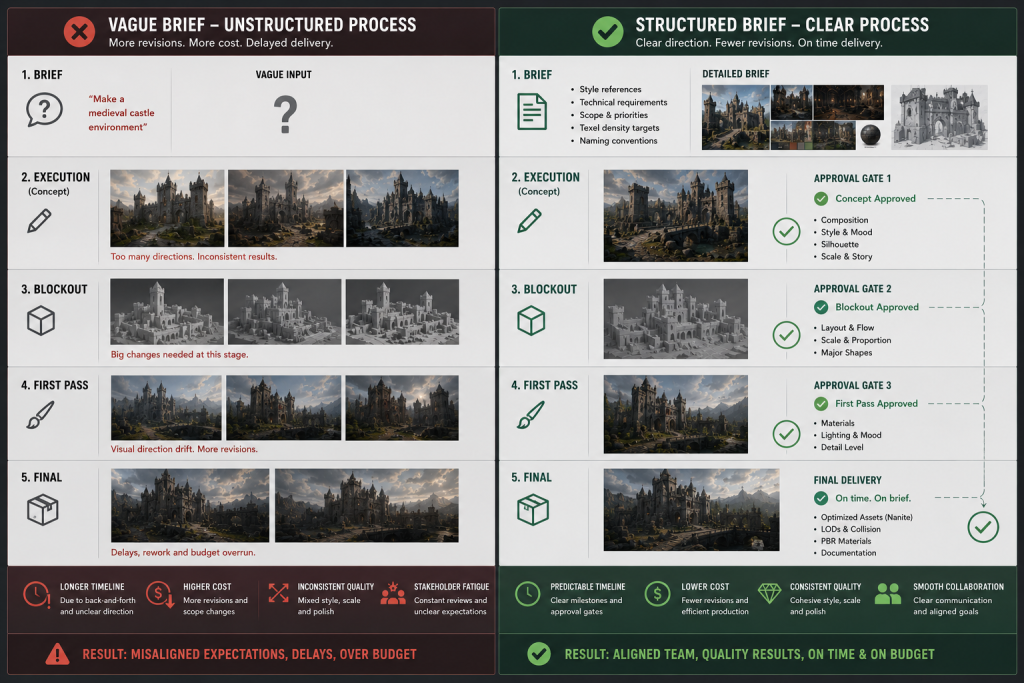
Art direction is sometimes treated as a role that exists primarily at project start — someone writes the style guide, establishes references, and steps back while production runs. In outsourcing, that model consistently produces the same result: the first few assets match the guide, subsequent batches drift, and by the time a full milestone is in review, the team is reconciling visual inconsistencies that should never have appeared.
The brief is the mechanism that keeps art direction active throughout production without requiring your art director to manually review every asset in real time. When a brief is structured well, the external team can self-check against documented criteria at every stage. When it is not, every decision left ambiguous gets resolved by someone who does not have the full context of your game — and those decisions accumulate.
“Editorial illustration created for visual reference purposes. It does not represent a real project, client work, or official software screenshot unless stated otherwise.”
For UE5 pipelines specifically, this matters at a deeper technical level. A brief that specifies visual references but says nothing about Nanite configuration per asset category, Lumen calibration targets, or how material instances should map to the master material hierarchy creates downstream integration problems that the environment team or tech art lead inherits. These are not polish issues — they are structural ones, and they affect frame rates, streaming budgets, and platform certification.
The brief is not a description of what you want. It is the production contract that defines what acceptance looks like.
Lock Scope Before You Write a Single Line
Before writing anything, scope needs to be resolved with more precision than most initial conversations produce. Studios frequently begin outsourcing conversations knowing they need “environment art” or “character assets” without having answered the questions that determine what the brief actually needs to contain.
Scope definition answers four questions before briefing begins.
Asset type and production depth. Is the external team producing concept-to-final assets, or are they receiving approved concepts and building 3D from those? Are they responsible for LOD generation, collision setup, and in-engine import testing — or does your internal team absorb those stages? Each answer changes what the brief needs to specify, and leaving either assumption implicit creates gaps.
Platform and performance tier. A UE5 project targeting PC and current-generation consoles has a very different technical brief than one targeting last-generation hardware. Nanite is not supported on all platforms. Lumen’s behavior varies between software mode and hardware ray tracing mode. If the external team is not briefed on the specific platform profile from the start, they optimize for a target that may not match the actual shipping condition.
Volume and batching logic. Outsourcing a hero environment set and outsourcing modular tile kits for a large open-world game are structurally different engagements. In UE5, modular geometry, shared master materials, and World Partition loading regions create interdependencies between assets that do not exist in isolation. The brief for a modular kit needs to address those relationships explicitly.
Art direction ownership. Who approves assets at each stage, and what authority do they have to change direction mid-batch? Conflicting feedback from multiple stakeholders is one of the most reliable predictors of revision spirals. Establishing a single point of contact with clear approval authority before the brief is written — and naming that person in the brief itself — prevents the most common coordination failure in outsourced production.
The Art Bible: Foundation, Not Decoration
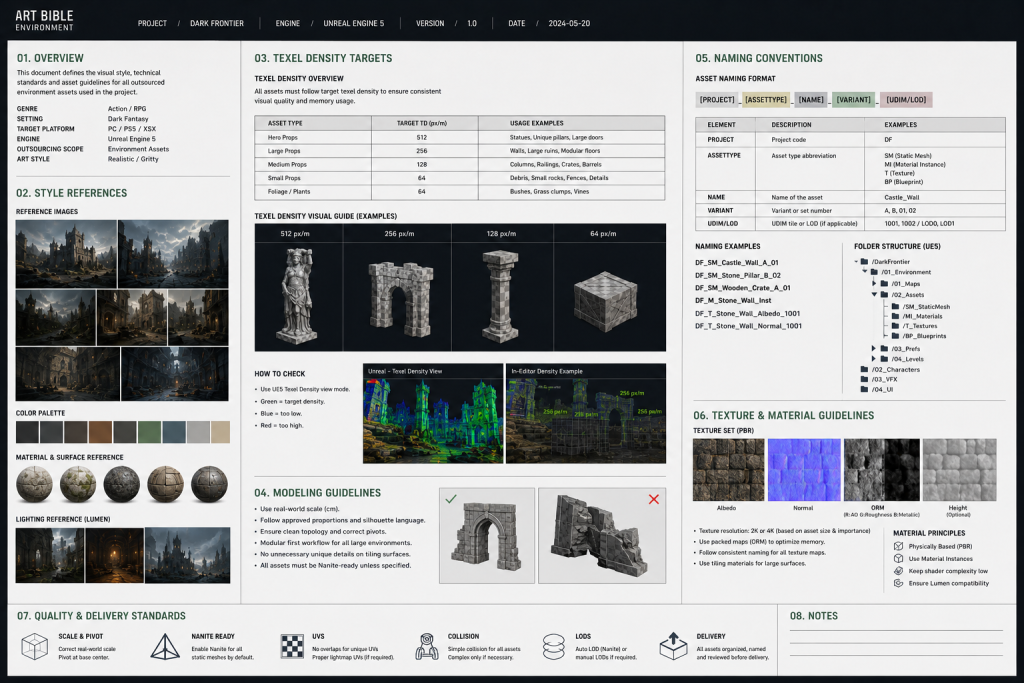
Almost every outsourcing relationship references an art bible. In practice, the quality of that document ranges from a well-organized visual and technical specification to a loose collection of mood board images with no production guidance. The difference between the two determines how much of your art director’s time gets consumed resolving ambiguity during production.
“Editorial illustration created for visual reference purposes. It does not represent a real project, client work, or official software screenshot unless stated otherwise.”
An art bible for UE5 outsourcing needs to cover three distinct categories of information, and treating any of them as optional creates predictable gaps.
Visual direction. This is the component most studios invest in — style references, color palette, lighting tone, silhouette principles, material feel. The key requirement is that references must answer two questions: what the game looks like, and what it explicitly does not look like. References that only show the desired direction leave the external team to infer the rejection criteria. Including “negative references” — images that share superficial similarity with your style but represent directions you have consciously rejected — reduces interpretive drift more reliably than additional positive references alone.
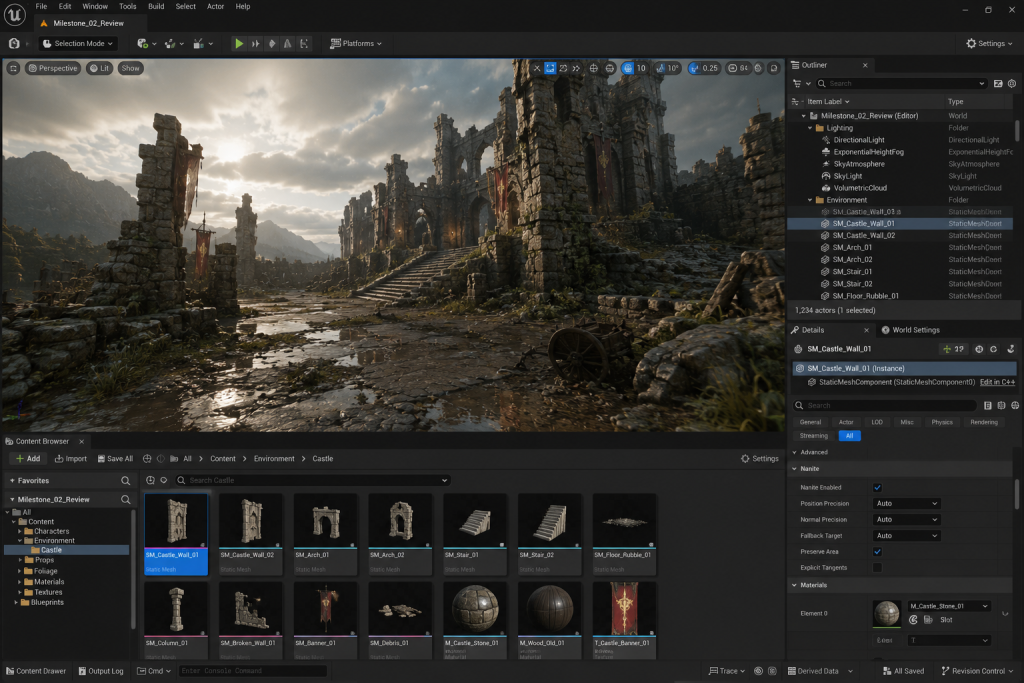
For UE5, visual direction should also include at least one sample scene rendered in engine — not a concept painting or a beauty shot from a DCC tool. The difference between how a material reads in an offline renderer and how it reads under Lumen with dynamic indirect lighting can be significant, and the external team needs to know which rendering context defines the quality target. At Nasty Rodent, we request or provide in-engine reference frames as a standard part of any UE5 brief before concept alignment begins — it eliminates a class of material calibration errors that would otherwise surface at the first-pass review.
Technical standards. This is where UE5 briefs most commonly fall short. Technical standards need to include: texture resolution by asset category, channel packing conventions (ORM vs. separate maps), naming conventions for static meshes, materials, textures, and folder structure within the project, UV layout requirements including the lightmap UV channel, Nanite eligibility per asset category, LOD expectations for assets where Nanite is not appropriate, material instance hierarchy with clear documentation of which parameters are exposed vs. locked, and collision settings by asset type.
Naming conventions deserve particular attention. In large UE5 projects, inconsistent naming creates asset management problems that scale with volume. Specifying a schema early — with examples of correct and incorrect naming — prevents the cleanup work that otherwise happens at integration. A typical schema follows patterns like SM_[Category]_[Name]_[Variant] for static meshes and MI_[Category]_[Name] for material instances. Whatever schema fits the project, documenting it with examples and making it part of the acceptance criteria, not a post-delivery checklist item, is the structural move that saves hours per batch.
Production governance. The art bible should also establish revision protocol: how many feedback rounds are included per asset at each milestone stage, who consolidates feedback before it reaches the external team, how scope changes are handled, and what constitutes a new-scope request versus normal revision.
The UE5 Technical Spec: What Generic Briefs Miss
The technical specification is where UE5-specific knowledge makes the largest practical difference. A generic technical spec for 3D outsourcing covers polygon counts, UV requirements, and texture formats. A UE5-specific spec needs to go considerably further.
Nanite: current capabilities and production tradeoffs. Nanite has evolved substantially since UE5.0. As of UE5.5 and the current 5.7 documentation, Nanite supports both Opaque and Masked blend modes, World Position Offset for dynamic deformation (enabled since 5.1), and — through the Nanite Foliage and Nanite Skinning systems — skeletal mesh workflows for vegetation and animated foliage assets. Translucency remains outside Nanite’s coverage; assets using Translucent blend modes fall back to the traditional render path regardless of Nanite settings.
“Editorial illustration created for visual reference purposes. It does not represent a real project, client work, or official software screenshot unless stated otherwise.”
The practical implications for a production brief are more nuanced than a simple supported/unsupported list. Masked materials work with Nanite, but they carry a performance cost: the masking operation increases overdraw and creates material bin overhead that scales with instance count and scene complexity. For large open-world environments with dense foliage, this cost needs to be budgeted explicitly — a brief that says “Nanite-enabled foliage” without addressing masked overdraw is passing that decision to the external team, and the external team may not know your frame budget. The brief should specify whether masked Nanite assets require overdraw optimization testing before delivery, or whether the project’s scene density makes this a non-issue.
For skinned character meshes used in gameplay animation — as opposed to skeletal foliage wind rigs — conventional pipeline approaches remain the practical standard in most productions. If your project intends to use Nanite for character rendering, the brief should state this explicitly and acknowledge the additional setup requirements.
Source mesh quality matters more than it did under traditional LOD workflows: Nanite’s cluster-based geometry handles LOD internally based on screen-space visibility, so the source geometry should be clean and coherent without degenerate triangles. The brief should note which asset categories have Nanite enabled and, crucially, what the fallback mesh configuration is for platforms where Nanite is not supported — because an external team that authors beautiful Nanite geometry without a configured fallback mesh creates a platform certification problem.
Lumen and lighting response. Lumen’s fully dynamic global illumination changes how materials read at a fundamental level. Material roughness and metallicity values that look correct under baked or HDRI-based lighting can read differently under Lumen’s dynamic indirect light bounce. The practical implication for briefing is that the technical spec should include validated PBR value ranges tested against the project’s actual Lumen configuration — not generic PBR guidelines — alongside a lit in-engine reference scene the external team can use for calibration.
If the project targets hardware where Lumen runs in software mode rather than hardware ray tracing mode, the spec should note this. The two modes have different visual characteristics, and the external team should calibrate to the mode players will actually experience.
World Partition and streaming. For open-world projects using World Partition, outsourced environment assets need to be authored with streaming awareness. Assets that load and unload as the player moves through the world need to be designed with the streaming budget in mind — not just the static frame budget. This affects decisions about asset scale, modularity, and how assets cluster within loading cells. The brief should specify streaming cell size, expected asset density per cell, and any constraints on actor count or draw call budget per cell. External teams that have not worked in World Partition environments will not know to ask about this.
Material instances and master material hierarchy. External studios working on large asset batches will typically create standalone materials per asset unless the brief specifies otherwise. In a UE5 project with a defined master material hierarchy, every asset should derive from master materials rather than creating unique material graphs — this reduces draw call overhead, simplifies parameter control, and allows global visual adjustments without touching individual assets. The brief should include the master materials the external team is expected to use, or explicitly scope master material creation as a deliverable.
Milestone Design: Gates, Not Deadlines
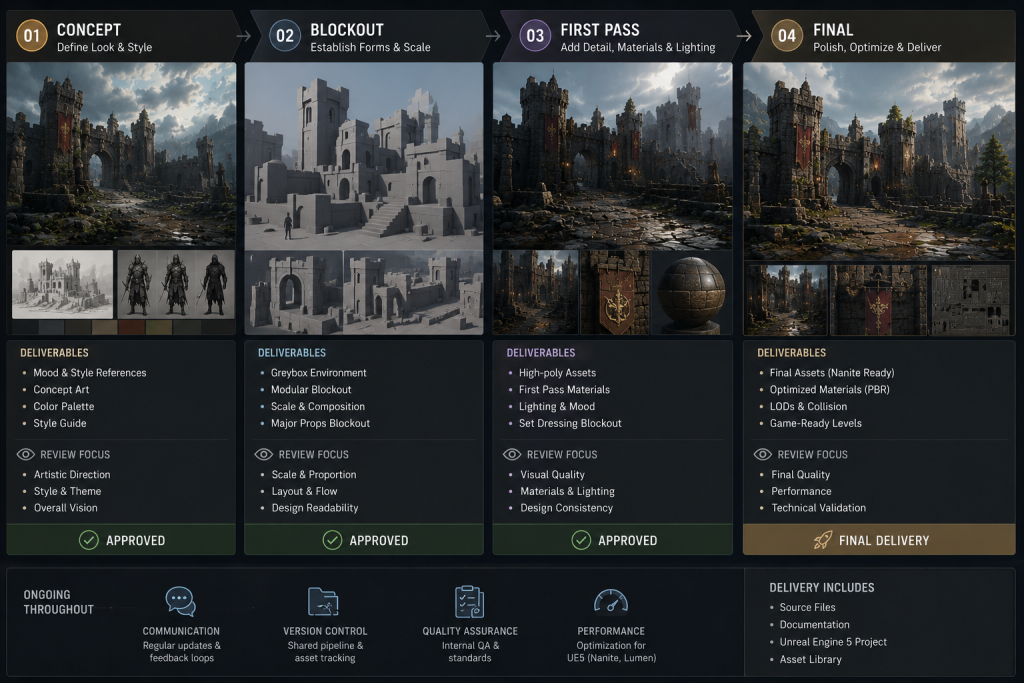
Milestone-based delivery is near-universal in outsourcing guidance, but the practical implementation varies significantly. A milestone defined only as “deliver assets by [date]” functions as a deadline without a quality checkpoint. A milestone with a defined approval gate functions as a quality control mechanism that catches problems when they are cheap to fix.
“Editorial illustration created for visual reference purposes. It does not represent a real project, client work, or official software screenshot unless stated otherwise.”
For UE5 art production, the approval gate structure for each asset category should follow the sequence of production stages:
Blockout approval. Before any surfacing or detail work begins, the external team delivers grey-blocked geometry at final scale within the engine. The purpose of this gate is to validate proportions, modular fit, gameplay interaction clearances, and how the asset reads at intended viewing distances. Changes at this stage cost hours. The same changes after full texturing cost days.

First-pass material approval. The asset reaches its first textured state — base color, roughness, metallicity, and normal map applied, but not final polish. This gate validates that PBR values are within the specified range, that the material reads correctly under Lumen in the reference scene, and that texel density matches the brief specification. This is also the appropriate stage to validate naming conventions and file organization.
Engine import review. Before final approval, assets are imported into the project build and reviewed in context — placed in a representative level section, under actual project lighting, with Nanite enabled or configured per spec. This catches scaling errors, pivot point placement issues, and material assignment problems that are invisible in the DCC application. At Nasty Rodent, this import test is a non-negotiable step before any asset is submitted as final — it eliminates the category of errors that look fine in an artist’s render and break immediately in the target environment.
Final approval. The asset meets all visual, technical, and organizational criteria. Acceptance criteria defined in the brief are checked against the delivered asset systematically, not by impression.
The interval between milestones should be calibrated to asset volume and complexity. For modular environment kits with many small assets, weekly gates on representative samples work better than waiting for a full batch — style drift accumulates between reviews and is significantly more expensive to correct than to prevent.
Revision Protocol: Write It Down Before Production Starts
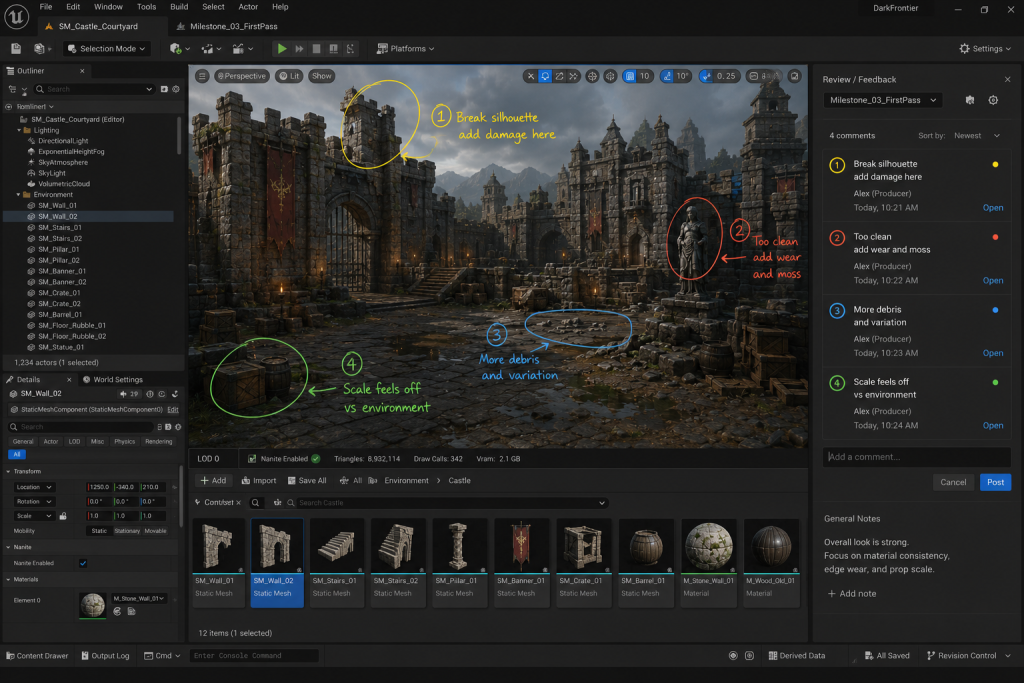
Revision cycles are the primary mechanism by which outsourcing budgets overrun and timelines compress. The most reliable way to prevent uncontrolled revision is to specify revision scope explicitly in the brief rather than leaving it to implicit understanding.
A revision protocol defines three things: the number of feedback rounds included per asset at each milestone stage, what type of feedback each round is intended to address, and when a requested change constitutes new scope rather than revision.
“Editorial illustration created for visual reference purposes. It does not represent a real project, client work, or official software screenshot unless stated otherwise.”
Separating feedback types by round is a practice that structured outsourcing relationships develop over time. A first-round feedback pass should address directional issues — proportion, silhouette, broad material read, structural fit. A second-round pass should address refinement — surface detail, color calibration, specific material parameters. Treating a first-round review as an opportunity to address both categories simultaneously often produces a third-round requirement that the brief did not anticipate.
Scope change definitions are equally critical. When a client requests a variant of an approved asset that was not in the original brief — a different material skin, an additional LOD level, a configuration change — this is new scope, not revision. Briefs that leave this undefined consistently generate disputes at the most inconvenient production moments. A clear scope change protocol — defining what triggers a formal change order and how the timeline adjusts — prevents the ambiguity that makes those conversations adversarial.
Reference Assembly: What Needs to Exist Before the Brief Ships
The reference package accompanying a brief determines how much interpretation the external team needs to supply. Interpretation is not a failure of the external team — it is the predictable result of a brief that leaves gaps.
For UE5 art outsourcing, an effective reference package includes:
Visual references with annotations. Five to ten images representing the intended visual language, with notes on what specifically each reference contributes — a silhouette approach, a material quality, a color temperature. References without annotations leave the external team inferring which aspect of each image is relevant.
In-engine reference renders. Screenshots from the actual UE5 project, rendered under the lighting setup the final game will use. The external team needs to know what production lighting looks like for this specific project.
A negative reference set. Two or three images representing visual directions explicitly rejected, with brief annotations explaining the rejection reason. These notes prevent the team from exploring directions that look superficially similar to positive references but diverge from the actual intent.
A scale reference. For environment assets, a scale reference showing human-height or object-size relationships prevents the proportion errors that cause otherwise high-quality assets to fail the blockout gate.
One Voice, One Contact, No Exceptions
The structural problem that causes the most revision cycles in outsourced production is not visual ambiguity — it is conflicting feedback reaching the external team from multiple voices. An art director says one thing in the review call. A producer adds different notes in the project management tool. A technical artist flags integration concerns separately. The external team receives directions that do not agree and cannot resolve the conflict without escalation.
The brief should establish — by name and role — who holds approval authority at each stage. One person consolidates all feedback before it goes to the external team. All communication routes through that person. This is not a bureaucratic constraint; it is the most reliable operational mechanism for maintaining directional consistency across a large batch.
In-Engine Integration: The Gate That Catches Everything Else
Every asset accepted at the milestone level needs to be validated in the target engine before it is considered production-ready. In-engine validation catches a category of problems that are invisible in DCC applications and rendering previews: scaling errors, pivot point placement that breaks modular snapping, UV seams that are invisible in an artist’s renderer but visible under Lumen at specific viewing angles, and normal map channel conventions that differ between applications.
For UE5 specifically, the in-engine import test should confirm: Nanite is enabled or disabled per the asset spec, with the fallback mesh correctly configured; material assignments map to the project’s master material hierarchy rather than standalone materials created in DCC; lightmap UV channel resolution is appropriate for asset scale; naming conventions and folder placement match the project schema; and the asset performs within budget when placed alongside adjacent assets in a representative level section.
This final gate is the brief’s guarantee. If acceptance criteria are written clearly enough that both teams can evaluate an asset against them without subjective interpretation, the in-engine review becomes a systematic check rather than a judgment call.
What a Complete Brief Contains
Pulling it together, a production-grade brief for a UE5 environment art outsourcing engagement includes:
Project overview. Game genre, visual style in one sentence, target platform with explicit performance tier, engine version.
Scope of work. Asset list with quantity, category, and production depth per category. Which assets the external team produces start to finish, which have approved concepts provided, which require in-engine setup as part of scope.
Technical specifications. All UE5-specific requirements — Nanite eligibility per asset category with fallback mesh configuration, Lumen calibration reference, material instance protocol, texture channel packing convention, naming schema with examples, LOD requirements for non-Nanite assets, collision type by category, lightmap UV channel spec.
Reference package. In-engine renders, annotated positive visual references, negative references with rejection rationale, scale reference.
Milestone structure. Dates, deliverables, and acceptance criteria per milestone. Each acceptance criterion specific enough for the external team to self-check before submitting.
Revision protocol. Rounds included per stage, feedback type per round, scope change definition and process.
Communication. Point of contact on both sides by name and role, communication channel, review cadence, escalation path.
Delivery format. File organization schema, handoff documentation requirements, final import test protocol.
How Nasty Rodent Approaches This in Practice
The brief structure above reflects how we work at Nasty Rodent on every UE5 engagement — not as an ideal to aspire toward, but as the operational baseline we apply from the first project call.
Before any production scope is agreed, we align on platform profile and Nanite configuration. We request or provide in-engine reference frames rather than relying on concept renders. We establish the master material hierarchy, naming schema, and delivery format in writing before the blockout phase begins. During production, we run import tests at every milestone — not as a final QA pass, but as a continuous check that catches integration issues before they compound.
This approach means that when studios work with us on Unreal Engine art production, revision cycles are predictable and bounded. Assets that enter the pipeline with a structured brief do not accumulate ambiguity — they accumulate toward delivery.
For studios that need production support across environments and visual development — from concept alignment through final engine-ready delivery — we align our collaboration model to your pipeline’s technical and organizational structure, not the other way around.
If you’re planning a UE5 outsourcing engagement and want to discuss brief structure, scope definition, or technical specifications before production begins, that conversation is the right starting point.
Nasty Rodent — structured game art outsourcing for Unreal Engine 5 productions.