
How Many Concept Art Iterations Does a Project Actually Need?
-

Written byDenys Zadoienyi
-

Updated on03.09.2026
-

Time to read12 min

- Why a Flat Round Count Is the Wrong Starting Assumption
- Two Core Axes for the First Iteration Estimate: Concept Stage and Direction Clarity
- What Makes Iterations Multiply: The Real Drivers
- Different Concept Types Need Different Iteration Structures
- Case Notes: What This Looks Like in Practice
- A Worksheet for Planning Iteration Rounds Before You Ask for a Quote
- Scope, Capacity, and the Quote Request
Concept art scope estimation is the process of working out, before a brief goes out for quote, how many iteration rounds a specific piece of concept work actually needs – based on what stage it’s at, how clear the direction already is, and what type of asset it is. A brief that simply says “include three revision rounds” may look scoped, but the number means little on its own unless it reflects exploration depth, direction clarity, and the approval structure behind it. Some concepts converge quickly because the visual direction is already settled elsewhere; others need several rounds because exploration and direction-setting are still happening inside the assignment itself.
This is a different question from what a round costs, which is its own topic covered in our concept art cost breakdown. This article is about the count itself: how a producer or art director works out, before the quote request goes out, how many rounds to actually plan for.
“Editorial illustration created for visual reference purposes. It does not represent a real project, client work, or official software screenshot unless stated otherwise.”
Why a Flat Round Count Is the Wrong Starting Assumption
A flat number attached to a brief – for example, “budget three rounds” – is easy to write down, but it isn’t derived from the actual uncertainty in the work. What actually matters is two things a flat number ignores entirely: how far along the concept is in its own process, and how settled the direction is before the first sketch happens.
A character concept for an established style – a roster addition to a game whose art bible is already locked – can converge faster than a flat default would suggest, because the direction questions were largely answered before this specific brief was written. A character concept for a new IP with no locked style, reviewed by several stakeholders who haven’t aligned with each other yet, can reasonably need more rounds than that same flat default assumes – not because the artist is slower, but because the rounds are doing double duty: exploring direction and refining execution at the same time, when those are really two different jobs.
Treating both cases the same way – “a character concept, budget a fixed number of rounds” – produces the same failure mode in both directions: the locked-style project pays for revision capacity it doesn’t use, and the new-IP project runs out of budgeted rounds while direction is still being decided, turning rounds beyond the original assumption into additional scope, capacity, or cost that wasn’t planned up front.
Two Core Axes for the First Iteration Estimate: Concept Stage and Direction Clarity
Two independent questions form a useful starting point for how many rounds a piece of concept work needs, though they aren’t the whole picture – additional drivers that refine the estimate further are covered in the next section.
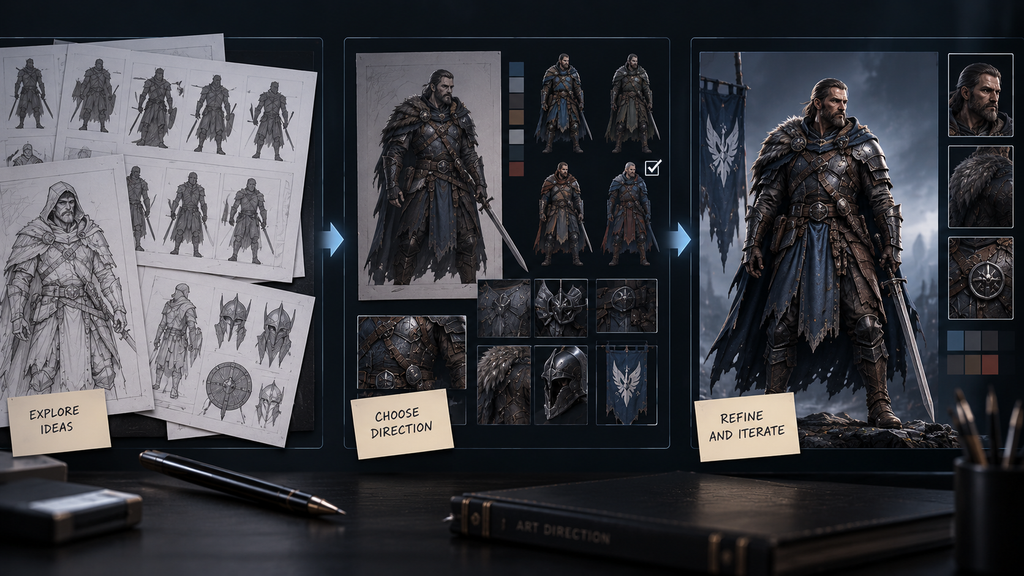
Concept stage is where the piece sits in its own process: early exploration (multiple divergent directions, deliberately rough), direction selection (narrowing toward one approach), refinement (polishing a chosen direction), or production lock (a final, technically specified sheet ready to hand off). Each stage tends to generate a different type of feedback and needs to be scoped differently – exploration-stage feedback is about direction, refinement-stage feedback is about execution, and conflating the two within one round count is a common source of mismatch. If unresolved direction questions are skipped rather than genuinely resolved at the right stage, they often reappear later as revision or rework at a stage that was supposed to be about something else.
Direction clarity is a separate axis: how settled the visual direction already is before this piece of work starts, independent of what stage it’s nominally at. A refinement-stage piece for a project with an unclear or contested art direction can still burn through rounds the way an exploration-stage piece would, because the rounds are actually re-litigating direction under the label of refinement. A well-briefed exploration-stage piece for a studio with a genuinely locked style reference can converge faster than the stage label would suggest, because there’s less genuine uncertainty to explore.
Neither axis replaces the other. A production-lock piece with unclear direction is not a one-round job just because “lock” sounds final, and an exploration piece with a tightly defined style bible is not automatically a five-round job just because “exploration” sounds open-ended. Scoping iteration count means checking both before assuming either one from the asset’s label alone.

What Makes Iterations Multiply: The Real Drivers
Beyond stage and direction clarity, a handful of concrete factors commonly increase iteration risk or widen the expected round range, and naming them explicitly is more useful than treating “revisions” as a single undifferentiated risk.
Stakeholder count and sign-off structure. A concept reviewed and approved by one decision-maker converges differently than one reviewed by several stakeholders who each have partial, sometimes conflicting authority. This isn’t about any one reviewer being difficult – more independent approval points increase the number of opportunities for conflicting feedback or a decision the previous round appeared to close getting reopened.
Reference and brief quality. A brief with a genuinely locked reference set narrows the first round’s job considerably. A brief that says “something like this but different” is asking the first round to do direction-finding work that a clearer brief would have resolved before the artist started – this is exactly the gap our concept art brief guide covers from the client side: what a brief needs to contain to avoid spending rounds on direction questions it should have answered up front.
Style novelty versus established continuity. A concept for a new IP with no existing visual language often carries more exploration risk than a roster addition to an established style, because more of the visual language may still need to be defined. This isn’t a quality judgment on either project – it’s a structural difference in how much direction work the concept stage has to carry.
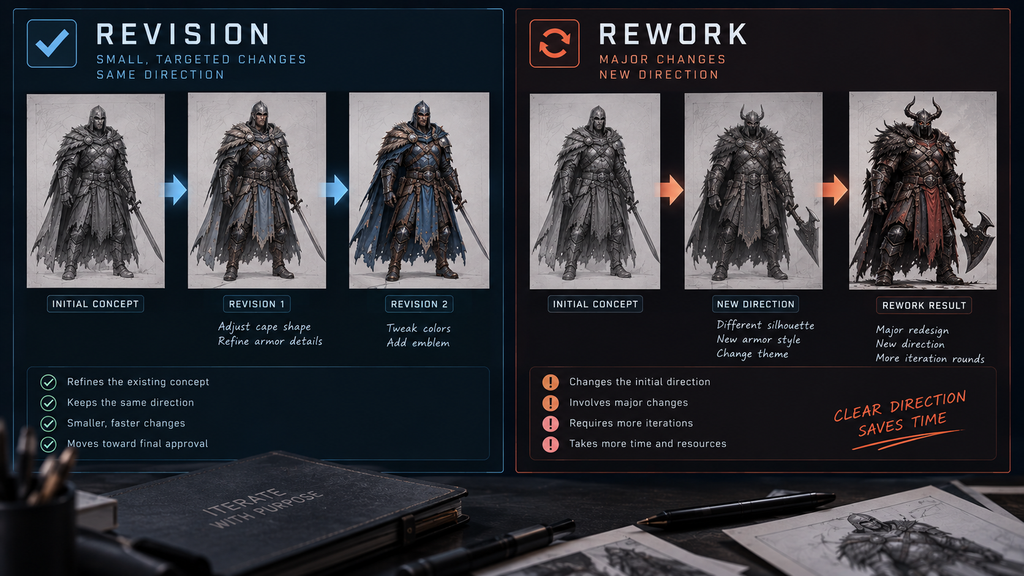
Revision versus rework. A revision refines a direction that’s already been chosen. Rework restarts from a new direction after one was already approved – a genuine creative-direction change mid-production, not a normal part of the iteration count that was planned. Treating a rework request as “one more revision” understates what it actually costs; it should be treated as a scope change rather than silently absorbed into the planned revision rounds.
“Editorial illustration created for visual reference purposes. It does not represent a real project, client work, or official software screenshot unless stated otherwise.”
Different Concept Types Need Different Iteration Structures
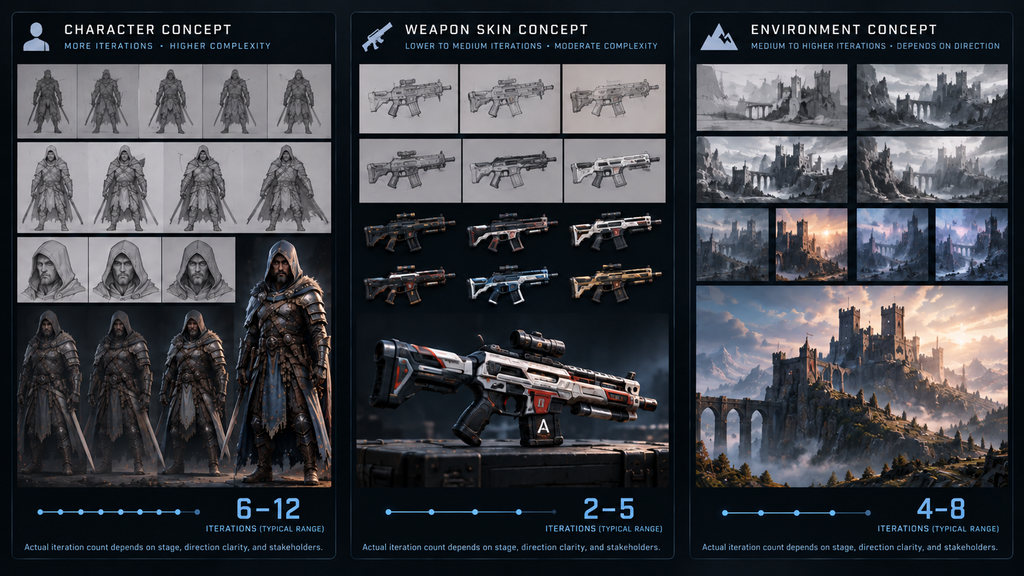
The framework above applies across concept types, but the typical shape of the iteration count differs by what’s actually being concepted, and conflating them is a common scoping mistake.
“Editorial illustration created for visual reference purposes. It does not represent a real project, client work, or official software screenshot unless stated otherwise.”
Character concepts can carry substantial exploration weight because silhouette, proportion, costume, and equipment decisions interact – a change to one often forces a re-look at the others. That doesn’t make character concepts categorically heavier than every other type; it means the interaction between design decisions is a factor worth checking specifically for this type. Once a character concept reaches production lock, it becomes the input to the next stage entirely: our character concept-to-3D pipeline breakdown covers what a locked concept needs to contain to hand off cleanly, which is a separate question from how many rounds it took to get there.
Skin and variant concepts – a faction recolor, a cosmetic variant of an already-approved base design – are often narrower in scope when the base silhouette and design language are already approved: the remaining rounds address material, palette, or detail variation rather than direction-finding from scratch. This is a tendency rather than a rule – a premium or licensed cosmetic reviewed by multiple stakeholders can still run through several rounds – but treating every skin-variant concept as automatically equivalent in scope to a from-scratch character concept overestimates the typical case.
Environment concepts may require multiple composition, scale, mood, and functional-layout decisions, and how much of that gets resolved per round depends heavily on whether the assignment is exploratory (early world-building, direction still open) or production-facing (a specific location within an already-established world).
Key art is worth scoping separately from production concept art altogether: it serves a marketing or presentation function rather than a production-pipeline one, and it may follow a different approval path, often involving stakeholders (marketing, publishing) who aren’t part of the production concept review chain at all.
Case Notes: What This Looks Like in Practice
Wild Rage, a stylized MMORPG project for Whimsy Games, is a relevant example of a project where Nasty Rodent owned both art direction and concept production for the character roster. The verified fact is limited to that ownership structure – the actual iteration counts and approval history for Wild Rage aren’t public. As a general inference rather than a claim about this specific project: keeping direction ownership and concept execution closely aligned can reduce the risk of conflicting feedback loops, since there’s no second team’s direction to reconcile against.
On Squad, for Offworld Industries, Nasty Rodent delivered concept art and unique skins alongside final weapon and vehicle assets. A weapon-skin assignment of that general kind can have a narrower decision space than a from-scratch weapon concept when the base design is already approved – material, faction, and cosmetic variation rather than silhouette or direction-finding – though the specific round structure used on Squad isn’t detailed here. This is a useful illustration of why skin-variant concepts and from-scratch character concepts shouldn’t be scoped with the same assumed round count, even when both are labeled “concept art” on a brief.
Worked example: a hypothetical concept art slate
| Brief item | Iteration structure |
| New hero character, new IP, several stakeholders | Higher iteration exposure likely – exploration and direction-finding overlap, sign-off chain adds reopen risk |
| Faction skin variant on an approved base weapon | Lower iteration exposure likely – direction and silhouette already locked, remaining work is material/palette |
| Environment concept, exploratory stage, world-building still open | Higher iteration exposure likely – composition, scale, and mood decisions still being resolved |
| Background NPC concept, shared style guide, no new decisions | Lower iteration exposure likely – closest thing to a template job within an established style |
This slate is illustrative only and doesn’t represent an actual client brief or a Nasty Rodent production breakdown; it’s meant to show how the same “concept art” label can carry very different iteration exposure once stage, direction clarity, and asset type are checked separately.
A Worksheet for Planning Iteration Rounds Before You Ask for a Quote
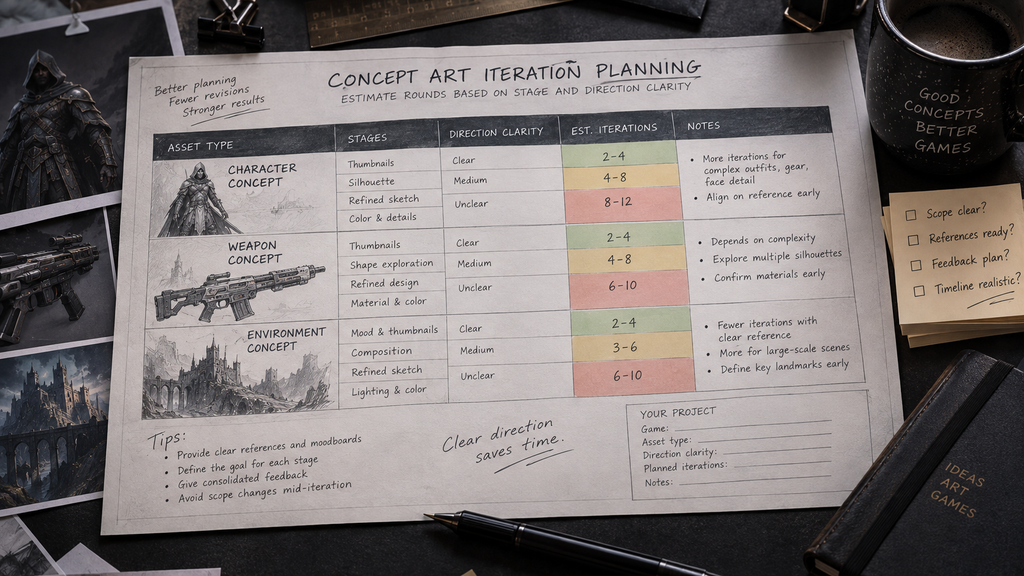
“Editorial illustration created for visual reference purposes. It does not represent a real project, client work, or official software screenshot unless stated otherwise.”
| Field | What it captures |
| Brief item | Character, skin/variant, environment, key art, prop |
| Concept stage | Exploration / direction selection / refinement / production lock |
| Direction clarity | Locked style reference / partial reference / undefined |
| Stakeholder count | Single reviewer / small group / multiple independent sign-offs |
| Approval owner | Who holds final sign-off, distinct from who reviews |
| Style novelty | New IP or style / established roster addition / direct variant of approved work |
| Reference quality | Specific and locked / directional but loose / verbal only |
| Deliverable / documentation depth | Sketch / selected direction / orthographics / turnaround sheet / callouts / production-ready sheet |
| Revision vs. rework risk | Low – scope is well defined / moderate / high – direction itself may still change |
| Assumption status | Confirmed / assumed / to-be-confirmed, with an owner named |
The stakeholder, approval-owner, and reference-quality fields are worth filling in before a brief goes out, since all three are usually knowable in advance and can be more informative than asset type alone – stakeholder count without a named final approver doesn’t give the full picture, since a large review group with one clear decision-maker behaves differently than the same group with no single owner. Flagging a piece as “high rework risk” before work starts – rather than discovering it several rounds into production – is what keeps a rework request a planned conversation instead of a scope surprise.
Scope, Capacity, and the Quote Request
A brief that states concept stage, direction clarity, and stakeholder structure up front lets a studio scope round count with fewer assumptions than a brief that only names the asset type. It doesn’t eliminate the need for a working estimate – some direction questions genuinely can’t be resolved before the first round starts – but it narrows the range considerably compared to a bare “character concept, please quote.”
Once the round structure is roughly scoped this way, Nasty Rodent’s concept art team can quote against it directly, and the separate question of what each round costs is covered in our concept art cost breakdown.
For teams still deciding whether concept work belongs in-house or with an outsource partner, that decision interacts with iteration planning directly: in-house and outsourced teams absorb rework differently depending on the engagement model. A fixed-scope project may require a formal change to the plan when a rework round shows up, while ongoing support, time-based, or dedicated-team engagements can often absorb the extra round as additional capacity instead – a distinction our hire vs. outsource concept art guide covers in more depth. The engagement shape itself also changes by production stage – a pre-production exploration engagement and a full-production batch arrangement carry very different scope logic even for the same client, which our concept art outsourcing guide covers separately from the iteration-count question this article focuses on.

Let's work
together


in mind?
From 3D characters and environments to weapons, props, concept art and game UI/UX: ten years deep, 40+ artists strong, zero fluff. Tell us what you are making and get a free, no-pressure estimate.
estimate