Concept Art Outsourcing Studio Engagements: What Changes at Each Production Stage
-

Written by Denys Zadoienyi
-

Updated on05.08.2026
-

Time to read15 min

Two questions about outsourced concept art are already well covered, including on this blog. The first is what concept art actually is and what makes a package production-ready – the full breakdown sits in our article on what concept art does in production.
The second is how to specify the work so a vendor delivers on the first pass, which is the subject of our guide to writing a concept art brief.
This article is about neither. It is about the thing that changes underneath both: the shape of the engagement itself.
The same studio, working to the same standard, needs a fundamentally different arrangement depending on where your project is. In pre-production, scope cannot be measured only in finalized asset deliveries. In full production, it largely has to be. The person who signs off changes. The contract form changes. So does the definition of finished. Teams that carry one engagement model across all four stages usually discover the mismatch as a dispute about scope, three months after the disagreement actually started.
Below: what each of the four engagement shapes looks like, what actually moves a concept schedule, and how to write the exit point into the agreement instead of discovering it later.
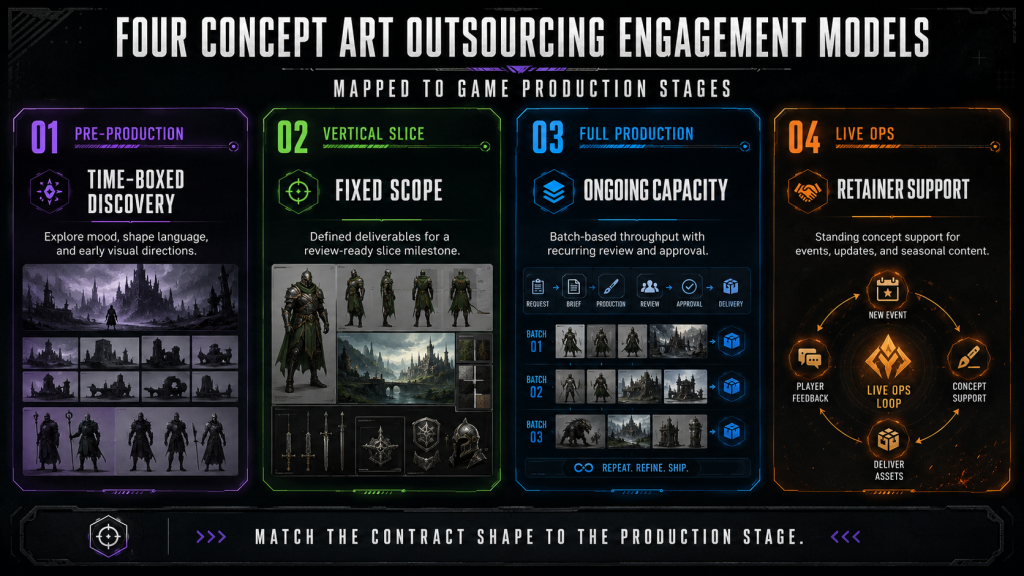
Four stages, four different engagements
“Editorial illustration created for visual reference purposes. It does not represent a real project, client work, or official software screenshot unless stated otherwise.”
| Stage | Scope is measured in | Contract shape that fits | The engagement ends when |
| Pre-production | Design questions, exploration time, agreed outputs | Time-boxed discovery | A direction is approved |
| Vertical slice | A named, finite asset set | Fixed scope, named deliverables | The slice passes review |
| Full production | Batches against a locked style guide | Ongoing capacity or batch-based | Rolling – per batch |
| Live ops | A recurring cadence | Retainer or standing capacity | Renewal, not completion |
Pre-production. The visual target does not exist yet, which makes a fixed list of finalized assets the wrong load-bearing element. Committing to “eight character concepts” before anyone knows what the characters are converts exploration into delivery pressure, and delivery pressure narrows options exactly when width is the point. Deliverables still belong in the scope – keyframes, mood paintings, faction explorations, benchmark concepts are all legitimate outputs of this phase. What changes is what the scope is anchored to: a defined design question and a defined block of exploration time, with agreed outputs attached, rather than a headcount of finished sheets.
Vertical slice. Scope becomes finite and nameable, because the slice itself defines it – these characters, this environment, at the fidelity the slice has to demonstrate. Fixed scope with named deliverables fits cleanly here, and acceptance can be tied to something real: the slice review. For teams evaluating an unfamiliar partner on production-relevant work, this stage offers a naturally bounded first engagement – though whether it is the right entry point depends on why you are engaging at all. Extending capacity and testing a vendor are different objectives with different ideal starting points.
Full production. The art bible is locked and the asset list exists, so scope can be expressed in batches. This stage tends to be the easiest to plan externally – not because the work is simpler, but because the visual system, the asset taxonomy, and the acceptance criteria are all comparatively stable. The dominant risk shifts from direction drift to style drift across batches, which is a review-cadence problem rather than a talent one.
Live ops. Seasonal drops, event assets, cosmetic variants. Volume is recurring and predictable enough to plan against a calendar rather than a milestone. Recurring work of this kind often suits a standing-capacity arrangement, particularly when the same team is expected to hold style continuity across releases – though plenty of live-ops content is also produced perfectly well as discrete fixed-scope batches.
Transitions deserve their own note, because most engagements begin in the middle of one rather than at a clean stage boundary. A partner brought in while pre-production is converging onto a direction inherits a half-settled visual system – some decisions locked, others still live, and rarely a document that distinguishes between the two. The useful preparatory step is not more reference but a short written list of what is already decided and closed. Producing that list is a small task next to the review time it prevents: without it, the first round goes on rediscovering which questions were already answered internally, at your cost.
One qualifier that matters more than the table suggests: classify by asset group, not by project. A team can be in full production on environments and in pre-production on a new character class simultaneously. Each group needs the engagement shape that matches its own visual maturity, not the one that matches the project’s headline stage. Mixing both under a single brief is how a batch that was scoped as production work quietly becomes an exploration exercise nobody scheduled.
A related decision sits upstream of all of this. If you have not yet settled whether the work belongs with a studio at all, versus individual artists or an internal hire, the comparison between those models resolves differently depending on whether your constraint is capacity, specialisation, or headcount policy – and it should be resolved first.

Who signs off changes with the stage
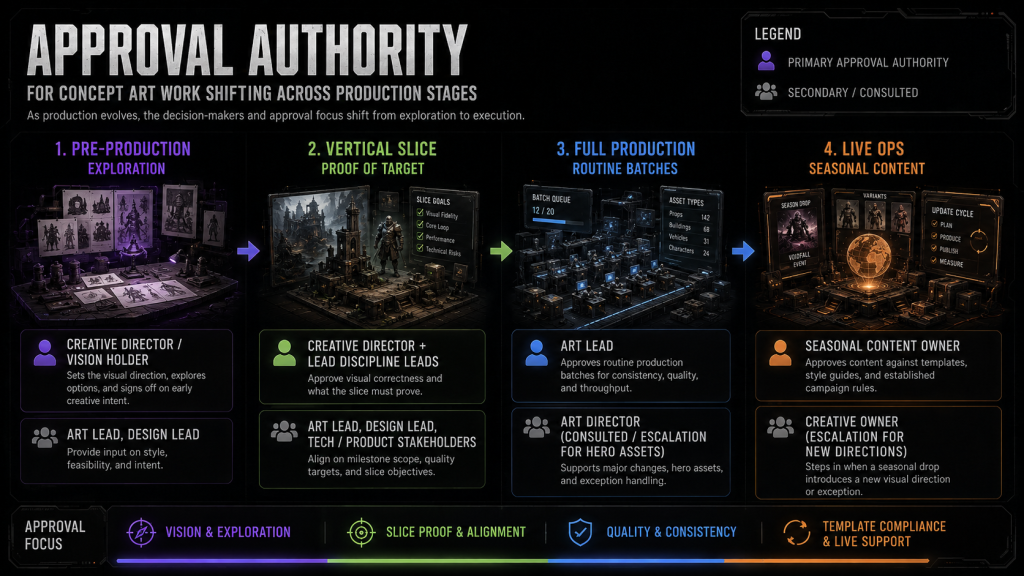
Approval authority is usually treated as a fixed property of the project: whoever owns art direction approves art. In practice the appropriate approver moves as the work matures, and mismatches here can create schedule damage even when the asset scope itself is perfectly clear.
“Editorial illustration created for visual reference purposes. It does not represent a real project, client work, or official software screenshot unless stated otherwise.”
In pre-production, final direction approval should stay with whoever owns the creative vision – art director, creative director, sometimes the founder. Exploration review can be delegated, and often should be; what cannot be delegated is the authority to close a direction rather than collect opinions about it. The problem is rarely the number of people involved. It is diffuse authority: a review where everyone can object and nobody can decide. A named owner with the mandate to reject and the availability to do it inside the review window is one of the strongest operational safeguards available in an outsourced concept engagement, and it costs nothing to arrange.
At vertical slice, approval has to answer two separate questions – whether the work is visually correct, and whether it serves what the slice is meant to prove. Those mandates may sit with two people or with one owner who holds both. What matters is that both questions actually get asked, because a concept can be visually right and still wrong for a slice that has to demonstrate something specific to a publisher.
In full production, routine batch review can usually move to an art lead working against an approved visual system – faster and more consistent than a director checking work against memory. The question shifts from “is this good” to “is this compliant with what we already approved.” Art directors often, and reasonably, keep final approval for hero assets, benchmark batches, franchise-sensitive content, and the opening batches from a new partner. What signals a problem is not the director’s involvement but the absence of any delegated path at all, which usually means the style guide is not yet complete enough to delegate against.
In recurring live-ops production, routine approval often becomes template and style-guide compliance, and can be delegated further still – to whoever owns the seasonal content template. Content that introduces a new faction, a new theme, or a visual refresh is a different case and belongs back with the creative owner. Escalation should be triggered by departure from the established system, not by every delivery.
The failure mode worth naming: an approver who is right for one stage applied to another. A creative director personally reviewing every routine batch can become a bottleneck once the visual system is already stable. An art lead asked to approve pre-production direction is being handed a decision they were not given authority to make, and the work stalls while it escalates. Both look like vendor slowness from the outside. Neither is.
Whichever arrangement fits, it belongs in the paperwork rather than in an assumption. Approval authority, feedback format, and what counts as consolidated notes are all governing terms, and the documents that carry them are covered in our guide to RFP and SOW structure for game art.
What actually moves a concept art schedule
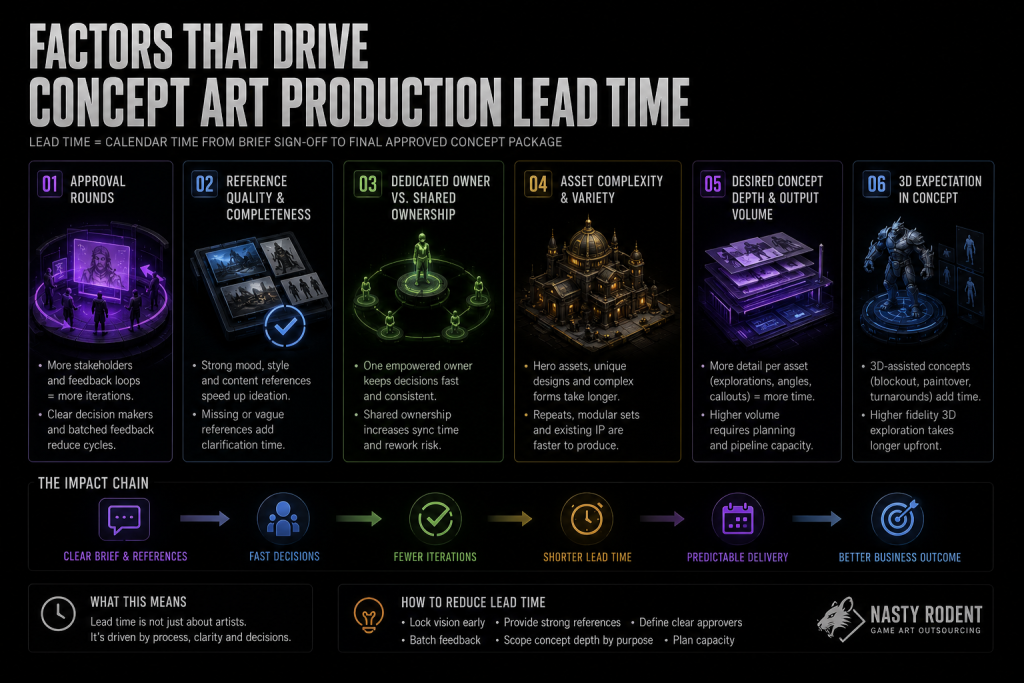
Published lead-time ranges are hard to apply, not because they are dishonest, but because they rarely state their assumptions: which asset type, at what finish level, with how many directions explored, under what feedback turnaround, with what revision policy. Two quotes for “a character concept” can describe workloads that differ several-fold. What travels better than a number is the list of variables that move it.
“Editorial illustration created for visual reference purposes. It does not represent a real project, client work, or official software screenshot unless stated otherwise.”
Approval latency. This is one of the largest multipliers on a concept schedule, because it extends calendar time without advancing production. A review round that waits four days for consolidated notes costs four days that nobody spent producing anything. Across a batch, repeated delays of that kind can outweigh relatively small differences in production speed between otherwise comparable teams.
Whether the reference base existed before kickoff. Building it during the engagement is legitimate work, but it shifts paid production time into discovery and typically adds alignment rounds that were not in the original estimate.
Whether feedback is consolidated. One owner returning a single set of notes moves the work forward. Three stakeholders returning contradictory notes can force a vendor to spend a round resolving direction rather than refining the asset – the round happens, the calendar advances, and the asset does not.
Asset class. A prop and a hero character are not comparable jobs. Characters carry silhouette, proportion, costume logic, and readability requirements that props do not, and they attract more opinions per delivery.
Whether 3D work sits inside the concept stage. Blockouts, kitbashing, and in-engine paintovers add time at the concept stage, but can reduce downstream ambiguity and modelling rework – particularly for spatially complex assets, or designs tied closely to a specific camera and environment. For a simple prop, the extra 3D pass may not justify its cost; for spatially constrained work such as a vehicle interior, it is usually much easier to justify.
How the batch is sequenced. Two batches with identical contents can run at noticeably different speeds depending on what gets produced first. Leading with the asset that carries the most unresolved design weight – usually the hero character or the establishing environment – front-loads the hardest approval conversation while there is still schedule to absorb it, and the decisions it settles then propagate into everything that follows. Leading with the easy assets produces early momentum and a batch that ends with its biggest unknown still open. Both approaches are defensible; the second is riskier and more often chosen by accident than on purpose.
Downstream context, not just platform. What the concept has to account for is shaped by camera distance, gameplay readability, asset scale, and modularity – which correlate with platform but are not the same thing. A top-down mobile unit, a first-person weapon, and a third-person hero character require different readability decisions even when their visual ambition is comparable, and specifying the wrong one produces work that is technically fine and functionally unusable.
Where the engagement ends, and why it belongs in the contract
A fixed-scope concept engagement needs a defined end point, and it is rarely written down: concept lock. Approved sheets exist for the agreed asset list, carrying enough context that downstream production can begin without reopening the approved direction.
In standing-capacity and live-ops arrangements the wider engagement does not end at all – but the same principle applies one level down, per batch or per asset group. Each batch still needs a point at which its direction is closed, or the arrangement quietly becomes an open-ended revision channel.
Three things are worth settling in writing before signing, because all three become expensive to negotiate later.
Who declares lock. Someone has to say the direction is closed. Without a named owner for that call, lock happens by default when 3D starts – which is exactly the wrong sequence, and the point at which unresolved design decisions begin propagating into modelling.
What happens to the concept artist afterwards. Two arrangements both work: the artist steps off at handover, or stays reachable through blockout review to answer the questions that arrive once forms exist in three dimensions. The second is not automatically free – continued availability may require reserved hours, a defined support allowance, or a budget for reopened design decisions. Price it and write it down before production begins; discovering which one you bought during milestone three is the expensive version.
What happens if 3D has already started on unapproved work. It happens, and the answer is not to halt an entire modelling stream. Pause downstream work on the affected assets, identify which design decisions are actually unresolved, get those approved, and resume. A short pause is often cheaper than letting rework accumulate while modelling proceeds against a moving target.
What comes after lock is a separate discipline with its own gates and failure modes – our breakdown of the 3D character pipeline for Unreal Engine 5 begins precisely where this article stops.
How we structure concept engagements at Nasty Rodent
We are a game art studio based in Tallinn, Estonia, producing concept art alongside 3D characters, environments, props, vehicles, and weapons for mid-core and AAA productions. Concept work here is not a separate service that hands something over a wall – it is scoped against what the receiving pipeline will need, whether that pipeline is ours or the client’s own production team.
We audit the brief before we quote, not after. When a brief arrives without negative references, without a defined finish level, or without a downstream specification, we raise those gaps in the pre-production conversation rather than interpreting them and letting the mismatch surface in the first review. That conversation often changes the scope and usually changes the estimate – which is exactly why it belongs before production starts rather than after.
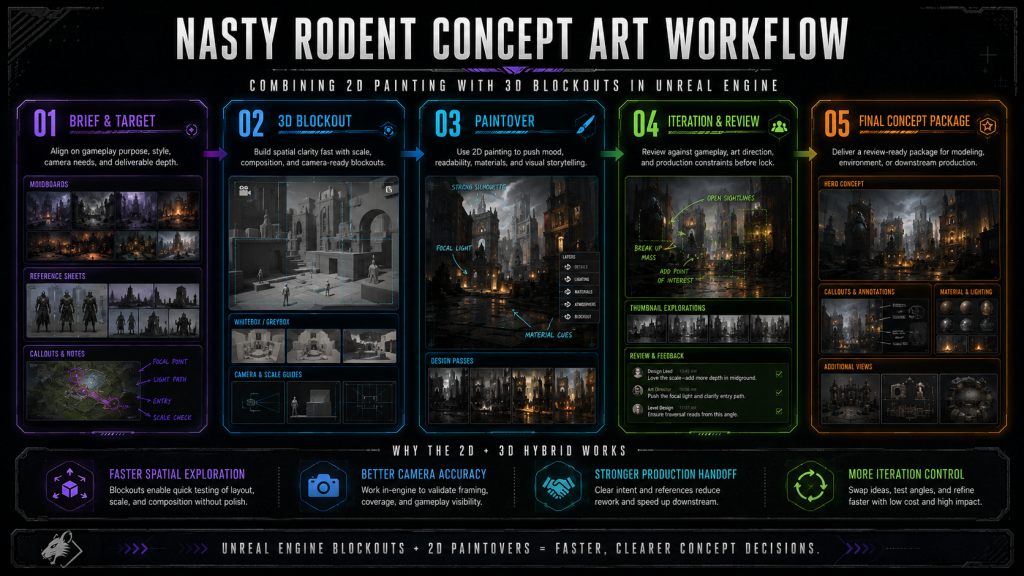
Our concept pipeline mixes 2D and 3D deliberately. Photoshop and Procreate alongside Blender, 3D kitbashing, and blockouts built in Unreal or Unity for lighting and paintover passes. The reason is practical: a 3D blockout lets the team test silhouette, proportion, and camera context across multiple angles before committing to a final paintover, which compresses the iteration that would otherwise happen through repeated redraws.
“Editorial illustration created for visual reference purposes. It does not represent a real project, client work, or official software screenshot unless stated otherwise.”
We have worked at the end of the fidelity spectrum where this matters most. A significant share of our publicly visible work sits on tactical shooters, where a realistic military visual language has to carry intact from concept through to shipped assets – including Squad, developed by Offworld Industries.
On Ready or Not, our published case describes environment development, with assets built to meet the project’s technical requirements and realistic visual direction. Different disciplines, same constraint: the direction agreed at concept stage has to survive the pipeline without being quietly reinterpreted downstream.
On scoping, we work the way this article describes. Discovery scopes for pre-production questions, named deliverable sets for slice work, batch-based arrangements once a style guide is locked, and standing capacity where the cadence is recurring. We would rather propose the shape that fits your stage than sell the one that is easiest to invoice.
And we write the exit point down. Who declares concept lock, and whether our concept artist remains reachable through your blockout review or steps off at handover, are settled before work begins rather than negotiated when the modelling team starts asking questions. Continued availability is scoped and priced like any other line; what we try to avoid is leaving it undefined, because that is the version nobody has budgeted for.
Practically, that means the first conversation is a scoping conversation rather than a sales one. We look at which asset groups are actually settled, which are still moving, and what the receiving pipeline will need from the handover – and the proposal follows from that, not from a standard package.
If you want a view on how a concept engagement would be structured for your particular stage and scope, our concept art production service covers characters, environments, props, vehicles, weapons, and UI across realistic and stylized directions. Send the brief in whatever state it exists – incomplete is normal, and the gaps are usually the most useful part of the first conversation. We usually reply within one to two business days, and if the honest answer is that your project is not ready to externalise this work yet, we will say so.